
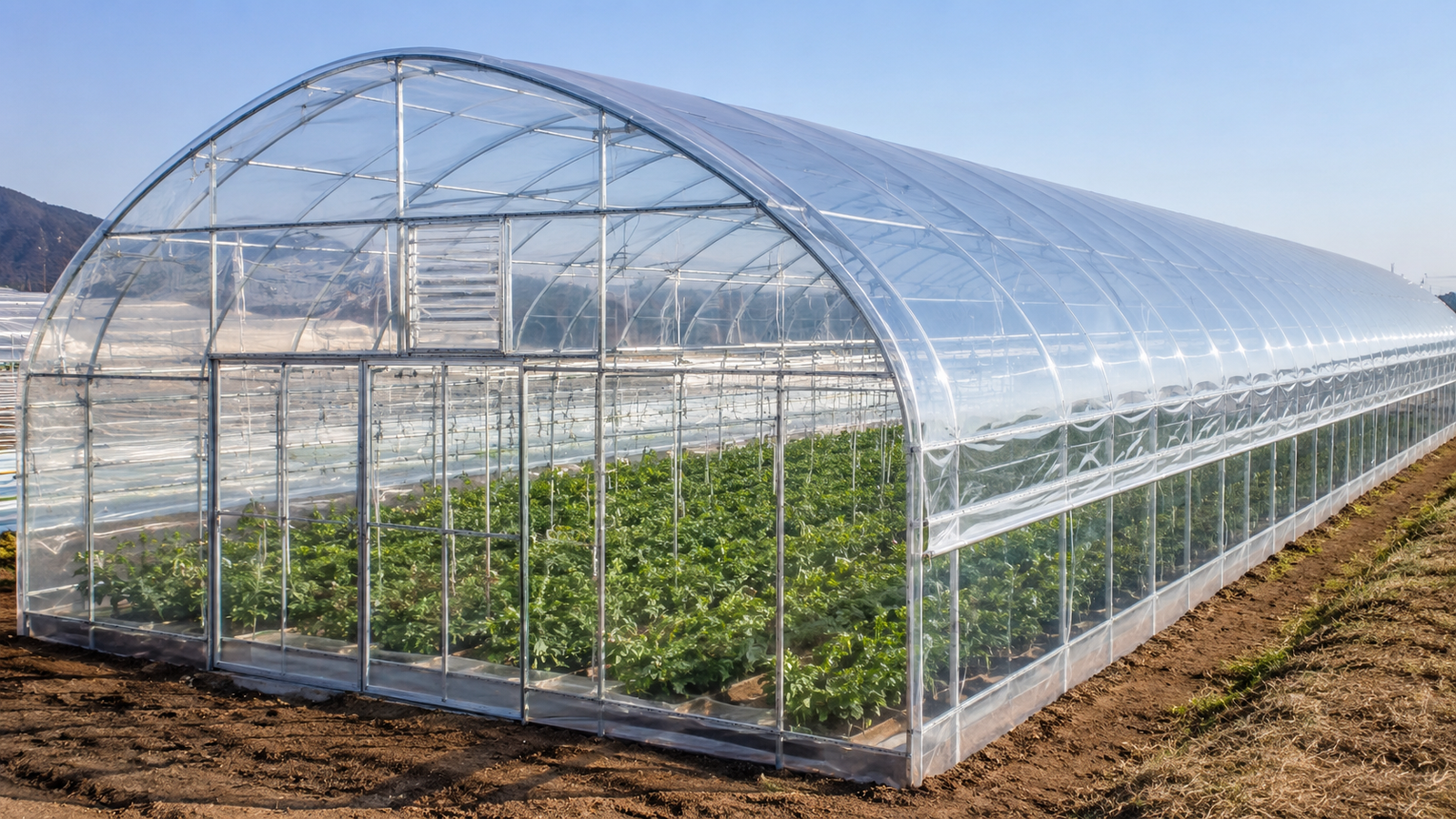
Greenhouse Film Quality: What Makes a Good Greenhouse Film?
Quick Answer: How Do You Evaluate Greenhouse Film Quality?
Practical starting point: Greenhouse film quality should be judged as a performance system, not by thickness, clarity or price alone. For most commercial projects, compare the approved material and layer structure, finished thickness and tolerance, light transmission and haze, UV aging requirement, anti-drip and anti-fog target, tensile and tear data, finished roll dimensions, packing method and batch-release documents.
A quotation is not technically comparable until every supplier is working from the same project brief and test basis. A lower price may reflect a different thickness tolerance, additive package, roll length, test method or packing format rather than a genuine saving.
The safer buying decision is the film grade that meets the crop, climate, structure, installation method and planned replacement cycle with verifiable production limits. For commercial greenhouses, tunnels, vegetable farms and nursery houses, these factors affect crop light, condensation control, installation stability, usable service life and total replacement cost.
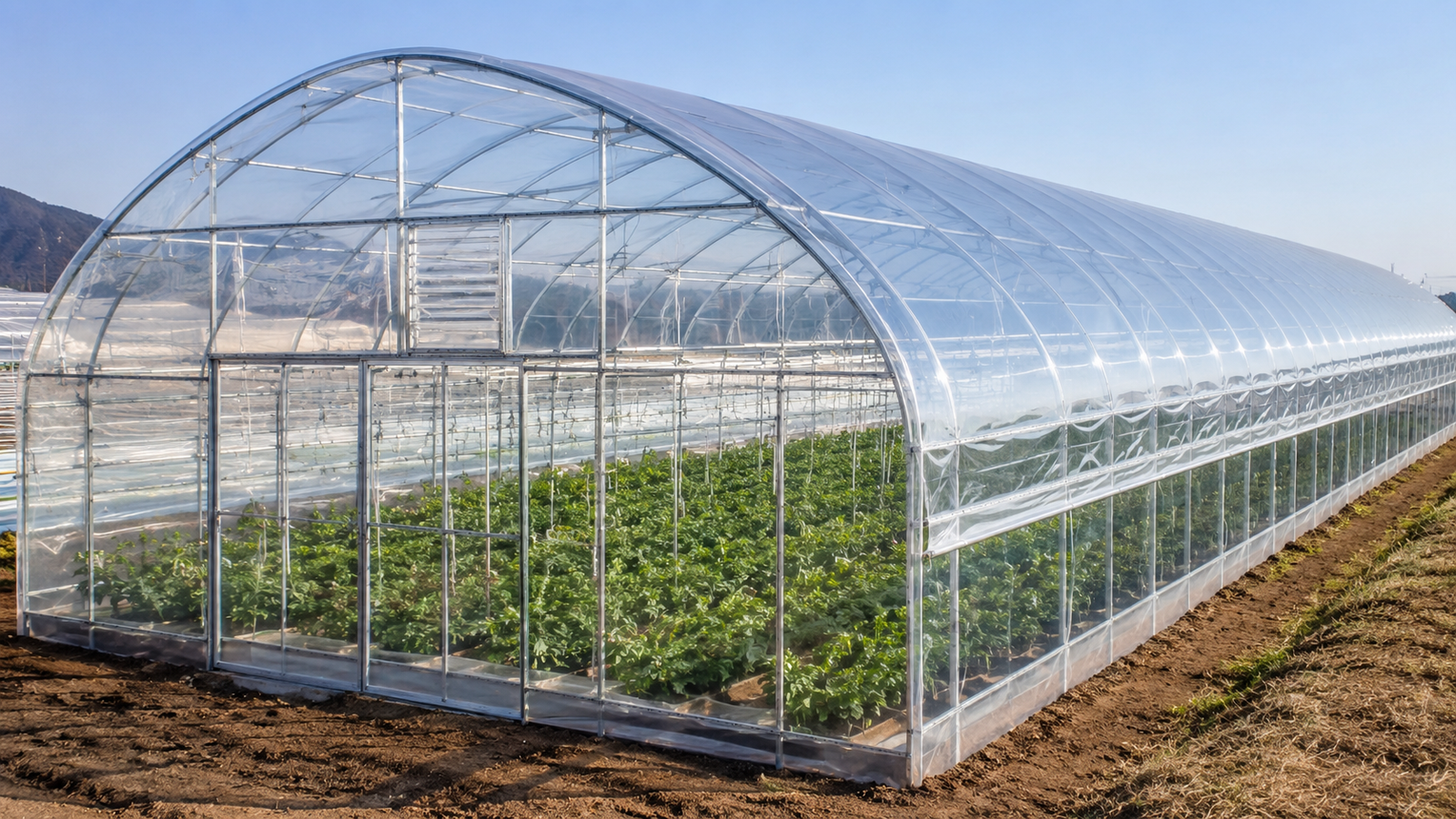
If you need a material definition first, start with what greenhouse film is. For a commercial overview of PE and PO options, specifications and applications, use the greenhouse film selection hub. If the decision is flexible film versus rigid panels, read the greenhouse covering material comparison.
1. High Light Transmission and Controlled Haze
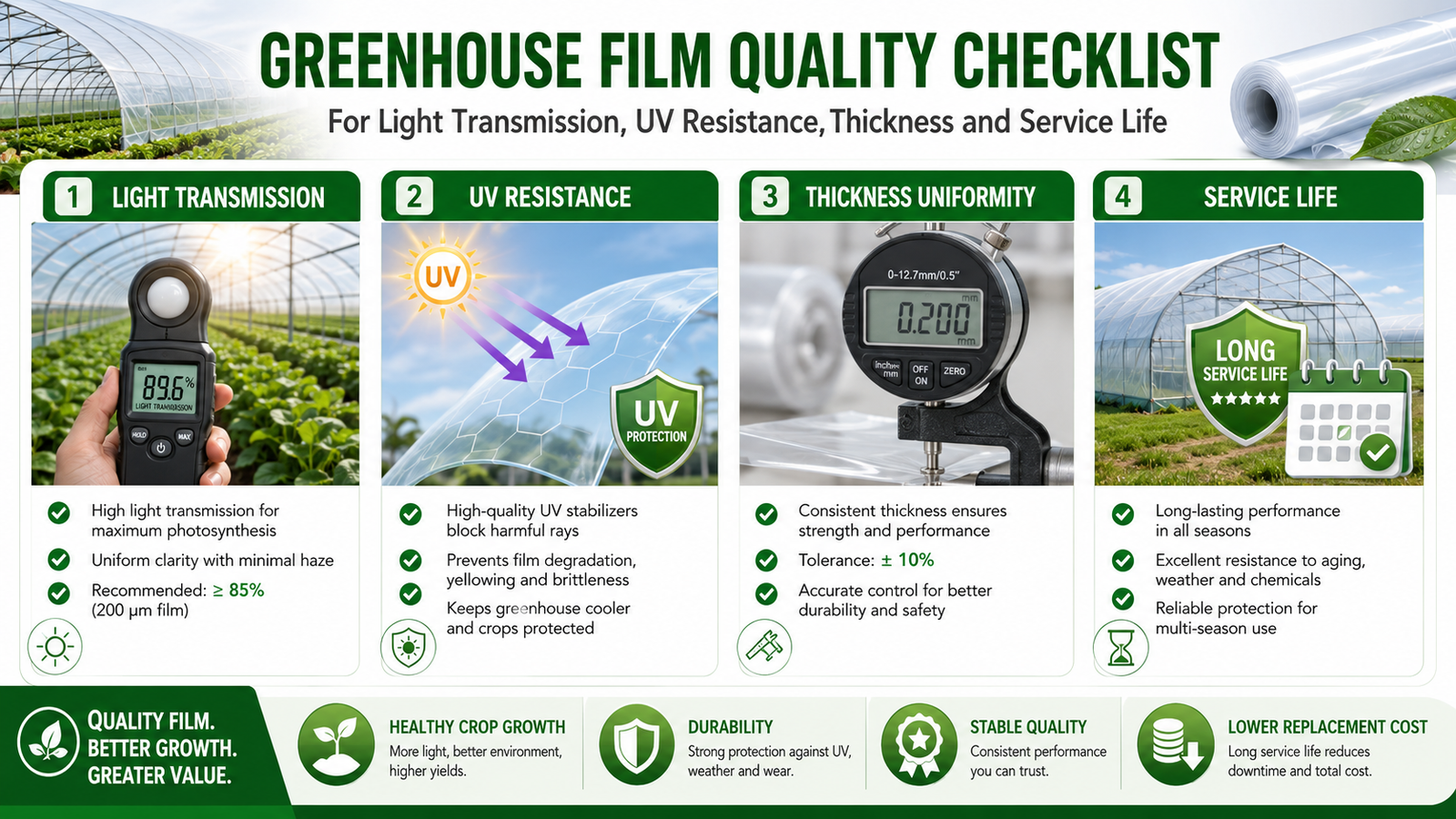
Light transmission is one of the first quality factors to check because greenhouse film sits directly between sunlight and the crop canopy. Clear film with high transmission can support light-limited production, but the number is only useful when the supplier states the test method, specimen thickness and whether the result is for a new or aged sample. University of Arkansas greenhouse glazing guidance also shows that transmission varies by glazing type and construction.
However, transparency is not the only optical factor. Haze and diffusion also matter. Very clear film allows direct light to enter, while diffused film spreads light more evenly inside the greenhouse. For tall crops such as tomatoes, cucumbers and peppers, better light distribution can help lower leaves receive more usable light.
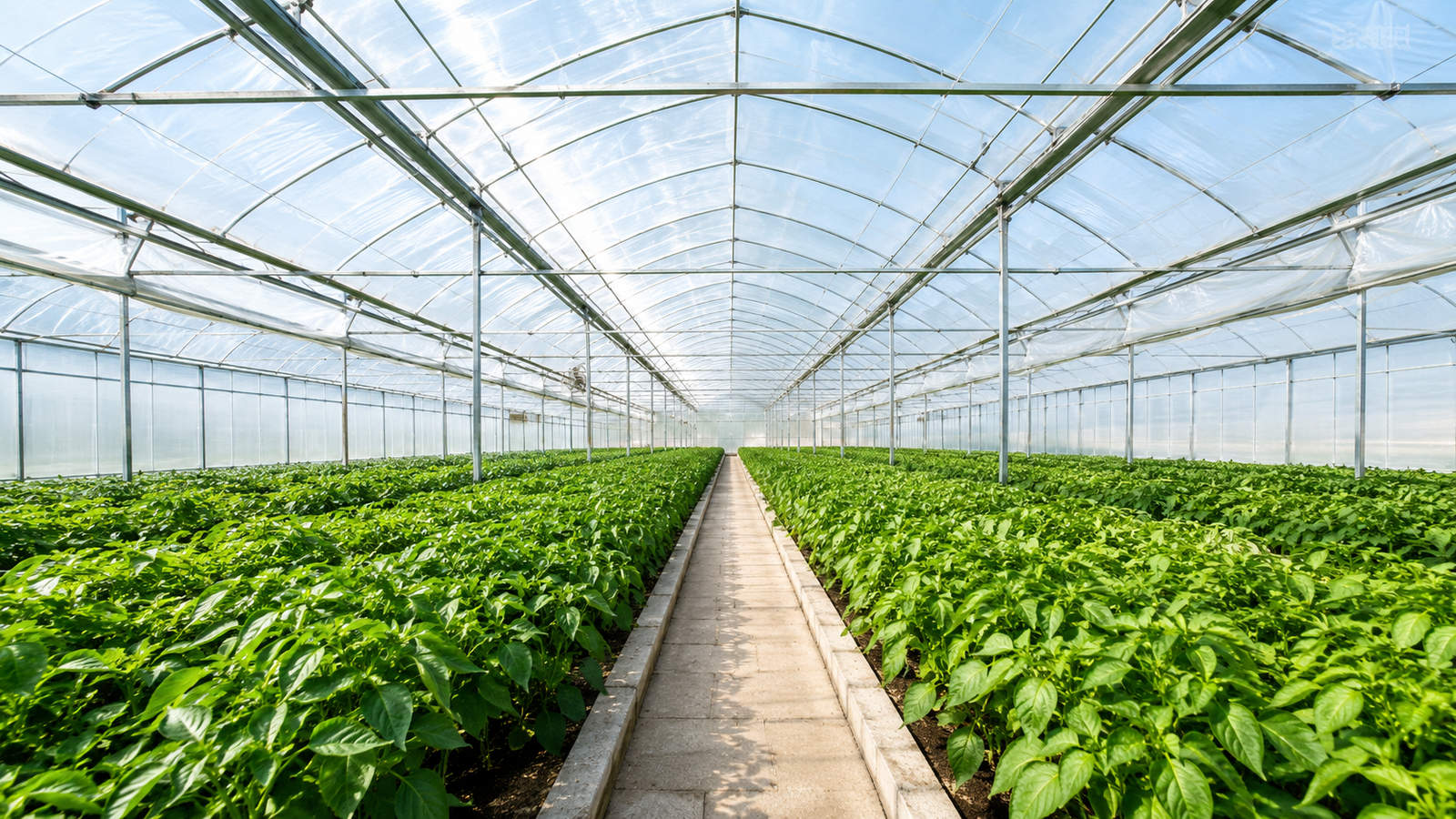
Do not treat a material name such as LLDPE, EVA or PO as a guaranteed optical grade. Request values for the named product instead of relying on generic material averages, and compare them only when specimen thickness, conditioning and method are equivalent. ASTM D1003 is one recognized method for haze and luminous transmittance of transparent plastics.
2. UV Resistance and Outdoor Service Life
Ordinary construction plastic may look similar to greenhouse film at first, but it usually lacks the UV stabilizers needed for long outdoor exposure. A greenhouse-grade film should contain UV stabilizers or weathering additives that slow down sunlight-induced degradation.
UV resistance affects more than appearance. When film ages too quickly, it may lose elongation, become brittle, crack around fastening points, or fail during wind and temperature changes. For this reason, UV resistance should be checked together with mechanical strength and aging retention.
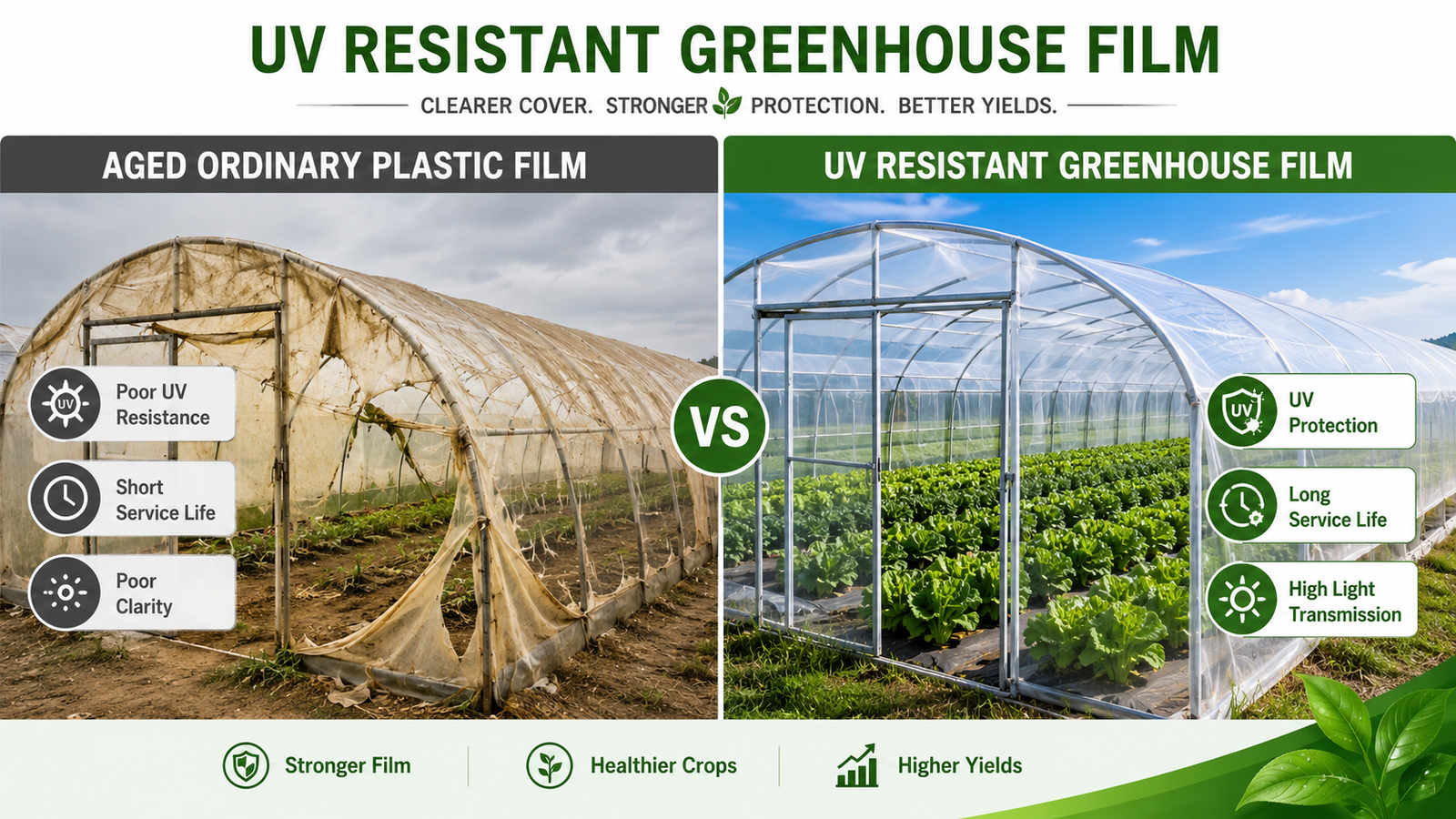
Typical service life should be treated as a specification target, not a universal guarantee. Actual life depends on climate, solar exposure, wind, chemical contact, greenhouse structure, installation tension and maintenance. University of Connecticut Extension identifies attachment stress, abrasion, heat buildup and chemical exposure as causes of early film failure and distinguishes greenhouse-grade, UV-stabilized film from short-term material.
For practical service-life ranges, early failure causes and replacement timing, review our greenhouse film lifespan and replacement signs.
UV resistance should be evaluated separately from thickness and visible-light transmission. Our guide to UV resistance and greenhouse film service life explains polymer stabilization, spectral transmission, chemical exposure and warranty limitations.
3. Anti-Drip and Anti-Fog Performance
Condensation is a common greenhouse problem. When water droplets form on the inner film surface, they can reduce light transmission, drip onto crops and increase disease pressure. Anti-drip greenhouse film uses additives or surface treatment to help condensation spread into a thin water layer and move down the film rather than falling as droplets.
Anti-fog performance is related but different. It helps reduce fogging inside the greenhouse during early morning, evening or high-humidity conditions. A film can be clear and UV resistant but still perform poorly if condensation control is weak. UConn Extension describes anti-drip as a wetting-agent function that allows condensation to flow rather than remain as droplets; that function should not be confused with the film's UV stabilization package.
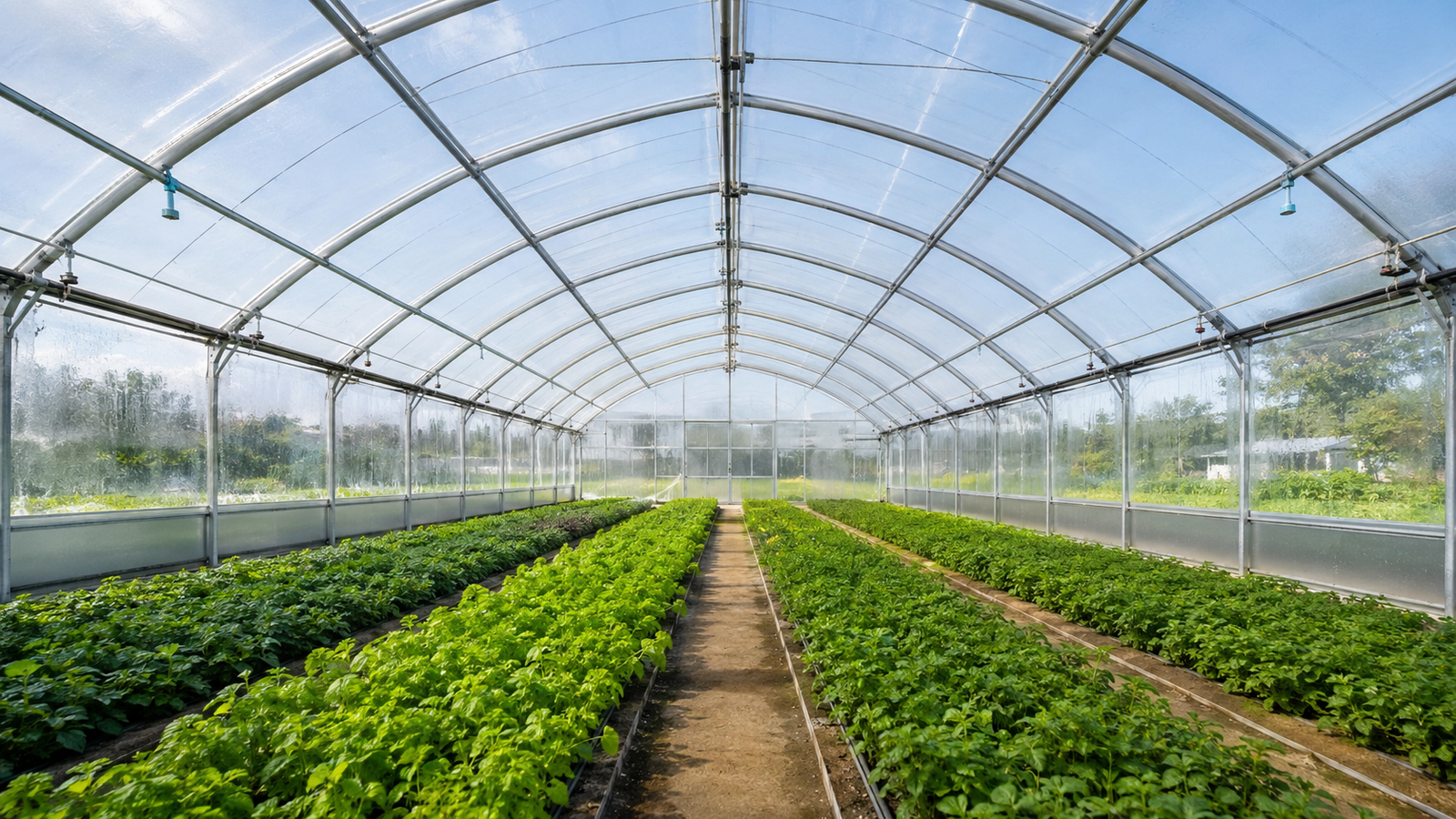
In actual quotation work, condensation performance should be requested as a defined function with the treated side, test or observation method and intended duration. EVA-containing and multilayer PO grades may be formulated for longer anti-drip or anti-fog performance, but the trade name alone does not prove the result. Confirm the product-specific TDS, sample orientation and supplier claim before production.
4. Thickness and Thickness Uniformity
Thickness is important, but a good greenhouse film is not judged by nominal thickness alone. A 150 micron film with poor thickness uniformity may be weaker than a well-controlled 150 micron greenhouse-grade film. The important checks are nominal thickness, minimum thickness, thickness tolerance and consistency across the full roll width.
Common greenhouse film thicknesses include 100, 150, 180, 200 and 250 micron. The right choice depends on greenhouse type, crop cycle, wind exposure, installation method, roll width and required service life. More thickness can increase roll weight, handling effort and material cost, while insufficient or uneven thickness raises mechanical risk. For the selection logic, see the greenhouse plastic thickness guide.
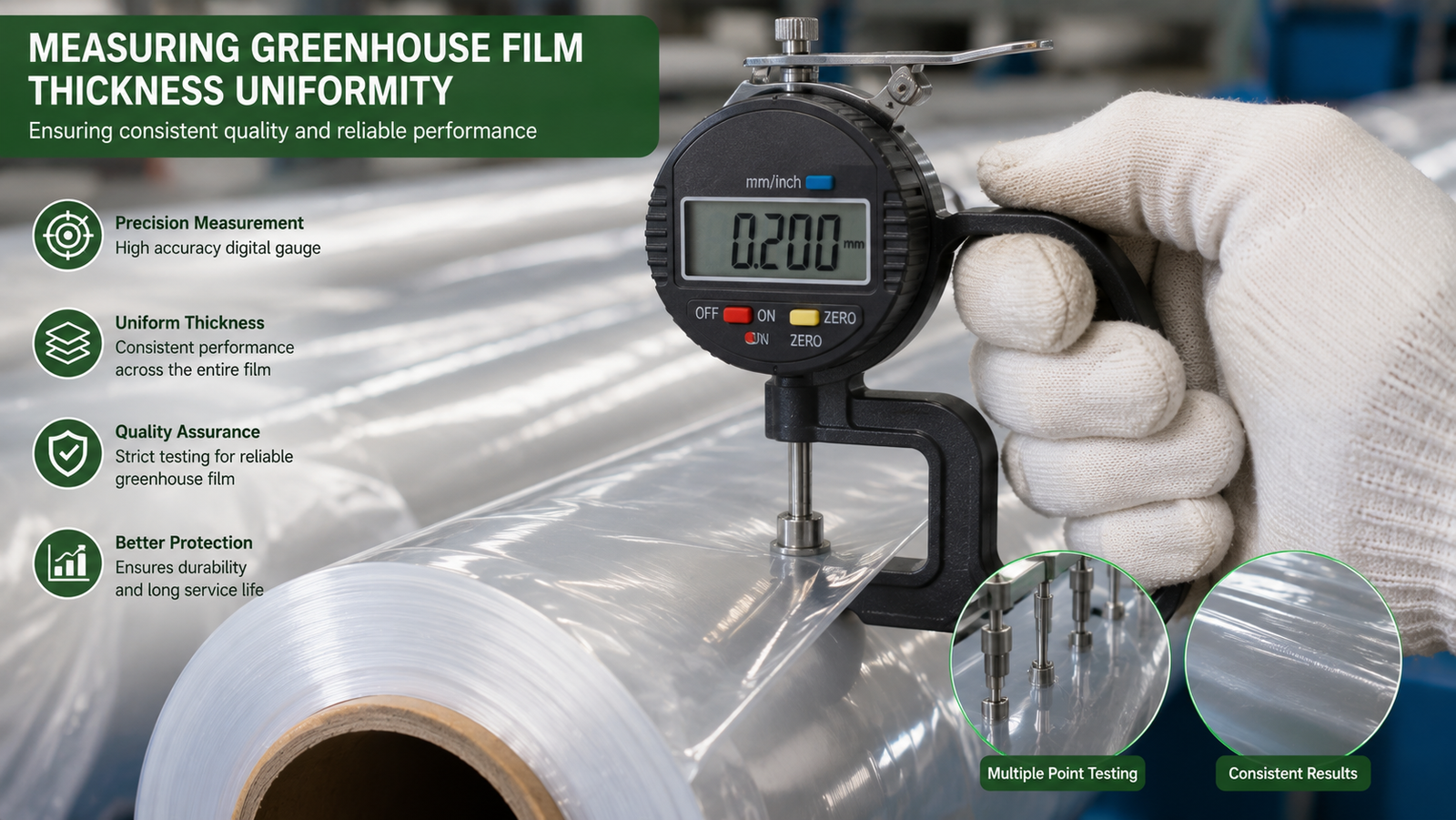
Practical check: Ask for nominal thickness, minimum permitted thickness, tolerance, measurement-point plan and test method. A tolerance such as +/-10% may appear in an individual supplier specification, but it is not a universal acceptance rule. Put the agreed value and acceptance method on the approved specification or purchase order before production.
5. Mechanical Strength: Tensile, Tear and Puncture Resistance
Greenhouse film must survive pulling, fastening, wind movement, contact with frame parts and repeated temperature changes. Optical performance alone is not enough. Mechanical strength determines how the film behaves during installation and long-term use.
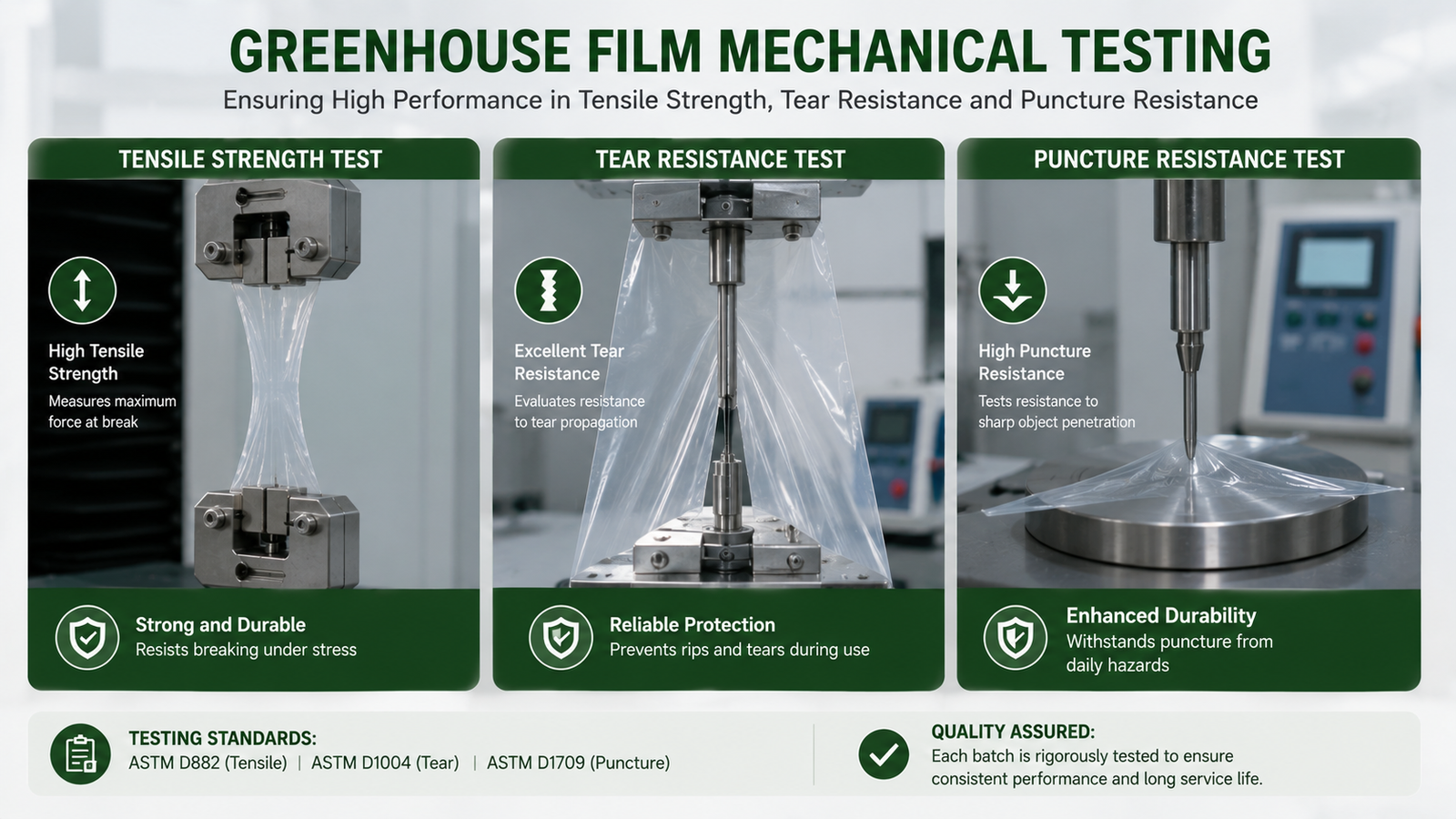
The most useful mechanical indicators include tensile strength, elongation at break, tear resistance and puncture or impact resistance. Elongation helps describe deformation before break, but no single number predicts field life. Tensile results are sensitive to thickness, specimen preparation and test speed; ASTM D882 therefore requires controlled conditions when films are compared.
| Test Item | What It Indicates | Why Buyers Misread It | What to Request |
|---|---|---|---|
| MD and TD tensile strength | Resistance to pulling in the machine and transverse directions. | Results change with specimen thickness, preparation and test speed. | Value, unit, thickness, direction and ASTM D882 or agreed equivalent method. |
| MD and TD elongation at break | Deformation before break in both film directions. | A high value does not by itself prove tear resistance or outdoor life. | Value, direction, conditioning and the same test basis used for tensile strength. |
| Tear resistance | Resistance to propagation after a nick or local defect starts. | Different tear methods and specimen geometries produce different results. | Named method, MD/TD result, specimen thickness and acceptance value. |
| Puncture or impact resistance | Response to concentrated contact or impact during handling and use. | Probe puncture, dart impact and field contact are not interchangeable tests. | Method, fixture or impact condition, result and project relevance. |
Evidence boundary: A data sheet should be used only for the named product grade. Results from different methods, specimen thicknesses or conditioning are not directly comparable. For a custom order, place the required method and acceptance value in the approved specification rather than relying on a generic brochure.
The useful question is not whether the largest number wins. The buyer needs enough strength and elongation for the frame, fastening method, wind exposure and handling process without paying for a specification the project cannot use. A greenhouse builder with repeated roll-up sides, for example, may place more weight on tear propagation and fastening detail than a distributor stocking film for static seasonal tunnels.
6. Material and Layer Structure
Most greenhouse films are polyethylene-based, but the formulation and layer design vary by manufacturer and grade. Commercial labels such as LLDPE, EVA and PO are useful starting points, not complete specifications. A multilayer co-extruded structure allows the supplier to assign weathering, condensation-control, optical and mechanical functions to different layers, but more layers do not automatically mean better field performance.
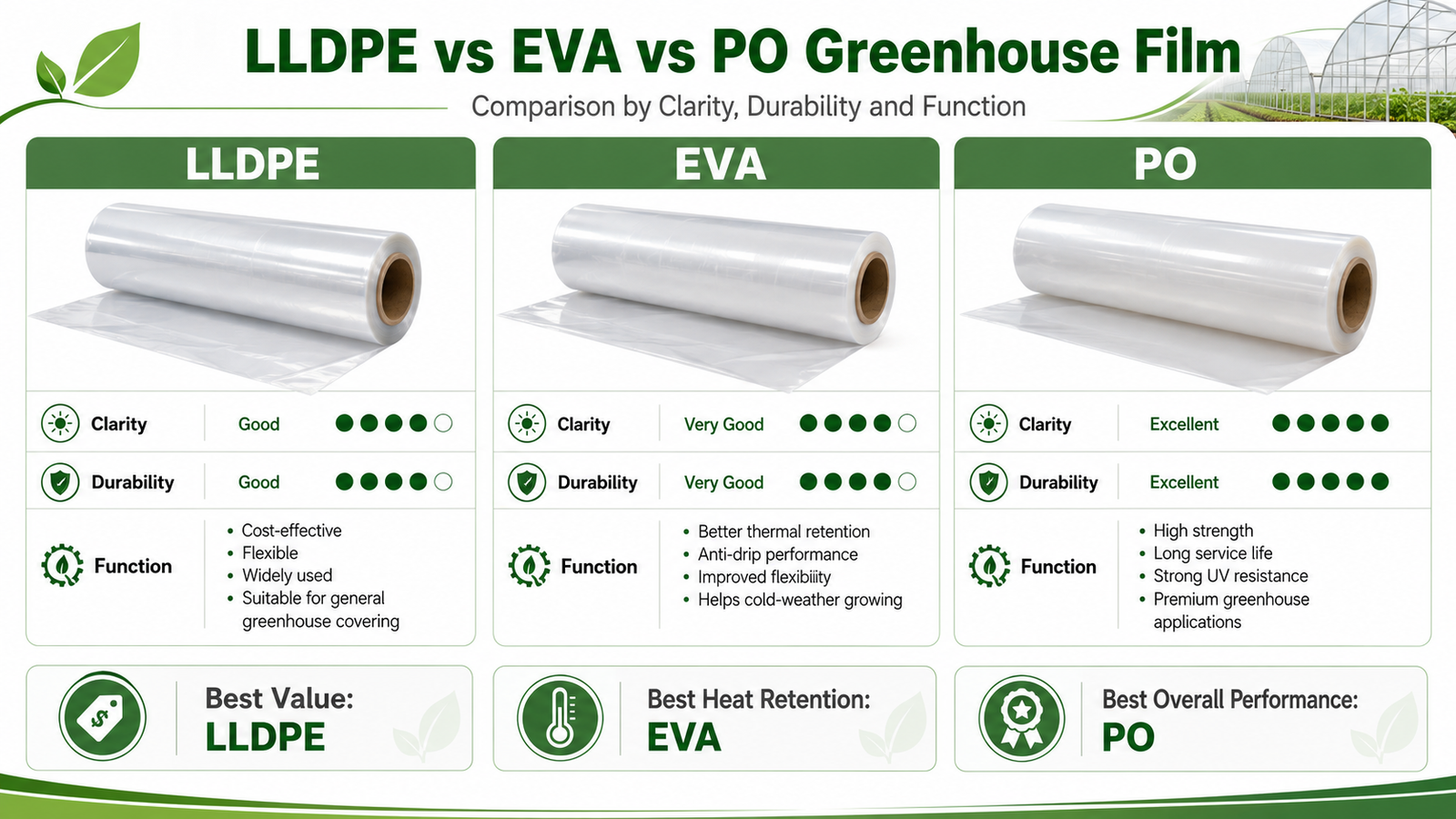
An LLDPE-based grade may be specified for seasonal or cost-controlled covering. An EVA-containing grade may be formulated for flexibility, optical or condensation-control targets. A multilayer PO grade may be designed for higher optical and weathering requirements. Each claim still needs product-specific evidence because resin blend, additive concentration, layer placement, thickness and production control determine the result.
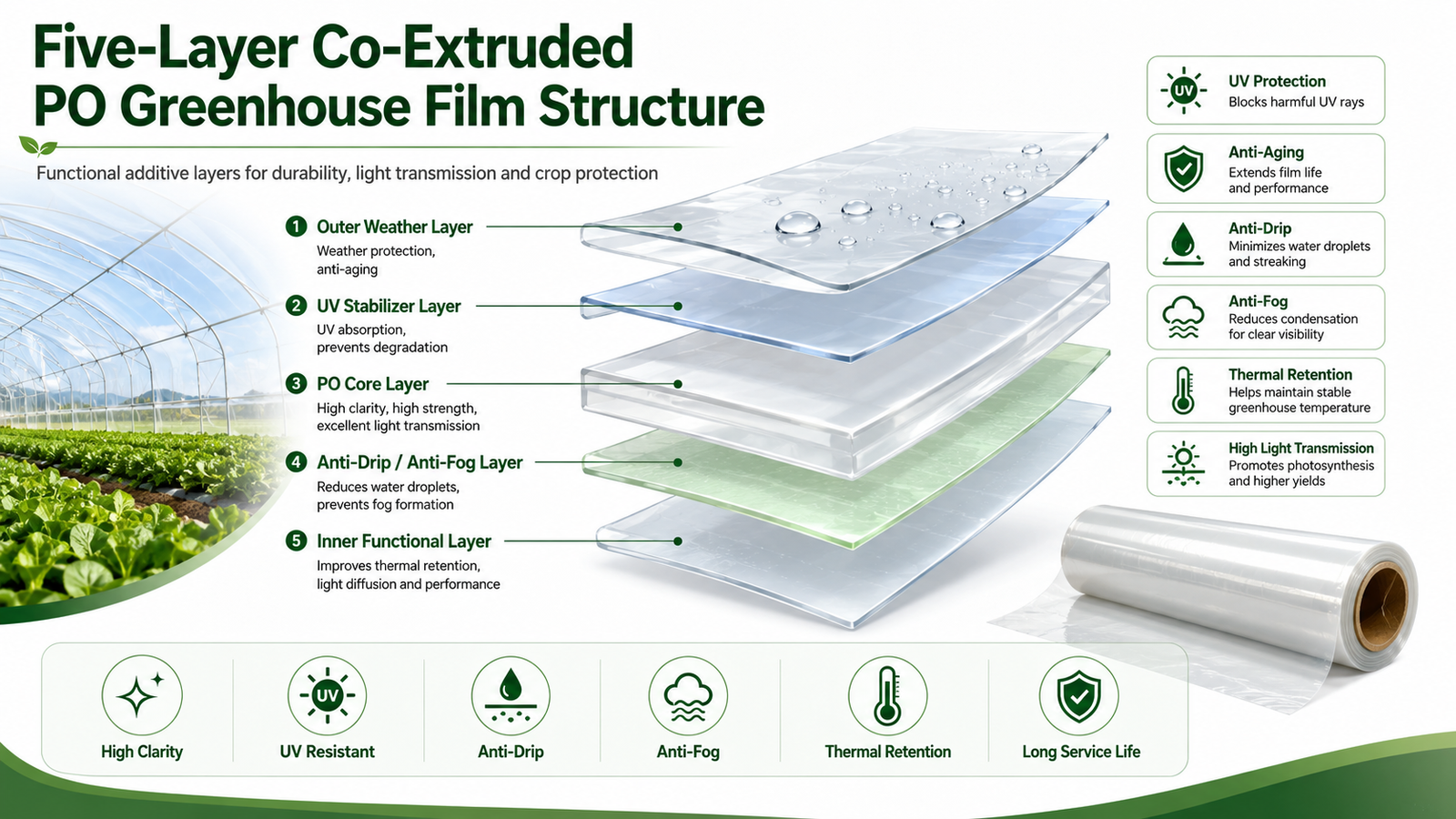
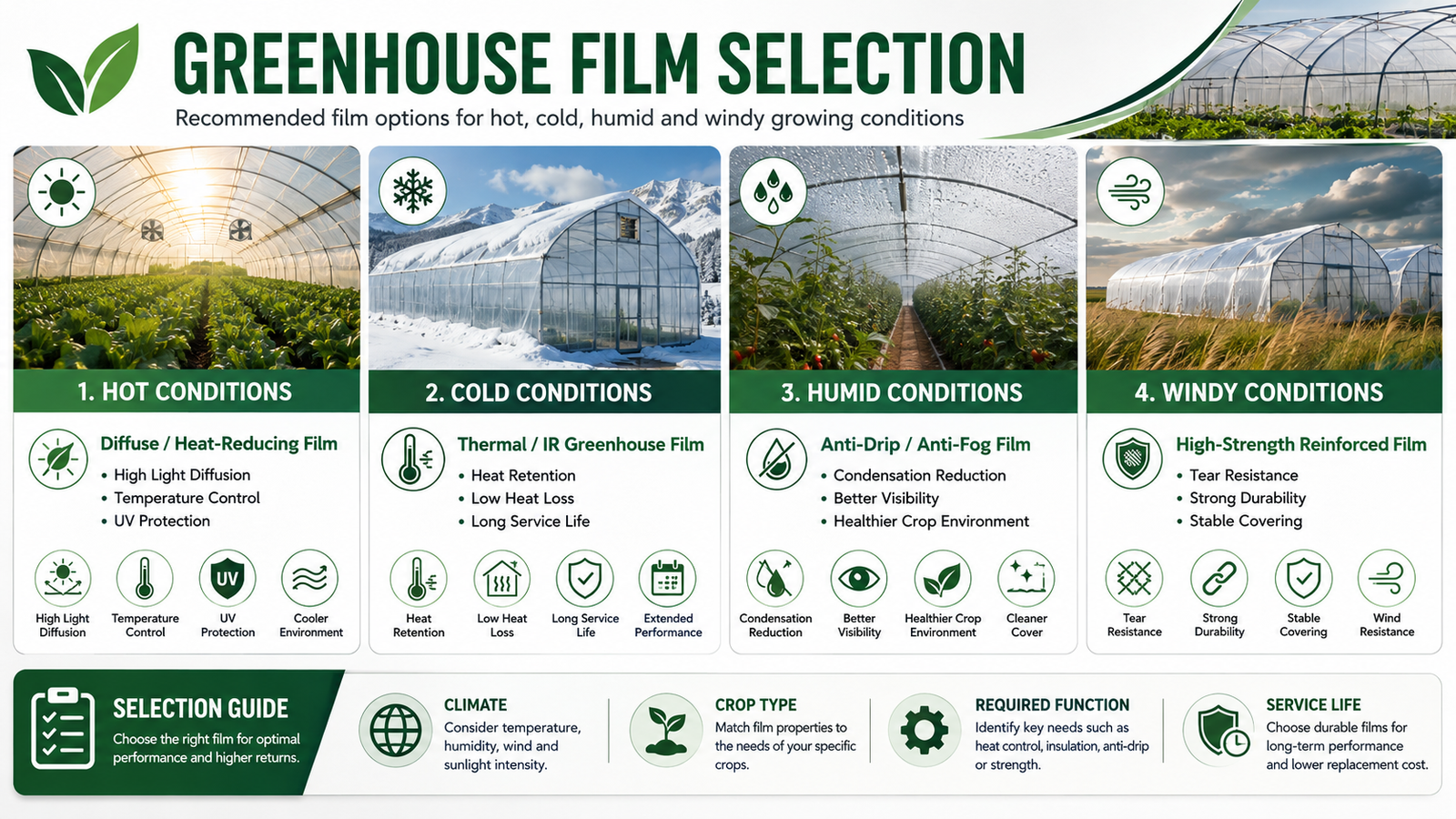
If the greenhouse project requires a multilayer functional covering, review the PO greenhouse film specification. For standard commercial rolls, finished dimensions and packing options, see the greenhouse plastic roll product page.
7. Greenhouse Film Quality Comparison: LLDPE, EVA and PO Film
The following table is a procurement comparison matrix, not a universal performance ranking by material name. Final values must be tied to an identifiable product grade, thickness, current TDS, agreed test method and production-batch acceptance record.
| Decision Factor | LLDPE-Based Grade | EVA-Containing Grade | Multilayer PO Grade |
|---|---|---|---|
| Commercial starting point | Often considered for seasonal or cost-controlled coverage. | Considered when flexibility or condensation-control functions are specified. | Considered for a tailored multilayer optical and functional package. |
| Structure to verify | Layer count, resin blend and stabilizer package. | EVA content or function, layer placement and additive package. | Actual layer functions, resin blend and functional-surface orientation. |
| Optical trade-off | Can meet clear or diffused targets depending on grade. | May be formulated for clarity and condensation control. | May combine transmission, diffusion or spectral targets across layers. |
| Condensation control | Not inherent; request the actual anti-drip or anti-fog package. | Often offered with anti-drip, but duration and test basis vary. | Can use a dedicated functional layer; verify treated side and duration. |
| Weathering and service target | Separate seasonal and UV-stabilized greenhouse grades. | Verify UV stabilization, heat and chemical-exposure conditions. | Verify aging data and warranty conditions for the named grade. |
| Thickness and handling | Specify finished thickness, tolerance, roll width, length, weight, core and unloading limit; material label does not replace roll engineering. | ||
| Main procurement risk | Buying construction or short-term film as greenhouse-grade film. | Assuming EVA content guarantees a specific anti-drip duration. | Assuming "PO" or more layers automatically proves better field life. |
| Evidence to approve | Named product code, current TDS, agreed sample where needed, methods and acceptance values, batch inspection document, labels, packing and warranty terms. | ||
Material families describe formulation direction, not guaranteed performance. Optical data, UV transmission or blocking, UV stabilization, accelerated aging and outdoor service targets are separate items. Approve each required property against the named grade and a defined evidence source.
From a procurement perspective, the higher stated grade is not always the better commercial decision. A short-season tunnel may not recover the added cost and handling burden of a premium multilayer film. A multi-season commercial greenhouse, however, usually justifies closer review of UV aging, condensation control, retained mechanical properties, warranty conditions and replacement labor. Compare price against the verified usable service target, not price per roll alone.
8. Climate and Crop Suitability
A good greenhouse film should match the climate and crop, not just the catalog specification. A film used for hot, high-radiation regions may need stronger UV resistance and heat control. A film used for humid vegetable production may need better anti-drip and anti-fog performance. A windy area requires stronger tear resistance, better fastening and careful installation.
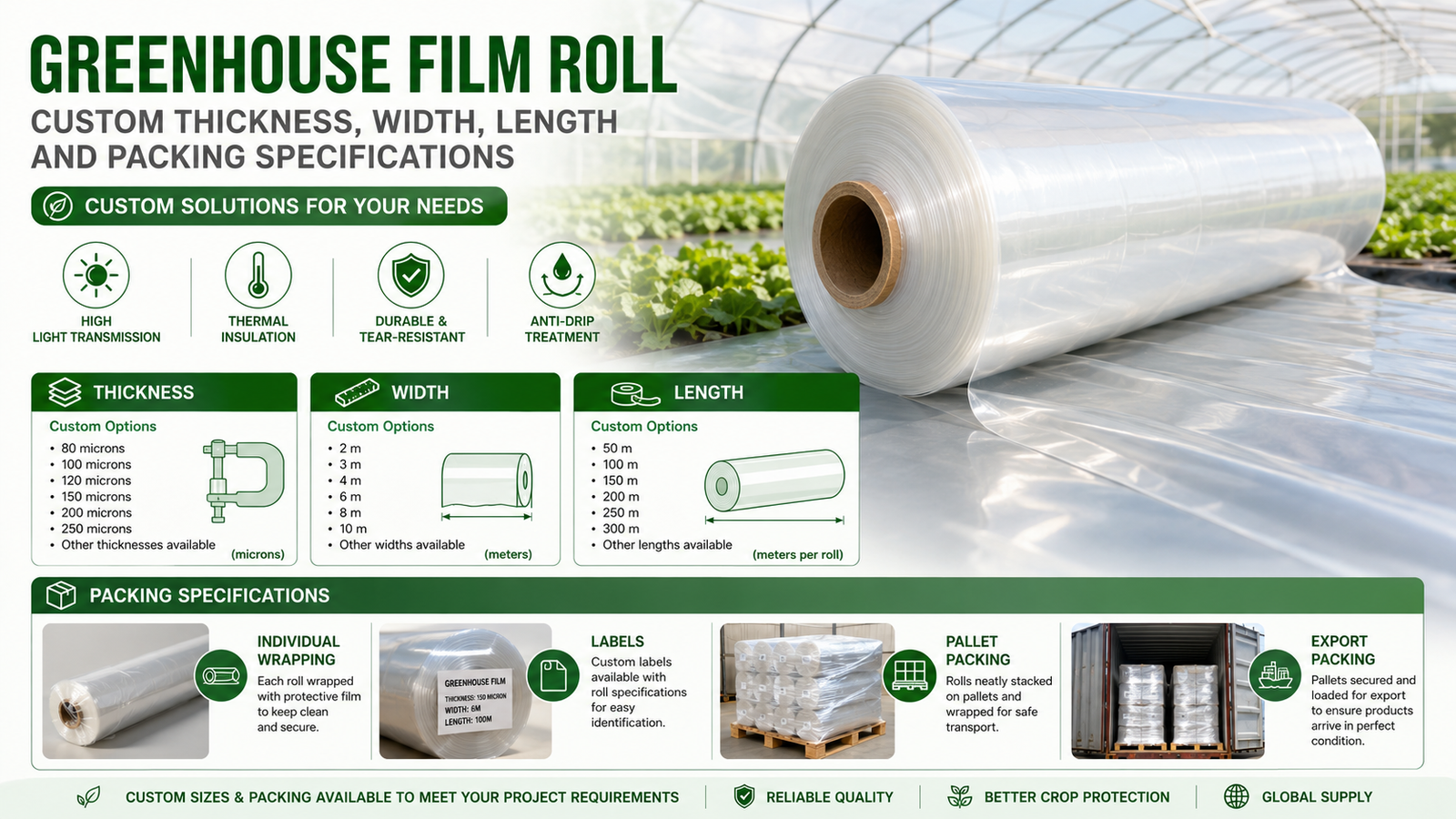
Hot and High-UV Regions
Check UV stabilizer, aging resistance, heat-control additives and the expected replacement cycle.
Humid Greenhouses
Prioritize anti-drip and anti-fog performance to reduce condensation, dripping and visibility problems.
Windy Areas
Check tensile strength, tear resistance, puncture resistance and fastening compatibility before installation.
Winter or Heated Houses
Consider thermal retention, double-layer inflation and correct film orientation when the greenhouse is heated.
Installation also affects film performance. Even a high-quality film can fail early if it is over-tensioned, rubbed against sharp frame parts or fixed with unsuitable fasteners. For installation details, see our greenhouse plastic installation guide.
9. Factory Quality Control and Batch Release Before Shipment
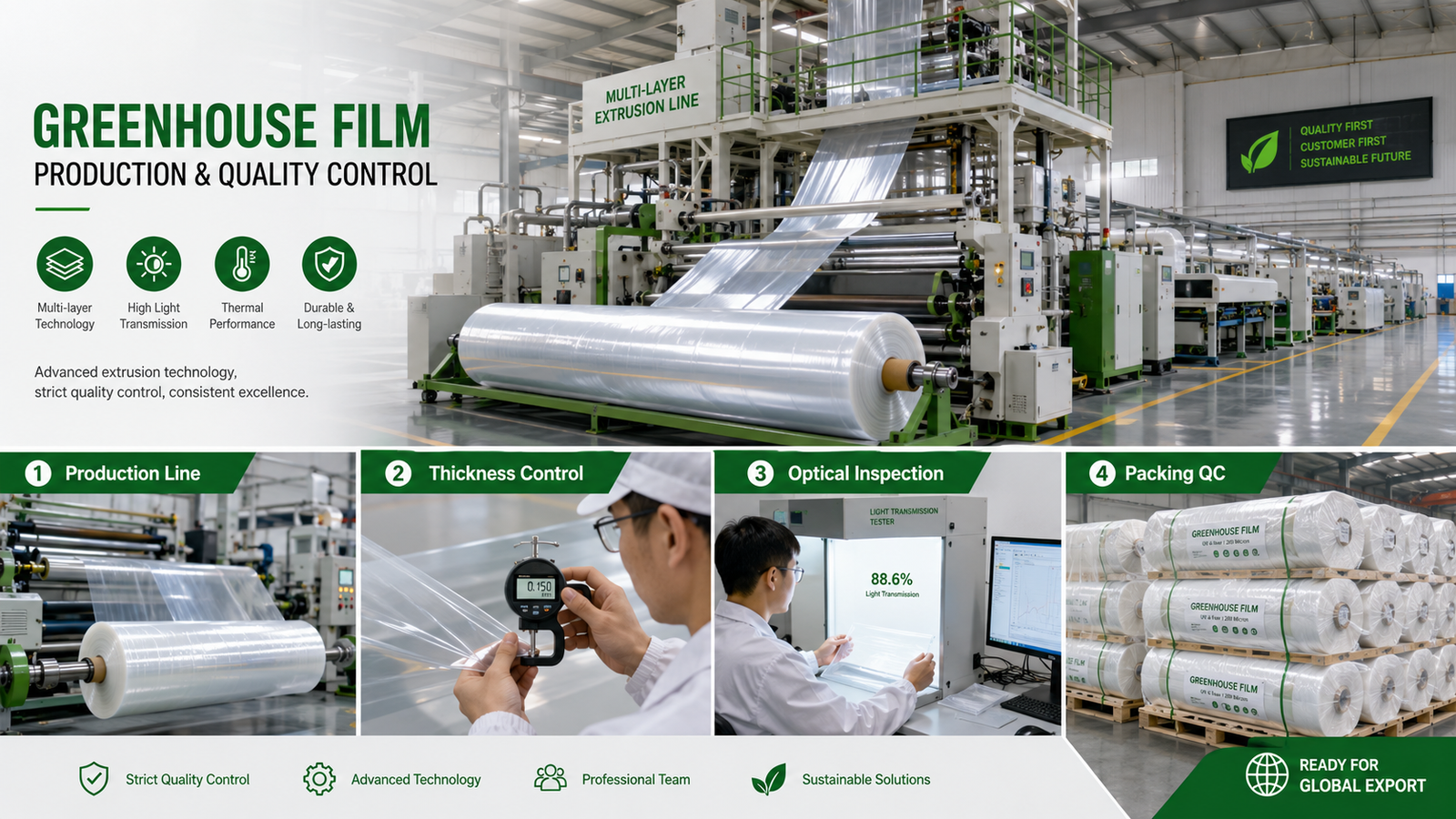
Greenhouse film quality cannot be created by a final visual inspection. The factory review should begin with an approved specification, continue through film blowing and winding, and finish with a traceable release record. Buyers can use the overview of plastic film quality control to align inspection points with the purchase specification.
Before Production: Freeze the Specification
The supplier normally checks whether the material and additive package, layer structure, finished width, roll length, thickness range, core, maximum roll weight and packing method are producible together. Optical, condensation-control and aging claims should name the target and test basis. The approved TDS, signed specification or pre-production sample becomes the reference; a sales quotation alone is not a complete quality standard.
During Production: Control the Process, Not One Sample
In-process checks commonly cover resin and additive lot records, film-blowing stability, thickness profile across the web, finished width, appearance, winding and sampled optical or mechanical properties. This looks procedural, but it prevents a roll with an acceptable average thickness from hiding weak edge or center zones.
Final Release: Match the Batch to the Order
Final release should verify roll dimensions, net and gross weight where specified, appearance, core, labels, batch identity and export packing. For technical review, optical tests may reference ASTM D1003, tensile and elongation may reference ASTM D882, and accelerated xenon-arc exposure may reference ASTM G155. Tear, puncture, anti-drip and anti-fog claims still need their own agreed method and acceptance value; one standard cannot validate every function.
Before dispatch, request the documents actually required by the order: current TDS, batch inspection report or COA, packing list, label sample, warranty terms and any approved retained sample. The quality documents guide explains what each document can and cannot prove. A generic brochure is not a substitute for a batch-linked release record.
10. Buyer and Factory Review Matrix Before Ordering
Before confirming a greenhouse film order, both sides need the same technical baseline. The buyer defines the use condition and acceptance priorities; the factory checks feasibility, test coverage, packing and delivery. Missing information can still produce a price, but not necessarily a film that fits the installation.
| Buyer Requirement | Factory Review Point | Evidence Before Release | Effect on Order |
|---|---|---|---|
| Crop, climate and expected use period | UV, thermal, diffusion and condensation-control package | Approved grade and current TDS | Formula, price and production planning |
| Material and layer structure | Resin/additive compatibility and producible construction | Product code, specification or approved sample | Performance claim, MOQ and lead time |
| Thickness and tolerance | Nominal, minimum and cross-web measurement plan | Batch thickness record | Strength, roll weight, handling and cost |
| Optical target | Transmission, haze, diffusion, specimen and method | Test report under the agreed method | Crop-light strategy and grade selection |
| UV and weathering target | Installation region, exposure, chemicals and aging basis | Aging data and written warranty conditions | Additive package and service-risk allocation |
| Anti-drip and anti-fog requirement | Treated side, test method, duration and film orientation | TDS, test record and installation marking | Formula, winding direction and installation control |
| Finished width and length | Machine limits, folding, core and maximum roll weight | Finished-size inspection and label | Yield, installation, container loading and unloading |
| Packing and delivery conditions | Wrapping, pallet, labels, destination and handling limits | Packing photos, packing list and shipping marks | Damage risk, freight and delivery schedule |
Three Situations That Change the Specification
Farm Buyer Provides Only Floor Width
The film must cover the frame profile and reach the final fastening points. Using floor width alone can make the finished roll too narrow. Submit the greenhouse drawing, arc measurement, fastening allowance and seam plan before width is approved.
Distributor Needs Repeatable Stock
A distributor usually benefits from stable product codes, standard widths, repeatable labels and batch documents rather than a different custom formulation for every order. This reduces mixed inventory and claim investigation.
Builder Asks for Thickness Only
A request for "150 micron greenhouse film" leaves UV exposure, condensation control, width tolerance, roll weight and fastening conditions undefined. The factory can quote it, but the offers may not be technically equivalent or suitable on site.
Premium Grade Without Test Alignment
A higher product label or larger data-sheet number is not useful when suppliers use different specimen thicknesses or methods. Normalize the test basis first, then compare the performance and landed replacement cost.
Common Mistakes When Judging Greenhouse Film Quality
Choosing by thickness only
Why it happens: thickness is easy to request and compare. Consequence: the buyer may receive a heavier roll with weak aging, uneven gauge or the wrong optical function. Correct action: evaluate thickness together with minimum gauge, UV requirement, optical data, mechanical tests and handling limits.
Using construction plastic as greenhouse film
Why it happens: construction sheeting can look similar and appear cheaper. Consequence: early brittleness, poor condensation control and unplanned replacement can erase the purchase saving. Correct action: specify greenhouse-grade material, outdoor-use target, relevant additives and documented acceptance criteria.
Ignoring anti-drip performance
Why it happens: new-film clarity is visible, while condensation performance is not. Consequence: droplets can reduce usable light and fall onto crops. Correct action: define treated side, performance method, intended duration and correct installation orientation before production.
Ignoring the greenhouse structure
Why it happens: material data is reviewed separately from the installation drawing. Consequence: sharp edges, hot contact surfaces, unsuitable fasteners or excessive tension can cause local failure that the film warranty may not cover. Correct action: review attachment points, frame protection, tension and chemical contact with the supplier before installation.
Procurement Action: Prepare a Comparable RFQ
If the dimensions are already known: use the commercial greenhouse plastic roll page to check available material, thickness, width, length and packing options.
If the grade is still uncertain: prepare the greenhouse drawing or cover profile, installation country, crop, seasonal conditions, expected use period, fastening method and required optical or condensation-control functions.
For a custom project: send those details through the specification and quotation request. Ask the supplier to return a named grade, producible roll format, TDS, test basis, packing plan, lead time and batch-release document list before the purchase order is finalized.
Frequently Asked Questions
What indicates good greenhouse film quality?
Good greenhouse film quality means that an identifiable grade meets the project's optical, UV-aging, condensation-control, thickness, mechanical, roll-size and packing requirements under agreed test and acceptance methods. A material name or thickness alone is not enough.
Is PO greenhouse film better than ordinary LLDPE film?
Not automatically. A PO grade may be formulated for stronger optical, weathering or condensation-control targets, while an LLDPE grade may suit seasonal or cost-controlled use. Compare named product grades, equivalent test conditions, TDS values, warranty terms and project fit instead of relying on the label.
Does higher light transmission always mean better film?
Not always. High light transmission is important, but haze, diffusion, UV stability, anti-drip performance and durability must also be checked. A good film should balance optical performance with strength and service life.
How important is anti-drip greenhouse film?
Anti-drip performance is important in humid greenhouses because condensation droplets can reduce light transmission and drip onto plants. It is especially useful for vegetable farms, nursery houses and multi-season growing projects.
What thickness should good greenhouse film use?
Common greenhouse film thicknesses include 100, 150, 180, 200 and 250 micron. The right thickness depends on greenhouse type, wind exposure, crop cycle and expected use life. Thickness should be checked together with material formula and test data.
What should I send before confirming a custom greenhouse film roll?
Send the greenhouse drawing or measured cover profile, crop, climate, exposure conditions, target thickness, finished width and length, color, functions, fastening method, maximum roll weight, packing format and expected use period. State the test reports and release documents required with the order.
Which documents should be approved before mass production?
Approve the product specification or TDS, drawing or finished dimensions, thickness tolerance and measurement plan, functional targets, test methods, sample where required, artwork and labels, packing method and warranty conditions. Before shipment, request the agreed batch inspection report or COA and packing records.
About the Author
Sean is the author of TIANFENG's greenhouse film technical guides, with a focus on specification review, quotation inputs, production feasibility, quality-control records, packing and B2B purchasing decisions. Product claims in a final order should be tied to the named film grade, approved specification and batch documents.
References and Further Reading
The university resources below support general greenhouse-film and glazing concepts. The standards identify recognized optical, tensile and accelerated-weathering methods; they do not create a complete greenhouse-film product specification by themselves.