
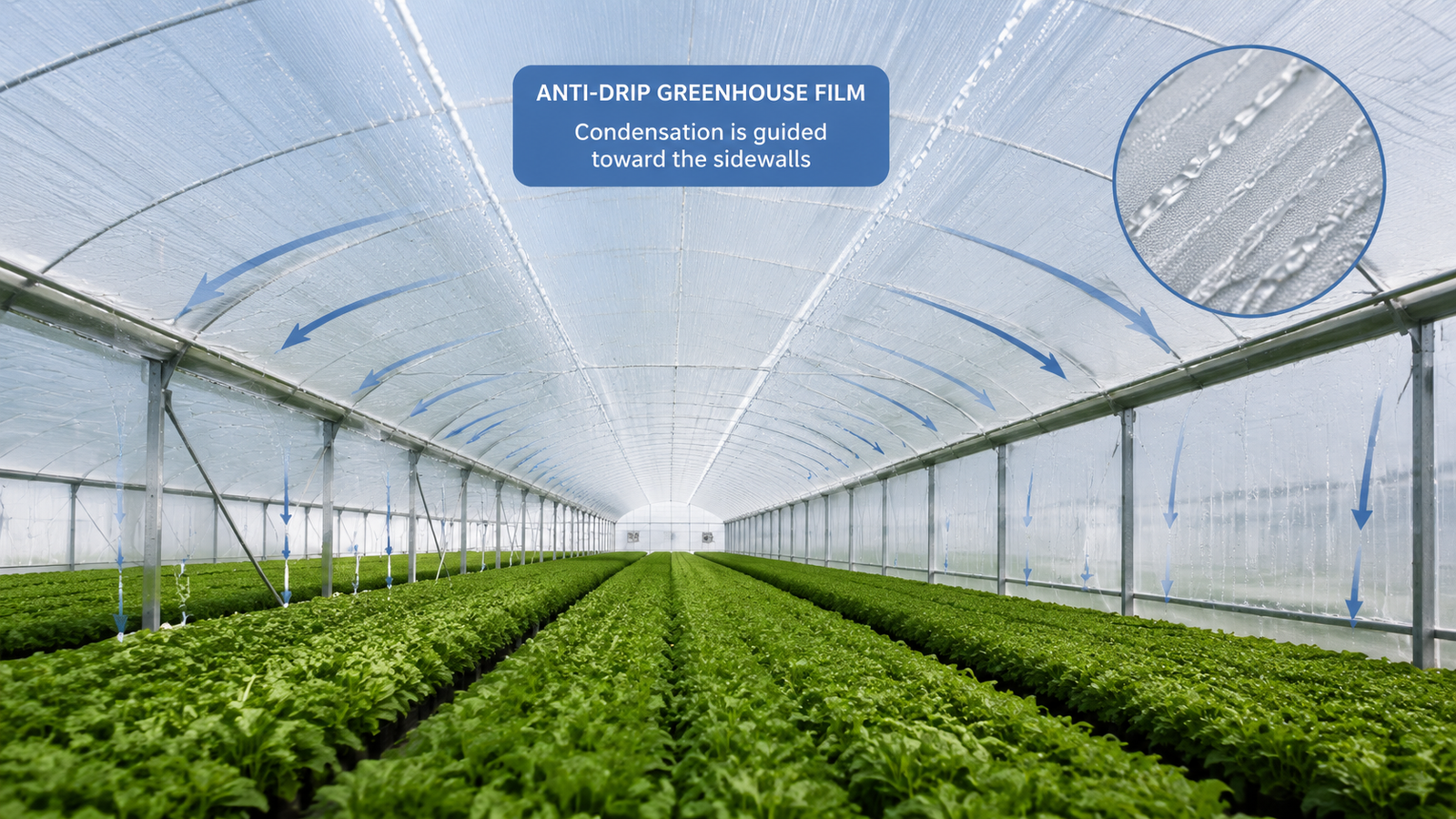
Anti-Drip Greenhouse Film Roll: How It Helps Reduce Condensation
Anti drip greenhouse film is most useful where condensation repeatedly forms on the inside of a polyethylene cover and droplets would otherwise fall onto crops, benches, workers or equipment. The practical benefit is not a magically dry greenhouse. It is more controlled condensate movement, less overhead dripping and, when the water film remains uniform, less optical disruption than large beads on untreated plastic.
In actual quotation work, a request such as "6 mil anti-drip film" is still incomplete. The supplier needs to know which side faces the crop, whether the structure can drain a water film, what crop and climate are involved, whether the film is single or double layer, which chemicals are used, and how long the condensate-control function is expected to remain effective. Thickness alone cannot answer any of those questions.
Contents
- How Does Anti-Drip Greenhouse Film Work?
- What Anti-Drip Film Does Not Do
- Why Condensation Matters in a Commercial Greenhouse
- Anti-Drip vs Anti-Fog Greenhouse Film
- Application and Selection Matrix
- Film, Function and Installation Tradeoffs
- What Determines Anti-Drip Service Life?
- Installation Details That Decide Whether It Works
- What Buyers Should Confirm Before Quotation
- How a Factory Reviews an Anti-Drip Film Order
- Three Procurement Scenarios
- Common Buying and Installation Mistakes
- Copy-and-Paste Order Checklist
- Frequently Asked Questions
- References
How Does Anti-Drip Greenhouse Film Work?
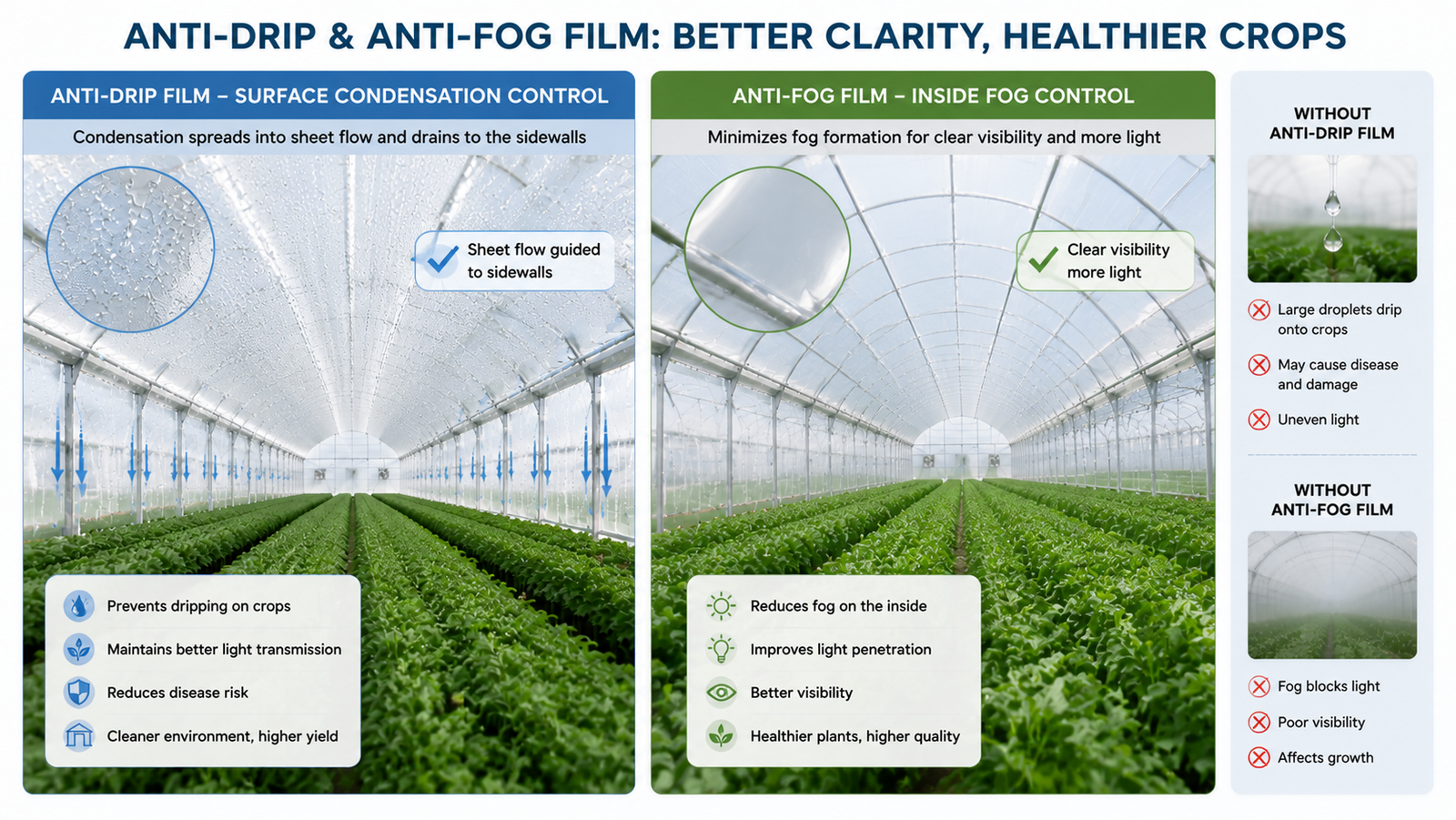
Warm greenhouse air can hold substantial moisture from crop transpiration, irrigation, wet floors and soil. When that air contacts a colder cover and the surface temperature falls below the dew point, water condenses on the inside of the film. Untreated polyethylene is hydrophobic, so the water tends to collect as separate beads. As the beads grow and combine, they can hang from the roof and eventually drip.
An anti-drip or anti-condensate treatment changes the surface wetting behavior. The water spreads across a larger area instead of maintaining a high contact angle as a rounded droplet. On a properly tensioned and sloped cover, the resulting water layer can move toward the lower edge of the roof. University of Connecticut Extension describes condensate control as a wetting agent that reduces surface tension so condensation flows rather than forms droplets.
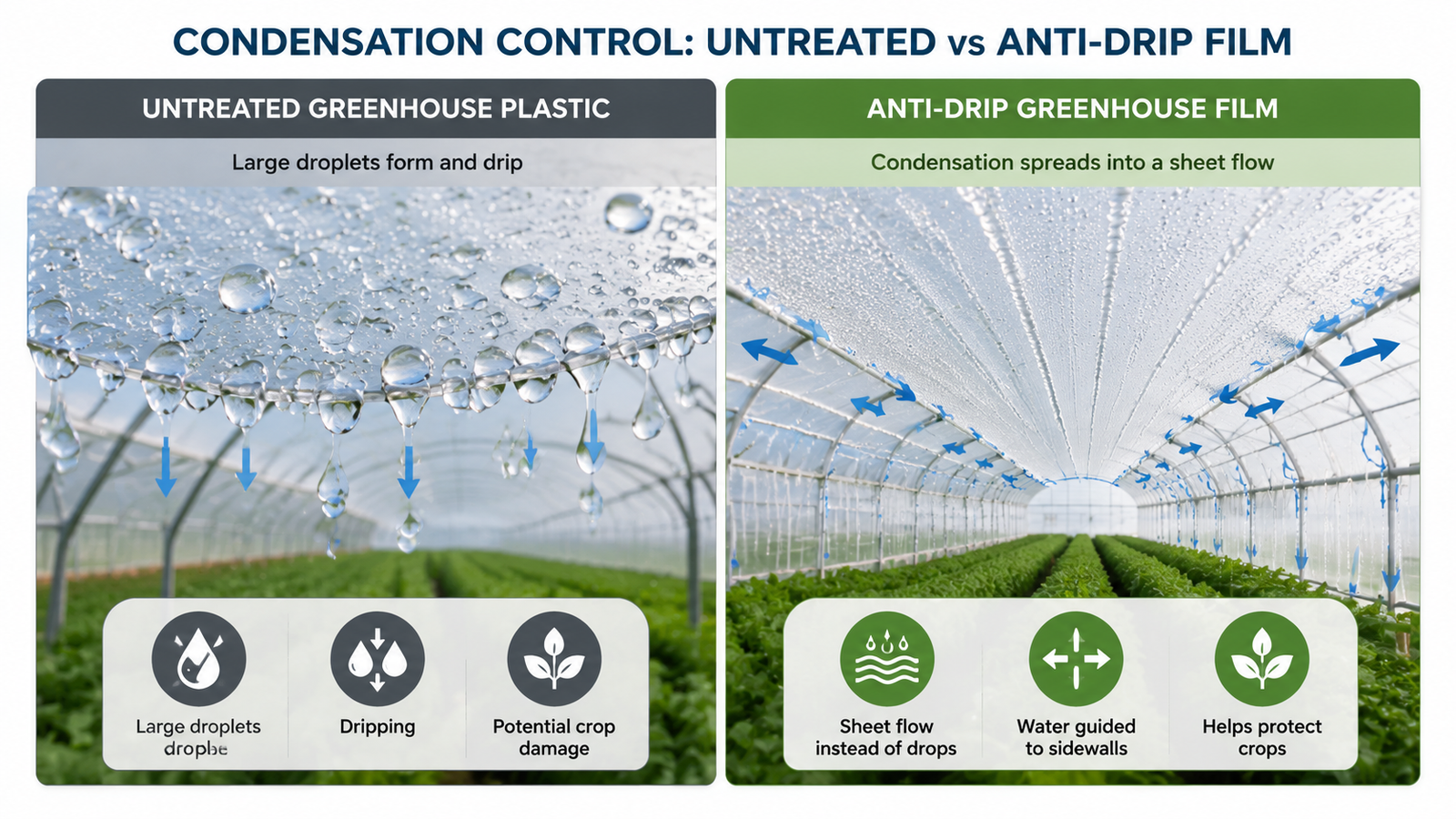
Integrated additive, surface layer or applied treatment
Condensate-control performance may come from an additive incorporated into the film structure, a dedicated surface layer, a coating or an after-market treatment. These are not interchangeable specifications. An incorporated system may depend on additive migration to the inner surface. A coating depends more directly on surface integrity. An applied treatment can be useful for an existing cover but should not be assumed to match the durability or compatibility of a purpose-made agricultural film.
Before production, the supplier should identify the method offered, the treated side, the expected effective period under the stated use conditions and any limitations involving cleaning agents, sulfur, pesticides or installation handling. If the quotation says only "anti-drip available," the functional specification is not complete.
What Anti-Drip Film Does Not Do
This distinction is easy to miss because the interior can look clearer after large droplets disappear. Relative humidity may still be high. Condensation may still form on cold pipes, frames, end walls, leaves or untreated surfaces. If the crop canopy stays wet overnight, the greenhouse still has an environmental-control problem even when the roof film is draining correctly.
| Question | What Anti-Drip Film Can Do | What Requires Separate Control |
|---|---|---|
| Will it stop condensation? | It can spread condensate into a film and reduce large hanging droplets. | Condensation formation depends on humidity, dew point and cover temperature. |
| Will it lower greenhouse humidity? | Runoff may prevent some water from dripping back into the crop area. | Moisture removal still needs ventilation, heating, air exchange or other climate control. |
| Will it prevent plant disease? | Less overhead dripping may help keep foliage from being wetted by roof condensate. | Disease management also depends on crop spacing, irrigation, sanitation, airflow and climate. |
| Will it improve light? | A uniform water layer can interfere with light less than large droplets on some materials. | Dry-film transmission, haze, dirt, aging, layer count and formulation still matter. |
Why Condensation Matters in a Commercial Greenhouse
Condensation is not automatically a product defect. It is a predictable result of warm moist air meeting a colder surface. The commercial problem begins when the structure, cover and climate-control strategy allow droplets to remain above the crop or fall where they cause operational damage.
1. Dripping can keep foliage and work areas wet
UMass Extension notes that dripping from greenhouse coverings can wet plant surfaces and spread plant pathogens by splashing soil and plant debris. Anti-drip film can reduce one source of overhead water, but it should be treated as part of a canopy-dryness strategy, not as a disease claim.
2. Condensate changes optical performance
Wet and dry transmission are not always the same. A Wageningen University & Research study of seven covering materials reported an average light-transmissivity reduction of 9% under the tested wet conditions, with large differences among materials; anti-drop treatments suppressed part of that effect. That result is evidence that condensate shape matters, not a universal promise that every anti-drip film gains 9% transmission.
3. Uncontrolled runoff simply moves the problem
Water that sheets down the film still needs somewhere to go. If it collects at a batten, crease, end-wall joint, lock channel or low spot, it can form a new drip point. A buyer should therefore review drainage together with film orientation, tension and fastening. Ordering the right additive while ignoring the structure is a common way to buy a correct film for an incorrect installation.
Anti-Drip vs Anti-Fog Greenhouse Film
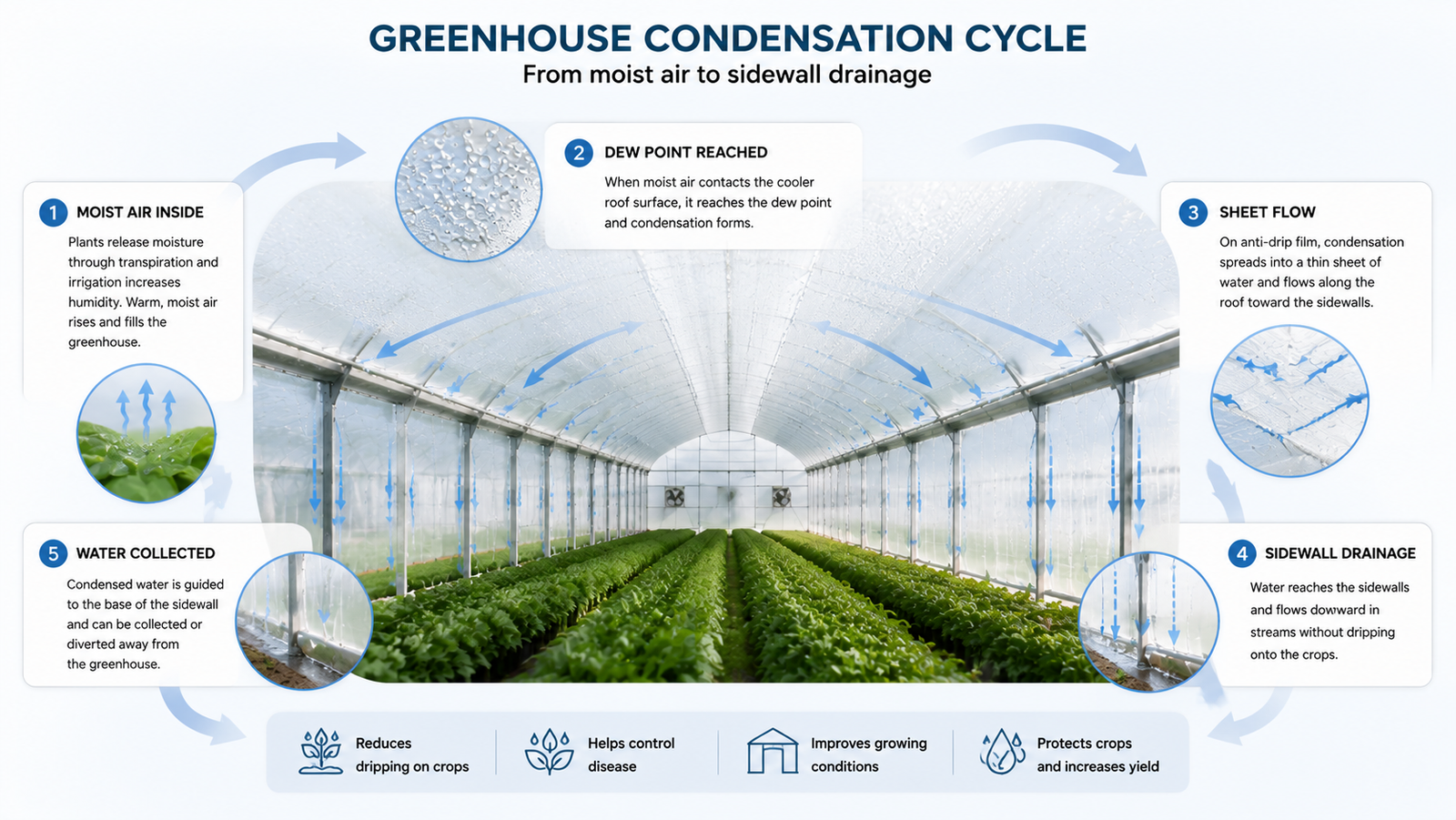
The two terms are often placed together in product descriptions, but buyers should not assume they mean the same test or the same formulation. Anti-drip generally refers to condensate on the film surface. Anti-fog generally refers to reducing suspended fine moisture or visible fog that affects visibility and light distribution. In the market, suppliers sometimes use "anti-fog," "anti-condensate" and "anti-drip" loosely, so the commercial name is less important than the written function.
| Term | Primary Target | What the Buyer Should Ask | Typical Misunderstanding |
|---|---|---|---|
| Anti-drip / anti-condensate | Large droplets on the inner film surface | Which side is treated, how performance is created, and how it is evaluated | Assuming it prevents condensation from forming |
| Anti-fog | Fine suspended moisture or fog inside the greenhouse | How the supplier defines anti-fog and whether it is a separate function | Assuming every anti-drip formulation also controls airborne fog |
| Humidity control | Water vapor in the greenhouse air | Ventilation, heat, air movement, irrigation timing and sensor strategy | Treating a film additive as a complete environmental-control system |
If both functions are required, write both into the RFQ and ask the supplier to define them separately. Do not approve a purchase order because a brochure uses a combined phrase such as "anti-fog anti-drip" without stating the treated surface, test basis or expected functional period.
Application and Selection Matrix
For most commercial projects, anti-drip is worth specifying when condensate forms above sensitive crops or occupied work areas. It becomes less useful when the roof is nearly flat, the film is badly wrinkled or drainage terminates over the crop. The following matrix is a purchasing starting point, not a substitute for structural review.
| Application | Practical Starting Point | Why | Confirm Before Ordering |
|---|---|---|---|
| Commercial vegetable greenhouse | Greenhouse-grade PE film with inward-facing anti-drip function | Reduces roof droplet formation above a dense crop canopy | Crop, climate, roof geometry, UV package, chemical exposure and runoff route |
| Nursery or seedling house | Anti-drip film plus disciplined nighttime humidity management | Young plants can be sensitive to repeated overhead wetting | Heating, ventilation, bench layout, irrigation timing and target service period |
| High tunnel or seasonal structure | Choose by season length and condensation risk, not by anti-drip label alone | A short project may not require the same film construction as a multi-year house | Season, thickness, fastening, wind exposure and whether reliable drainage exists |
| Inflated double-layer greenhouse | Place condensate-control function on the greenhouse-facing surface of the inner layer | The inner cover is normally where warm moist greenhouse air meets the film | Layer identification, inflation air source, film orientation and moisture between layers |
| Distributor stock program | Limit stock to repeatable widths, thicknesses and clearly identified film orientation | Too many custom combinations create slow inventory and installation mistakes | Regional crop mix, common structures, labeling, storage and roll traceability |
Film, Function and Installation Tradeoffs
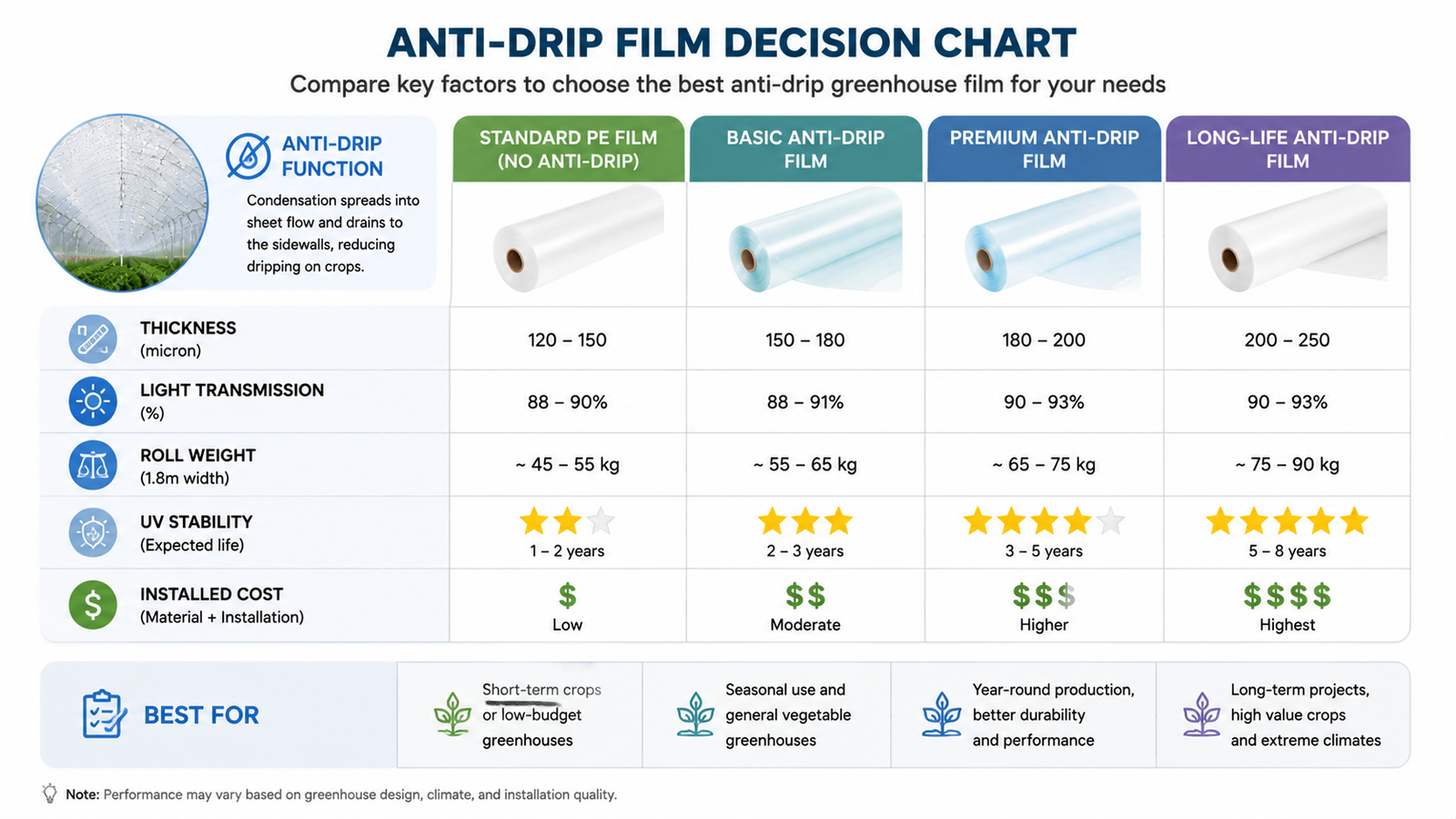
Anti-drip vs initial cost
The cheapest roll is not always the lowest-cost cover once wet foliage, poor winter light, worker discomfort and replacement labor are considered. However, anti-drip should not be added automatically to every order. A seasonal cover over a non-sensitive application may gain little if condensation is already managed by structure and ventilation. The buyer should pay for a defined risk reduction, not for a longer feature list.
Thickness vs roll handling
Increasing thickness can improve mechanical margin, but it also increases roll weight and handling difficulty. A wide roll that is too heavy for the available crew or lifting equipment may be dragged, creased or punctured during installation. Those low spots can interrupt sheet flow and create drip points. Use the greenhouse plastic roll size and measurement guide before approving width, cut length and roll arrangement.
Light transmission vs functional package
Anti-drip performance should be reviewed alongside dry and wet optical behavior, not treated as proof of high light transmission. Diffusion, UV spectral control, thermic additives, pigments, thickness and multiple layers all affect the final light environment. If light is commercially critical, request the relevant technical values and test method for the proposed grade.
UV stability vs anti-drip durability
UV stabilization protects the polymer from outdoor weathering; it does not automatically define how long the anti-drip function remains active. The two systems should be specified independently. The guide to UV-stabilized greenhouse plastic explains why polymer life, spectral behavior and functional-additive life must not be collapsed into one "UV film" claim.
Wide custom rolls vs logistics
Fewer seams can simplify covering, but a wider anti-drip roll may require a larger core, stronger packaging, lifting equipment and a different loading plan. Confirm whether the roll can pass through the warehouse, container, farm access and installation equipment before treating maximum width as the best width.
What Determines Anti-Drip Service Life?
There is no responsible universal service-life number for every anti-drip greenhouse film. Function duration may vary with the additive system, layer design, condensation frequency, water chemistry, temperature, cleaning, chemical exposure, storage and installation. A claim that the function lasts for the "life of the film" needs a definition of film life, use conditions and verification basis.
University of Connecticut Extension notes that condensate-control material can be sprayed on the film or incorporated and may last a couple of years. That is useful background, but it is not a warranty for a specific commercial roll. For procurement, the supplier's written grade specification, expected functional period and exclusions should control.
- Frequent heavy condensation: repeated water movement can accelerate loss or redistribution of some surface-active systems.
- Cleaning and rubbing: aggressive cleaning can affect a coating or treated surface.
- Agrochemicals: sulfur and other crop-protection chemicals may affect the film or additive package; exposure must be declared before quotation.
- Wrong-side installation: even a sound formulation will appear ineffective when the treated side faces outside.
- Poor storage: heat, sunlight, moisture and damaged packaging before installation can compromise rolls or labels.
Installation Details That Decide Whether It Works
An anti-drip formulation can be correct and still perform poorly after installation. The most common field failures are orientation errors, insufficient slope, slack film, low spots and blocked drainage.
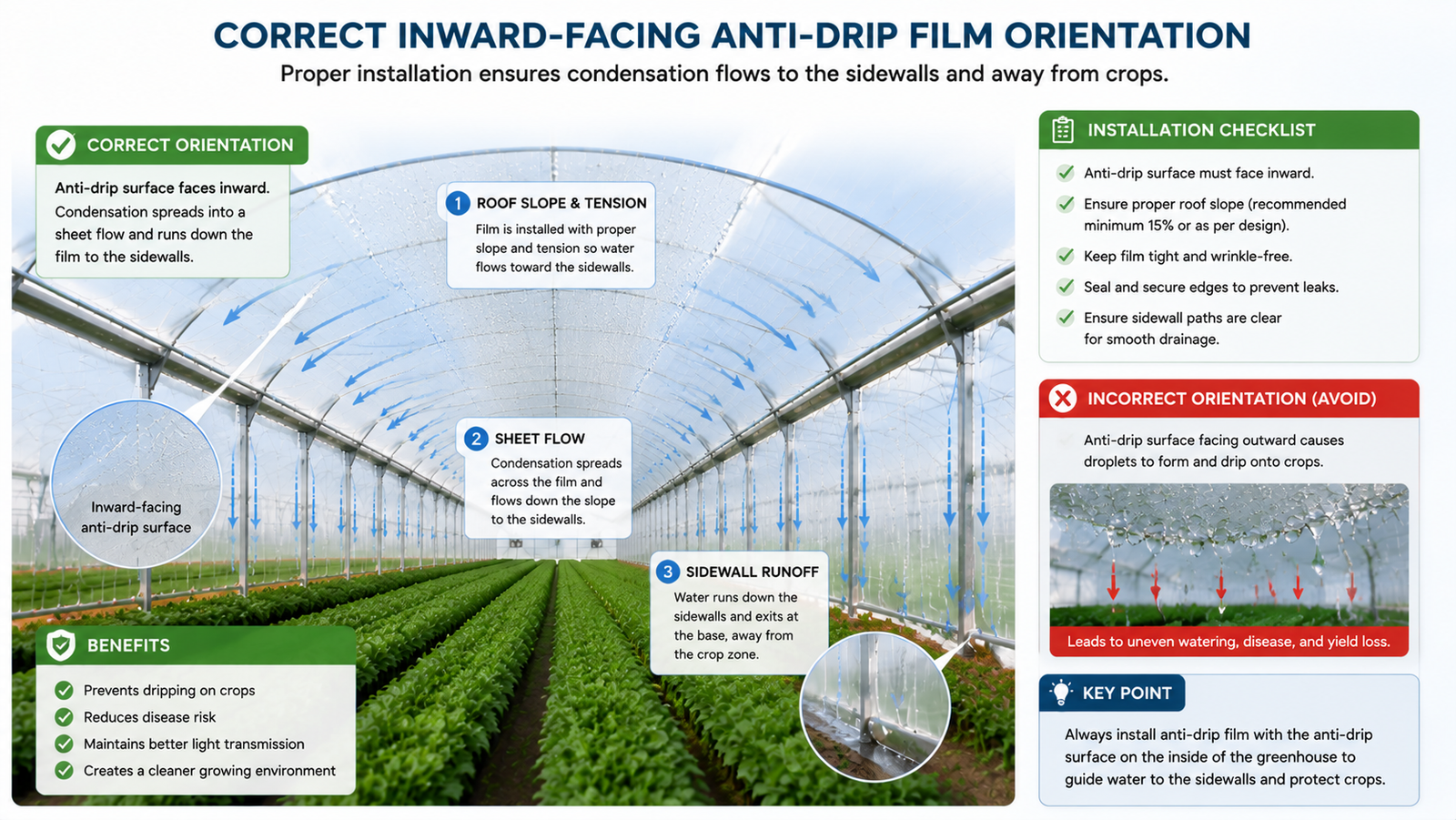
Confirm the inward-facing side
The treated surface generally needs to face the greenhouse interior, where condensation occurs. Film-edge printing, roll labels or supplier instructions should identify orientation. Marking must remain readable through unpacking and installation; verbal instructions alone are not enough for a large crew.
Maintain continuous slope and tension
Sheet flow needs gravity and a smooth path. Wrinkles, sagging bays and abrupt folds trap water. Over-tensioning can also damage film around fasteners and frame contact points. The aim is uniform installation tension appropriate to the structure, not simply pulling as hard as possible.
Plan where the water exits
Sidewalls, gutters, lock channels and end-wall transitions need review. If condensate reaches a horizontal profile and stops, the anti-drip function has moved the drip location rather than solved it. A greenhouse builder should confirm the drainage detail before the film is ordered.
Coordinate double-layer systems
For an inflated double layer, identify inner and outer rolls separately. Condensate control normally belongs on the surface exposed to greenhouse air. Inflation air, sealing and layer spacing affect moisture between layers. University of Florida guidance recommends bringing inflation air from outside to reduce condensation between the polyethylene layers and limit chemical exposure inside that cavity.
For frame preparation, pulling and fastening details, use the guide to install greenhouse plastic on metal and wood frames. Installation planning should happen before the roll width and packing arrangement are finalized.
What Buyers Should Confirm Before Quotation
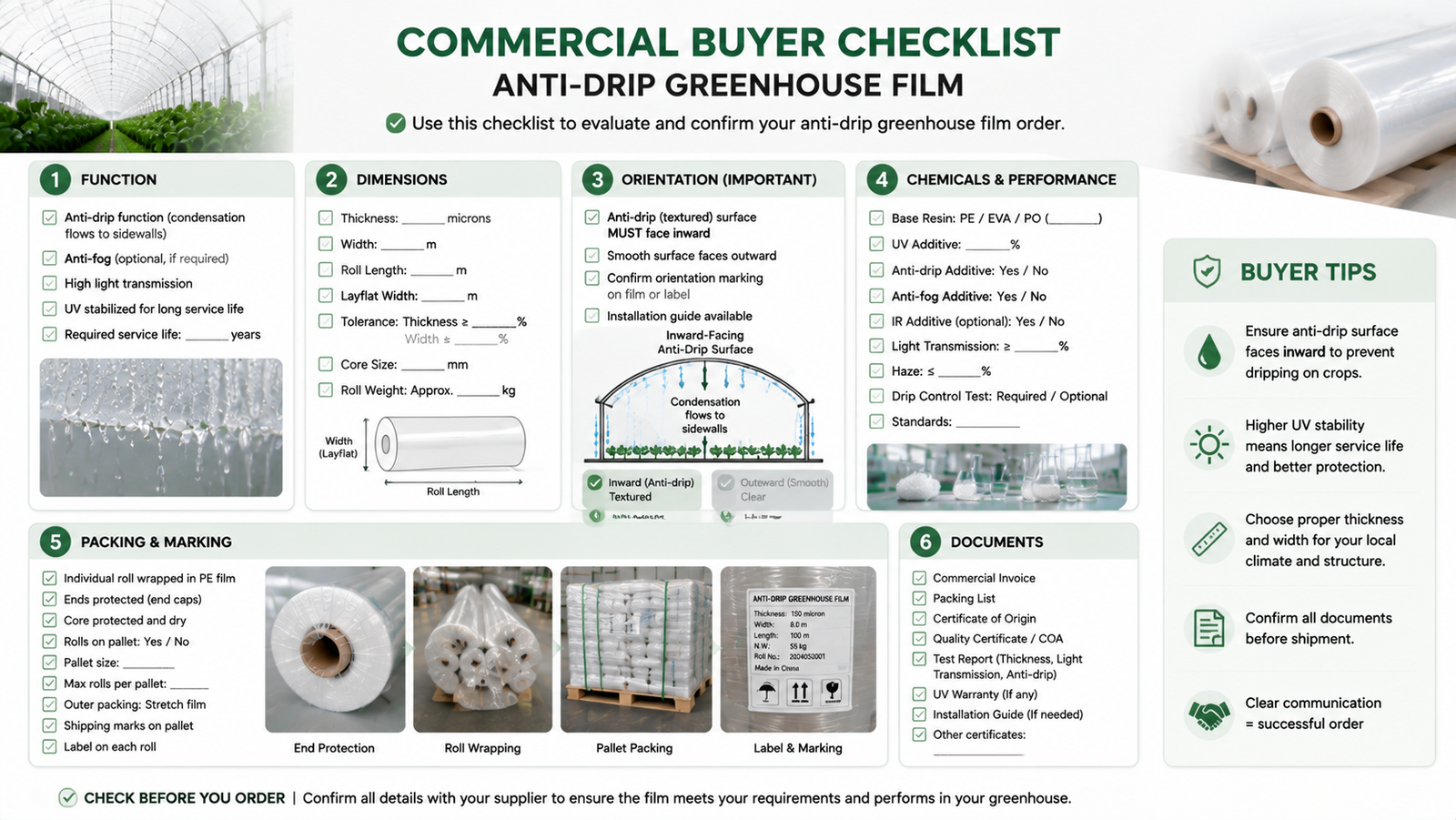
A usable quotation needs more than material, thickness and quantity. Send the following information as one specification package. Mark unknown fields instead of inserting assumptions.
| Information | Why It Affects the Order | How to State It |
|---|---|---|
| Structure and application | Defines roof geometry, runoff, mechanical exposure and installation method | Commercial multi-span greenhouse, high tunnel, nursery house or other structure |
| Installation location and season | Affects UV exposure, temperature, condensation frequency and service expectation | Country, region, elevation if relevant and intended installation month |
| Film size | Controls production width, cut length, roll weight, packing and handling | Finished width, length per roll, quantity and whether dimensions include fixing allowance |
| Thickness and tolerance | Affects weight, mechanics, price and consistency | Nominal micron or mil plus acceptable tolerance |
| Functional requirements | Prevents anti-drip, anti-fog, UV, thermic or diffusion terms from being assumed | List each required function separately and state priorities |
| Chemical exposure | May affect polymer and additive durability | Crop chemicals, sulfur practice, disinfectants and cleaning method |
| Installation orientation and labeling | Prevents the treated surface from facing the wrong direction | Required edge printing, roll labels and language |
| Packing and destination | Affects cores, protection, palletization, freight and unloading | Roll packing, pallet requirement, destination port and site handling limits |
Buyers who need a broader purchasing sequence can use the commercial greenhouse plastic roll buying guide before sending a final RFQ.
How a Factory Reviews an Anti-Drip Film Order
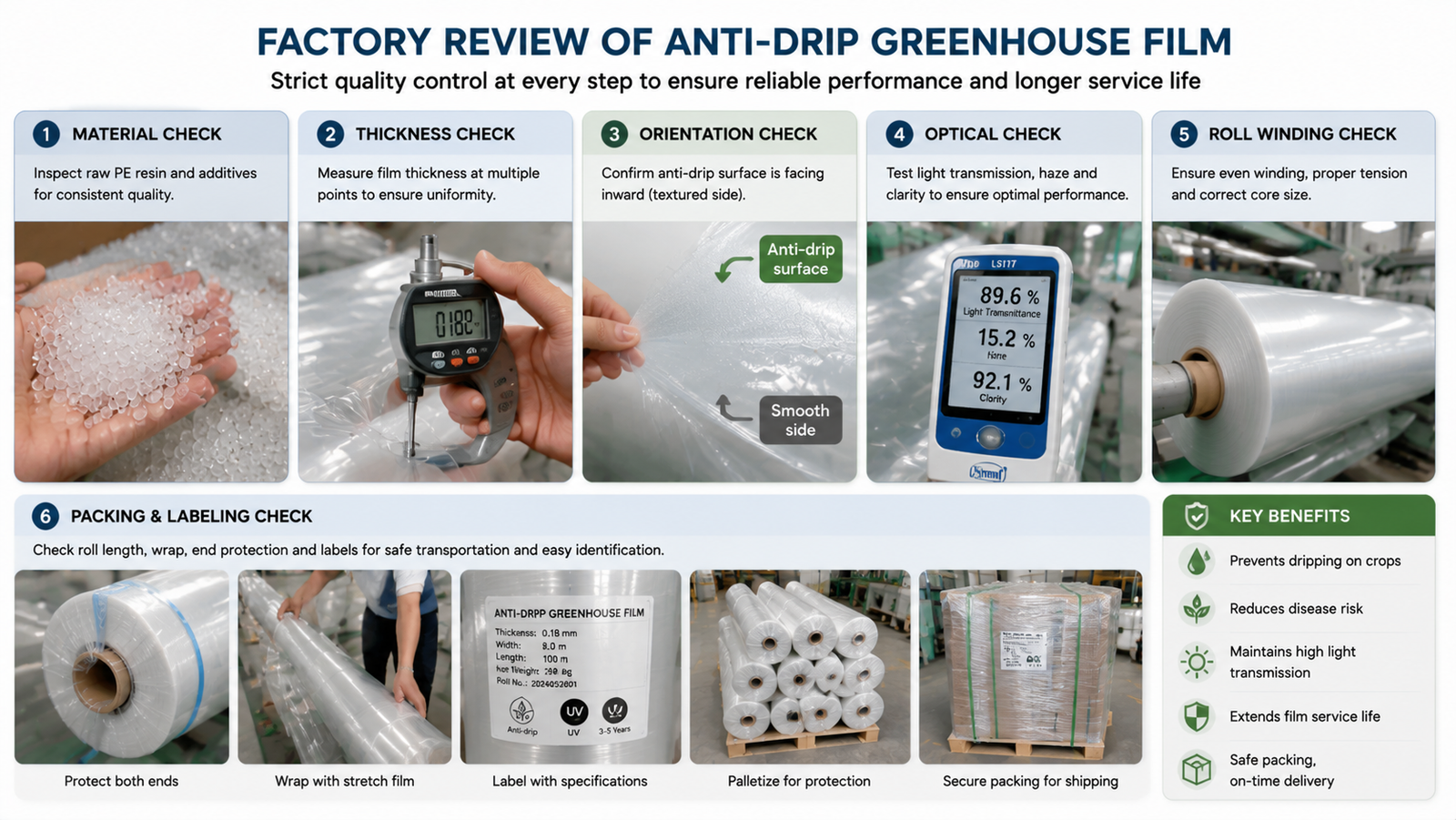
Before production, the supplier should convert the buyer's application into a controllable manufacturing specification. A serious review asks whether the requested width and thickness are feasible, whether the functional package is compatible, how the treated side will be identified and which checks are relevant to the batch.
- Specification review: confirm product type, dimensions, quantity, use location, structure and target service period.
- Material and formula review: confirm resin system, UV stabilization, anti-drip method and any anti-fog, thermic or diffusion requirement.
- Production feasibility: verify width, thickness range, tolerance, roll weight, core and packing limits.
- Identification plan: define inner-side marking, labels, batch code and installation instructions.
- Quality plan: identify thickness, width, appearance, roll winding, optical or functional checks that apply to the order.
- Pre-production approval: align the written specification, TDS or sample where required before scheduling the bulk run.
A sample can confirm appearance, handling, dimensions and marking, but a small sample cannot reproduce a full greenhouse condensation cycle. The sample, approved specification and batch records should therefore be used together. Review the site's explanation of available plastic film TDS and quality documents and the factory quality-control process when defining the order-document package.
Three Procurement Scenarios
Scenario 1: Vegetable grower with persistent morning drip
Initial request: clear greenhouse film that will stop condensation.
What is missing: roof slope, ventilation schedule, heating, irrigation timing, current drip locations, chemical exposure and film orientation.
Better decision: specify inward-facing anti-drip film to improve roof condensate flow, while correcting nighttime humidity and confirming where runoff leaves the cover. Film handles the surface behavior; climate management handles the moisture load.
Scenario 2: Distributor building regional inventory
Initial request: several anti-fog and anti-drip rolls in every available width.
Commercial risk: too many combinations create slow stock, mislabeled orientation and inconsistent customer expectations.
Better decision: select the most common local greenhouse widths and thicknesses, define the two functions in writing, standardize edge marking and retain batch traceability. Custom projects can be quoted separately instead of forcing every variation into inventory.
Scenario 3: Greenhouse builder ordering double-layer film
Initial request: two identical rolls of anti-drip greenhouse plastic.
What must be reviewed: which roll is inner, whether the outer roll needs the same function, how each roll will be labeled, the inflation-air source, roll weight and installation sequence.
Better decision: define inner and outer layers separately and place condensate-control performance where the greenhouse air meets the cover. This reduces cost ambiguity and prevents both rolls from being installed without clear orientation.
Common Buying and Installation Mistakes
| Mistake | Why It Happens | Likely Result | Correct Approach |
|---|---|---|---|
| Expecting anti-drip film to remove humidity | "Condensation control" is interpreted as dehumidification | Wet canopy and fog remain even if roof droplets improve | Use film for surface runoff and manage humidity separately |
| Installing the treated side outward | Roll marking was unclear or lost during installation | Little or no anti-drip effect on the greenhouse-facing surface | Confirm edge printing, labels and crew instructions before unrolling |
| Ignoring roof slope and low spots | The additive is treated as the whole solution | Water pools and drips at wrinkles, channels or frame transitions | Review tension and the full runoff path before ordering |
| Using anti-drip and anti-fog as identical terms | Marketing language combines the functions | The delivered performance does not match the buyer's actual problem | Define each required function and its evaluation separately |
| Buying by thickness only | Thickness is easy to compare across quotations | UV, optical, functional and installation requirements remain unspecified | Approve a complete grade and application specification |
| Assuming a universal anti-drip lifetime | A duration from another product is copied into the RFQ | Warranty disputes and unrealistic expectations | Request the expected period for the exact quoted grade and use conditions |
| Failing to declare sulfur or other chemicals | Chemical practice is separated from cover purchasing | Premature loss of film or functional performance may occur | Provide the chemical program before formula approval |
Copy-and-Paste Order Checklist
- Application and greenhouse type:
- Installation country, region and season:
- Single layer or inflated double layer:
- Finished roll width and length:
- Nominal thickness and tolerance:
- Required anti-drip function and expected effective period:
- Is anti-fog also required? How should it be defined?
- Required UV, thermic, diffusion or color functions:
- Crop and condensation problem to be addressed:
- Roof geometry, fastening method and runoff path:
- Agrochemicals, sulfur, cleaning agents and disinfection practice:
- Inside-surface marking and label language:
- Roll core, individual packing and pallet requirements:
- Quantity, destination port and unloading limitations:
- Required TDS, sample, inspection record or third-party testing:
Frequently Asked Questions
Does anti-drip greenhouse film stop condensation?
No. It changes the wetting behavior of condensation on the film so water spreads and can flow toward the edge instead of forming large droplets. Condensation formation still depends on humidity, dew point and cover temperature.
Is anti-drip the same as anti-fog?
Not necessarily. Anti-drip usually targets droplets on the cover surface, while anti-fog may refer to fine suspended moisture or visibility. Supplier terminology varies, so define both functions in the written specification.
Which side of anti-drip greenhouse film faces inside?
The treated side normally faces the greenhouse interior. Follow the edge printing, roll label and supplier installation instructions for the specific grade; do not infer orientation from how the roll is wound.
How long does the anti-drip function last?
There is no universal duration. It varies by additive or coating system, film construction, condensation frequency, chemicals, cleaning, storage and use conditions. Request the expected effective period and exclusions for the exact quoted grade.
Can anti-drip film reduce plant disease?
It may reduce one source of overhead dripping and leaf wetness, but it is not a disease-control guarantee. Ventilation, heating, airflow, irrigation timing, spacing and sanitation remain necessary.
Can anti-drip be used in a double-layer greenhouse?
Yes, but the inner and outer layers should be specified separately. The condensate-control surface normally needs to face the greenhouse interior, and the inflation and moisture-management plan between layers must also be confirmed.
Is 6 mil film automatically suitable for a commercial greenhouse?
No. Thickness is only one parameter. Resin system, UV stabilization, anti-drip method, dimensions, tolerance, chemical exposure, installation and target service period also determine suitability. Use the greenhouse plastic thickness guide to compare thickness in context.
What should I send to get an accurate quotation?
Send the structure and application, installation location, finished width and length, thickness, required functions, chemical exposure, quantity, packing and destination. If some items are unknown, use the plastic film specification and quotation form and mark them for review.
References and Technical Sources
- University of Connecticut Extension: Plastic Film Update - definition of condensate control and greenhouse film considerations.
- UMass Extension: Reducing Humidity in the Greenhouse - condensation, plant wetness, ventilation, heating and air movement.
- Wageningen University & Research: Effect of Condensation on Light Transmission and Energy Budget of Seven Greenhouse Cover Materials - measured wet-cover optical and heat-transfer effects.
- Polymer Testing: Testing of the Condensation Characteristics and Light Transmissions of Different Plastic Film Covering Materials - relationship between condensation behavior and light transmission.
- University of Florida IFAS Extension: Design Suggestions and Greenhouse Management for Vegetable Production in Solid Media - double-poly covers, condensation and inflation-air guidance.
Procurement Action
If the greenhouse dimensions, roll size, thickness and functional package are already known, review the available custom greenhouse plastic roll specifications and prepare the required quantity, orientation marking and packing details.
If the grade is still uncertain, compare the broader greenhouse film options and the guide to greenhouse film quality factors. Do not finalize anti-drip performance until the structure can provide a continuous runoff path and the supplier has reviewed climate, crop and chemical exposure.
Send a Usable Anti-Drip Film Specification
Provide the greenhouse type, installation region, roll size, thickness, required functions, chemical exposure, quantity and packing. Mark unknown fields for technical review before production.