
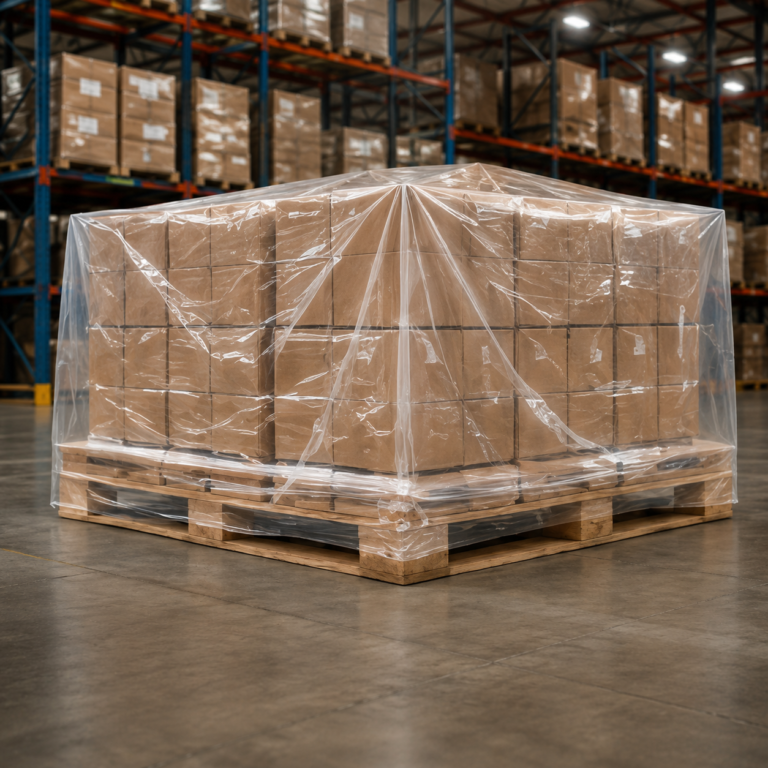
Plastic pallet cover for palletized goods protection, warehouse dustproof covering, storage protection, transportation covering, and industrial packaging applications.
Choose a PE cover around your palletized goods and the surfaces you need to cover. A bag-style cover extends over the top and sides of the load; specify where its lower edge should sit.
TIAN FENG supplies custom PE pallet cover bags. Use this overview to check coverage, size and film requirements, then review the detailed product specification. For dispatch, plan how the cover will work with the wrapping or strapping that holds the goods together.
Decide which surfaces need a cover and how the goods will be handled. Color, film thickness and cover construction are separate choices within that packaging plan.
| Your requirement | What to check |
|---|---|
| Cover the top and sides | Review a bag-style PE cover. Mark its intended lower edge and any overlap with the rest of the package. |
| Keep goods or labels visible | Consider clear film, then check label readability and the required access on a sample. |
| Conceal the contents | Specify the color and opacity you need. Approve the sample appearance rather than relying on a color name. |
| Cover corners or projections | Include overhang, corner protection and protruding parts in the loaded dimensions. Trial clearance and rubbing points. |
| Prepare goods for transport | Coordinate surface coverage with the wrapping, strapping and other restraint used to hold the load together. |

Our square bottom pallet cover bags are intended for the outside of palletized goods. Select the finished cover around the completed load, with the opening, seams and lower-edge coverage agreed on the drawing.
For detailed construction and quotation requirements, continue to the product page.
Record the maximum outside length and width after the goods and protective packaging are in place. Include carton overhang, corner protection and uneven stacks.
These are load measurements. Finished bag dimensions and fitting allowance depend on the agreed construction and must be checked on an opened sample.
Clear film can help with identifying goods and labels. If you need white, black or another color, specify opacity and check the proposed sample.
Color alone does not establish UV stability or outdoor service life.
Agree single-wall thickness, units and tolerance. Describe rough surfaces, projections and the way the cover will be applied.
A thickness label alone does not establish puncture resistance or suitability for a sharp load.
State indoor or outdoor use, expected duration, sunlight, dust and moisture exposure. Match any special requirement to the proposed grade and supporting evidence.
Assess openings, seams and the lower edge as part of the complete package.
Send the same load and packaging information to each supplier. Where a detail is undecided, ask for it to be identified in the preliminary quotation.
| Order detail | Information to share |
|---|---|
| Loaded dimensions | Outside length and width, top profile, projections and intended lower-edge position. Add a load photo or drawing if available. |
| Application and closure | How the cover will be applied and fastened, including any equipment and how it interfaces with wrapping or strapping. |
| Film specification | PE grade requirements, single-wall thickness, units, tolerance, color, opacity and any application-specific evidence needed. |
| Appearance and print | Label visibility and, if required, artwork and print position for feasibility review. |
| Presentation and packing | Required cover presentation, quantity per pack, carton labels and shipment packing. Confirm the format offered for the specification. |
| Quantity and destination | Quantity per specification, delivery destination and required date. Ask for MOQ, lead time and sample charges in the quotation. |
1. Agree the drawing
Mark the closed end, open mouth, seam positions and finished dimensions. Define any gusset notation and measurement basis.
2. Check a representative load
Check clearance, corner stress, seam placement, lower-edge position and access to labels or handling points. Record any snagging or tearing.
3. Confirm acceptance
Identify the sample and specification version. Agree the checks and records needed for the order, including any unresolved special-performance requirement.
A pallet cover addresses surface coverage. Stretch wrapping and other restraint address how the goods are held together. Check their interfaces, including the top, sides, lower edge and any bottom sheet, within your complete packaging plan.
The guide explains the different roles of cover bags, top sheets and wrapping. Use it to clarify your requirements before requesting a specification.
Read the Pallet Packaging GuideView Blown Stretch FilmA cover places a film barrier over the chosen surfaces of palletized goods. Define the dust, handling and exposure conditions for the job; the complete package determines the level of protection.
A PE film cover does not by itself establish a waterproof package. Openings, seams, the lower edge, closure and use conditions all matter. Request evidence relevant to any water-protection requirement.
Those names describe different application systems. Specify your application method and equipment so the proposed film and construction can be checked. Do not select a heat-shrink or mechanical stretch-hood process from appearance alone.
No. Specify exposure conditions and duration, then confirm the UV stability and other requirements of the proposed grade. Black color alone is not an outdoor-life specification.
Measure again with the goods and protective packaging in place. Include overhang and the intended lower-edge position. Use these inputs to agree the finished cover drawing and sample.
Use the inquiry form with your loaded dimensions, coverage needs, film requirements, quantity and destination. A photo or existing cover drawing can help explain the fit you need.