
UV Stabilized Greenhouse Plastic: What UV Resistance Means for Commercial Greenhouses
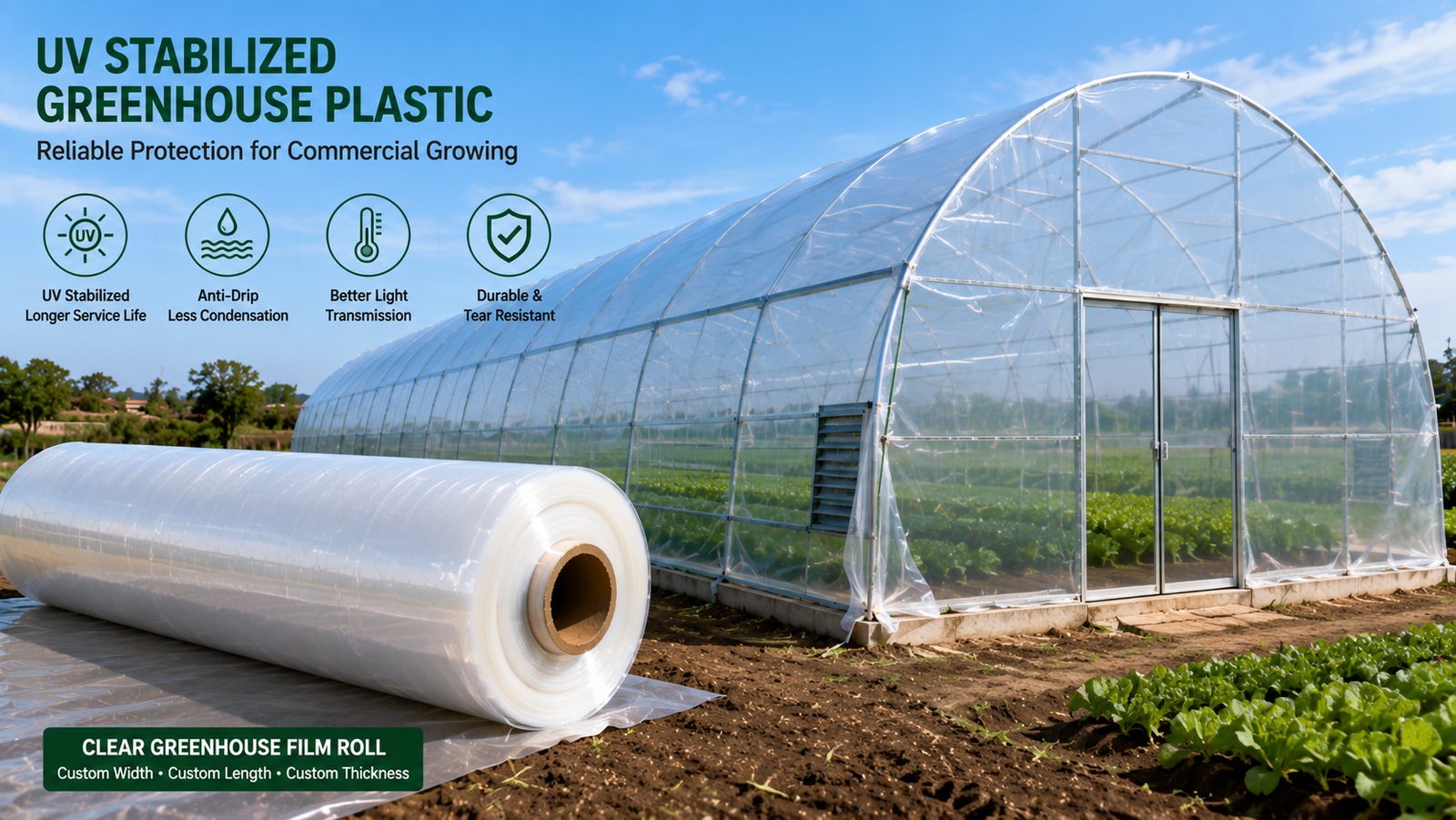
UV stabilized greenhouse plastic is formulated to slow the damage that sunlight, heat and weathering cause to the polymer. That is different from a UV-blocking film, which changes how much ultraviolet radiation passes into the greenhouse. A film can be stabilized against degradation without being designed to block the same UV wavelengths used in crop, pest or pollination management.
In actual quotation work, the most common mistake is receiving a request that says only “6 mil clear UV resistant greenhouse plastic.” The thickness can be quoted, but the performance requirement is still incomplete. A supplier cannot responsibly confirm outdoor life, crop suitability or chemical compatibility without knowing where the film will be installed and how it will be used.
Contents
- What Does UV Stabilized Greenhouse Plastic Mean?
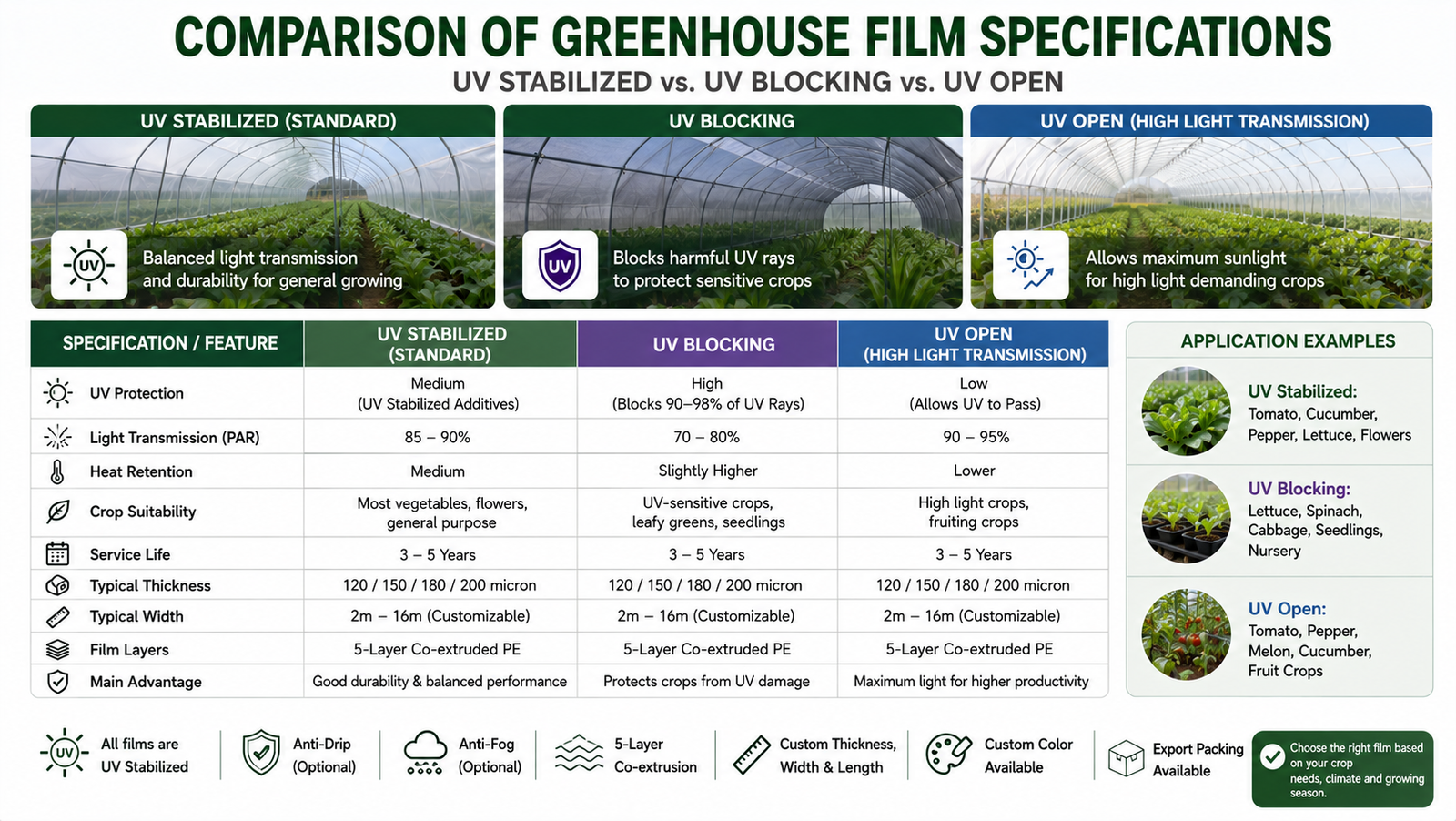
- UV Stabilized, UV Resistant, UV Blocking and UV Open Compared
- What UV Stabilization Protects and What It Does Not
- Why UV Resistant Is Not a Complete Durability Specification
- Thickness, Light, Functions and Service-Life Tradeoffs
- When UV Blocking or UV Transmission Matters
- Where Greenhouse Film Service Life Is Won or Lost
- Commercial Greenhouse Selection Matrix
- What Buyers Should Confirm Before Quotation
- How a Factory Reviews the Specification
- Three Real Procurement Scenarios
- Common Buying Mistakes
- Copy-and-Paste RFQ Checklist
- Frequently Asked Questions
- References
What Does UV Stabilized Greenhouse Plastic Mean?
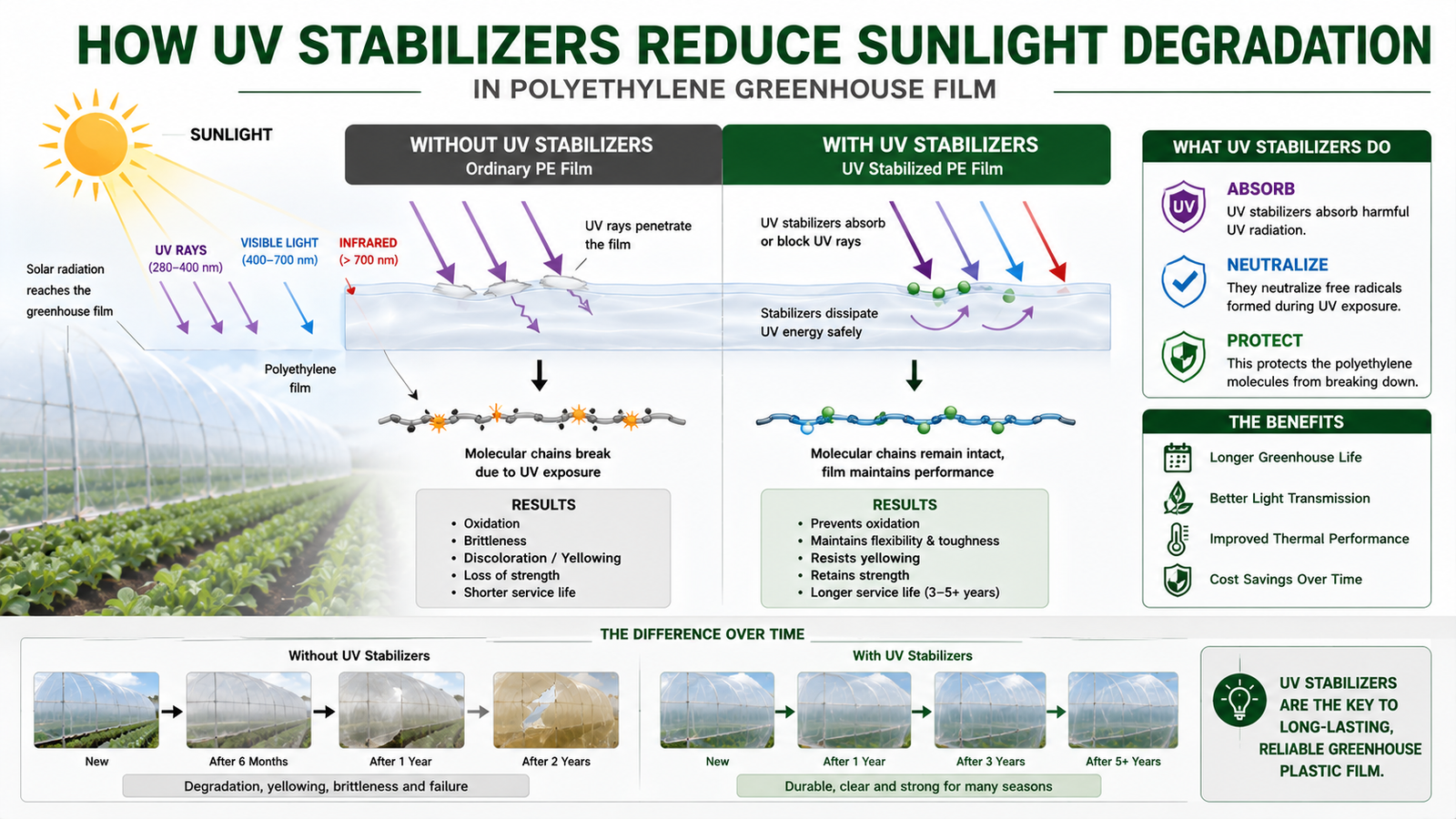
Polyethylene exposed outdoors does not remain unchanged. Solar radiation initiates chemical degradation, while elevated temperature, moisture, mechanical stress and contaminants can accelerate the loss of strength and flexibility. A UV-stabilization package is added to reduce that deterioration and help the film retain useful properties for its intended application.
The package may use different stabilizing mechanisms. Some additives absorb damaging ultraviolet energy; hindered amine light stabilizers are commonly used to interrupt degradation reactions in the polymer. The exact formulation is supplier-specific and should match the resin system, film structure, production process and intended exposure.
This is why “contains UV additive” is not enough for a serious purchase order. The useful questions are whether the finished film is greenhouse grade, what outdoor-use condition the supplier has designed it for, what evidence supports the statement, and which exclusions apply.
UV Stabilized, UV Resistant, UV Blocking and UV Open Compared
These terms are often placed in the same product description even though they answer different questions. The distinction matters because a buyer may need film durability, a specific crop-light environment, or both.
RFQs may describe the requirement as greenhouse plastic UV resistant, UV resistant greenhouse plastic sheeting or UV resistant plastic greenhouse film. In quotation work, these phrases are treated as a starting description rather than a finished specification: none identifies the stabilizer system, transmitted UV spectrum, exposure conditions or acceptance basis on its own.
| Term | Primary Meaning | What It Does Not Prove | What the Buyer Should Ask |
|---|---|---|---|
| UV stabilized greenhouse plastic | The formulation is designed to slow polymer degradation caused by outdoor light and weathering. | It does not by itself prove a universal number of outdoor years or a UV-blocking spectrum. | Ask for the intended exposure, service-life or warranty basis, test method and exclusions. |
| UV resistant greenhouse plastic | A broad performance or commercial description indicating resistance to UV-related deterioration. | The phrase alone does not define formulation, retained properties or test conditions. | Convert the claim into measurable or documentable purchase requirements. |
| UV-blocking greenhouse film | The film reduces transmission in a specified part of the UV spectrum. | Blocking UV is not automatically the same as improving the film's own outdoor durability. | Ask which wavelengths are reduced, the test method and how the spectrum fits the crop and pollination plan. |
| UV-open or UV-transmitting film | The covering allows more selected UV radiation to enter the growing space. | It does not mean the polymer has no stabilizer or that all UV wavelengths pass equally. | Confirm spectral-transmission data and the reason the growing system needs it. |
| Ordinary clear plastic sheeting | A general-purpose plastic cover that may be intended for construction, protection or short-term use. | Clear appearance does not prove greenhouse grade, UV stabilization or multi-season suitability. | Confirm the intended outdoor agricultural application before comparing price. |
What UV Stabilization Protects and What It Does Not
It helps protect retained mechanical performance
Outdoor ageing can show up as embrittlement, cracking, loss of elongation, reduced tensile performance, surface chalking or a film that tears more easily during wind movement. Stabilization is intended to slow this decline. For quality comparison, a buyer should focus on how the film performs after an agreed ageing procedure, not only on its strength before exposure.
It helps preserve a usable covering, not an indestructible one
UV stabilizers cannot correct an installation that leaves the film rubbing against a sharp frame, excessively tensioned at a fixing point, touching an incompatible surface or flapping continuously in wind. Mechanical damage and formulation ageing often interact. Once a notch or abrasion develops, a film may fail even though the remaining material still has acceptable properties.
It does not define crop-light performance
Visible-light transmission, haze, light diffusion, UV transmission and infrared behavior are separate optical characteristics. A clear film may transmit strong visible light while blocking part of the UV spectrum. A diffused film may have useful total transmission but a hazier appearance. Each property needs its own test and purchasing language.
Why “UV Resistant” Is Not a Complete Durability Specification
Commercial buyers often compare two quotations by thickness and stated outdoor years. That comparison is incomplete unless the conditions behind the claim are similar. Outdoor UV dose varies with latitude, altitude, season and local climate. Film temperature may be much higher than ambient air temperature. Crop-protection chemicals and disinfectants may contact the inside surface. Installation stress and frame contact add another layer of risk.
A supplier therefore needs a target use condition, not just a desired number. If a quotation promises a service period, ask whether it is a design target, a warranty period or a typical market description. Then ask what installation, chemical and climate exclusions apply. An accelerated-weathering result can help compare formulations, but its laboratory hours should not be converted directly into outdoor years without a validated correlation.
For a separate comparison of seasonal and multi-year grades, early failure causes and replacement timing, see how long greenhouse plastic lasts.
| Durability Factor | Why Buyers Miss It | Possible Consequence | Better Purchase Instruction |
|---|---|---|---|
| Installation location | The same “outdoor” description is used for very different UV and temperature conditions. | A film selected for a mild region may age faster in higher UV or hotter service. | State country, region, altitude if relevant, season and whether the structure is year-round. |
| Agrochemical exposure | Chemical practice is often discussed with the grower but not passed to the film supplier. | Some residues or high chemical concentrations may accelerate loss of film properties. | Disclose sulfur fumigation, chlorine products, pesticides and cleaning agents before quotation. |
| Film temperature | Buyers report ambient temperature rather than the temperature reached by the film. | Heat can accelerate weathering and additive consumption. | Describe intense sun, contact with hot metal and ventilation conditions. |
| Fastening and abrasion | UV resistance is treated as protection against every failure mode. | Premature tearing at channels, battens, frame edges or loose areas. | Provide the frame and fastening method; protect contact points and install at suitable tension. |
| Claim basis | A marketing lifetime is mistaken for a guaranteed result in every environment. | Disputes after installation when conditions fall outside the supplier's assumptions. | Confirm the document, test, warranty language, exclusions and acceptance criteria in writing. |
Thickness, Light, Functions and Service-Life Tradeoffs
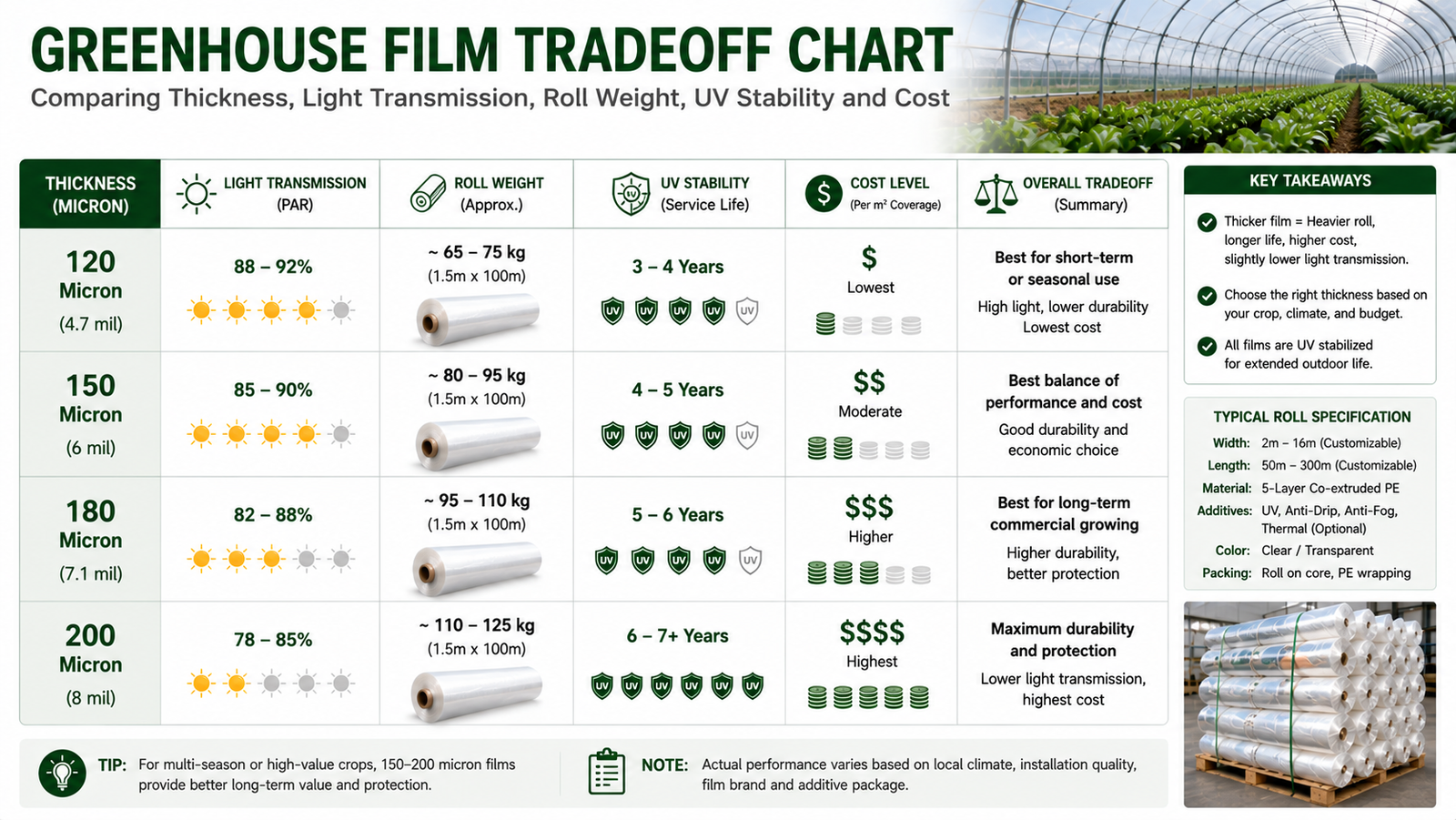
UV resistance is only one part of the greenhouse-film specification. The final covering still has to fit the frame, deliver the required light environment, resist handling and arrive in rolls that the installation crew can move safely.
Thickness versus UV stability
A thicker film contains more material and can improve handling or puncture resistance, but thickness alone does not prove a better stabilization package. A properly formulated greenhouse-grade film may outperform thicker general-purpose sheeting outdoors. Compare film grade, thickness tolerance and ageing evidence together.
Thickness versus roll weight and installation
Increasing thickness also increases roll weight. Wide commercial rolls may become harder to unload, position and pull over the structure. This looks like a logistics detail, but it affects labor, lifting equipment, packaging and the chance of damaging the roll before installation. Use the greenhouse plastic roll size and measurement guide before fixing the final width and cut length.
Light transmission versus film functions
UV absorbers, pigments, diffusion systems, anti-drip layers and thermal additives can change optical behavior. A high headline transmission value does not describe diffusion, haze or spectral distribution. The buyer should identify the crop and growing objective first, then request the relevant optical data using an agreed method.
Price versus usable service
The lowest price per kilogram is not necessarily the lowest covering cost. A cheap film that requires early replacement adds removal, labor, crop interruption and disposal costs. The opposite mistake is overspecifying a short seasonal tunnel with functions and lifetime that the project will never use. Compare price against the intended project cycle and replacement cost.
When UV Blocking or UV Transmission Matters
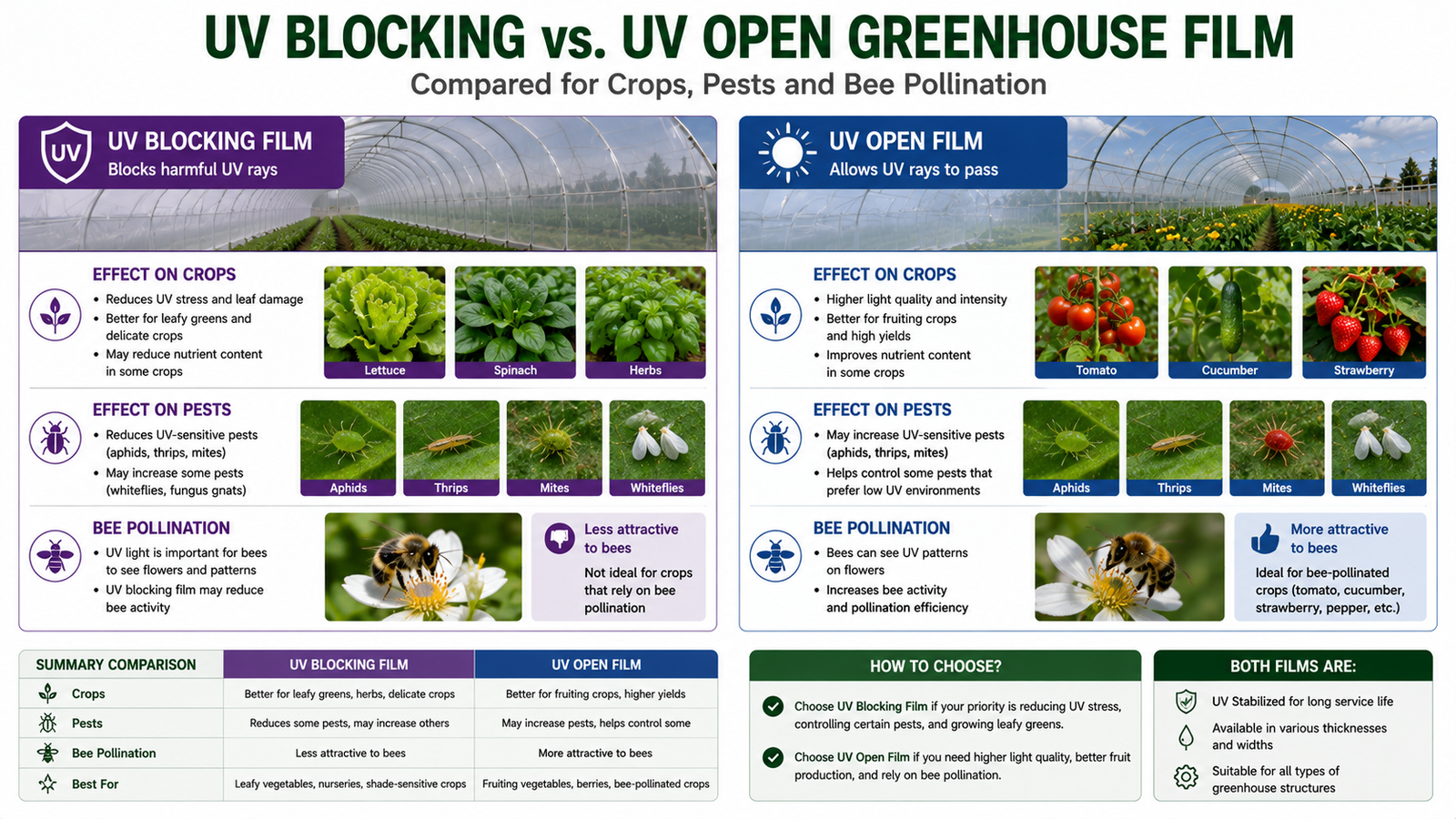
Scientific and extension literature treats UV-blocking covers as a crop-environment tool, not merely a durability upgrade. Research reviewed in Agronomy reports that changing UV transmission can influence pest activity, plant physiology and crop responses. The result is not identical for every crop, region or wavelength range.
Pollination introduces another practical constraint. The University of Connecticut Extension notes that bees use UV for navigation, so a greenhouse relying on bee pollination may need a film that allows part of the UV spectrum to pass. The same source notes that UV-blocking films may help reduce the activity of several greenhouse pests. A buyer therefore should not request “maximum UV blocking” without checking the production system.
| Growing Objective | Film Question | Why It Matters | What to Verify |
|---|---|---|---|
| General crop protection | Is polymer stabilization required without a special spectral target? | The priority may be film durability and visible-light performance rather than UV blocking. | Greenhouse grade, stabilization, thickness, optical data and target service conditions. |
| Bee-pollinated crop | Does the film pass the UV range needed by the pollination plan? | A strong UV-blocking cover may affect bee navigation. | Spectral-transmission curve, pollinator requirements and installed-film orientation. |
| Pest-management strategy | Is a defined UV-blocking range part of integrated pest management? | Reduced UV transmission may influence insect behavior, but crop effects must also be reviewed. | Wavelength range, crop, pest target, local evidence and expected change over time. |
| Color- or compound-sensitive crop | Could spectral modification change crop quality characteristics? | Research shows responses vary among crops and environments. | Crop-specific agronomic advice and measured spectral properties. |
Where Greenhouse Film Service Life Is Won or Lost
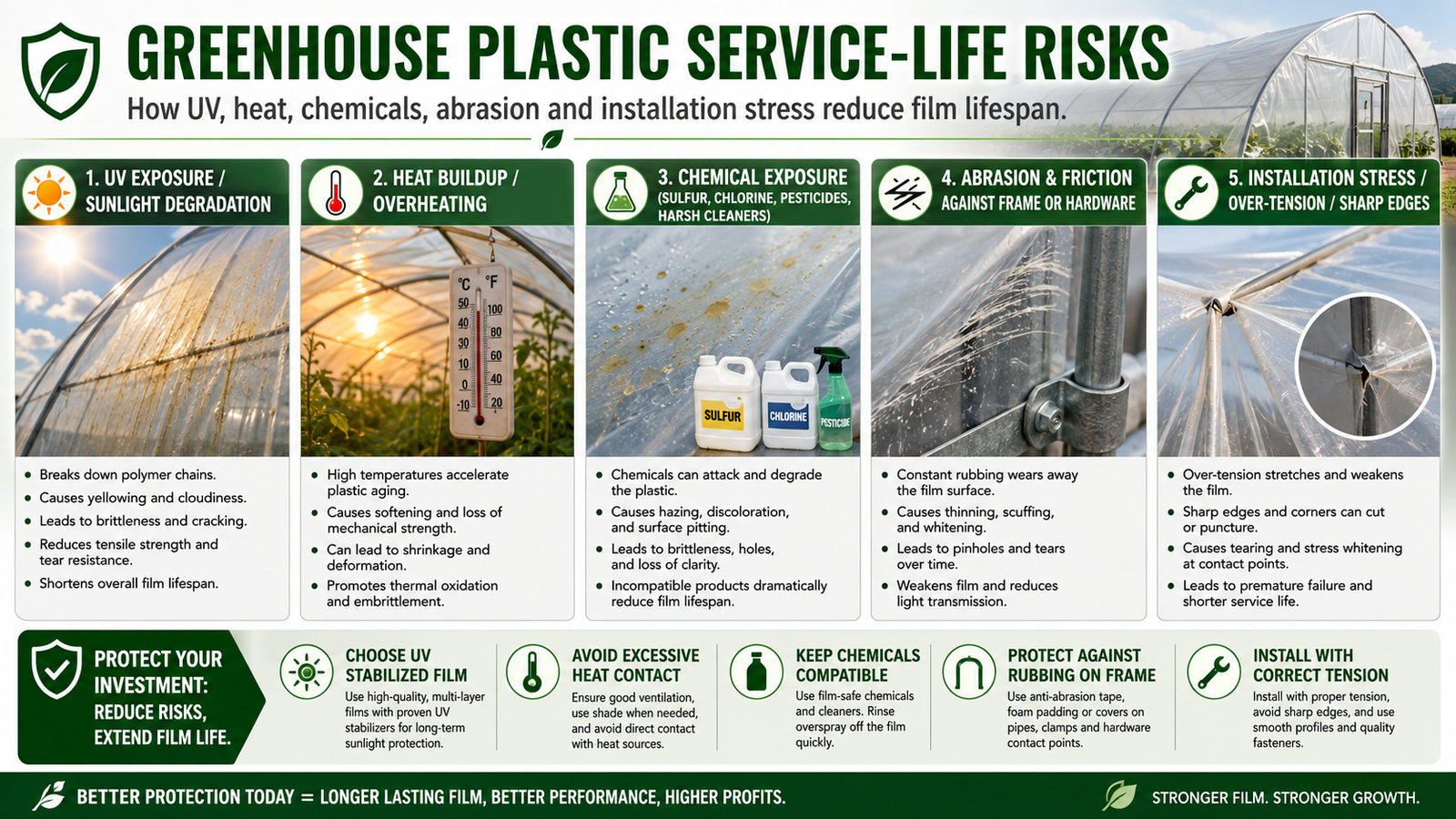
A film's useful life is produced by a system: formulation, extrusion, storage, installation and greenhouse operation. Weakness in any one stage can override a good specification.
- Formulation: Resin, stabilizer package, pigments and functional additives must be compatible and correctly processed.
- Thickness control: Large thin spots can become stress concentrations even when the average thickness looks acceptable.
- Storage: Rolls should remain protected from avoidable heat, sunlight, contamination and physical damage before installation.
- Installation: Sharp edges, unsuitable fastening, excessive tension, loose flapping and contact with incompatible surfaces shorten useful life.
- Operation: Sulfur, chlorine, pesticides, disinfectants, heat accumulation and repeated abrasion may affect ageing.
- Maintenance: Early repair of punctures and correction of loose areas can prevent small damage from becoming a structural tear.
For installation details, use the guide to installing greenhouse plastic on metal and wood frames. It covers measuring, pulling, fastening and tension rather than treating every early failure as a UV-formulation problem.
Commercial Greenhouse Selection Matrix
| Application Scenario | Safer Starting Direction | Why | Confirm Before Ordering |
|---|---|---|---|
| Year-round commercial greenhouse | Greenhouse-grade UV-stabilized PE film selected for the local exposure and required functions. | Replacement interrupts production and makes premature ageing expensive. | Target service period, region, thickness tolerance, chemicals, anti-drip or thermal functions, warranty basis. |
| Seasonal tunnel or temporary crop cover | A seasonal greenhouse-film specification matched to the planned use period. | A multi-function, long-life specification may add cost the project cannot recover. | Season length, removal plan, wind exposure, reuse expectation and storage. |
| Bee-pollinated crop | UV-stabilized film with spectral transmission selected around the pollination requirement. | Durability and UV transmission must be specified independently. | Pollinator type, UV-transmission curve, crop-light requirement and other optical properties. |
| High pest-pressure greenhouse | Evaluate a defined UV-blocking option as part of the crop-management plan. | UV blocking may affect pest behavior but can also change the plant-light environment. | Target pest, crop response, wavelength range, pollination and local agronomic advice. |
| Frequent sulfur fumigation or intensive chemical use | Disclose the chemical program and request a compatible formulation or written exposure limits. | Chemical contamination can interact with solar ageing and reduce retained performance. | Chemical names, frequency, concentration, application method and supplier exclusions. |
| Distributor stock program | A limited range of repeatable greenhouse-grade specifications for the target region. | Consistent stock, labels and documentation are usually more valuable than changing every roll. | Regional climate, common widths, thickness, functions, packing, batch identification and replenishment plan. |
What Buyers Should Confirm Before Quotation
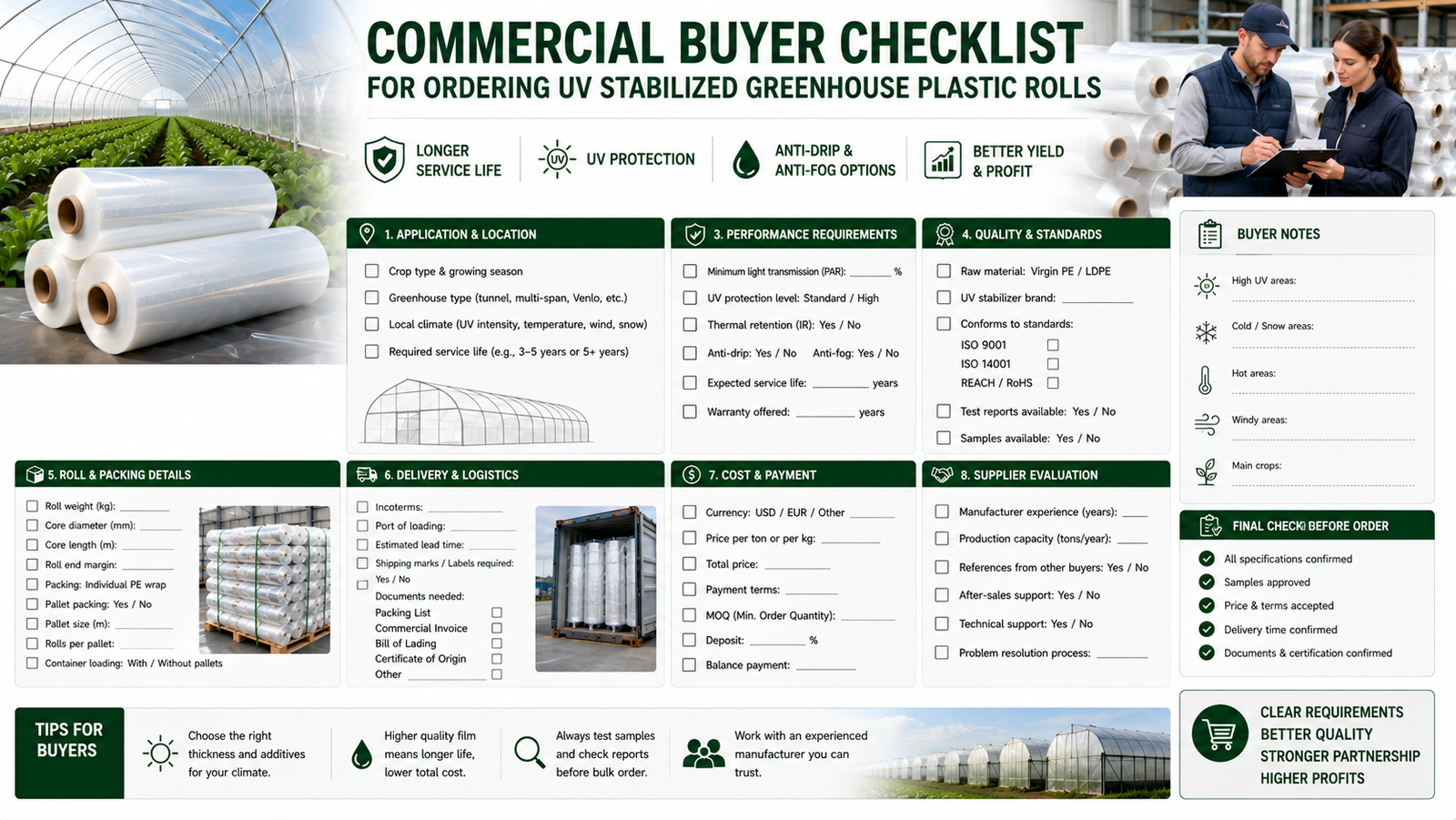
The quality of a quotation depends on the quality of the specification sent to the supplier. The following items affect material selection, production feasibility, price, lead time, roll handling and shipment:
- Application: commercial greenhouse, hoop house, nursery tunnel, seasonal cover or replacement project.
- Installation region: country, climate, altitude if relevant, season and year-round or seasonal exposure.
- Target service requirement: planned crop cycle, intended outdoor period and any required warranty language.
- Material and structure: PE film grade, clear or colored film, single- or multilayer requirement if specified.
- Thickness: nominal micron or mil and acceptable tolerance; use the greenhouse plastic thickness guide if this is not yet settled.
- Roll size: finished width, cut length, quantity, roll-weight limit and whether the crew can handle the proposed roll.
- Functions: UV stabilization, anti-drip, anti-fog, thermal retention, light diffusion, color or other project functions.
- Spectral requirement: ordinary transmission, UV blocking or UV-open performance, including the required wavelength range when applicable.
- Chemical environment: sulfur fumigation, pesticides, chlorine disinfectants and cleaning agents.
- Installation method: frame material, fixing channel, wiggle wire, battens, clips, single or inflated double layer.
- Packing and logistics: roll protection, labels, woven bag, pallet, container loading, destination and unloading restrictions.
- Documents: specification sheet, available TDS, sample approval, internal inspection record or third-party test requirement.
How a Factory Reviews the Specification Before Production
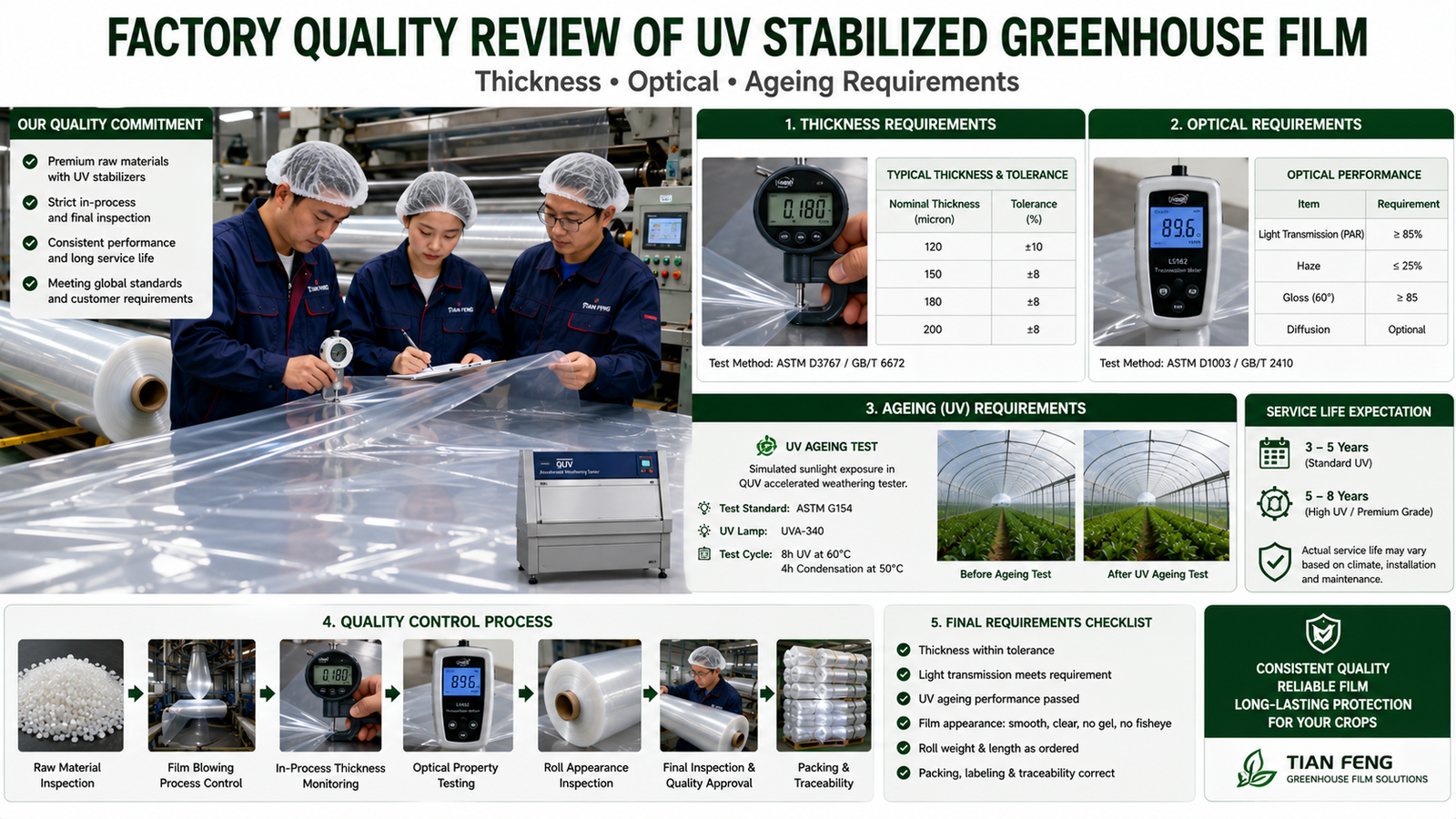
A useful factory review does more than check whether a width can be produced. It confirms whether the requested combination is technically coherent and whether the roll can be packed, moved and shipped as planned.
1. Application and formulation review
The supplier matches the intended environment with a feasible resin and additive direction. If a buyer requests UV blocking, high visible transmission, anti-drip, diffusion and a specific color at the same time, the optical and functional requirements should be reviewed together rather than accepted as independent labels.
2. Dimensions and production feasibility
Nominal thickness, tolerance, width, length and roll-weight expectations are checked against production and converting limits. Very wide or heavy rolls may require changes to cut length, core, packing or shipment handling even when the film itself can be manufactured.
3. Quality and document plan
The purchase order should identify which properties need inspection and which document will record them. Thickness, width, roll appearance and packing can be checked as production controls. Optical, mechanical, weathering or spectral tests require agreed methods, sample conditioning and acceptance criteria.
Examples of recognized methods include ISO 4892-2 for xenon-arc exposure, ASTM D4329 for fluorescent UV exposure, ASTM D1003 for haze and luminous transmittance, and ASTM D882 for tensile properties of thin plastic sheeting. The current edition and project-specific procedure should be confirmed before testing.
4. Sample, TDS and approval
A sample can confirm color, handling, appearance and initial measurements, but a small sample cannot reproduce every installed condition. For repeat or high-value orders, align the approved sample, written specification and batch identification. Review the site's explanation of available plastic film TDS and quality documents and the factory quality-control process before defining the order-document package.
Three Real Procurement Scenarios
Scenario 1: The farm asks only for “6 mil UV resistant”
What is missing: region, year-round exposure, target service period, sulfur use, anti-drip requirement, finished width and packing.
Why it matters: the supplier can quote a 6 mil film but cannot determine whether the selected formulation and roll format fit the site.
Better action: provide the greenhouse dimensions, location, crop, chemical practice and required functions. Treat 6 mil as one parameter, not the complete product.
Scenario 2: The distributor wants the “strongest UV film”
What is unclear: whether “strongest” means longer outdoor use, higher tensile strength, greater puncture resistance or more UV blocking.
Why it matters: these characteristics require different formulation and testing language. Maximizing one may not improve the others.
Better action: define a regional stock specification with target film grade, thickness, functions, common widths, packing, label information and repeat-order controls.
Scenario 3: The greenhouse builder specifies a very wide custom roll
What can go wrong: the covering path may be correct, but the finished roll becomes too heavy for unloading or jobsite pulling.
Why it matters: roll weight affects core choice, packing, container loading, lifting equipment and installation risk.
Better action: review frame drawings, fixing method, cut length, roll weight and crew handling before confirming the production width.
Common Buying Mistakes
| Mistake | Why It Happens | Consequence | Correct Approach |
|---|---|---|---|
| Treating clear construction sheeting as greenhouse film | Both products may look similar in photographs. | Unverified outdoor durability, strength and crop-light performance. | Specify greenhouse-grade film and request the relevant product documentation. |
| Assuming thicker means better UV resistance | Thickness is easy to compare while formulation is less visible. | Higher roll cost and weight without proof of the required outdoor performance. | Review thickness, stabilization and ageing evidence separately. |
| Using “UV resistant” and “UV blocking” as synonyms | Both phrases contain UV and are often combined in sales descriptions. | The film may not create the spectral environment expected by the grower. | Specify polymer durability and spectral transmission as different requirements. |
| Hiding sulfur or chemical use from the supplier | The chemical program is finalized after the covering purchase. | Unexpected ageing and disagreement over service-life responsibility. | Disclose chemical type, concentration and frequency before quotation. |
| Accepting an outdoor-life number without conditions | A simple year claim is easier to compare than test details and exclusions. | The buyer assumes a guarantee that the supplier did not actually provide. | Confirm claim type, supporting document, region, installation and exclusions in writing. |
| Confirming production before sample or specification approval | Lead-time pressure causes technical details to remain in chat messages. | Color, roll size, functions or documents do not match the final purchase need. | Approve one consolidated specification before bulk production. |
Copy-and-Paste RFQ Checklist
Product: Greenhouse-grade UV stabilized polyethylene film
Application: [commercial greenhouse / hoop house / nursery tunnel / seasonal cover]
Installation location: [country, region and altitude if relevant]
Use period: [seasonal / year-round / target replacement cycle]
Crop and pollination: [crop type and whether bees or other pollinators are used]
Thickness and tolerance: [micron or mil, plus required tolerance]
Roll size: [finished width, cut length, quantity and preferred maximum roll weight]
Required functions: [UV stabilization, anti-drip, anti-fog, thermal, diffusion, color]
UV spectrum: [standard / UV blocking / UV open, including requested wavelength data]
Chemical exposure: [sulfur, pesticides, chlorine, disinfectants and application frequency]
Installation: [frame, fastening method, single or double layer]
Packing and destination: [roll protection, woven bag, pallet, container and delivery country]
Documents: [TDS, sample, inspection record, test report or third-party inspection]
Send confirmed and unknown items through the plastic film specification and quotation form. Mark uncertain parameters for review rather than filling them with assumed values.
Frequently Asked Questions
Is UV stabilized greenhouse plastic the same as UV-blocking film?
No. UV stabilization primarily protects the plastic from degradation. UV blocking describes reduced transmission in a defined part of the ultraviolet spectrum. A film can have one function, both functions or a different spectral profile.
How long does UV-resistant greenhouse plastic last?
There is no universal service period for every installation. Formulation, UV dose, heat, chemicals, thickness, installation stress and maintenance all matter. Ask whether the supplier's statement is a design target, typical description or written warranty, and confirm the applicable conditions.
Does a thicker greenhouse film have better UV resistance?
Not automatically. Thickness can improve handling and provide more material, but UV resistance depends strongly on film grade and stabilization. Compare thickness tolerance and stabilization evidence rather than thickness alone.
Can sulfur fumigation or pesticides shorten greenhouse-film life?
Chemical contamination can interact with solar ageing and affect mechanical properties. The risk varies by formulation, chemical, concentration and frequency, so the chemical program should be disclosed to the supplier before ordering.
Does UV-blocking greenhouse film affect bees?
Bees use ultraviolet cues for navigation. A greenhouse that relies on bee pollination should review the film's spectral transmission with the crop and pollination plan rather than selecting maximum UV blocking by default.
What tests can support a UV-stability claim?
Weathering procedures may use xenon-arc or fluorescent UV equipment, followed by appearance, tensile, elongation or optical evaluation. The method, cycle, specimen, pass criteria and relationship to the purchase requirement must be agreed. Laboratory hours should not be presented automatically as outdoor years.
What should be included in a greenhouse-film TDS?
A useful TDS identifies the product and material, nominal dimensions, tolerances, functions, relevant optical or mechanical data, test methods, packing and handling information. Order-specific requirements may still need a separate specification or approved sample.
Should a distributor order standard rolls or custom sizes?
For repeat stock, a small number of documented regional specifications is usually easier to replenish and explain. Custom widths and functions are better reserved for projects with confirmed dimensions, volume and performance requirements.
What to Do Next
If the frame dimensions, target thickness and functions are already known, review the greenhouse plastic roll product specifications and prepare the required quantity and packing details.
If the film grade is still uncertain, compare the broader greenhouse film options and the guide to greenhouse film quality factors before requesting production.
Request a Specification Review Before Quotation
Send the application, installation region, dimensions, required functions, chemical exposure, quantity, packing and destination. Unknown parameters can be identified for technical review before a production specification is approved.
References and Technical Sources
- University of Connecticut Extension: Plastic Film Update
- Plant Responses to UV Blocking Greenhouse Covering Materials: A Review
- USDA Agricultural Research Service: UV-Blocking Plastics and Japanese Beetle Response
- Correlation Between Agrochemicals, Solar Radiation and Mechanical Properties of Greenhouse Plastic Films
- ISO 4892-2: Plastics - Xenon-Arc Exposure
- ASTM D4329: Fluorescent UV Exposure of Plastics
- ASTM D1003: Haze and Luminous Transmittance of Transparent Plastics
- ASTM D882: Tensile Properties of Thin Plastic Sheeting