
How Long Does Greenhouse Film Last? Lifespan, UV and Replacement Guide
Quick Answer: How Long Does Greenhouse Plastic Last?
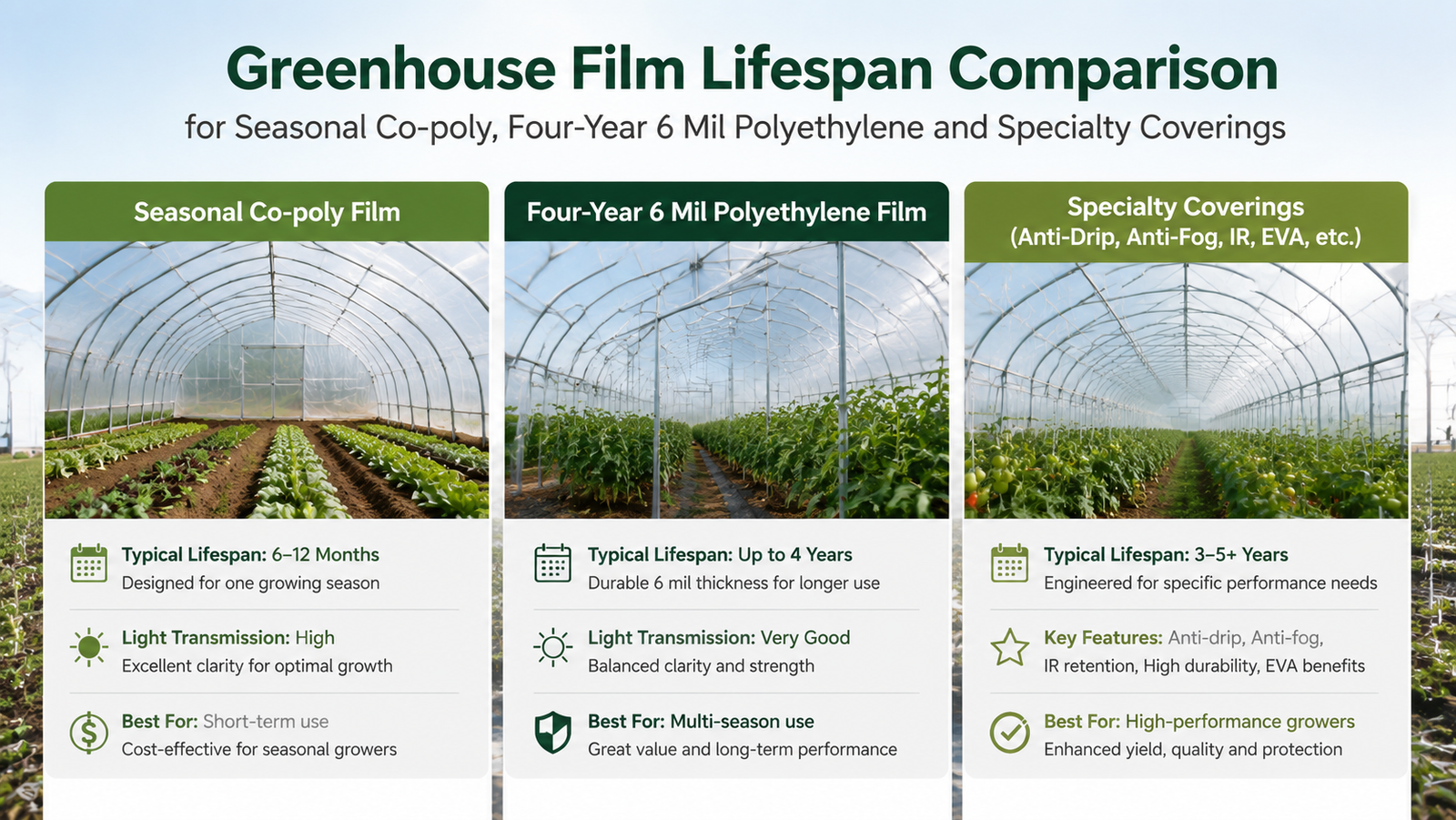
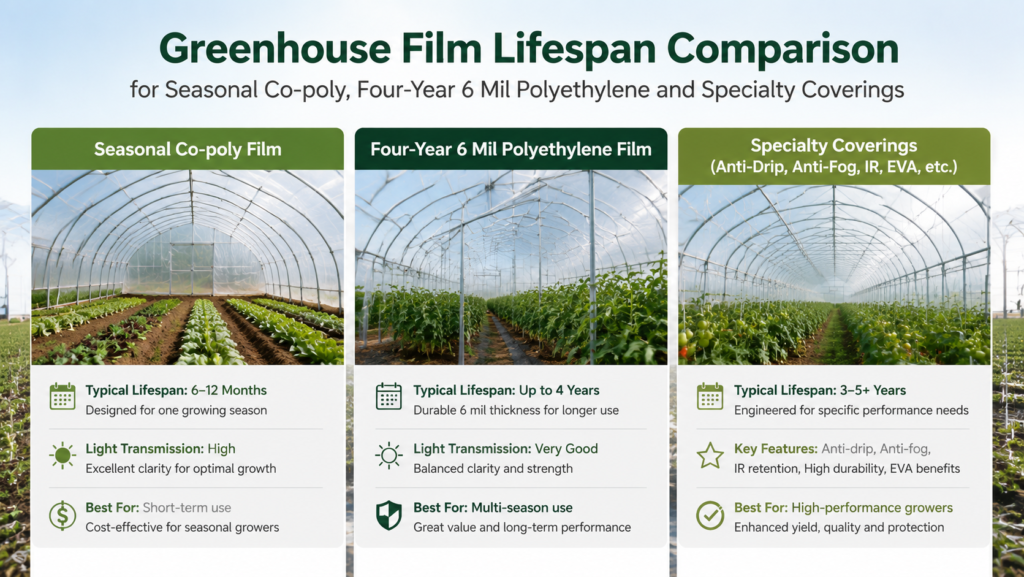
Seasonal co-poly greenhouse film may be intended for one growing season. For a multi-year commercial tunnel, a 6 mil (about 152 micron) greenhouse-grade polyethylene film with a written four-year rating is a common starting point. UMass Extension states that greenhouse-grade poly is warranted for four years or more, while low-cost co-poly is suitable for one season. Actual field life can be shorter because of intense sunlight, heat, chemical exposure, frame abrasion, wind or installation stress.
Do not use the printed year rating as the only replacement rule. A cover may remain intact while light transmission or anti-drip performance has already declined enough to affect production. Review the film condition, crop risk and replacement labor together.
Evidence basis: UMass Extension's Plastic Greenhouse Film Update. Its one-season and four-year guidance applies to defined greenhouse-film grades, not to every clear polyethylene sheet.
Practical starting point: use seasonal film for temporary protection; specify greenhouse-grade, UV-stabilized 6 mil PE with a documented service rating for most multi-year commercial tunnels; and evaluate reinforced, PO or specialty systems only when climate, crop value, optical requirements or replacement cost justify them. The material name alone is not a service-life guarantee.
For a broader comparison of PE, PO and functional options before choosing a service-life grade, use the commercial greenhouse film selection guide.
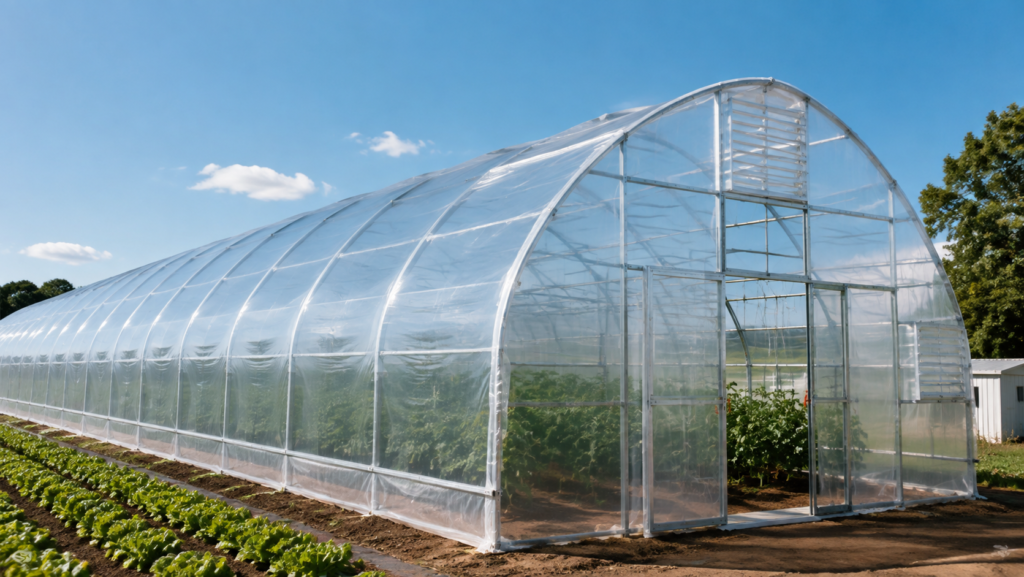
Table of Contents
1. Typical Greenhouse Film Lifespan by Product Grade
The first buying decision is not simply one year versus four years. It is whether the quotation describes a seasonal covering, greenhouse-grade multi-year film or a different covering system. Clear appearance and nominal thickness do not identify the grade.
| Covering type | Practical service-life reference | Where it fits | What the buyer must verify |
|---|---|---|---|
| Low-cost co-poly film | Commonly intended for one season | Seasonal houses, overwintering structures and temporary tunnels | Whether replacement after the season is already built into the operating plan |
| 3-4 mil seasonal PE film | Short-term or one-season use | Narrow tunnels and temporary crop protection | Greenhouse grade, expected exposure, fastening method and tear risk |
| 6 mil UV-stabilized greenhouse-grade PE | Common commercial reference: a written four-year rating or warranty | Multi-year commercial tunnels and greenhouse roofs | Actual warranty wording, region, chemical exclusions, installation requirements and film identification |
| Reinforced or woven film | Supplier- and construction-specific | Sites needing additional mechanical reinforcement | Light transmission, reinforcement pattern, fastening compatibility and written service terms |
| PO or other multilayer greenhouse film | Product-specific; do not infer life from the name PO | Projects prioritizing optical, condensation-control or other documented functions | TDS, layer structure, performance values, warranty, climate and chemical limits |
| Specialty bubble film or rigid covering | May be marketed for longer service than standard PE film, but it is a different system | Long-term structures where installed cost and insulation justify the change | Material category, structural design, complete installed cost and comparable warranty basis |
A buyer searching for “10 year greenhouse plastic” should be especially careful. A ten-year statement may describe a reinforced, bubble, rigid or otherwise specialized covering rather than a standard flexible 6 mil PE greenhouse film. Compare the complete system, not the year printed in the headline.
What a Four-Year Greenhouse Film Rating Actually Means
A four-year rating is a product-grade and warranty reference, not a promise that every installed cover will survive every site for exactly 48 months. In actual quotation work, the supplier should identify the film grade, nominal thickness, intended outdoor-use period and warranty conditions in writing. The buyer should check whether the stated period is measured from manufacture, shipment or installation and whether the warranty is full replacement, prorated credit or another remedy.
Climate explains why the same general product category does not produce the same field result everywhere. University of Florida IFAS Extension notes that UV-stabilized polyethylene grades may last from about 18 months to four years under Florida conditions, while Mississippi State University Extension advises buyers in a high-UV region to avoid unspecified-life film. These are regional engineering references, not universal guarantees.
2. Warranty Life Is Not the Same as Actual Field Life
Three different time periods are often compressed into one sales phrase. Separating them prevents disputes and poor replacement decisions.
| Term | What it means | Why buyers confuse it | Procurement action |
|---|---|---|---|
| Product rating | The service category used to describe the film, such as seasonal or four-year greenhouse film | It looks like a guaranteed installed duration | Ask what formulation, exposure assumptions and documents support the rating |
| Warranty period | The period and remedy defined by the supplier's written warranty | The exclusions and claim process may not appear on a product label | Review exclusions, proof requirements, start date, prorating and remedy before ordering |
| Actual field life | The period during which the installed film remains usable for the crop and structure | Usability includes light, condensation and tear risk, not only whether the sheet remains in place | Set replacement criteria based on condition, crop risk and operating cost |
Procurement Scenario: “6 Mil” Is Not a Complete Lifespan Specification
A farm asks three suppliers for clear 6 mil greenhouse plastic. One supplier prices seasonal film, one prices four-year UV-stabilized greenhouse-grade PE, and one leaves the UV package undefined. All three offers may show the same thickness. They are not equivalent quotations.
The correct RFQ states the application, installation region, greenhouse-grade requirement, nominal thickness and tolerance, expected service category, required functions, roll size, chemical exposure and warranty-document request. Thickness then becomes one controlled parameter instead of a substitute for the full specification.
3. What Shortens Greenhouse Film Life?
Sunlight initiates polymer degradation, but early failures in the field are often concentrated at a contact point or linked to an operating condition. The priority is to identify the dominant failure mechanism before paying for a higher specification.
UV Exposure and Heat
Greenhouse-grade film uses a stabilization package to slow sunlight degradation. More intense radiation, high film temperature and heat buildup where plastic contacts structural members can accelerate aging. A UV package is therefore tied to formulation and exposure; it is not interchangeable with “UV blocking,” which describes how the film changes ultraviolet transmission into the greenhouse. Buyers using pollinators or spectral pest-management strategies should keep those two requirements separate.
Pesticides, Sulfur, Chlorine and Incompatible Contact Materials
Chemical exposure is a frequent warranty blind spot. UMass Extension notes that pesticides and pressure-treated lumber can affect plastic life. University of Delaware Extension documented premature damage where polyethylene film contacted PVC electrical conduit and also warns about chlorine-based disinfectants and certain sulfur- or copper-containing products. The practical action is not to guess chemical compatibility: list the chemicals, application method and frequency in the RFQ, then review the film supplier's written exclusions.
Abrasion, Fastening Stress and Sharp Edges
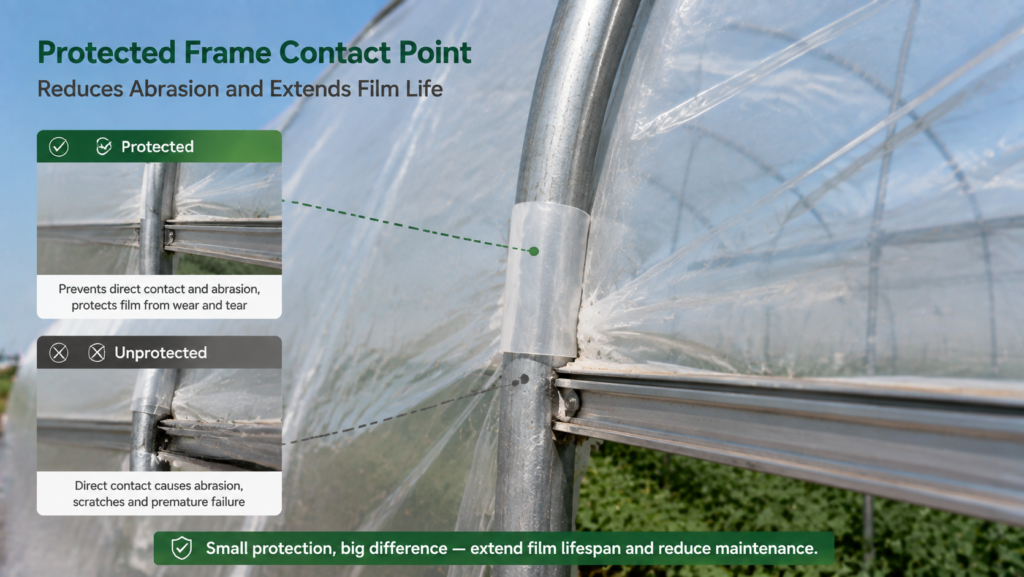
A small burr, hot metal contact point or overtight fastening can create a local failure long before the rest of the film has aged. Repeated movement in wind turns the contact point into an abrasion zone. The higher film grade does not correct an unfinished frame, unsuitable fastener or missing protective tape.

Wind, Snow and Incorrect Tension
Loose film flexes and rubs; excessively tight film concentrates stress at channels, clips and edges. Wind exposure, frame spacing, snow loading and whether the cover is single or inflated double layer all change the mechanical demand. Film selection cannot replace structural design. A greenhouse builder should provide frame drawings, fixing details and environmental design requirements when the covering is part of a new project.
4. Does Thicker Greenhouse Plastic Last Longer?
Not automatically. Thickness can improve handling margin and resistance to some mechanical damage, but UV stabilization, resin and layer design, thickness consistency, installation and chemical exposure can dominate service life. A thick construction sheet without a suitable outdoor agricultural stabilization package is not a substitute for greenhouse-grade film.
| Trade-off | What improves | What may get worse | Better buying question |
|---|---|---|---|
| Greater thickness | Handling margin and resistance to some puncture or installation stresses | Roll weight, installation effort, freight and material cost | What minimum thickness and tolerance fit the structure and handling plan? |
| Higher light transmission | Initial light entry | It may conflict with diffusion, thermal or other functional targets; the result depends on formulation | Which optical values are required for the crop, and by what test method? |
| More additives or functions | UV stability, condensation control, thermal or spectral performance | Cost and formulation complexity; different functions may not retain performance for the same duration | Which functions need a documented target, and how long must each remain effective? |
| Extra-wide or extra-long rolls | Fewer joints and potentially faster covering of large blocks | Roll weight, winding, unloading and installation risk | What finished width and maximum roll weight can the crew handle safely? |
For most multi-year PE projects, 6 mil is a practical baseline, not an automatic final answer. Use the greenhouse plastic thickness guide to compare mil and micron values, then match the thickness to the UV package, structure and installation method.
5. Anti-Drip Performance May End Before the Film Fails
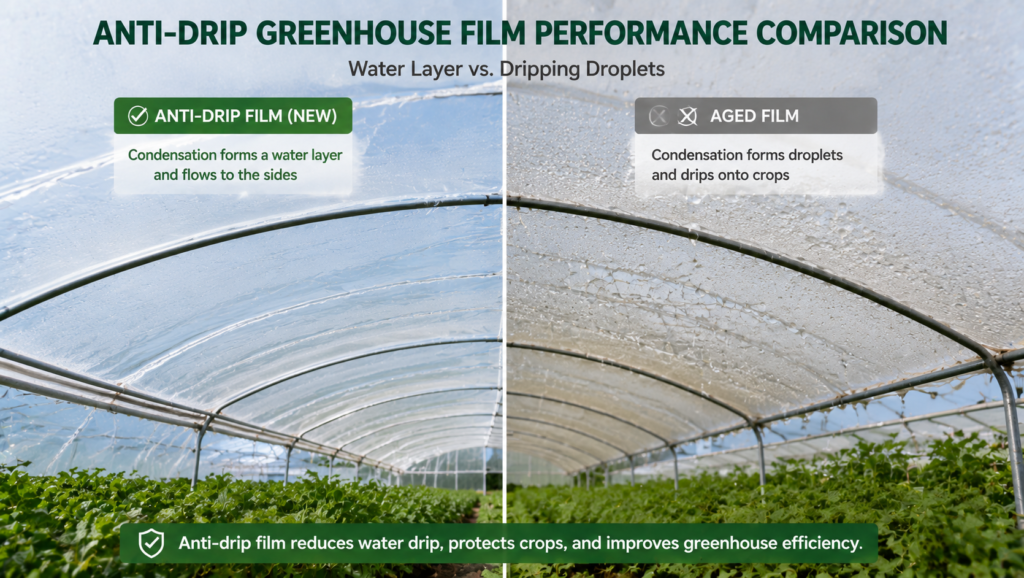
Anti-drip, also called condensate control, changes how water wets the inner film surface so condensation forms a layer rather than separate droplets. UMass Extension notes that sprayed or incorporated condensate control commonly lasts a couple of years. A structurally intact four-year film may therefore show weaker condensation control before the cover reaches the end of its structural life.
This distinction matters in humid vegetable and flower houses. A buyer who needs anti-drip for the full planned covering cycle should ask how the function is incorporated, which side faces inward, what duration the supplier documents and what operating conditions affect it. Do not treat “four-year film” as proof of four-year anti-drip performance.
6. When Should Greenhouse Plastic Be Replaced?
Replace greenhouse plastic before a predictable weakness becomes an emergency during wind, snow or a critical crop stage. Age is one input. Condition and production risk determine the decision.
| Observed sign | Likely meaning | Operational risk | Correct action |
|---|---|---|---|
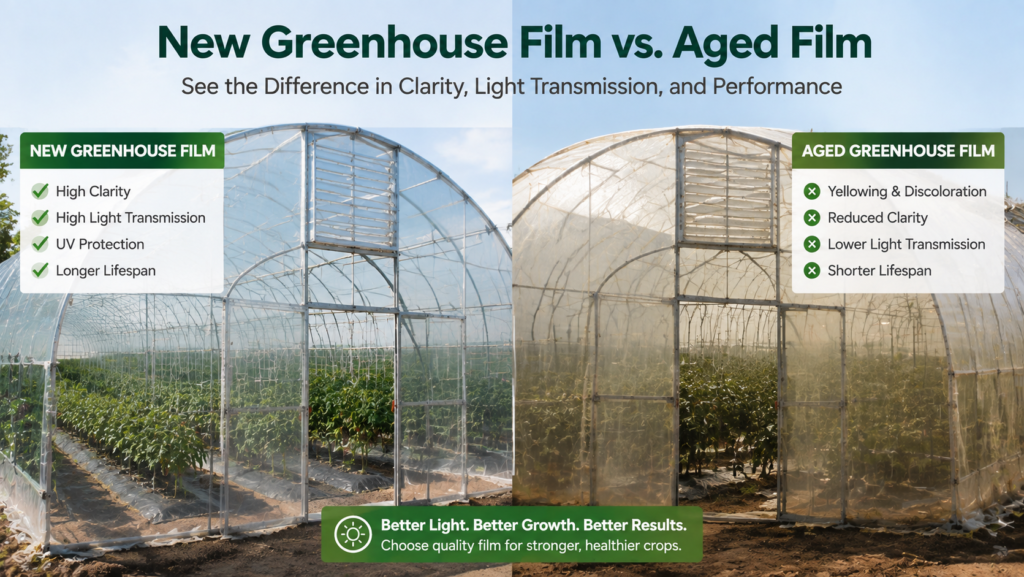
| Yellowing, persistent haze or visible loss of clarity | Surface contamination, optical aging or both | Reduced useful light and less predictable crop response | Clean a test area; compare it with the rest of the cover and review optical data if production is light-sensitive |
| Brittleness, cracking or powdery surface | Advanced weathering or chemical damage | Rapid tear propagation during wind or handling | Plan replacement; do not rely on patching as the primary control |
| Repeated tears or growing patches | Declining mechanical reserve or a recurring structural contact problem | Labor increases while sudden cover loss remains possible | Inspect the frame and fastening, then replace the film if degradation is widespread |
| Cracks at clips, channels, folds or purlins | Stress concentration, heat or abrasion | Localized failure can spread across an otherwise usable sheet | Correct the contact detail before installing replacement film |
| Anti-drip no longer controls droplets | Condensate-control function has weakened | Lower light, crop wetting and disease-management pressure | Balance crop risk against remaining structural life; verify ventilation and film orientation |
| Sagging or loss of tension | Installation movement, thermal cycling or material change | Flapping, abrasion and water or snow accumulation | Retension only if the film remains flexible and sound; otherwise schedule replacement |
Grower Scenario: Can the Existing Cover Run One More Season?
A grower may see no large tear and assume replacement can wait. The better audit asks four questions: Is the film still flexible? Are cracks concentrated around fasteners? Has clarity changed after cleaning? Would a mid-season failure damage a high-value crop or interrupt heating and climate control?
If the consequence of failure is high, schedule replacement during a planned crop break. Using the cover until it splits extracts the maximum calendar life but can create the highest labor and crop-loss cost.
7. Commercial Replacement Planning: Compare Cost per Usable Year
The cheapest roll is not necessarily the lowest-cost cover. Commercial comparison should include film, removal, installation labor, lifting equipment, disposal, production interruption and the risk of emergency replacement.
Planning formula: annualized covering cost = (delivered film + removal + installation + equipment + disposal) / expected usable years. Keep the expected years conservative and consistent with the written film grade, site exposure and operating history.
A longer-life option has value when replacement labor is high, crop scheduling makes access difficult or an unexpected failure would be expensive. A seasonal option may still be rational for a temporary tunnel that is dismantled every year. The correct choice follows the operating model, not a universal “best film.”
Distributor and Greenhouse Builder Scenarios
Distributor: stock a small number of repeatable grades with clear roll labels, widths, thicknesses and written service categories. Do not create an unsupported local lifespan promise because a buyer asks for a simple number. Keep supplier TDS and warranty versions tied to the SKU.
Greenhouse builder: specify film from project drawings, fastening details, climate and installation sequencing. The builder's responsibility includes contact surfaces and tensioning; the film supplier's responsibility includes the confirmed product and documented properties. Combining both reviews before production is safer than assigning every later failure to material thickness.
8. Factory and Procurement Review Before Quotation
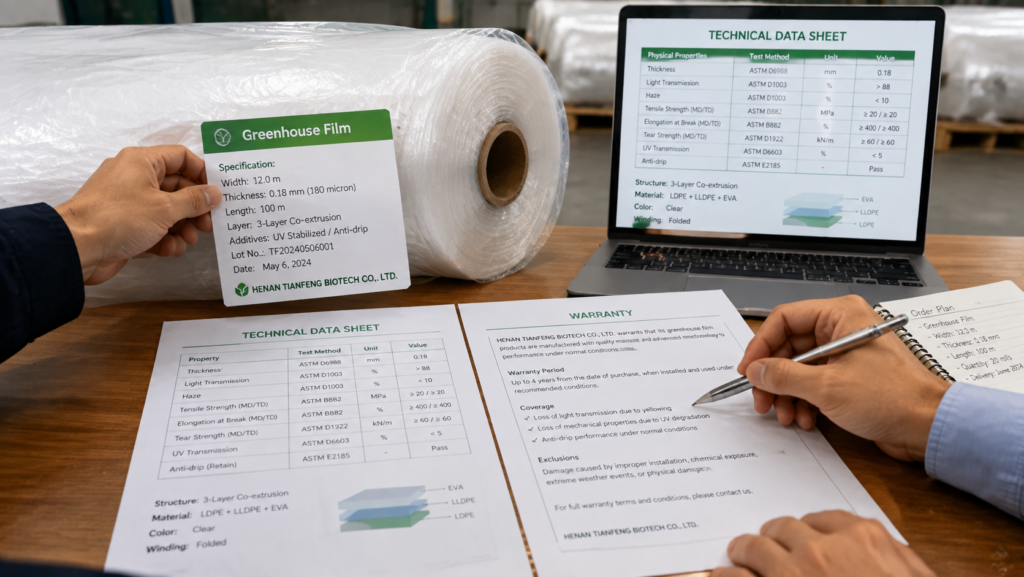
A supplier cannot recommend a defensible service-life grade from “6 mil clear plastic” alone. Before quotation, the factory or technical sales team needs enough information to review formulation direction, production feasibility, warranty basis, roll handling and documentation.
| Buyer information | Supplier review | Why it affects price, lead time or risk |
|---|---|---|
| Installation country, region and season | UV, temperature, wind, snow and humidity exposure | Changes the appropriate product grade and the assumptions behind any service statement |
| Greenhouse type and frame drawing | Cover path, contact points, span, fixing and single- or double-layer arrangement | Affects width, installation stress and roll configuration |
| Target use period | Seasonal, multi-year or project-specific service requirement | Determines whether a seasonal or greenhouse-grade product is being quoted |
| Chemicals and application frequency | Sulfur, chlorine, disinfectants, pesticides and possible warranty exclusions | May change suitability, written conditions and claim risk |
| Thickness, width, length and quantity | Extrusion, folding, winding, roll weight, MOQ and production plan | Changes material use, line setup, handling, packing and shipment |
| Required functions | UV stabilization, anti-drip, anti-fog, diffusion, thermal or spectral request | Additives must be reviewed together; their useful durations may differ |
| Evidence required | TDS, specification, approved sample, internal inspection or agreed third-party test | Test scope and acceptance criteria must be arranged before production |
| Packing and destination | Core, protection, pallet, labels, container loading and unloading limit | Wide or long rolls may be producible but impractical to move or install |
How a Factory Reviews Production Feasibility
- Specification coherence: confirm that material, thickness, functions, optical targets and service requirement describe a feasible film rather than a collection of unrelated marketing labels.
- Dimensional feasibility: review finished width, fold format, roll length, expected roll weight, core, winding and packing.
- Document plan: define which properties belong in the purchase specification, which are supported by a TDS and which require agreed testing.
- Approval point: align the signed specification, sample if required, label and packing before mass production.
- Pre-shipment review: check agreed items such as thickness, width, appearance, roll condition, labels and packing; laboratory or third-party tests are included only when agreed in advance.
ASTM D882 can be used for tensile properties of thin plastic sheeting, ASTM D1003 for haze and luminous transmittance, and ASTM D4329 for fluorescent UV exposure practice. These methods describe how a property or exposure is evaluated; none of them, by itself, proves a universal number of outdoor years. The edition, specimen, conditioning, exposure and acceptance criteria must match the purchase requirement.
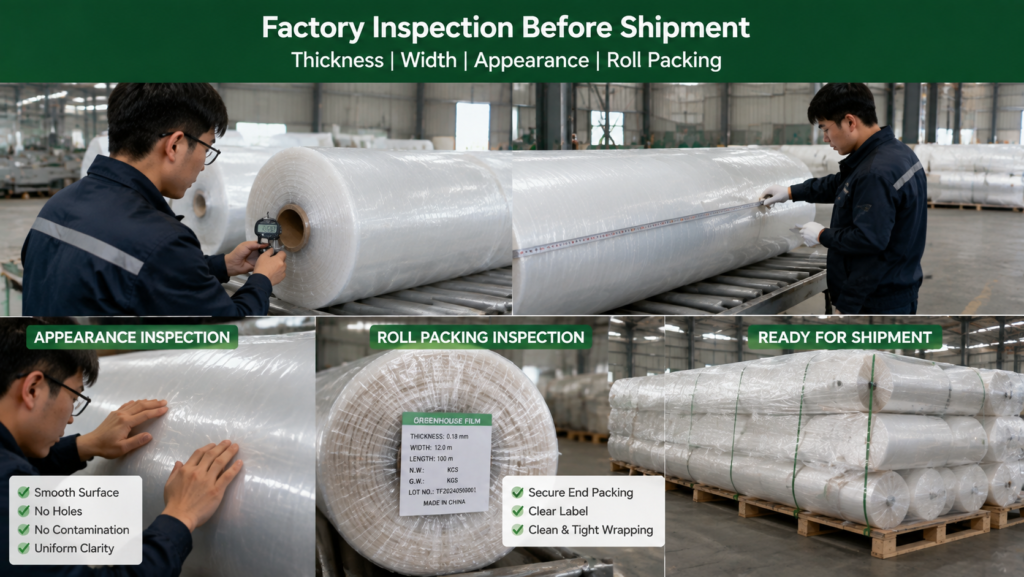
For document planning, review the available plastic film TDS and quality documents. Not every order needs every test; the evidence package should match the project risk and contract.
9. Common Greenhouse Film Lifespan Mistakes
| Mistake | Why it happens | Consequence | Correct approach |
|---|---|---|---|
| Treating a four-year label as unconditional field life | The number is easier to remember than the warranty terms | A chemical, installation or climate exclusion appears only after failure | Review the written warranty, site assumptions and claim process before ordering |
| Buying construction plastic because it is the same thickness | Both products can look clear and be called polyethylene | Outdoor aging or mechanical performance may not match greenhouse use | Specify greenhouse-grade film and the required service category |
| Assuming thicker always means longer life | Thickness is visible and easy to compare | UV formulation, chemicals and frame abrasion remain unaddressed | Compare grade, stabilization, thickness tolerance and installation together |
| Ignoring sulfur, chlorine or pesticide exposure | Chemical use is managed by the grower, not the purchasing team | Premature aging and warranty disputes | List chemicals, application method and frequency in the RFQ |
| Waiting for a large tear before replacement | Intact film is assumed to be productive film | Emergency labor, crop exposure and unplanned downtime | Audit brittleness, optical condition, fasteners and patches before the critical season |
| Assuming anti-drip lasts as long as the sheet | Both functions are sold on one film label | Condensation risk returns while the cover remains structurally intact | Confirm anti-drip duration separately and inspect its field performance |
| Comparing supplier prices without matching specifications | Each supplier fills missing details differently | The lowest quotation may be seasonal film or omit required functions and documents | Issue one RFQ sheet and normalize delivered cost and written terms |
| Reusing removed film without assessing fold damage | The sheet still looks usable when laid flat | Creases, punctures and orientation errors create new weak points | Inspect flexibility, folds, orientation and fastening areas before reuse |
10. Buyer Decision Matrix
| Application | Safer starting point | Why | Confirm before ordering |
|---|---|---|---|
| Temporary or overwintering tunnel | Seasonal greenhouse film | Replacement is expected and installed cost is limited | Season length, greenhouse grade, fastening, width and disposal plan |
| Commercial multi-year high tunnel | 6 mil UV-stabilized greenhouse-grade PE with a written multi-year rating | Common balance of flexibility, cost and multi-year use | Region, warranty, chemicals, anti-drip, width, roll weight and installation |
| High-UV or hot location | Supplier-reviewed UV grade based on the installation region | Unspecified-life film may age too quickly | Climate assumptions, TDS, service statement and warranty exclusions |
| Windy site or abrasive frame | Corrected frame details plus an appropriate reinforced or heavier option if justified | Mechanical failure may dominate UV aging | Structural design, purlin spacing, sharp edges, fastening and light trade-off |
| Humid, high-value crop | Multi-year UV film with documented condensation-control requirement | Anti-drip loss can become a crop issue before structural failure | Anti-drip duration, film orientation, ventilation and crop risk |
| Distributor inventory | Repeatable seasonal and multi-year SKUs with stable labels | Clear segmentation reduces unsupported claims and stock confusion | Widths, roll lengths, grade identification, TDS version and packing |
| Long-life specialty project | Compare complete PE, PO, reinforced or rigid covering systems | Installed labor, optical performance and structure may outweigh roll price | Material category, total installed cost, warranty basis and replacement method |
11. RFQ Checklist for a Greenhouse Film Lifespan Recommendation
Send the following information before asking a supplier to recommend a lifespan grade:
- Application: commercial greenhouse, high tunnel, nursery or temporary cover
- Installation country and region, including high heat, strong UV, wind or snow exposure
- Target use period and planned replacement cycle
- Greenhouse type, frame material, cover path and fastening method
- Nominal thickness and required tolerance
- Finished width, cut length, quantity and maximum practical roll weight
- Required UV, anti-drip, anti-fog, thermal, diffusion or spectral functions
- Sulfur, chlorine, pesticides, disinfectants and application frequency
- Single- or double-layer installation and whether inflation is used
- Packing, labels, pallet, destination and unloading limitations
- Required TDS, specification, sample, inspection record or agreed third-party test
- Requested warranty document and claim conditions
If dimensions and functions are already known, compare the custom greenhouse plastic roll specification. For a higher-function film, review the PO greenhouse film option without assuming that the material name alone proves a longer life. If key parameters are still missing, use the commercial roll specification checklist before requesting price.
Frequently Asked Questions
How long does 6 mil greenhouse plastic last?
Six-mil greenhouse-grade polyethylene is commonly sold with a four-year rating, but 6 mil only describes nominal thickness. Actual life depends on UV stabilization, climate, chemicals, frame contact and installation. A 6 mil construction sheet or seasonal film should not be assumed to have the same service life.
What does a four-year greenhouse film rating mean?
It identifies a multi-year product category or supplier warranty basis. It does not guarantee exactly four installed years under every condition. Review the written start date, exclusions, prorating, claim evidence and remedy.
Does thicker greenhouse plastic always last longer?
No. Additional thickness can improve handling margin, but it cannot replace a suitable UV package, consistent production, compatible chemicals, smooth frame contacts and correct tensioning.
When should greenhouse film be replaced?
Replace it when brittleness, cracking, repeated tears, optical decline, failing fastener areas or lost condensation control creates unacceptable crop or structural risk. Plan the work before a critical season instead of waiting for a large tear.
Does anti-drip performance last as long as greenhouse film?
Not necessarily. UMass Extension notes that condensate-control treatments commonly last a couple of years. Confirm the documented anti-drip duration separately from the structural film rating.
Can greenhouse plastic really last ten years?
Some specialty coverings may carry longer claims, but they may be reinforced, bubble, rigid or otherwise different from standard flexible 6 mil PE film. Verify the exact material system, test or warranty basis, installation requirements and total installed cost.
Can pesticides or sulfur shorten greenhouse film life?
Yes. University extension sources report that pesticides, sulfur, chlorine, pressure-treated lumber and some incompatible contact materials can contribute to premature degradation. Provide the chemical-use program to the supplier and read the warranty exclusions.
What proof should a commercial buyer request before a bulk order?
Request a signed product specification, current TDS, warranty, roll-label format and agreed packing details. Add an approved sample, internal inspection record or specific third-party testing when the project risk justifies it. Define methods and acceptance criteria before production.
Next Step: Turn the Lifespan Target into a Purchase Specification
If the greenhouse dimensions, location and target replacement cycle are known, prepare the film grade, thickness, width, length, functions, chemical exposure and warranty requirements before comparing quotations. If they are not known, measure the cover path, document the frame and list the operating conditions first.
A custom project should submit the greenhouse drawing or measurements, installation region, target use period, chemical program, fastening method, roll-size requirement, quantity, packing and required evidence through the plastic film quotation form. This gives the supplier enough information to review a producible specification instead of quoting an unsupported number of years.
External References
- UMass Extension: Plastic Greenhouse Film Update
- Mississippi State University Extension: Environmental Control for Greenhouse-Grown Sweetpotato Slips
- University of Florida IFAS Extension: Physical Greenhouse Design Considerations
- University of Delaware Extension: Do Not Mix PVC Pipe and Polyethylene Greenhouse Film
- ASTM International: ASTM D882, Tensile Properties of Thin Plastic Sheeting
- ASTM International: ASTM D1003, Haze and Luminous Transmittance of Transparent Plastics
- ASTM International: ASTM D4329, Fluorescent Ultraviolet Exposure of Plastics