
Drip Irrigation Under Plastic Mulch: Layout and Root-Zone Checks
Drip irrigation under plastic mulch puts water beneath the covered bed surface, close to the crop. But a working drip tape does not automatically mean that the intended roots receive enough water. The crop rows, tape routes, soil wetting pattern and operating conditions must work together.
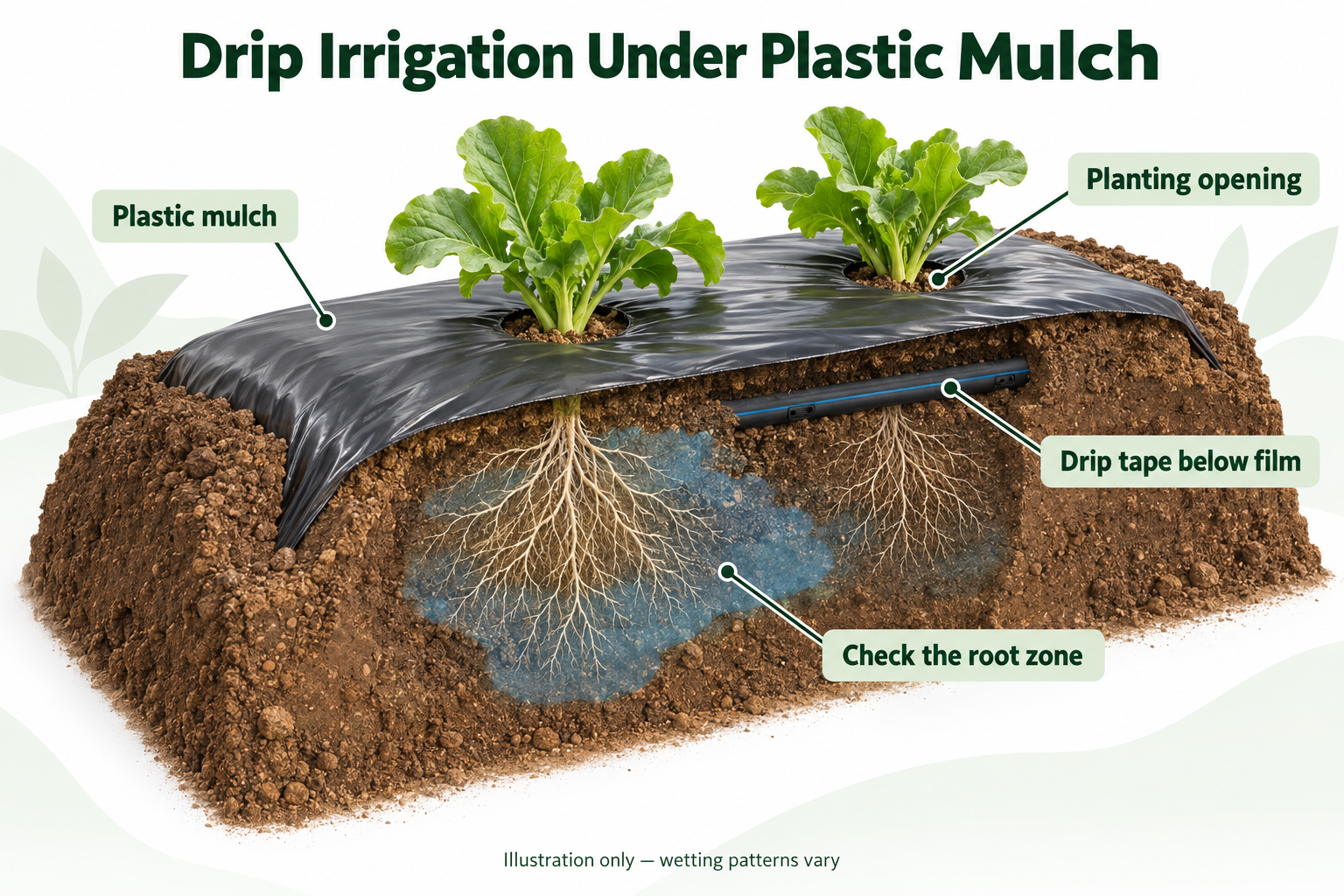
The short answer: in a typical plastic-mulched vegetable bed, drip tape runs below the film. Whether it rests on the soil or is shallowly buried depends on the selected tape and installation system. Check three things separately: how much water is delivered, how evenly it is delivered and whether the wetted soil reaches the crop roots.
This guide focuses on seasonal crop beds covered with agricultural plastic film, not wood-chip mulch or the design of a deep, permanent subsurface irrigation system. For the full laying and anchoring sequence, use our plastic mulch installation guide.
Where should drip tape sit under plastic mulch?
Place the water-delivery line beneath the film so it supplies the soil rather than relying on water to pass through an intact plastic sheet. Position it as part of the bed layout before the film hides it. Follow the tape manufacturer's instructions for burial, emitter orientation and permitted operating conditions, together with the laying-machine instructions where applicable.
Keep planting holes, transplanting tools and crop-support stakes clear of the tape route. Leave connections and the intended flushing or inspection points accessible. Approve a short first section before repeating the same arrangement across the field, and recheck water delivery after holes are made.
Plastic film is not the same as permeable ground cover. If the cover material is still undecided, compare the water-management implications in plastic mulch versus landscape fabric.
Separate crop spacing, tape layout and emitter spacing
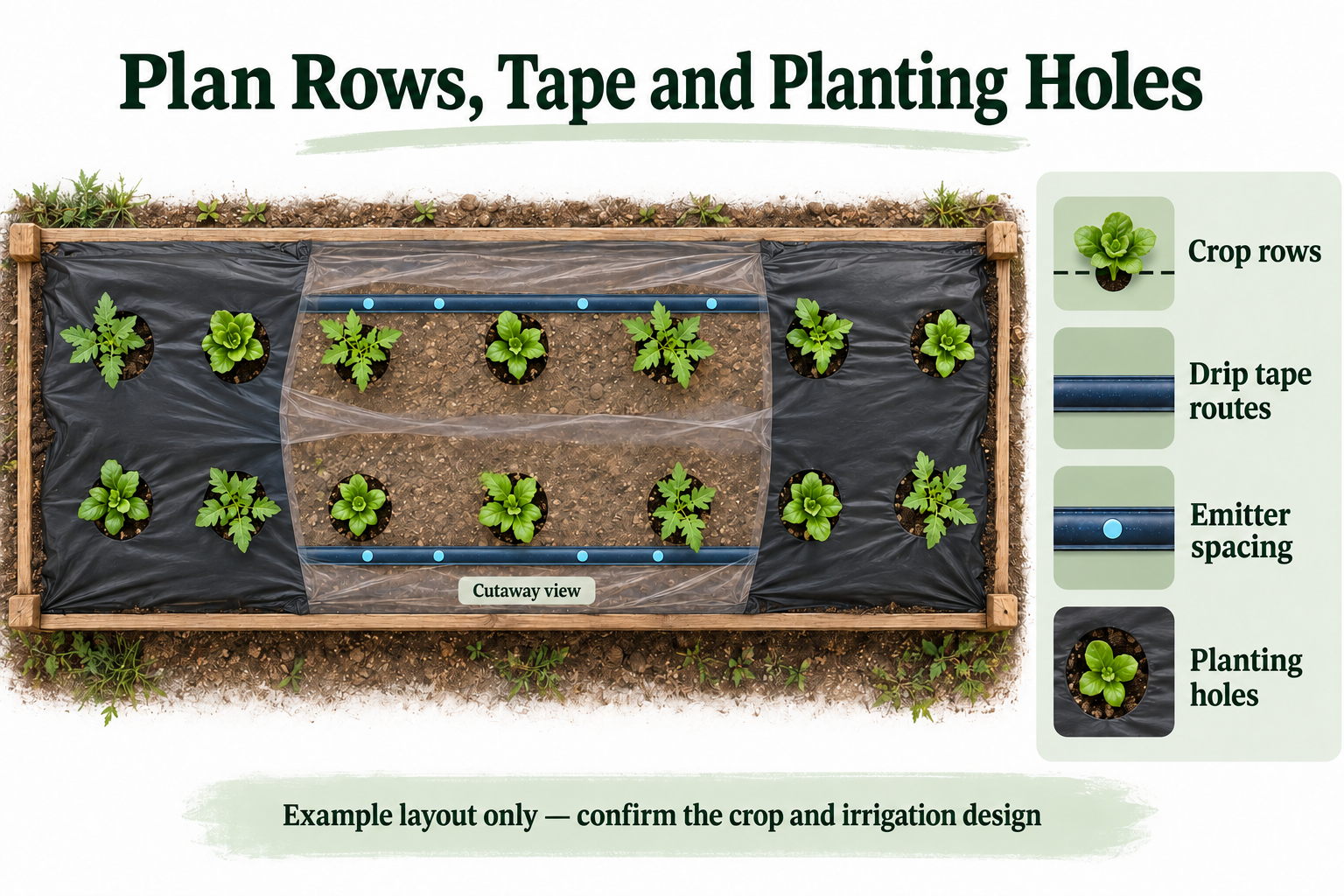
Three different dimensions are often called “spacing.” Put them on the same drawing, but do not treat them as interchangeable.
Crop spacing
The distance between crop rows and between plants within each row. This defines where the young roots start and where the crop must be established.
Tape layout
The number of tape lines per bed and each line's offset from the crop rows. This defines where water enters the soil across the bed.
Emitter spacing
The distance between outlets along a tape. Together with discharge and soil conditions, it influences wetting along the row.
Do not assume that every planting hole must sit directly above an emitter. What matters is whether moisture reaches the seed or transplant and its developing roots at establishment, then supports the crop as roots spread. Matching two spacing numbers on paper does not establish that result.
One or two drip tapes per bed?
One tape can be appropriate where its wetted strip reaches the intended crop rows. Multiple rows or limited lateral wetting may call for two or more tapes, a different layout or a different emitter configuration. Check the actual bed before choosing between these options.
Adding a second identical tape approximately doubles the nominal tape flow for that bed at the same specified pressure. Confirm that the supply, active irrigation zone and operating schedule can accommodate the change. A wider wetted area is not an improvement if the revised system loses pressure or sends excessive water below the roots.
Check the root zone, not just the surface
Water moves downward and sideways through soil. Texture, bed preparation, compaction, existing moisture and soil layers affect the resulting wetting pattern. A wet patch beside one outlet or a wet row middle cannot show whether the entire intended root zone has been supplied.
In a Purdue demonstration in relatively wet sandy soil, adjacent wetting zones did not fully connect after the tested irrigation event. The useful lesson is to verify the field arrangement, not to copy that demonstration's emitter spacing or runtime as a rule for another farm.
- Check across the bed. Inspect moisture at the crop-row locations, not only immediately beside the tape. Include both crop rows where a bed carries more than one.
- Check along the row. Include positions between emitters and representative near, middle and far sections of the irrigation zone.
- Check relevant depths. Look for moisture in the active root zone and evidence that water is moving below it. Interpret the pattern for the crop's current growth stage.
- Record the conditions. Note soil condition before irrigation, the active zone, runtime, operating pressure and the tape model so later checks are comparable.
Use planned inspection points or appropriately placed moisture sensors without damaging established roots, tape or film. Where the pattern remains unclear, an irrigation or crop adviser can arrange a representative field test. A result from a different soil or differently prepared bed is not a substitute.
Separate three questions: a flow meter checks total delivery; pressure and discharge checks help assess distribution; soil observations show where the water goes. Passing one check does not automatically pass the other two.
Use operating pressure and flow to interpret runtime
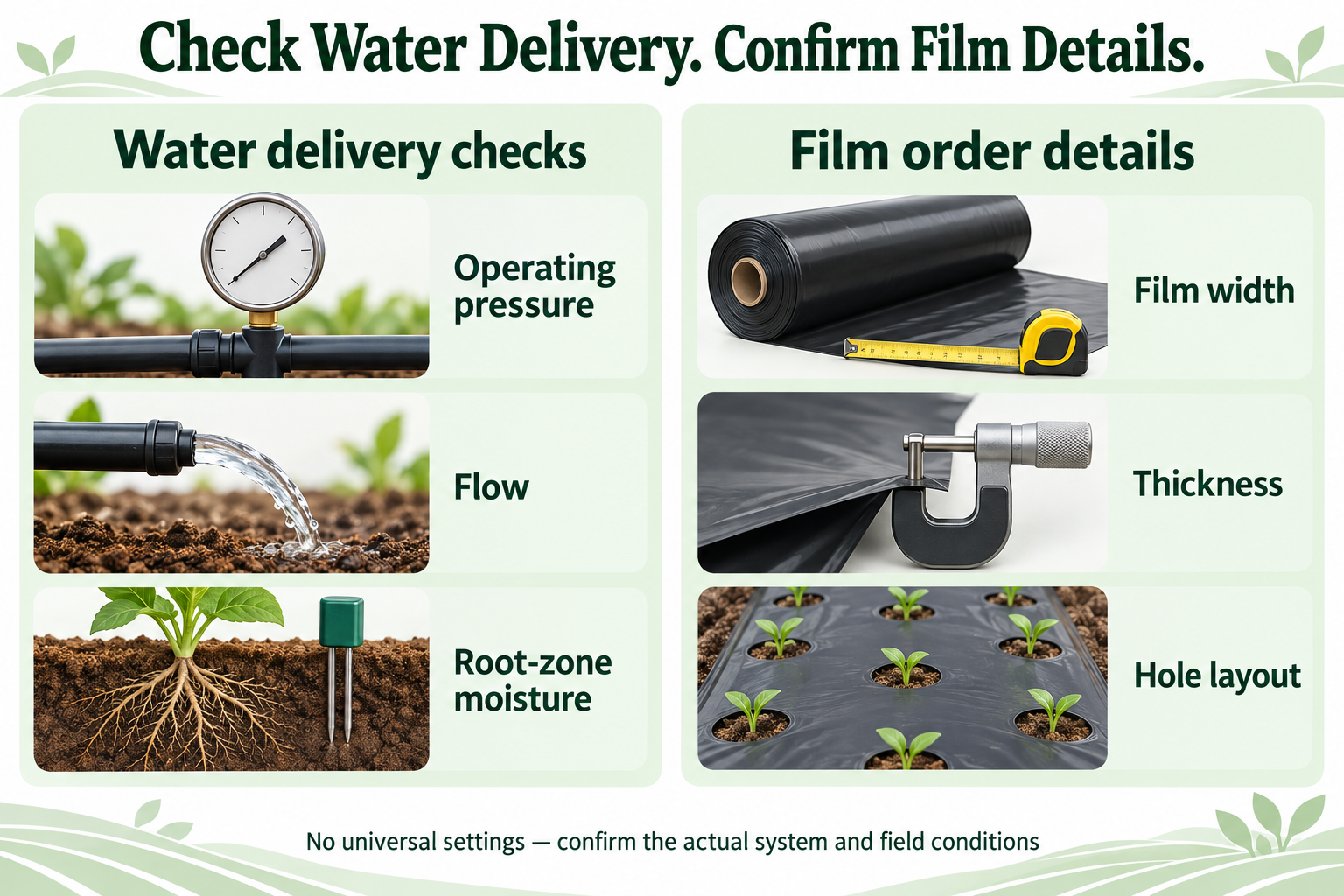
Read the specification for the exact tape being used. Check its flow units, rated pressure, emitter spacing, recommended filtration and permitted lateral length for the relevant conditions. A flow quoted per emitter is different from a flow quoted per 100 metres or 100 feet of tape.
Measure pressure while the intended zone is operating. Static pressure at an idle supply does not establish the pressure available at the tape. Record a normal working baseline, including zone flow, relevant pressure readings and filter pressure differential, for later comparison under the same valve configuration.
How long should drip tape run?
Start with the crop's required water supply and the amount the active root zone can hold, then check what the system actually delivers. Use moisture observations to evaluate the event. If water moves below the active roots before the intended crop rows are adequately wetted, simply extending the event may not solve the layout problem.
Illustrative calculation, not a watering recommendation
Assume a tape rating of 250 L/h per 100 m at its stated operating pressure. Ten lines, each 60 m long, contain 600 m of tape.
Nominal zone flow = 250 × (600 ÷ 100) = 1,500 L/h.
Nominal delivery during 20 minutes of fully operating flow = 1,500 × (20 ÷ 60) = 500 L.
This calculates nominal delivery only. It does not prove that 500 L meets crop demand, is distributed evenly or remains in the root zone. Check actual meter readings and operating conditions; filling and shutdown behavior can also affect the delivered amount.
Count total tape length, not just bed length. If each of those beds carries two lines, the calculation must include both. Establish the final schedule with the crop and irrigation adviser, then adjust it as crop demand and field conditions change.
After rain, check moisture where the roots are
Intact plastic sheds water from its covered surface, but rainfall can enter through exposed soil, bed edges and openings, then move laterally. The contribution depends on the soil, rain event, bed condition and root distribution.
A wet bed edge is therefore useful context, not proof that the crop-row root zone has received enough water. Equally, the presence of plastic is not proof that rain contributed nothing. Compare root-zone readings at representative locations and depths before and after the event, and use their trend to inform the next irrigation.
Avoid a fixed rule such as “always stop for two days after rain.” Do not respond to wilting by automatically adding water either: both inadequate supply and waterlogged soil can stress plants. Check the soil and the delivery system first.
Uneven watering: what to check before running longer
The observations below are starting points for diagnosis, not proof of a single fault. Compare with the normal baseline for the same operating zone. On small screens, scroll the table sideways to read all three columns.
| Observation | First checks | Why extra runtime may not help |
|---|---|---|
| One crop row stays drier | Check tape offset and moisture across the bed at both crop rows; inspect for a kink or damaged section. | The wetting strip may miss the intended roots even when the tape is working. |
| Far ends underperform | Compare operating pressure and discharge along representative laterals; review slope, line length, tail deposits and supply capacity. | A hydraulic restriction, clog or unsuitable layout remains in place. |
| An isolated wet pocket appears | Inspect accessible connections and the affected section for leaks; compare flow with the baseline. | A leak can worsen local saturation while other areas remain short of water. |
| Problems begin after planting or staking | Compare the hole and stake positions with the tape route; inspect the affected section for punctures or displacement. | More operating time does not repair mechanical damage. |
| Whole-zone flow changes | Check which valves are open, source pressure, filter differential and the meter against comparable conditions. | A supply or component fault is not just a scheduling problem. |
| Soil below roots is wet but crop rows are dry | Examine lateral and downward wetting, root position and the timing of irrigation events. | Additional water may move deeper before reaching the desired lateral area. |
Use the equipment supplier's procedures for flushing, maintenance and pressure limits. Do not force a blockage through by exceeding the tape's rating. Pump, electrical and chemical-treatment work belongs with appropriately qualified personnel.
Coordinate the film order with the approved bed layout
The irrigation plan and the film specification should describe the same bed. Film width must cover the intended bed profile and anchoring allowance, while planting openings must suit crop positions without damaging the tape. Use the plastic mulch roll-size guide for the film-dimension details.
| Order item | Information to confirm |
|---|---|
| Bed cross-section | Bed-top width, shoulders, bed height where relevant and the film allowance needed for the chosen anchoring method. |
| Crop and planting openings | Number of crop rows, row offsets, plant spacing, hole shape and size, repeating pattern and agreed tolerances. |
| Tape routes | Number of lines and their positions relative to crop rows, planting tools and stakes. Keep the irrigation drawing distinct from the film manufacturing dimensions. |
| Film specification | Material, color and intended upper face, total unfolded width, nominal thickness and tolerance, and required outdoor exposure period. |
| Laying and packing | Manual or machine laying, roll length, equipment/core limits, quantity, packaging and delivery destination. |
| Approval before the full order | Agree the drawing and use a suitable first-bed or sample check to confirm fit, hole clearance and the customer's irrigation arrangement. |
Crop-specific constraints still belong in the planting plan. For example, coordinate support stakes when planning plastic mulch for tomatoes; a generic tape drawing does not replace the crop layout.
Drip irrigation under plastic mulch FAQ
Does drip irrigation go above or below plastic mulch?
In a typical covered vegetable bed, the tape goes below the plastic so it supplies soil beneath the sheet. Surface placement beneath the film or shallow burial should follow the selected tape and installation system's requirements.
Can I use plastic mulch without drip irrigation?
Drip is not the only possible water supply, but the alternative must reliably reach the crop roots beneath the cover. Do not assume overhead watering or rain on intact film will do that. Evaluate the proposed system, crop and field conditions before choosing the film and layout.
Do planting holes need to line up with every emitter?
Not as a universal rule. The planting pattern and emitter spacing are different design choices. Verify that moisture reaches seeds or transplants and the developing root zone; matching hole and emitter positions alone does not verify adequate watering.
Is one drip tape enough for a double-row bed?
It can be if the wetted strip supplies both rows under the actual field conditions. If it does not, review tape count, offsets and emitter configuration. Adding a line changes the system's flow demand and may require a different zone or schedule.
How many minutes should I run drip tape each day?
There is no useful universal daily number. Use crop demand, root-zone moisture and storage, measured system delivery and field conditions to establish a schedule. A volume calculation describes delivery; it does not by itself set the correct irrigation dose.
Should I stop drip irrigation after rain?
Check representative root-zone moisture and its trend. Rain can contribute through exposed areas and lateral movement, but wet row middles or bed edges do not establish that all crop roots received enough water.
Specify mulch film around your planting plan
TIAN FENG supplies PE mulch film. Send your bed cross-section, proposed film width and thickness, color, planting-hole drawing, laying method, quantity and destination to discuss film specifications and a quotation.
If a dimension is undecided, describe the intended bed and crop rather than guessing. Your irrigation supplier or crop adviser should confirm tape selection, hydraulic capacity and operating settings.
References and further reading
- NC State Extension: Using Plastic Mulches and Drip Irrigation for Vegetables — background on the covered-bed production system.
- Purdue University: Understanding Wetting Patterns in Drip Irrigation — a field demonstration of wetting between emitters.
- UF/IFAS: How to Conduct an On-Farm Dye Test to Improve Drip Irrigation Management — evaluating water movement in actual beds.
- UF/IFAS: Drip-Irrigation Systems for Small Conventional Vegetable Farms and Organic Vegetable Farms — system operation, measurement and maintenance.
- Penn State Extension: Making Drip Irrigation Decisions After Rain in Plasticulture — rainfall contribution and root-zone monitoring.
- Purdue Extension: Water Management for Vegetable Crops on Small Farms — soil, crop demand and irrigation capacity.
- University of Georgia Extension: Drip Irrigation Checklist—Start-Up — operating flow, pressure and damage checks.
- UC ANR: Surface Drip Tubing Distribution Uniformity Measures — interpreting pressure and discharge variation.
- University of Arkansas Extension: Troubleshooting a Drip Irrigation System — mechanical and system-level causes of uneven delivery.