
Soil Solarization Plastic: Clear Film, Thickness and Field Preparation
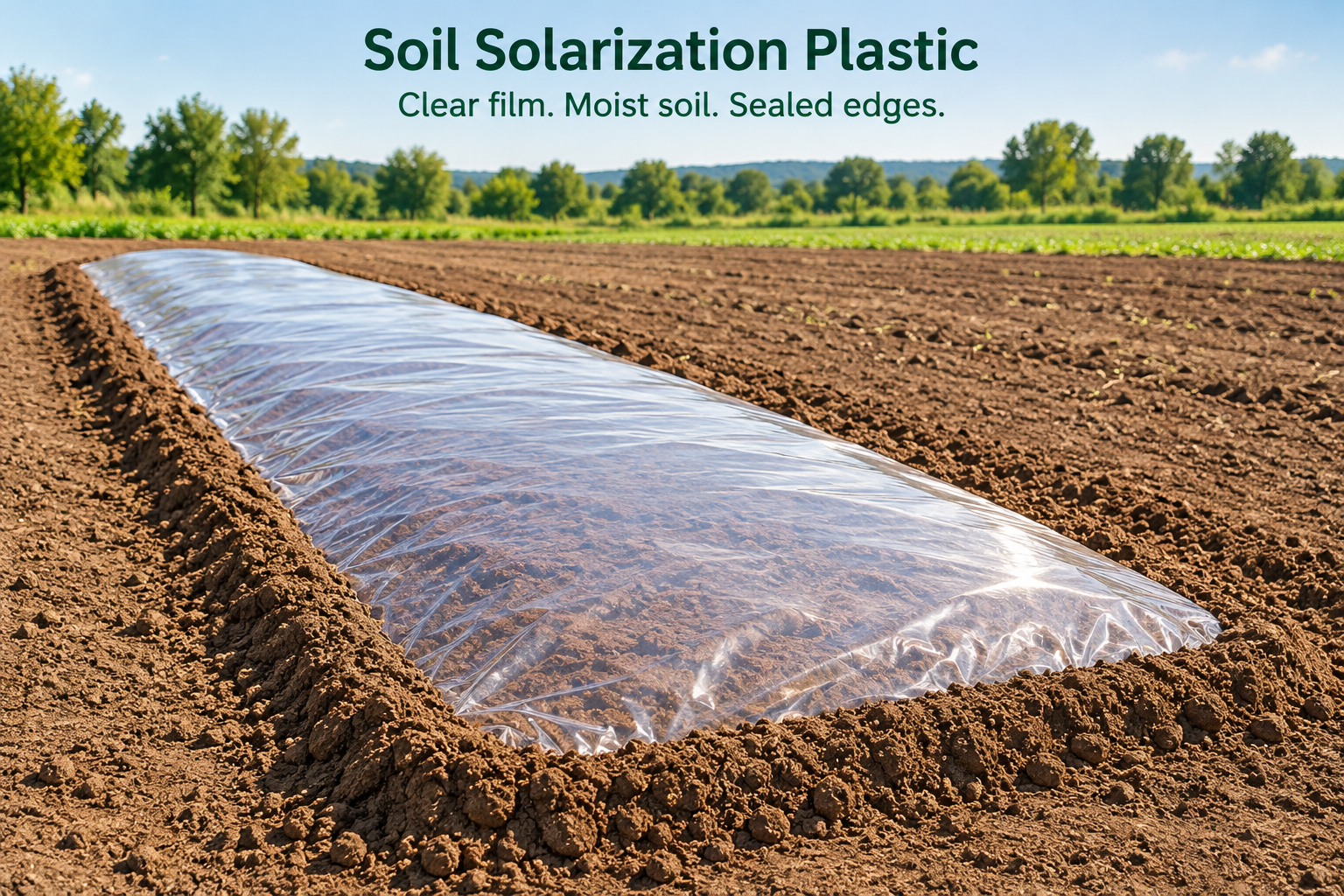
Soil solarization plastic is a temporary cover used to help heat prepared soil before planting. For a grower buying film, the important question is not simply whether a roll is clear. It is whether the proposed film, installation method and treatment window are suitable together.
The aim is to suppress susceptible soilborne pests, pathogens and weeds through a suitable heating treatment, as described in UF/IFAS's solarization review. This guide helps buyers choose between cover types, define thickness and width, and prepare a useful bulk-film inquiry.
The short answer: a conventional solarization treatment uses continuous clear film over moist, prepared soil, with sealed edges and a suitable sunny treatment period. Keep planting holes out of the cover during treatment. Do not assume that a film's thickness, appearance or product name proves how well it will control a particular soil problem.
What does soil solarization plastic actually do?
Sunlight passes through a clear cover and warms the soil. Sealing the cover helps reduce heat and moisture losses. However, conventional clear polyethylene and specialized thermal-infrared-retentive films are not interchangeable: a USDA ARS study of soil-heating films compared different constructions and found different heating performance. Ordinary clear PE should not be described as blocking all outgoing infrared radiation.
Solarization is also different from covering an actively growing crop. In the preplant use described here, the covered soil receives a planned heating treatment before the crop is established. A clear mulch installed around plants is not automatically carrying out the same treatment.
Start with the problem to be managed and a locally appropriate protocol. For a recurring disease or suspected nematode problem, identify the target with a qualified local adviser before deciding that solarization is the right intervention. Film procurement cannot replace that diagnosis.
Clear or black plastic for soil solarization?
Clear solarization and opaque tarping address different processes. University of Minnesota Extension's comparison of solarization and occultation distinguishes heating under clear plastic from weed suppression under a light-excluding cover. The right choice depends on the objective and local conditions, not color alone.
On a small screen, swipe the table sideways.
| Cover and use | Main distinction | Buying implication |
|---|---|---|
| Clear film for solarization | Allows sunlight to reach soil for a planned heating treatment. | Specify the treatment purpose, continuous coverage and required outdoor exposure. |
| Opaque tarp for occultation | Excludes light as a weed-management method; do not assume equivalent soil heating or disease control. | Ask for a cover suited to the intended tarping method, rather than substituting it without review. |
| Mulch around a growing crop | Selected for crop-season conditions, not automatically for a preplant treatment. | Confirm crop, season, color and planting-hole layout separately. |
For broader crop-season choices, see our plastic mulch color guide. A black, white-on-black or silver-colored crop mulch should not be ordered as an assumed equivalent of clear solarization film.
How thick should soil solarization plastic be?
There is no single best thickness for every site. UC IPM's solarization guidance gives 1 mil as a thin-film example with strong heating but greater tearing risk, and 1.5 to 2 mil as a more robust option for windy conditions. These are extension examples, not a universal specification or a claim about our film.
| Thickness in mil | Thickness in microns |
|---|---|
| 1 mil | 25.4 microns |
| 1.5 mil | 38.1 microns |
| 2 mil | 50.8 microns |
Mil is not millimeter: 1 mil is 0.001 inch, or 0.0254 mm. On a purchase specification, state single-wall thickness and the tolerance rather than relying on a rounded product label. Our plastic mulch thickness guide explains the wider measurement and ordering questions.
Balance heating, handling and exposure
A thicker roll is not automatically the better treatment cover, and a thinner one is not automatically the better purchase. Ask which exact grade the quotation refers to, how it will be handled and what evidence supports its intended outdoor exposure. A sample helps check appearance and fit; it does not by itself demonstrate soil-pest control.
Specify usable width, continuous coverage and exposure
Give the supplier a simple drawing of the area being covered. Include the bed top, shoulders or slopes, and the film needed for edge burial. Film width is not necessarily the same as the horizontal bed width.
- Measure the surface path: show how the sheet travels over the prepared bed and down to the anchoring points.
- Define width clearly: confirm whether the quoted figure is the fully opened sheet width or the folded delivery width.
- Plan cut lengths: include end anchoring and the number of individual beds or treatment areas.
- Separate net and ordered area: edges, cuts and unusable offcuts need their own allowance. Use a measured layout, not an unexplained universal waste percentage.
Use the mulch roll size guide for the wider width-and-length ordering method. Ask about practical production and handling limits before assuming that one extremely wide or heavy roll is the best solution.
Outdoor durability is a separate specification. Record the installation location, planned dates and total exposure period, including any intended crop-season reuse. Ask the supplier to identify what is confirmed, what supporting information is available and what remains unverified. “Clear,” “PE” and “UV stabilized” describe different aspects of a product; none alone establishes a treatment result.
Prepare the soil, seal the cover and monitor the treatment
UF/IFAS's beginner guidance supports this preparation and maintenance sequence:
- Prepare the final treatment surface. Remove sharp debris and smooth clods that could leave gaps or puncture the sheet.
- Moisten before covering. Aim for moist soil, not waterlogging, using locally appropriate advice for the soil and treatment depth.
- Lay continuous film and seal the perimeter. Avoid open seams and loose edges; do not leave planting holes in the treatment cover.
- Inspect during treatment. Repair tears promptly and restore displaced edge seals.
Confirm the temperature rating and placement of any irrigation beneath the cover. UF/IFAS cautions that treatment heat can damage some near-surface drip tape.
How long does soil solarization take?
UC IPM commonly describes four to six weeks during the hottest sunny period, while the Florida introduction recommends at least six weeks in its context. These are regional planning examples, not a countdown that proves success. Use local guidance for the target organism and conditions.
UF/IFAS's technical review of solarization shows why bed position, moisture, film construction and pest biology affect results. Shaded edges, difficult weeds and insufficient heating can undermine a treatment. A hot film surface or one high afternoon reading does not establish an adequate treatment throughout the relevant soil depth.
A useful field record: record the film grade, installation date, representative soil-temperature measurements at the advised depths, weather interruptions, tears and repairs. Ask the local adviser how those observations should be assessed. Keep this record separate from the supplier's dimensional inspection record.
Should solarization plastic have planting holes?
Keep the treatment film continuous and unpunched. A supplier's ability to punch a custom hole pattern does not mean those holes belong in a solarization cover. Treat film manufacture and the field-treatment sequence as separate decisions.
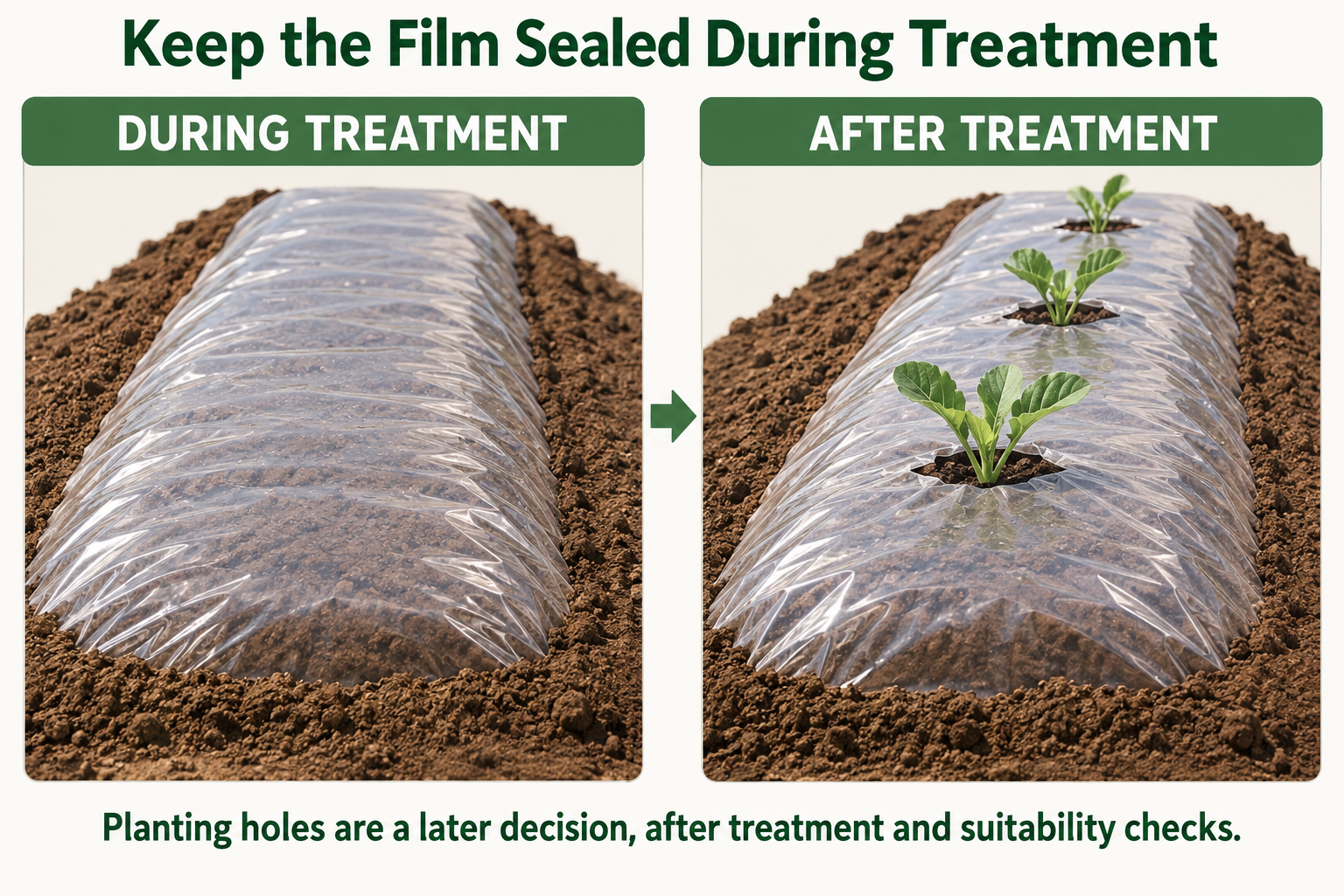
Oklahoma State Extension's solarization guidance describes opening planting holes after treatment when the film is retained as mulch. It also cautions against subsequent soil disturbance that brings untreated material back into the treated zone.
At completion, choose between removing the cover and conditionally retaining it. Check remaining film life, crop-temperature requirements, irrigation arrangements and planting conditions before reuse. If the cover is removed, lift and collect it carefully; do not till conventional PE into the soil. See our mulch-film removal and disposal guide for end-of-use planning.
What to confirm before a bulk film order
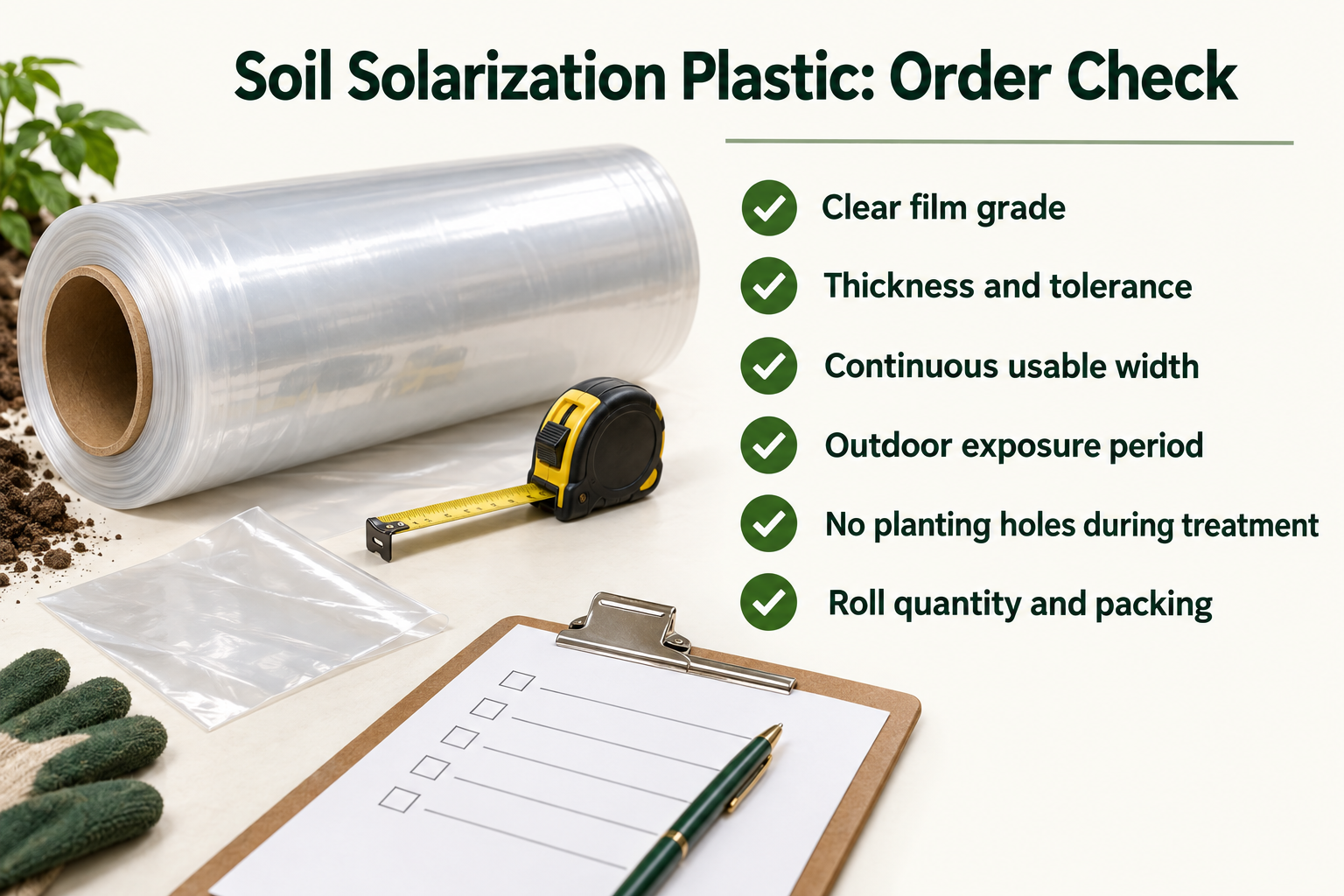
A useful request for quotation connects the treatment plan to a measurable film order. Use this checklist to make the requirements explicit.
| Confirm | Put in the inquiry | Resolve before approval |
|---|---|---|
| Application | Preplant solarization, project location, treatment season and target problem. | Who provides the local agronomic protocol and evaluates suitability? |
| Film identity | Clear PE film and any required optical or material properties. | Exact proposed grade; available supporting data; no assumed equivalence to a specialist film. |
| Thickness | Single-wall thickness in microns or mil, with the unit explicit. | Tolerance, measurement approach and the sample or inspection basis. |
| Width and length | Fully opened usable width, cut length or roll length, and a bed drawing. | Edge allowances, folded format, practical handling and permitted joins. |
| Hole status | Continuous, unpunched film for the treatment stage. | Do not substitute a standard pre-punched crop-mulch configuration. |
| Exposure | Planned outdoor dates and any proposed post-treatment use. | What durability is actually supported for the proposed grade and conditions? |
| Quantity and packing | Number of rolls, net roll length, core requirements and destination. | Net film versus gross packed weight, labels, roll handling and packing arrangement. |
| Commercial basis | Required delivery window and quotation destination. | Confirmed production feasibility, order quantity, price basis, freight scope and timing. |
Compare quotes on the same specification
A price per roll is incomplete if the suppliers quote different widths or lengths. For a continuous sheet, nominal film area is its fully opened width multiplied by its length. Compare area only after aligning grade, thickness, tolerance, packing and delivery scope. Gross shipping weight should not be mistaken for net film weight.
Before a larger purchase, agree what a sample evaluation will establish. Dimensional checks, installation fit and an application trial answer different questions. If a property is unconfirmed, leave it explicitly unresolved instead of turning an assumption into an accepted order requirement.
Discuss a clear PE film specification
TIAN FENG offers custom dimensions for transparent PE mulch film. Send your location, treatment window, bed drawing, requested thickness, roll length and quantity so manufacturing feasibility can be reviewed.
Solarization-specific performance data are not currently available for this offer. Do not treat a dimensional quotation as confirmation of pest-control efficacy. If you require tested properties or a dedicated treatment grade, state those requirements before ordering.
Still comparing crop-season products? Browse the plastic mulch range.
Soil solarization plastic FAQ
Can I use construction sheeting for solarization?
Do not choose by the label alone. Confirm clarity, condition, thickness, required coverage and the ability to remain intact for the planned exposure. For a commercial project, unidentified sheeting makes it harder to compare or repeat the specification. Ask for the actual grade and relevant information before ordering.
Can I reuse old greenhouse plastic?
Treat it as a candidate to assess, not a guaranteed substitute. Check dirt, clouding, punctures, brittle areas, usable dimensions and known exposure history. A sheet that looks intact does not establish remaining outdoor life or treatment performance. Compare the uncertainty and handling effort with a defined new-film specification.
Is 1 mil or 2 mil plastic better?
Use the thickness section above to compare the options, then specify the selected value and tolerance in the quotation. Compare the same film grade, exposure requirement and handling conditions.
Can I order film with planting holes?
Custom punching is available, but a standard solarization treatment calls for continuous film. Specify the treatment stage clearly in the inquiry. If suitable film is kept as mulch, planting holes are a later operation after treatment, not a reason to supply the treatment cover pre-punched.
Will solarization kill every weed, pathogen and nematode?
No. UF/IFAS's review describes variable outcomes across organisms and treatment conditions. Do not describe the process as complete soil sterilization or assume it replaces every other management measure. Diagnose the problem and evaluate results locally.
What should I send to request a quotation?
Send the destination, intended application and dates, bed dimensions, required fully opened width, single-wall thickness, roll length and quantity. Specify unpunched film for treatment. Include any required test evidence or durability conditions, and identify undecided items so they can be addressed explicitly.
References and further reading
These sources explain the treatment and its limits. Their published results are not test results for TIAN FENG products.
- UC IPM: Soil Solarization for Gardens & Landscapes — thickness examples and regional treatment guidance.
- UF/IFAS: Introduction to Soil Solarization — preparation, sealing, film maintenance and irrigation cautions.
- UF/IFAS: Solarization for Pest Management in Florida — technical evidence, conditions and organism-specific limitations.
- University of Minnesota Extension: Using the Sun to Kill Weeds and Prepare Garden Plots — clear solarization versus opaque occultation.
- Oklahoma State Extension: Soil Solarization for Control of Soilborne Diseases — treatment integrity and post-treatment handling.
- USDA ARS: Heat-Retentive Films for Increasing Soil Temperatures During Solarization in a Humid, Cloudy Environment — research comparing film constructions; specialist-film findings are not interchangeable with ordinary PE.