
Plastic Mulch for Watermelon: Film Choice and Planting Layout
Plastic mulch for watermelon works as part of a planting system: the bed, water supply, crop plants and, for seedless production, pollen-producing plants must fit together. Choosing a roll by color and price alone can leave the wrong openings, unsuitable bed coverage or avoidable establishment problems.
The short answer: define the planting season and crop layout first. Consider black film where early soil warming is useful and white-on-black where limiting additional soil heating is the priority. Then match the film width, planting openings and roll format to the approved bed and irrigation plan. There is no single best mulch for every watermelon crop.
Define the watermelon planting system before choosing film
Begin with the growing location, planting month and establishment method. Include whether the crop is seeded or seedless, grown in an open field or high tunnel, and whether another crop will follow on the same film.
Direct sowing
Confirm the grower's sowing method and how openings will be made. Seed placement, emergence and any later thinning belong in the planting plan; an opening intended for a transplant should not automatically become the sowing specification.
Transplanting
Coordinate the opening with the plug and planting equipment. Commercial seedless watermelon commonly uses transplants, but the selected cultivar and local production method still need confirmation before approving a hole pattern.
Ground mulch, a high-tunnel roof and temporary row covers perform different jobs. A roof does not replace root-zone irrigation. Temporary covers used during establishment also require a temperature and pollinator-access plan as the crop develops.
Select the film around the planting window
Ask whether extra soil warmth is useful at establishment and what conditions are expected later. A country's climate label is too broad to choose film for every planting month or protected-crop system.
| Growing objective | Film to evaluate | Decision checkpoint |
|---|---|---|
| Early warming during a cool planting window | Black PE mulch | Check soil conditions, close film-to-soil contact and the heat expected after establishment. |
| Avoiding additional soil heating in a hot planting window | White-on-black film, white face upward | Review the actual grade, local agronomic advice and water management; color alone does not define a temperature result. |
| A specific soil-warming program | Clear agricultural film | Assess local heat exposure and weed management. Clear film admits light to the soil and is not a general cooling option. |
| A defined reflective-film objective | A clearly identified reflective construction | Match supporting evidence to the exact material, crop and conditions. A silver color alone does not establish pest or yield performance. |
Transparent film is not a general hot-weather cooling solution. Likewise, silver-pigmented PE and aluminum-metallized films are not interchangeable evidence categories. TIAN FENG's silver-black film is silver-pigmented coextruded PE.
For the broader material comparison, use our plastic mulch color guide and reflective mulch guide. The watermelon decision should apply those distinctions to a real planting window.
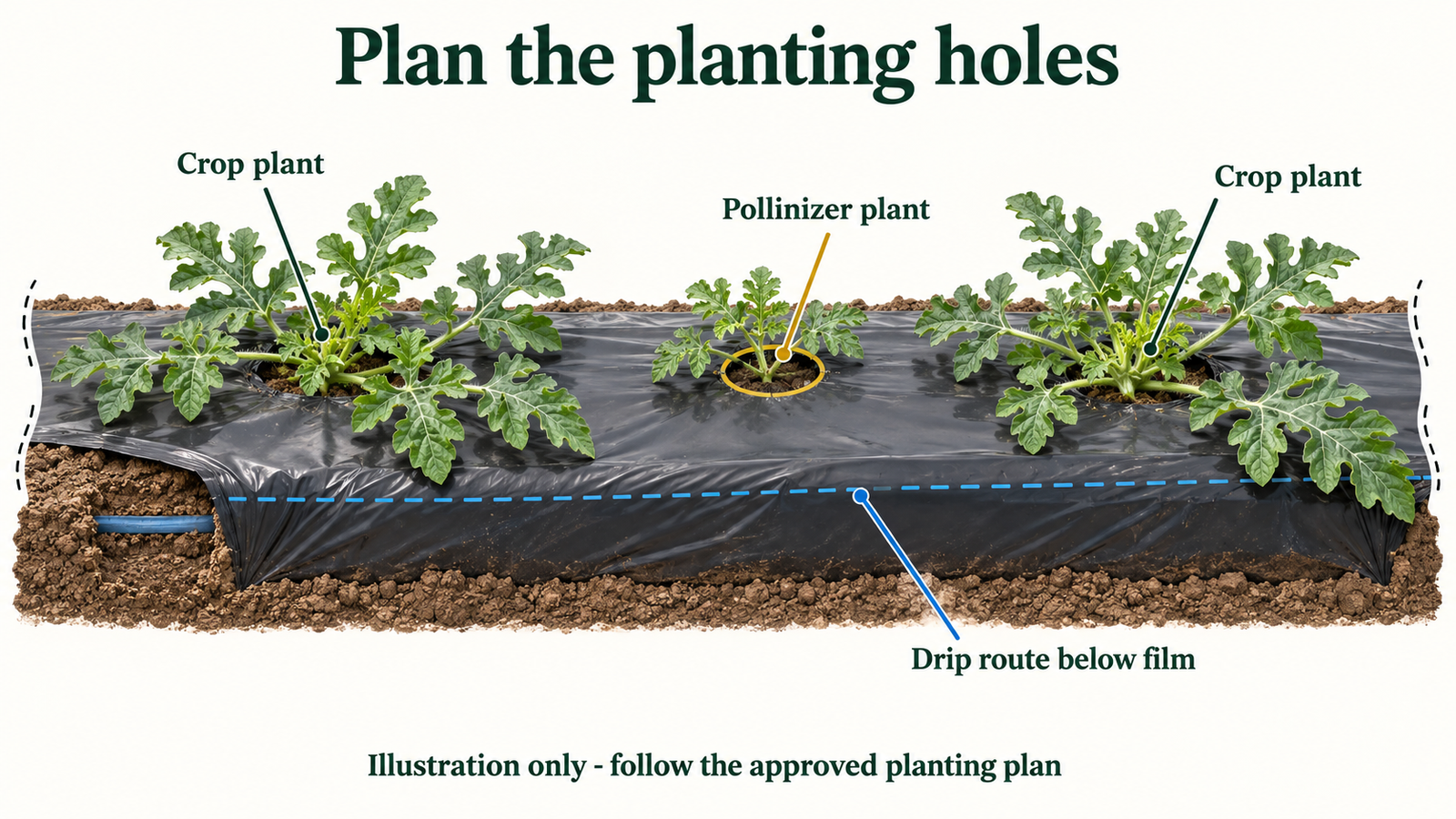
For seedless watermelon, approve pollinizer positions before punching holes
A pollinizer is a plant supplying viable pollen; a pollinator is the insect or other agent transferring it. Seedless watermelon production needs the appropriate pollen source and effective pollen transfer. Film does not provide either.
Production systems can use dedicated pollinizer rows or pollinizers within crop rows. The arrangement and flowering overlap should be confirmed with the seed supplier or crop adviser, not selected simply to fit an available perforated roll.
Before ordering pre-punched watermelon plastic mulch, mark these items on the field plan:
- The positions of the market-crop plants and the required pollinizer plants.
- Which openings are factory-punched and which, if any, will be made during planting.
- The planting sequence, including any different dates or methods for pollinizers.
- The drip-tape route, clear of the planned punching and planting operations.
- How the film repeat pattern will align with the approved field arrangement.
Approve the crop map first, then the film drawing. A repeating hole pattern cannot establish flowering synchrony or a suitable pollinizer arrangement. If the planting plan is unresolved, compare unpunched film with a later, confirmed perforation option instead of guessing.
Do not confuse film width with space for the vines
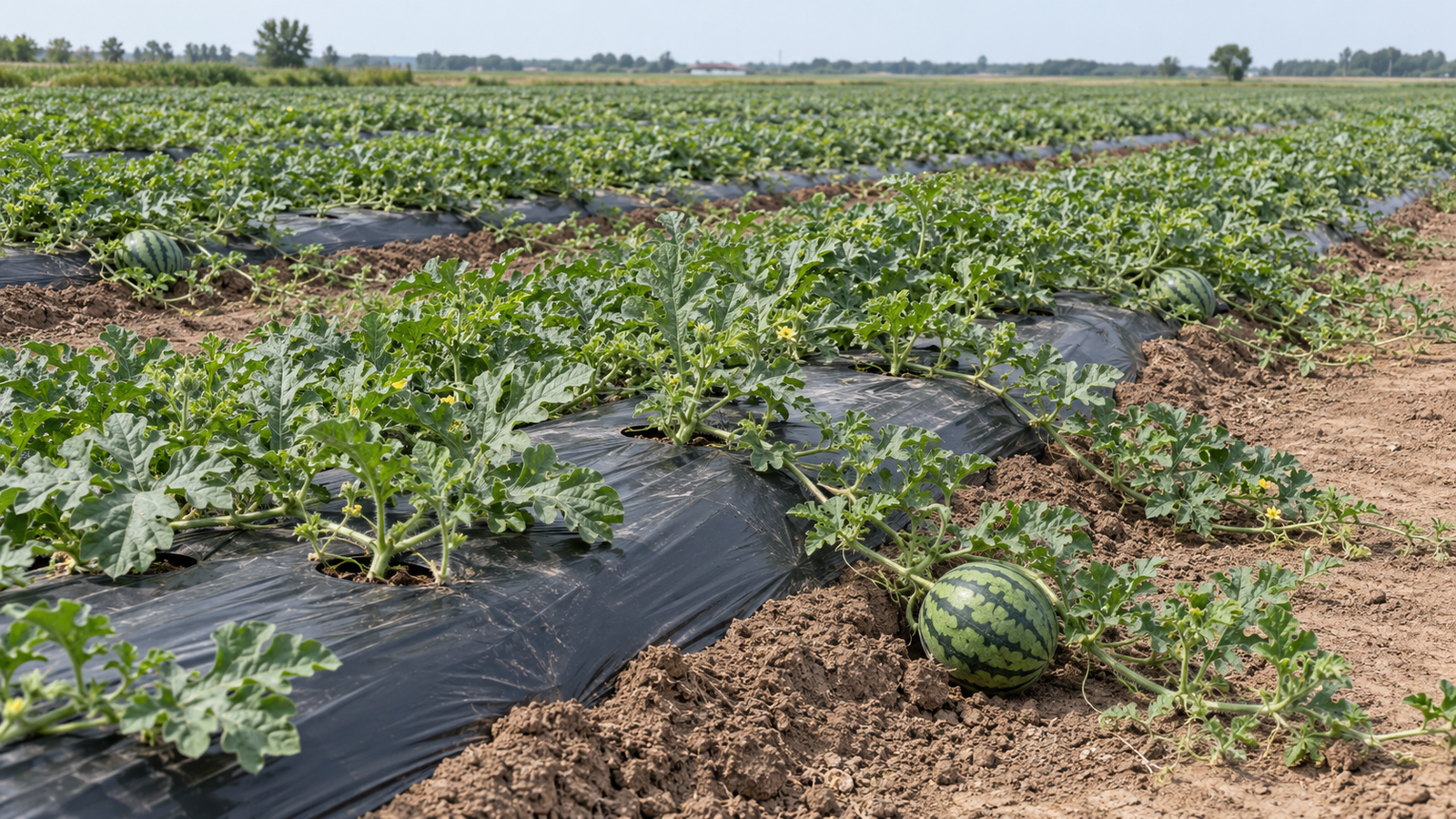
Watermelon vines can spread beyond the mulched bed. That does not mean the roll must cover the entire distance between beds, nor that every developing fruit will rest on film.
Use a bed cross-section to define the bed top, shoulders and anchoring allowance on both sides. Together, these determine the required coverage. Separately, use a plan view to show bed-center spacing, plant positions, vine space and access for crop work.
Confirm the finished, unfolded film width with the laying equipment. Also check roll length, core and handling limits; two rolls with the same nominal width may not fit the same loading or working arrangement. The mulch roll-size guide explains the general measurement terms.
Check the first planted section, especially in hot conditions
Growing watermelon on black plastic requires more than laying a dark sheet over soil. Review a short installed and planted section before repeating it across the field.
- Bed contact and anchoring: fit the film closely and secure the edges. Loose film can move against plants, while cavities can channel hot air toward openings.
- Stem clearance: avoid leaving tender stems against sun-heated plastic. Hot-film contact and hot air escaping through a planting hole are different injury routes.
- Openings: check alignment, tearing and compatibility with the planting method. Do not enlarge every opening indiscriminately; exposed soil also creates weed and moisture-management issues.
- Water delivery: run the irrigation and inspect the intended root zone. A dry-looking film surface does not tell you whether roots have sufficient moisture.
- Temporary covers: monitor temperature and arrange opening or removal when pollination access is needed, following local crop guidance.
If seedlings struggle, examine weather, water, plug condition, planting depth and film fit before assigning a cause. For the full laying sequence, see how to lay plastic mulch.
Separate earlier harvest from total yield, sweetness and water savings
These are different outcomes and should be evaluated separately. UF/IFAS guidance describes multi-year North Florida work in which black mulch improved early watermelon yields more consistently than total yields. Earlier fruit may have commercial value, but that depends on the buyer's harvest market and costs.
A 2023 UF/IFAS trial also provides a useful caution about color comparisons. Its white-on-black PE treatments, installed black-face-up or white-face-up, did not differ significantly in early or total yield under that trial's conditions. This does not make the two orientations equivalent for every season; it shows why a universal color-to-yield promise is unreliable.
Do not convert a yield claim into a sweetness claim. Fruit quality needs its own measurements. Similarly, Bayer/Seminis notes that water-use efficiency can improve while total crop water use rises with greater growth. Mulch does not remove the need for irrigation scheduling.
Weed control has limits too: weeds can develop around openings and between beds, and nutsedge can penetrate ordinary film. Neither a black color nor an intact-looking bed establishes complete weed exclusion.
Make a local comparison useful. Keep cultivar, planting date, bed system and irrigation comparable. Record establishment, weed pressure, early and total marketable harvest, film condition and retrieval work. Those records are more useful than assuming a film-color claim will reproduce in another field.
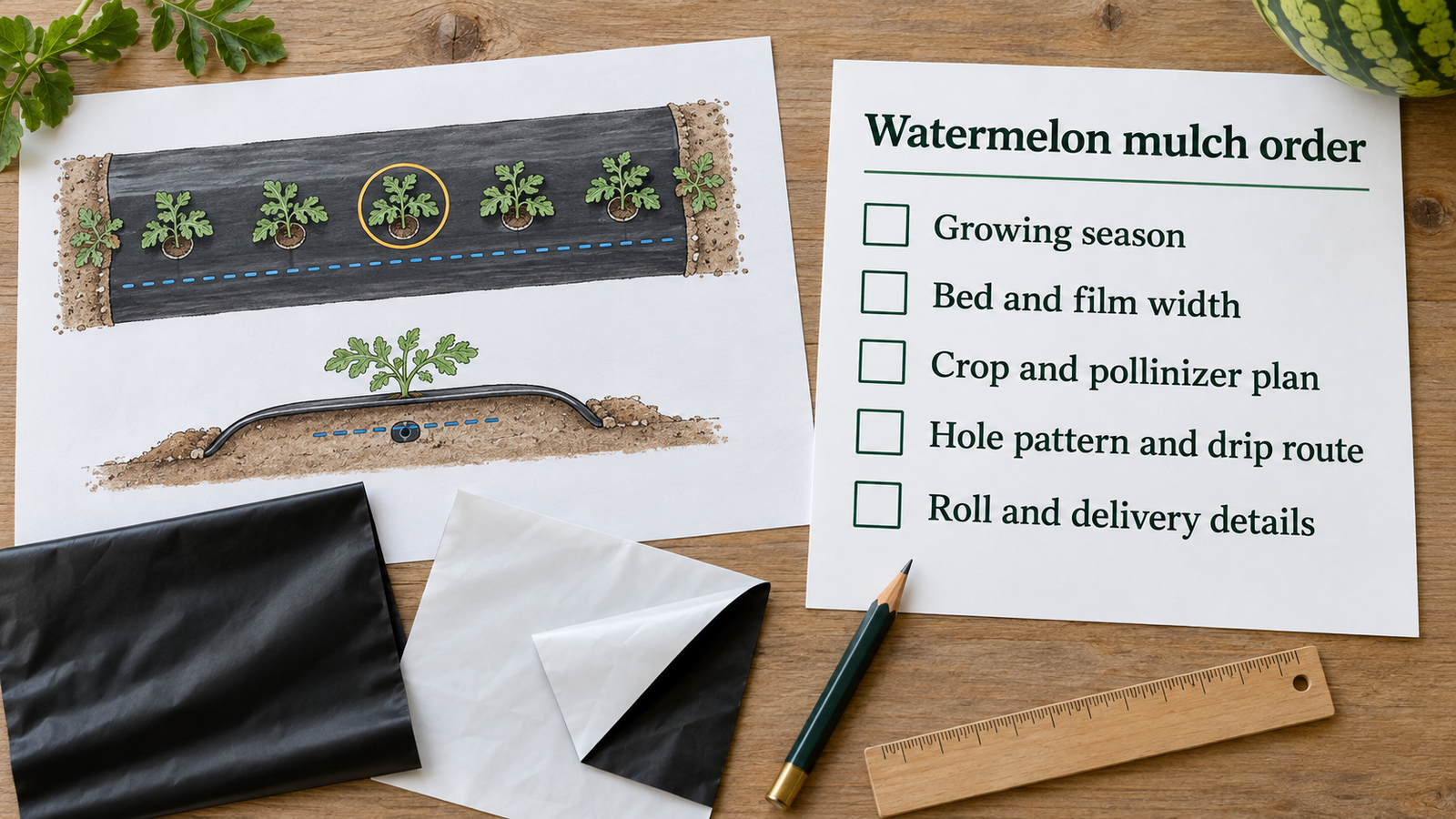
Convert the approved crop plan into a film order
Compare quotations against the same drawing and specification. An inexpensive roll is not equivalent if it provides less usable coverage, a different thickness or the wrong planting pattern.
| Order item | Information to agree |
|---|---|
| Growing program | Location, planting month, field or tunnel, seeded or seedless, sowing or transplanting, and any planned second crop. |
| Film construction and face | Material, color combination, intended upper surface and any grade-specific requirement. |
| Bed coverage and machinery | Bed cross-section, total unfolded film width, anchoring allowance and laying-equipment compatibility. |
| Thickness and exposure | Thickness units, nominal value and tolerance; laying, harvest and removal dates; suitability for the intended exposure. |
| Planting openings | Unpunched or pre-punched; approved drawing revision, hole dimensions, offsets, repeat pattern and tolerances, including pollinizer provisions. |
| Rolls and delivery | Length per roll, quantity, core and handling limits, packing, destination and required arrival date. |
| Approval and removal | Sample or trial-fit requirements, acceptance checks, retrieval method and local used-film acceptance conditions. |
There is no universal watermelon-film thickness or outdoor lifetime. The mulch thickness guide explains units and tolerance. Include installation, irrigation integration, retrieval and disposal or accepted recycling in the project comparison, not only the film invoice.
Plastic mulch for watermelon FAQ
Should every watermelon crop use plastic mulch?
No. Compare it with the existing production system, including planting season, weed pressure, available irrigation, installation and removal. Plasticulture is a system choice, not a requirement for growing watermelons.
What hole spacing should I order for seedless watermelon?
Use the spacing and pollinizer arrangement approved for your cultivar and production system. Send the plan before requesting factory perforation; one fixed pattern cannot suit every seeded or seedless crop.
Does the plastic need to extend beneath every watermelon?
Not necessarily. Bed mulch covers a defined strip, while vines and fruit may extend into row middles. Plan fruit-contact conditions and field access separately rather than assuming bed film covers the entire cropping area.
Can one film remain for a second crop?
Possibly, if the proposed grade and field condition suit the combined exposure and the next planting layout. Disclose the full program before ordering and inspect the film and irrigation system before reuse.
Discuss mulch film for your watermelon planting plan
TIAN FENG supplies custom PE mulch film, with dimensions and perforation requirements subject to order review. Start with your region, planting month, seeded or seedless program, approximate quantity and delivery destination. Include a bed sketch and crop/pollinizer layout when available.
Review our black mulch film and white-on-black mulch film options. If a detail is undecided, identify it as an open question; you do not need to invent dimensions or agronomic values to begin a discussion.
References and further reading
These crop guides and research reports support the distinctions above. Their regional recommendations and external trials are not performance specifications for TIAN FENG products.
- University of Georgia Extension: Commercial Watermelon Production — establishment, bed preparation, irrigation and weed-management context.
- UF/IFAS: Florida Crop/Pest Management Profile: Watermelon — seeded and seedless production, pollinizers and cropping systems.
- University of Missouri Extension: High Tunnel Melon and Watermelon Production — protected-crop conditions, film fit, seasonal colors and heat injury.
- Utah State University: Ground Mulch, Row Covers, and Pollination — installation, stem contact and temporary-cover management.
- UF/IFAS: Polyethylene Mulching for Early Vegetable Production in North Florida — season, soil contact and the distinction between early and total yield.
- UF/IFAS: 2023 Watermelon Paper and Polyethylene Mulch Trial — treatment-specific results, including the black-facing and white-facing PE comparison.
- Bayer/Seminis: Plasticulture vs. Bare Ground Production of Watermelon — system costs, water-use efficiency and removal requirements.