
Plastic Mulch Removal and Disposal: A Grower’s Guide
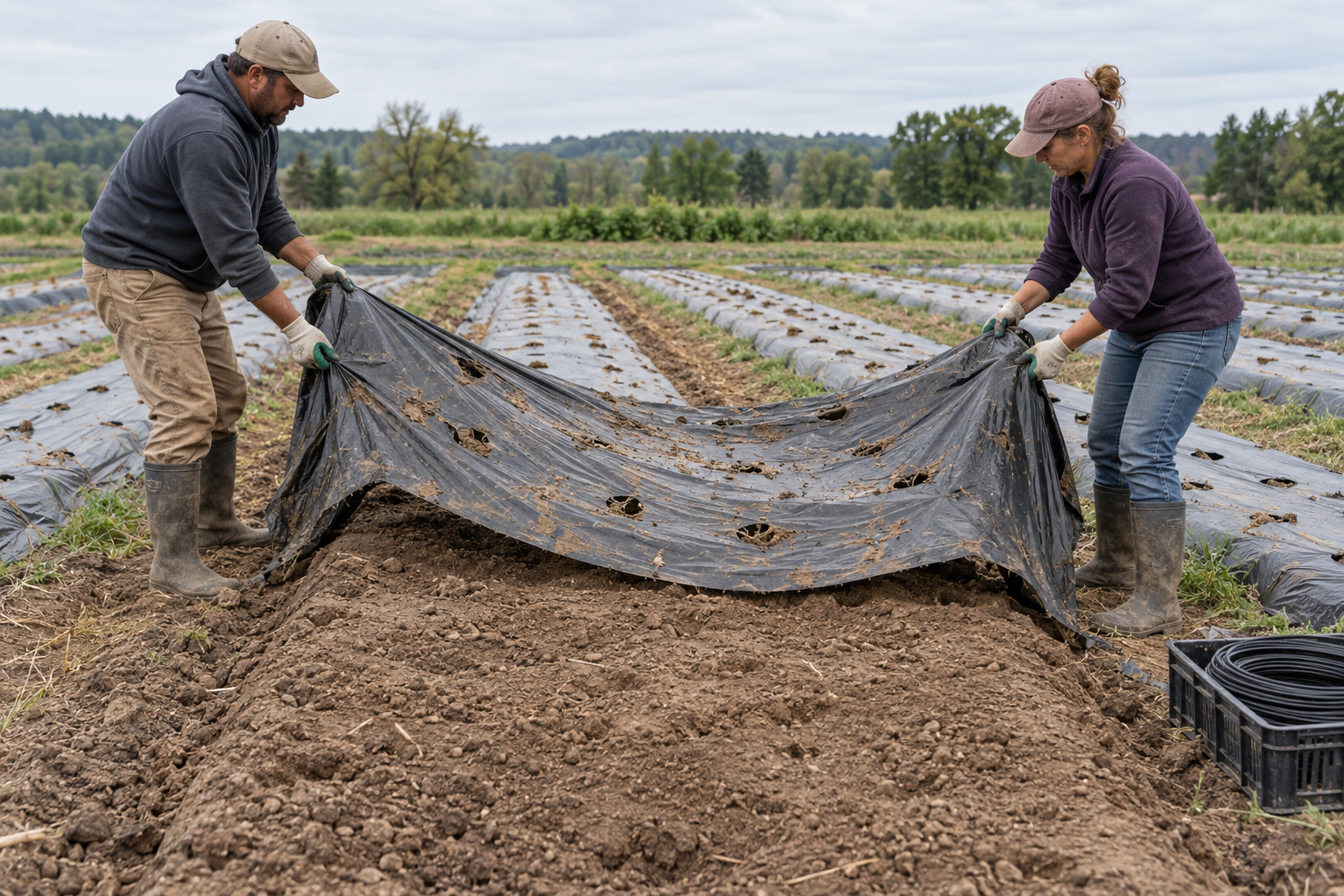
Plastic mulch removal starts before the sheet is pulled from the bed. First identify the material and confirm where the used film can go. Then plan field cleanup around recovering the film with as little tearing and contamination as practical.
Short answer: after conventional PE mulch has finished its intended cropping use, free the buried edges, lift and collect the film, keep other materials separate, and inspect for remaining pieces. Arrange recycling only with a receiver that explicitly accepts used agricultural mulch film. If no such route is available, ask the local waste authority about an approved disposal facility. Do not till ordinary PE into the soil.
This guide covers thin agricultural bed mulch, mainly polyethylene (PE). It is not a removal manual for woven groundcover, greenhouse covers or fumigation tarps. Follow applicable product labels, worker-protection requirements and equipment instructions before field work.
1. Confirm what was laid in the field
Use the roll label, invoice and supplier documentation to identify the film. Color, brittleness and the fact that a sheet has broken into pieces do not establish its end-of-use route.
- Conventional PE mulch: plan for removal and a confirmed collection or disposal route.
- Verified soil-biodegradable mulch: follow the specific product's documented soil-use instructions and applicable local requirements. Do not assume that a compostable label alone establishes suitability for incorporation into soil.
- Unknown material or an unclear “degradable” claim: keep it separate and obtain identification before deciding how to manage it.
Washington State University Extension distinguishes biodegradation environments and laboratory assessment from variable field conditions. Even with soil-biodegradable mulch, conventional non-biodegradable drip tape still needs removal before incorporation, as noted by UC ANR.
For the material-selection and evidence questions, read the separate biodegradable versus PE mulch film comparison. The remaining steps here focus on collecting conventional PE.
2. Confirm acceptance before removal and packing
Ask specifically about used agricultural mulch film, not simply “plastic film” or “LDPE.” The Cornell Cooperative Extension Suffolk County directory illustrates the distinction: one listed business accepts drip tape and several agricultural films but excludes plastic mulch film. The directory also says to contact each company for current information.
Conversely, the New Jersey Department of Agriculture describes a mulch-film and drip-tape recycling initiative. These are examples of regional routes, not confirmation of availability in your area or acceptance of your particular load.
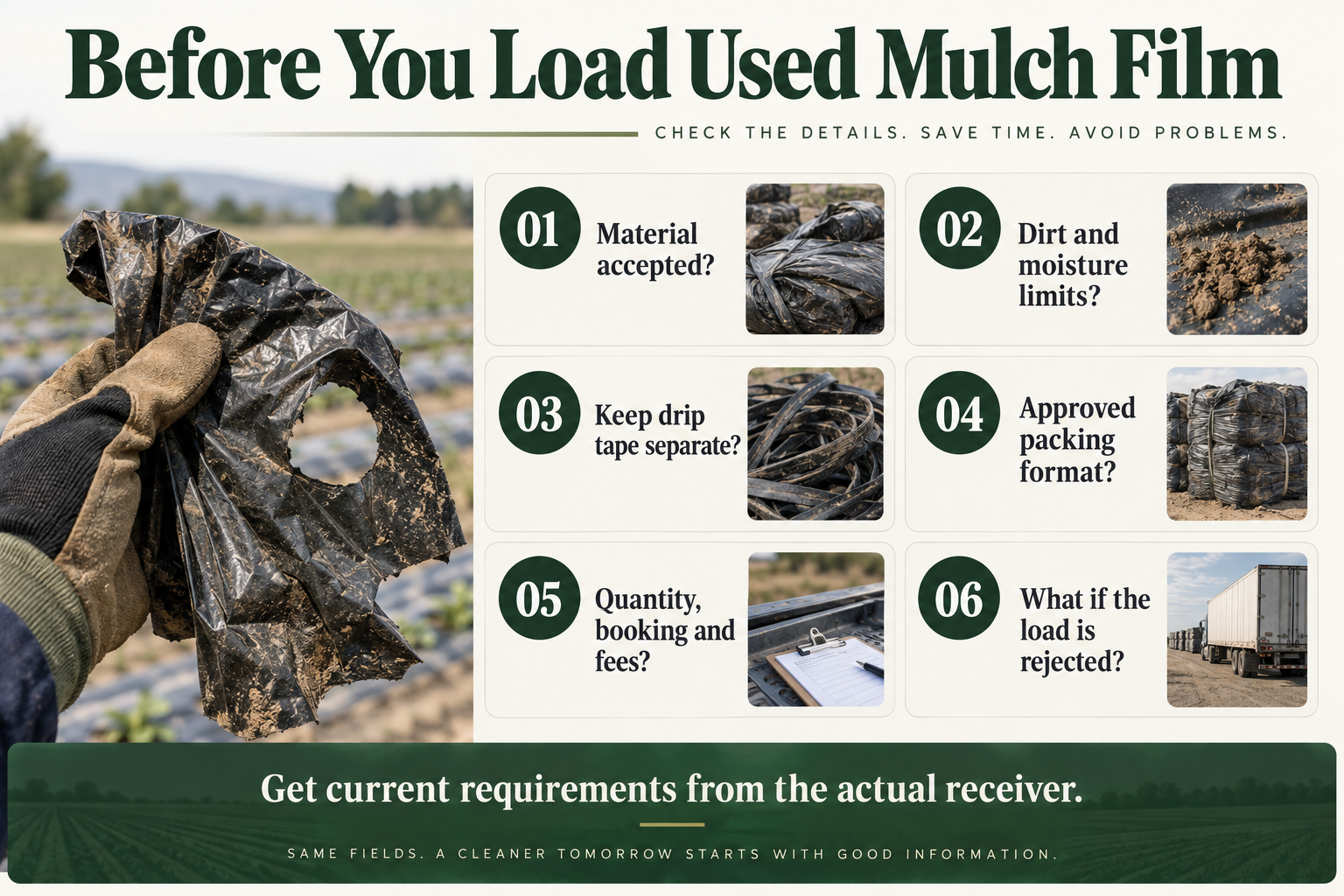
On a small screen, scroll the table sideways to read both columns.
| Confirm | Ask the actual receiving facility |
|---|---|
| Material and condition | Do you accept used agricultural PE mulch in this color and construction? Can you review photographs or a sample? |
| Contamination | What soil, crop residue, moisture or chemical-contamination conditions would lead to rejection? How do you assess them? |
| Separate streams | Must drip tape, connectors, twine and other plastics be delivered separately? Which of them do you accept? |
| Packing | Do you want loose rolls, bundles, bags or bales? What limits apply to dimensions, weight and binding materials? |
| Logistics and costs | Is there a minimum quantity, service area, appointment, collection charge, preparation charge or tipping fee? |
| Rejection and records | What happens to a rejected load? What collection, weighing or acceptance record will you provide? |
Example inquiry to a receiver:
We have used [material / color] agricultural mulch from [location and crop]. The approximate quantity is [quantity and units]. Attached photographs show its current soil and plant-residue condition. Do you accept this specific material? Please confirm preparation, separation, packing, delivery, fees and rejected-load arrangements. Drip tape and other materials can be identified separately.
Keep the reply with the collection plan. An internet listing or a resin code is not a booking confirmation, and acceptance should not be assumed from a previous season.
3. How to remove plastic mulch after its final intended use
The sequence below is a planning guide, not a machine-specific operating procedure. Adjust the work to the film's condition, soil and irrigation layout, using suitable retrieval equipment according to its instructions.
Step 1: Schedule the work while the film is still retrievable
Remove the mulch when its planned use has ended, rather than leaving it to become overgrown. This may be after the final crop in a planned multiple-cropping system, not necessarily the first harvest. Oklahoma State Extension's removal guidance supports prompt cleanup after use ceases.
Step 2: Clear access without shredding the sheet
Identify stakes, ties, irrigation components and other obstructions before pulling. Decide whether the drip tape should be recovered before, during or after lifting, based on the layout and equipment; do not let it become trapped in the wrong collection stream. Remove crop residue using a method that does not cut the film into small pieces. Penn State Extension recommends retrieving agricultural plastics while intact and avoiding mowing that fragments the film.
Step 3: Check a short section before committing the crew
As a practical planning check, try a short accessible section. Does soil release from the edges? Does the sheet lift, or tear repeatedly? Can irrigation components be recovered without becoming tangled? Record what needs changing before continuing across the block.
The 2024 Southeastern Vegetable Crop Handbook, printed page 23, recommends reducing attached soil and plant debris and retrieving film in dry weather. That is not a universal soil-moisture threshold or a fixed number of days to stop irrigation.
Step 4: Release buried edges, then lift and collect
For hand work, free the anchored edges with suitable tools before lifting manageable sections. Do not keep pulling against an edge still held by soil if the sheet is tearing. For mechanized work, use a suitable mulch lifter or retrieval system and follow its instructions. Oklahoma State describes the basic principle of loosening the soil holding the edges so the film can be lifted.
Step 5: Check that recovered materials remain separate
Confirm that drip-tape recovery is following the planned sequence. Do not wind unidentified fittings, twine and tape into the mulch simply because they came from the same bed. Keep the agreed receiving streams distinguishable during collection and loading.
Step 6: Inspect the bed and work area
Before the next cultivation operation, check former buried edges, planting holes, row ends and collection points for visible pieces. Recover loose fragments and secure collected material against dispersal. Note sections that need another pass; a tidy-looking roll does not prove the field is free of residue.
Stop safely before clearing a machine
Never reach into moving rollers or pull tangled film from powered equipment. The UK HSE agricultural machinery guide calls for a safe stop before adjustments or clearing blockages: secure the equipment, stop and isolate all power sources, prevent restart, and wait for movement to cease. Account for stored hydraulic or mechanical energy and anything that could fall or move. Use trained operators, intact guards and the manufacturer's procedure; switching off the PTO alone may not isolate every hazard.
4. Separate materials and prepare them for the receiver
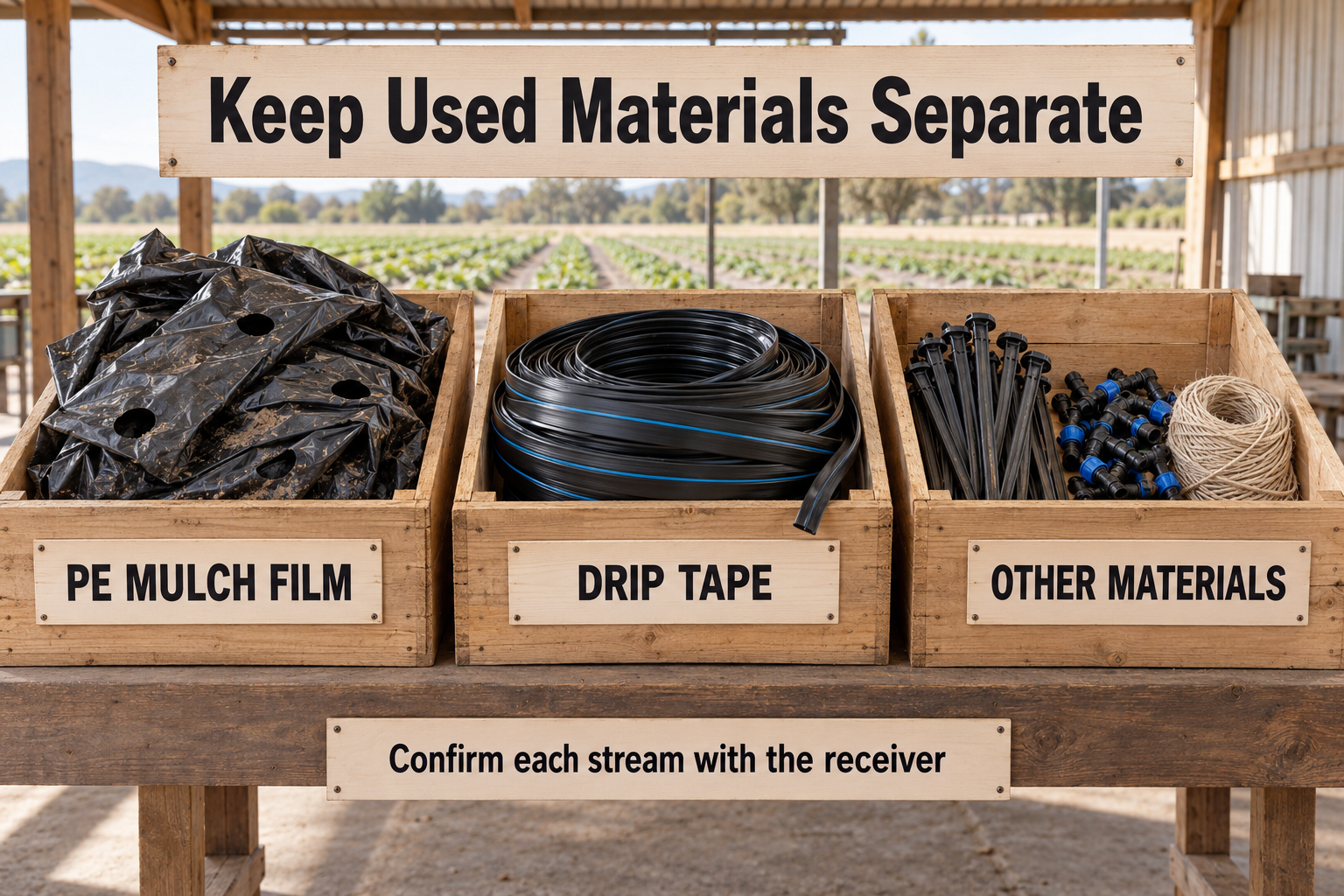
Use labeled collection areas so one crew's sorting is not undone during loading. Keep conventional mulch, unknown or soil-biodegradable films, drip tape, greenhouse covers and non-film items distinguishable until the receiver confirms how each should be handled. Do not assume two black plastics have the same acceptance requirements.
Remove loose attached soil and vegetation as practical without scattering the film. Protect collected material from rainfall and prevent water accumulating in folds. These preparation principles are discussed in the Southeastern handbook; the receiver must still confirm what is acceptable.
- Before packing: check the approved format and whether labels, binding, pallets or other packaging are allowed.
- Before storage: identify the material and field batch, secure it against wind, and keep access suitable for safe handling.
- Before loading: verify the appointment and that the load still matches the condition described to the receiver.
Do not assume farm-scale washing is required. If cleaning beyond loose-debris removal is proposed, ask the receiver and relevant local authority how wash water and possible chemical residues must be managed before starting. This guide does not prescribe a washing process.
5. What if plastic mulch recycling is unavailable?
Contact the local agricultural extension service, waste authority or an authorized waste facility. Describe the material as used agricultural mulch, disclose relevant contamination, and ask which route is permitted and available. Confirm acceptance, preparation, transport conditions and fees before delivery.
Do not substitute a household film drop-off, ordinary compost pile, roadside dumping or burial in the field for an approved route. NC State Extension specifically warns against incorporating conventional plastic mulch into soil. An authorized disposal facility is different from burying waste on the farm.
Do not open-burn plastic waste. EPA's archived Burn Wise guidance warns against burning plastic. It is a safety reference, not a statement of current agricultural-waste law in every jurisdiction. Obtain current local disposal guidance rather than relying on an old publication's regional burning provisions.
If a load is refused, keep it contained and ask why. Determine whether an agreed preparation change can make it acceptable or whether another authorized route is needed. Do not mix it into a different material stream to avoid rejection.
6. Keep a field-cleanup and handover record
A short record helps compare your own seasons without borrowing another farm's removal-cost estimate. Use this suggested worksheet alongside any required local waste records.
On a small screen, scroll the table sideways to read both columns.
| Record item | What to enter |
|---|---|
| Field and film | Block, crop, film identity, installed quantity if known, and removal date. |
| Work and follow-up | Crew person-hours, equipment hours, areas with tearing, and any repeat collection needed. |
| Preparation and transport | Sorting, packing, storage and transport charges; note any work already included in another charge. |
| Destination | Receiver, acceptance confirmation, actual fees and collection or delivery documents. |
| Quantity | Actual weighed load where available, units, and whether the weight includes packaging, water or dirt. |
Separate estimates from invoices. Do not equate a dirty load's weight with recovered polymer, or treat delivery to a collection point as documented proof of the final recycling process.
7. Use the cleanup findings when specifying the next film
Turn recurring problems into purchasing and installation questions. If buried margins were difficult to release, review the bed and anchoring arrangement in the plastic mulch installation guide. If the film became difficult to retrieve, discuss the expected exposure period and removal method with the supplier.
Compare film thickness and units using the plastic mulch thickness guide, but do not make thickness alone a recovery guarantee. Ask how the proposed construction matches the intended crop cycle and handling conditions, and assess a representative trial where practical.
Include end-of-use planning in your next inquiry
When reviewing plastic mulch film options, provide the crop, location, planned coverage period, bed dimensions, installation method and expected removal route. Include any material requirements from your local receiver. Product selection does not establish local recycling acceptance; collection and disposal must be arranged separately.
Frequently asked questions
When should plastic mulch be removed?
Plan removal after its final intended cropping use, while the sheet can still be recovered. Do not leave it to become overgrown simply because a collection date has not been arranged. Confirm the receiving route early.
Can I rototill ordinary black plastic mulch into the soil?
No. Ordinary PE mulch needs removal. Breaking it into smaller pieces is not evidence of biodegradation. A different route requires verified soil-biodegradable material and appropriate product instructions.
Can used plastic mulch be recycled?
Some specialist programs accept it, but local acceptance depends on the material, contamination, preparation and service conditions. A greenhouse-film program or an LDPE symbol does not by itself confirm acceptance of used mulch.
Can drip tape and mulch film go in the same bale?
Do not assume they can. Ask the receiver about both materials and keep them separate unless that receiver explicitly approves a combined format.
What if the film tears during removal?
Pause to check trapped edges, obstructions and the retrieval method rather than continuing to pull it into fragments. For machinery, follow safe-stop procedures before inspection or adjustment. Collect visible pieces and identify areas needing follow-up.
Should I wash used mulch film before collection?
Ask the receiver first. Do not assume washing is required or that wash water can be discharged onto the field. Confirm the preparation requirements and how water and possible chemical residues would need to be managed before starting.
References and further reading
These sources support the technical distinctions above. Reconfirm regional programs, preparation requirements and service availability locally; source-specific numbers are not universal handling limits.
- Oklahoma State University Extension — Use of Plastic Mulch and Row Covers in Vegetable Production. Removal timing and the edge-release principle; its older regional disposal statements are not adopted as universal advice here.
- 2024 Vegetable Crop Handbook for Southeastern United States, printed page 23, PDF page 39. Retrieval and contamination management; local numerical recommendations are not universal specifications.
- Penn State Extension — Microplastics in Agricultural Lands. Timely recovery and avoiding film fragmentation.
- Washington State University Extension — Soil-Biodegradable Plastic Mulch: Suitability for Sustainable and Organic Agriculture, revised May 2026. Material identification and biodegradation conditions.
- UC ANR — Biodegradable Plastic Mulch: Is it Right for your Farm?. Drip-tape removal remains relevant with soil-biodegradable mulch.
- Cornell Cooperative Extension Suffolk County — Recycling Ag Plastics, updated April 21, 2026. Examples of differing material acceptance.
- New Jersey Department of Agriculture — Agricultural Recycling Programs. A regional example, not a worldwide service directory.
- UK Health and Safety Executive — Working Safely with Agricultural Machinery. Safe-stop, guarding and energy-isolation principles.
- NC State Extension — Plasticulture for Commercial Vegetables. Conventional mulch removal and disposal.
- US EPA — Backyard Recreational Fires. Archived safety guidance warning against burning plastic; not current local agricultural-waste legislation.