With years of industry experience, we provide high-quality plastic film products tailored to meet the evolving needs of global customers.

Biodegradable mulch film roll for eco-friendly weed control and soil moisture retention
  • 1 Tianguan Avenue, Wancheng District, Nanyang City, Henan Province。
  • 0086-371-66390699
  • info@tianfengbiotech.com
  • Solution
    • Application Solutions
      • Agricultural solutions
      • Packaging and Storage Solutions
      • Building and Painting Solutions
      • Industrial and Safety Solutions
    • Related Support
      • Compare Product Groups
      • Factory & Quality Control
      • Custom Plastic Film Manufacturing
      • Request a Quote
  • Product
    • Product Series
      • All Plastic Film Products
      • greenhouse film
      • mulch film
      • packaging film
    • Agricultural film
      • Greenhouse Plastic Roll
      • PO Greenhouse Film
      • Black Mulch Film
      • Black White Mulch Film
      • Black-Silver Mulch Film
      • Transparent Mulch Film
      • Biodegradable Mulch Film
      • pond liner film
    • Packaging and Warehousing
      • stretch film
      • pallet cover
      • square bottom bag
      • plastic chair cover
      • plastic mattress bag
      • plastic sofa cover
    • Architecture and Protection
      • Building Film
      • Contractor Bag
      • plastic drop cloth
      • PE warning tape
      • plastic christmas tree bag
      • plastic tire bag
      • Recycled film roll
  • blog
  • support
    • Order Support
      • Request a Quote
      • Custom Plastic Film Manufacturing
      • Quality Documents
      • Greenhouse Film Width Calculator
    • FACTORY TRUST
      • Factory & Quality Control
      • Factory capacity
      • po greenhouse film order case study
      • Our certificate
      • FAQ
    • company
      • About Us
      • video
      • Download
      • Contact
logo1
  • Solution
    • Application Solutions
      • Agricultural solutions
      • Packaging and Storage Solutions
      • Building and Painting Solutions
      • Industrial and Safety Solutions
    • Related Support
      • Compare Product Groups
      • Factory & Quality Control
      • Custom Plastic Film Manufacturing
      • Request a Quote
  • Product
    • Product Series
      • All Plastic Film Products
      • greenhouse film
      • mulch film
      • packaging film
    • Agricultural film
      • Greenhouse Plastic Roll
      • PO Greenhouse Film
      • Black Mulch Film
      • Black White Mulch Film
      • Black-Silver Mulch Film
      • Transparent Mulch Film
      • Biodegradable Mulch Film
      • pond liner film
    • Packaging and Warehousing
      • stretch film
      • pallet cover
      • square bottom bag
      • plastic chair cover
      • plastic mattress bag
      • plastic sofa cover
    • Architecture and Protection
      • Building Film
      • Contractor Bag
      • plastic drop cloth
      • PE warning tape
      • plastic christmas tree bag
      • plastic tire bag
      • Recycled film roll
  • blog
  • support
    • Order Support
      • Request a Quote
      • Custom Plastic Film Manufacturing
      • Quality Documents
      • Greenhouse Film Width Calculator
    • FACTORY TRUST
      • Factory & Quality Control
      • Factory capacity
      • po greenhouse film order case study
      • Our certificate
      • FAQ
    • company
      • About Us
      • video
      • Download
      • Contact
  • Tel. +0086-371-66390699
plastic-film.cn > blog center > Greenhouse Film Guides > Greenhouse Plastic Roll Specifications: 12 Checks Before Ordering
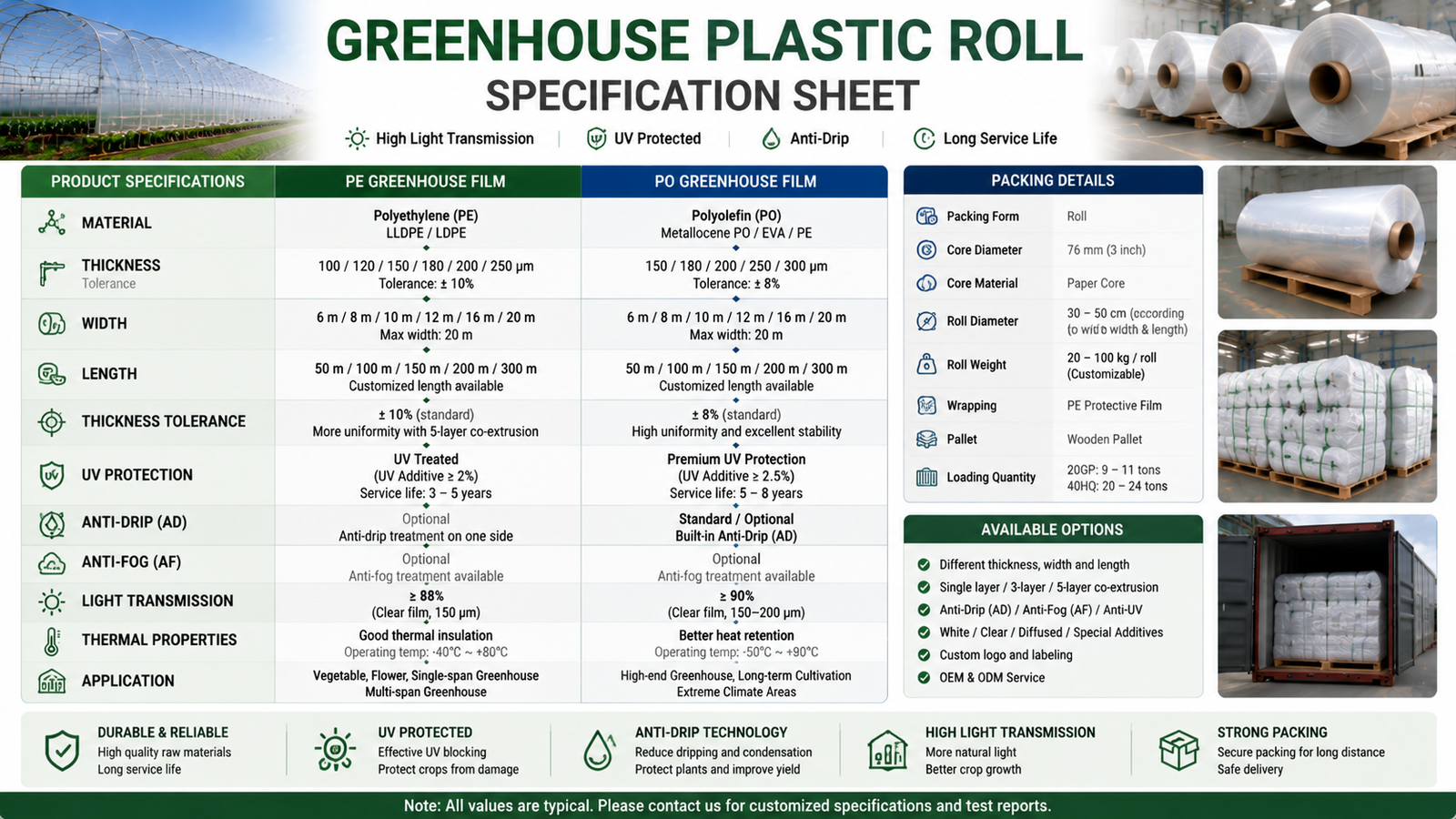
Greenhouse plastic roll specification sheet showing material, thickness, width, length, UV, anti-drip and packing details
  • By 肖恩
  • August 5, 2026

Greenhouse Plastic Roll Specifications: 12 Checks Before Ordering

Quick Answer: What Should You Check Before Buying Greenhouse Plastic Roll?

Greenhouse plastic roll specifications should define the material structure, finished width, roll length, thickness and tolerance, UV package, optical targets, functional additives, installation method, roll format, packing and required quality documents. For many commercial greenhouse and high-tunnel projects, UV-stabilized greenhouse-grade polyethylene film around 6 mil, or about 150 microns, is a practical starting point—not a complete order specification.

In actual quotation work, the expensive mistakes usually happen before production starts. A buyer may ask for "greenhouse plastic roll, 6 mil" and receive several low prices, but those quotations may not be based on the same width, additive package, roll length, service life or packing method. The roll can be produced correctly and still fail the project if the specification was incomplete.

If you already know the greenhouse dimensions, review the custom greenhouse plastic roll. If you are still choosing between film types, start with the commercial greenhouse film options and use the checklist below before sending an RFQ.

Table of Contents

Quick Specification Checklist
1. Start With the Greenhouse Project
2. Select Material and Film Construction
3. Define Thickness and Tolerance
4. Calculate Width, Length and Roll Format
5. Review UV Stability and Service Life
6. Compare Light Transmission, Haze and Diffusion
7. Decide on Anti-Drip, Anti-Fog and IR
8. Ask for Mechanical Strength and QC Data
9. Factory Review Before Quotation
10. Packing, Loading and Delivery
11. Common Mistakes
12. Decision Matrix
RFQ Checklist
FAQ

Quick Specification Checklist

Use this checklist before comparing prices from different greenhouse film suppliers. A few missing details can change the real cost, delivery time and installation result.

Greenhouse plastic roll specification sheet showing material, thickness, width, length, UV, anti-drip and packing details
Commercial greenhouse plastic roll specification sheet
ItemBuyer input neededFactory review pointRisk if missing
ApplicationTunnel, multi-span greenhouse, nursery, vegetable house, flower house, temporary coverWhether the film structure and additives match the useA low-cost film may be quoted for a project that needs multi-season performance
MaterialPE, PO, LDPE/LLDPE blend, EVA option or supplier recommendationResin blend, layer structure and additive compatibilityTwo films with the same thickness may perform differently
ThicknessMil or micron, plus tolerance if requiredThickness control, roll weight and mechanical strengthA cheap nominal thickness may not match the buyer's expected durability
Finished widthFlat width after unfoldingExtrusion width, folding method, roll diameter and handlingThe roll may be too narrow for installation
Roll lengthMeters or feet per rollWeight, winding, container loading and cutting planRolls may become too heavy to unload or pull over the frame
UV stabilityUV-stabilized, UV-blocking, UV-open, expected service lifeAdditive package, climate assumptions and warranty limitsEarly aging or crop/pollination problems
Anti-drip / anti-fogRequired function and expected durationAdditive type, layer orientation and production timingCondensation may reduce light or drip onto crops
Optical dataClear, diffused, white, cooling film, transmission and haze valuesTDS values and crop suitabilityA visually clear film may not give the best canopy light distribution
Mechanical dataTensile, elongation, tear or puncture data if availableQC method and film structureSame-thickness films may not handle installation stress equally
PackingCore, wrapping, pallet, label, private label, container loadingExport handling and unloading practicalityCorrect film may arrive in a format that is hard to handle
DocumentsTDS, sample, PI, COA, inspection photosPre-production and final inspection processDisputes become harder to resolve after shipment

1. Start With the Greenhouse Project

A greenhouse plastic roll is not specified only by "6 mil" or "200 micron." The first decision is the project itself: crop, structure, climate, replacement schedule and installation method.

For a seasonal low tunnel, a basic film may be acceptable if the buyer expects regular replacement. For a commercial vegetable greenhouse, nursery house or multi-span project, the film usually needs better UV stability, more accurate width control, stronger roll packing and clearer quality records.

A useful RFQ sounds like this:

We need UV-stabilized greenhouse plastic sheeting for a commercial hoop house. The frame width, arch height, required cover path, roll length, thickness, fastening method, crop type, climate and target service life are listed below.

A weak RFQ sounds like this:

Please quote greenhouse plastic, 6 mil.

The second message can still receive a price, but the price is not reliable for comparison. Different suppliers may assume different widths, roll lengths, UV packages, anti-drip systems or packing formats.

Workers installing greenhouse plastic sheeting over a commercial metal hoop house frame
Greenhouse plastic installation on metal hoop frame

Practical Scenario: Ground Width Is Not Film Width

A farm buyer may provide only the greenhouse ground width. That is not enough for a hoop structure. The film must cover the arch curve, sidewall allowance, fastening margin, overlap and trimming loss. If ground width is used as finished film width, the delivered roll can be too narrow even when the factory made exactly what was ordered.

Correct practice: measure the cover path over the actual frame or send the greenhouse drawing. Include sidewall height, fixing method and extra margin before the width is locked for production.

2. Select Material and Film Construction

Most greenhouse plastic film is based on polyethylene, but the final product can vary by resin, layer design and additive package. PE, LDPE, LLDPE, EVA blend, co-extruded film, PO film and reinforced film are not interchangeable labels. They affect flexibility, aging behavior, optical performance, strength and cost.

Greenhouse-grade PE film remains common because it is flexible, available in wide rolls and can be customized with UV stabilizers, anti-drip, anti-fog, IR, diffusion, color and anti-dust options. PO greenhouse film is often considered when the project needs longer service expectations, stronger optical stability or higher-value crop protection. The material name alone is not enough; ask for the actual film structure and technical data.

For PO-specific projects, compare the PO greenhouse film product page before deciding between PE and PO.

Film typeMain advantageLimitationSuitable use
Standard PE greenhouse filmCost-effective, flexible, easy to customizeService life depends heavily on UV package and installationCommercial tunnels, vegetable houses, nursery covers
UV-stabilized PE filmBetter outdoor aging resistance than non-greenhouse plasticWarranty conditions still need reviewMulti-season greenhouse covering
Anti-drip / anti-fog PE filmHelps control condensation inside humid structuresFunction duration depends on additive system and environmentHumid greenhouses, heated houses, high-value crops
PO greenhouse filmOften selected for stronger optical and aging performanceHigher cost and more specification-sensitiveMulti-span greenhouses and longer-service projects
Reinforced filmHigher tear resistance under demanding handlingHeavier and may affect light or flexibilityWindy sites, rough frames, exposed structures

3. Define Thickness and Tolerance

Thickness matters, but it is one of the easiest parameters to misunderstand.

In the US market, greenhouse plastic thickness is often described in mils. One mil equals 0.001 inch. International buyers often use microns. A common commercial starting point is 6 mil, about 150 microns. UMass Extension notes that greenhouse-grade poly for multi-year application is typically available in 6 mil thickness, while thinner 3 or 4 mil films are more common for one-year use on narrow tunnels or overwintering houses.

That does not mean thicker is always better. A heavier film may improve handling strength and puncture resistance, but it also increases roll weight, freight cost and installation labor. Depending on formulation, thickness can also influence light transmission. On wide greenhouse projects, a very heavy roll can become the installation problem.

Ask for:

  • Nominal thickness in mil or micron
  • Thickness tolerance
  • Roll weight estimate
  • Whether the value is for the finished film
  • Mechanical data where available
  • TDS or internal inspection standard
Thickness choiceAdvantageTradeoffProcurement advice
Thin seasonal filmLower cost and lighter handlingShorter usable life and lower tear resistanceUse only when replacement is planned
6 mil / about 150 micron greenhouse-grade filmBalanced starting point for many commercial projectsStill needs UV, width and additive detailsGood baseline for multi-season tunnel covers
Heavier filmBetter resistance to handling and puncture riskHigher cost, heavier roll, harder installationUse when wind, frame friction or service life justify it
Reinforced filmStronger tear resistanceMore expensive and may change optical performanceUse for exposed sites or rough structures

For a deeper thickness discussion, read the greenhouse plastic thickness guide.

4. Calculate Width, Length and Roll Format

Finished width and roll length affect installation, loading, labor and cost. A wider roll may reduce seams, but it also increases roll weight and handling difficulty. A longer roll may reduce changeovers during installation, but it can create a roll too heavy for farm unloading.

Before production, define:

  • Finished width after unfolding
  • Roll length
  • Folding method: unfolded, single-fold or double-fold
  • Core diameter
  • Maximum roll weight the buyer can handle
  • Pallet, woven bag or loose loading requirement
  • Label and private-label requirement
  • Container loading method
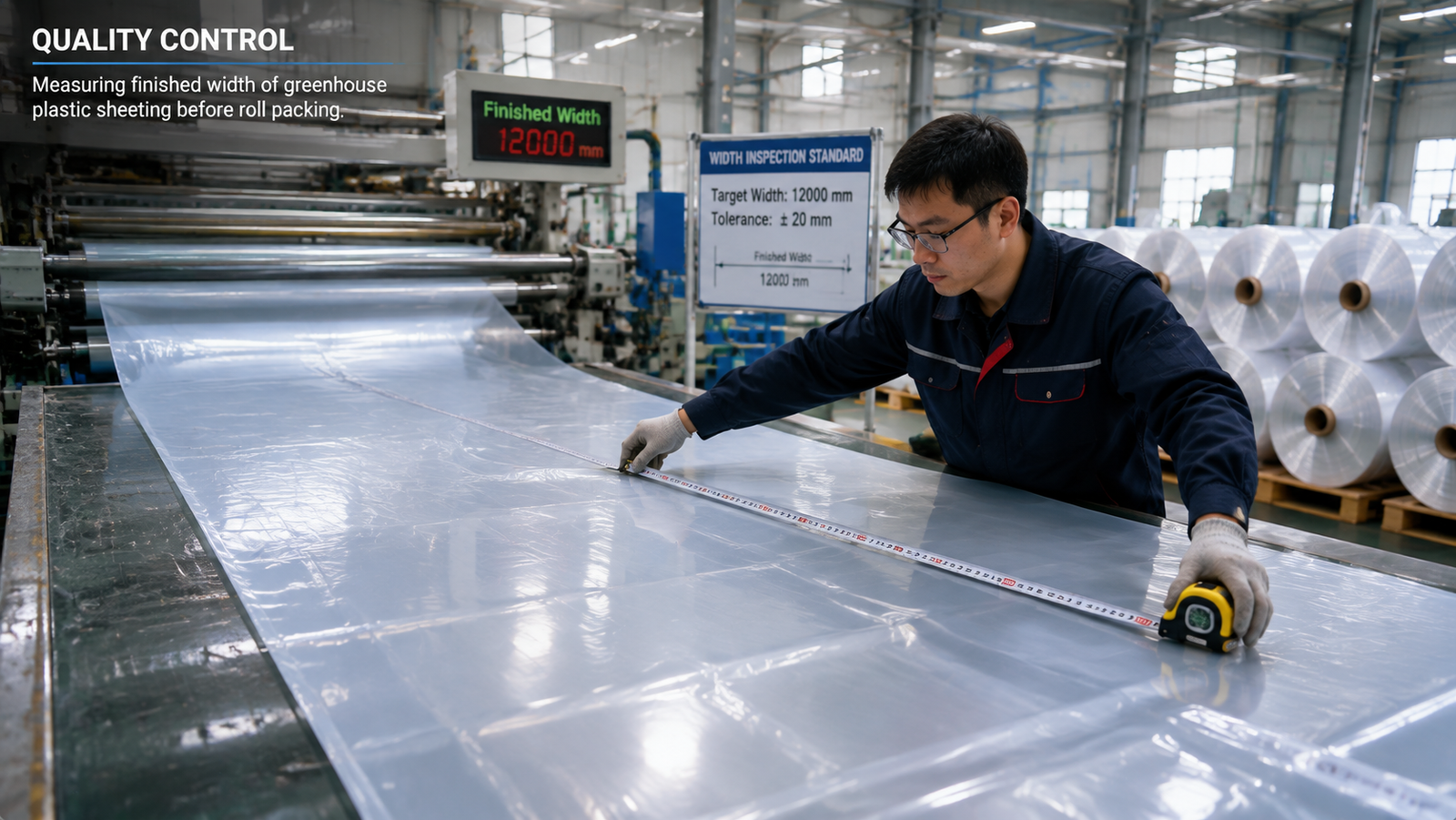
Factory technician measuring the finished width of greenhouse plastic sheeting before roll packing
Measuring finished greenhouse plastic width before production

Practical Scenario: Greenhouse Builders Need Drawings

A greenhouse construction company may work from project drawings. The buyer knows the structure span, arch height, sidewall height, lock channel position and overlap details. In this case, the film width should be calculated from the drawing, not chosen from a generic product list.

If the buyer orders standard width without checking the frame path, the installer may cut excessive overlap or lack enough margin at the fixing point. This can increase labor, leak risk and field complaints.

Correct practice: send the drawing or frame measurements before the PI is approved. Ask the supplier whether the requested width can be produced, folded, wound and shipped in the required roll length.

For finished-width calculations, roll-weight estimates and handling limits, use the greenhouse plastic roll sizes guide before approving the dimensional RFQ.

5. Review UV Stability and Service Life

UV stability is not the same as thickness. A thick non-greenhouse film without the right UV package can age faster than a thinner greenhouse-grade film with suitable stabilizers.

UMass Extension explains that greenhouse-grade poly contains UV stabilizer to reduce degradation and is intended for longer use than low-cost seasonal material. In procurement terms, that means buyers should not compare only film weight or price per square meter. When a quotation says UV resistant greenhouse plastic or UV stabilized greenhouse plastic, ask whether it refers to outdoor aging resistance, UV blocking, UV-open performance or a specific warranty condition. The UV package, climate, chemical exposure and installation quality all affect real usable life.

Define these points before the order:

  • Expected service life
  • UV-stabilized, UV-blocking or UV-open requirement
  • Local climate and sunlight intensity
  • Crop and pollination method
  • Chemical restrictions, including sulfur, chlorine, pesticides and fumigants
  • Contact with metal, wood, clips or rough frame edges
  • Warranty conditions and exclusions

This looks like a small wording issue, but it affects both performance and claim handling. If the project uses bees for pollination, UV-blocking film may need extra review. If the greenhouse uses chemicals that affect film aging, warranty language must be checked before purchase.

For related details, see the UV stabilized greenhouse plastic guide.

6. Compare Light Transmission, Haze and Diffusion

Greenhouse film is also a light-management material. Buyers often ask for "clear film," but clear appearance alone does not define crop performance.

Light transmission shows how much usable light enters the greenhouse. Haze and diffusion describe how the light is scattered. A highly clear film may look attractive, while a diffused film can distribute light more evenly across the crop canopy, especially with taller crops or intense sunlight. White or cooling films can help reduce heat but may lower direct light.

ASTM D1003 is a recognized test method for haze and luminous transmittance of transparent plastics. If optical performance matters, ask for TDS values instead of judging only by sample appearance.

RequirementBenefitTradeoffBuying advice
High transmissionMore light enters the greenhouseMay create harsher direct light if diffusion is lowAsk for data and crop suitability
Higher haze / diffusionMore even canopy light distributionFilm may look less clearUseful for tall crops or intense sunlight regions
White or cooling filmHelps reduce heat and soften sunlightLower direct light than clear filmUse where heat control matters more than maximum light
Anti-dust surfaceHelps maintain light over timeAdds costUseful for dusty farms or long-service applications

7. Decide on Anti-Drip, Anti-Fog and IR

Anti-drip and anti-fog are small line items in a quotation, but in humid greenhouses they can affect light, crop wetness and disease pressure.

UMass Extension describes anti-drip, also called condensate control, as a wetting agent that helps condensation flow rather than form droplets. It also notes that condensation droplets can reduce light transmission and cause disease issues when water drips onto plants.

Comparison of water droplets and flowing condensation on anti-drip greenhouse film surface
Anti-drip greenhouse film condensation comparison

The buyer should specify whether the project needs:

  • Anti-drip
  • Anti-fog
  • Both functions
  • Incorporated additive or surface treatment
  • Expected duration
  • Inner-layer orientation guidance
  • IR or thermal function for heated houses
FunctionWhat it managesBest fitProcurement warning
Anti-dripDroplets on the inner film surfaceHumid greenhouses and high-value cropsUsually needs to be specified before film production
Anti-fogFog formation inside the greenhouseEarly morning or late afternoon humidityDo not assume anti-drip automatically means anti-fog
IR / thermalNight heat lossHeated winter greenhouse or cold-night productionLayer orientation may matter in double-layer systems

If condensation is already a problem, review the anti-drip greenhouse film guide.

8. Ask for Mechanical Strength and QC Data

Two films with the same nominal thickness can behave differently during installation. Tensile strength, elongation, tear resistance and puncture resistance depend on resin, film structure, extrusion control and additives.

For exposed sites, rough frames or wide rolls, mechanical data is not a formality. The film must survive winding, loading, unfolding, pulling over the frame, fastening and wind movement.

Ask whether the supplier can provide:

  • Tensile strength in machine direction and transverse direction
  • Elongation
  • Tear resistance
  • Puncture or impact resistance if available
  • Thickness tolerance
  • Sample or reference sample
  • TDS or internal QC standard

ASTM D882 is a relevant test method for tensile properties of thin plastic sheeting and films. For roll length and average free width, ISO 4592 is a useful standard reference. The practical point is straightforward: price per kilogram does not tell you whether the roll will handle field installation.

9. Factory Review Before Quotation

A serious greenhouse film supplier should review whether the requested roll is producible, packable and suitable for the project. The quotation should not be only a unit price.

Buyer informationFactory checksEffect on price or delivery
Material and additive requestCompatibility of UV, anti-drip, anti-fog, IR, diffusion or colorAdditives affect cost, MOQ and production planning
Thickness and toleranceWhether the target can be controlled in the requested widthTight tolerance may increase inspection cost
Finished widthExtrusion, folding, winding and packing limitsVery wide rolls affect production speed and handling
Roll lengthRoll diameter and weightLong rolls may be difficult to unload or install
Packing methodCore, wrapping, pallet, label and container loadingPacking changes labor, freight volume and damage risk
QuantityMOQ, raw material preparation and production efficiencySmall custom runs may have higher unit cost
DocumentsTDS, COA, sample approval and inspection photosDocumentation requires QC planning before shipment

For custom commercial orders, agree on these files before mass production:

  • Proforma invoice with full specification
  • Sample or approved reference sample
  • Technical data sheet
  • Packing method and roll label
  • Color or transparency sample if relevant
  • Tolerance agreement
  • Inspection or COA requirement

You can review available quality documents and technical data sheets before placing an order.

10. Packing, Loading and Delivery

Packing becomes important when the roll reaches the farm or distributor warehouse. A technically correct film can still create problems if the roll is too heavy, unlabeled, poorly protected from moisture or loaded in an impractical sequence.

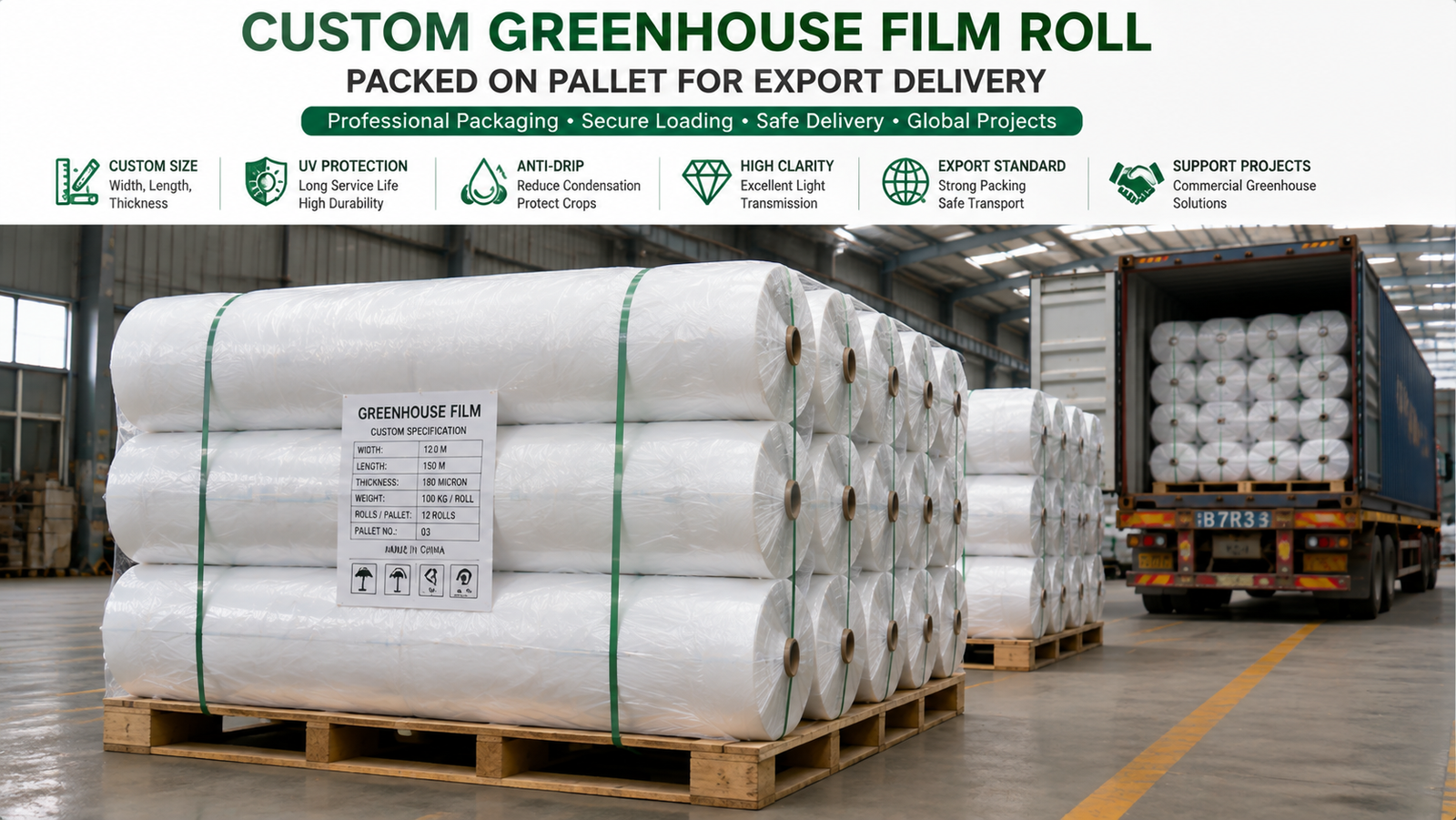
Custom greenhouse plastic roll packed on pallet for export delivery to a commercial greenhouse project
Greenhouse film roll packed for export shipment

For export and distributor orders, define:

  • Roll weight
  • Core size
  • Outer roll diameter
  • Individual wrapping
  • Pallet or loose loading
  • Label content
  • Private label requirement
  • Container loading quantity
  • Forklift availability at destination
  • Sorting by size, greenhouse block or project zone

Practical Scenario: Distributor Stock Is Not Project Customization

A distributor often needs regular inventory sizes, stable labels and repeatable packing. A greenhouse builder may need project-specific roll widths, roll lengths and block markings. These are different quotation models.

If the same assumptions are used for both, someone pays for the wrong complexity. A distributor may not need every roll customized. A project installer may not be able to use a generic stock roll efficiently.

11. Common Mistakes When Ordering Greenhouse Plastic Roll

MistakeWhy it happensConsequenceCorrect approach
Asking only for thicknessThickness is easy to compareThe quote may ignore UV, width, additives, tolerance and packingSpecify material, thickness, width, length, UV, anti-drip and documents together
Confusing ground width with finished film widthThe greenhouse looks rectangular from aboveThe roll may arrive too narrow for the frameMeasure the cover path over the arch and add fixing margin
Choosing the cheapest rollUnit price looks simpleEarly aging, tearing or replacement may cost more than the savingCompare price against usable life, crop risk and installation labor
Ignoring anti-drip in humid housesCondensation is treated only as a ventilation issueDroplets can reduce light and drip onto cropsDecide anti-drip and anti-fog before production
Ordering maximum width without handling planFewer seams sound betterThe roll may be too heavy to unload or install safelySet a practical roll weight based on crew and equipment
Treating warranty as a fixed guaranteeWarranty language sounds simpleChemicals, abrasion or incorrect installation may reduce actual lifeRead warranty limits and installation conditions before buying
Comparing quotes with different assumptionsSuppliers fill missing details differentlyThe lowest price may not be the same productAsk every supplier to quote the same RFQ sheet

12. Decision Matrix: Match Film Specification to Application

ApplicationSafer starting specificationWhyCheck before ordering
Seasonal low tunnelLower-cost PE or thinner seasonal filmReplacement is expectedSeason length, tunnel width, fastening and replacement plan
Commercial single-span greenhouseUV-stabilized greenhouse plastic roll around 6 mil as a baselineBalanced cost, flexibility and multi-season useFinished width, length, UV package, anti-drip need and roll weight
Humid vegetable greenhouseUV film with anti-drip, and anti-fog if neededCondensation can affect light and crop healthCrop type, humidity, ventilation and anti-drip duration
Heated winter greenhouseUV film with IR or thermal option plus condensation controlNight heat retention mattersHeating season, double-layer system and layer orientation
High wind or rough frameHeavier or reinforced optionInstallation stress and wind movement increase failure riskFrame condition, purlin spacing, fastening and abrasion points
Distributor stockStandard sizes with stable labels and packingRepeatability mattersPopular widths, label design, packing method and MOQ
Greenhouse builder projectCustom width and length based on drawingsInstallation fit matters more than stock convenienceDrawing, fixing method, block marking and delivery sequence

RFQ Checklist Before Ordering

Copy this format when sending an inquiry:

RFQ itemInformation to provide
Project typeSingle-span tunnel, multi-span greenhouse, nursery, vegetable, flower or temporary cover
Country and climateUV intensity, wind, snow, humidity, hot or cold region
CropVegetable, flower, nursery, mushroom, seedling or other
Film materialPE, PO, LDPE/LLDPE blend, EVA option or supplier recommendation
ThicknessMil or micron, plus tolerance if required
Finished widthRequired flat width after unfolding
Roll lengthLength per roll
Film functionUV, anti-drip, anti-fog, IR, diffusion, anti-dust or color
Light requirementClear, diffused, white, cooling or supplier recommendation
InstallationWiggle wire, lock channel, buried edge, batten, rope, clip or double layer
QuantityRolls, square meters, kilograms or container quantity
PackingCore, wrapping, label, pallet or private label
DocumentsTDS, COA, sample, inspection photos and export documents
DeliveryDestination port, unloading limits and required lead time

If the information is ready, send it through the request a quote page. If the installation method is still uncertain, define the fastening method and width allowance before finalizing the roll.

FAQ

What is the best greenhouse plastic roll specification for most commercial projects?

For many commercial greenhouse and high-tunnel projects, a UV-stabilized greenhouse-grade PE film around 6 mil, or about 150 microns, is a practical starting point. The final specification should still reflect frame size, crop, climate, wind exposure, condensation, expected service life and installation method.

Is greenhouse plastic sheeting the same as greenhouse film?

In many searches, greenhouse plastic sheeting and greenhouse film refer to similar flexible polyethylene covering materials. In procurement, the exact wording is less important than material, thickness, width, roll length, UV package, anti-drip requirement and roll format.

What mil plastic should I use for a greenhouse?

If the question is "what mil plastic for greenhouse use is safest for most commercial projects," 6 mil greenhouse-grade plastic is commonly used as a multi-season starting point. Thinner films suit temporary or seasonal tunnels. Heavier or reinforced films may fit windy locations, rough frames or high handling stress, but they increase roll weight and cost.

Does thicker greenhouse plastic last longer?

Not automatically. Thickness can improve handling strength, but service life also depends on UV stabilization, resin formulation, additives, installation, frame abrasion, chemical exposure and climate.

Do I need anti-drip greenhouse film?

If the greenhouse has high humidity, large day-night temperature differences or crops sensitive to leaf wetness, anti-drip is worth specifying. It helps condensation flow along the film instead of forming droplets.

What is the difference between UV-stabilized and UV-blocking greenhouse plastic?

UV-stabilized film is formulated to resist sunlight degradation. UV-blocking film reduces part of the UV spectrum entering the greenhouse. These are different decisions, especially where pollination or pest control matters.

Can the supplier adjust roll width after production?

Not in a practical way for a finished roll. Width must be defined before extrusion, folding, slitting and winding. If the width is wrong, the issue usually becomes a cutting, replacement or installation problem.

How should I compare supplier quotations?

Compare the same RFQ sheet across suppliers: material, thickness, tolerance, width, length, UV package, anti-drip, optical data, packing, documents, MOQ and lead time. If one quote is much cheaper, check what has been removed.

Conclusion: Turn Project Information Into a Confirmed Specification

If you already know the greenhouse dimensions, start with the custom greenhouse plastic roll specification. If the project needs longer service life or higher optical performance, compare PO greenhouse film options before requesting price.

If the order is not ready, prepare these details first:

  • Greenhouse type and frame dimensions
  • Film cover path or required finished width
  • Roll length and quantity
  • Thickness in mil or micron
  • UV, anti-drip, anti-fog, IR or diffusion needs
  • Crop and climate conditions
  • Installation method
  • Packing and unloading requirements
  • Required documents

Once these points are clear, the factory can quote a roll that is producible, packable and suitable for the greenhouse site. That is the difference between buying plastic film and buying a confirmed greenhouse covering specification.

About the Author

Sean writes about greenhouse film specification, quotation preparation and B2B purchasing decisions for commercial farms, greenhouse builders and agricultural distributors. His work focuses on practical details that affect real orders, including PE and PO greenhouse film selection, finished width calculation, UV and anti-drip requirements, roll packing, technical data sheets and pre-shipment quality checks.

External References

  • UMass Extension: Plastic Greenhouse Film Update
  • ASTM D882: Standard Test Method for Tensile Properties of Thin Plastic Sheeting
  • ASTM D1003: Standard Test Method for Haze and Luminous Transmittance of Transparent Plastics
  • ISO 4592: Plastics - Film and sheeting - Determination of length and width

Leave a Reply Cancel reply

Your email address will not be published. Required fields are marked *

Search Here

Categories

  • Greenhouse Film Guides
  • Plastic Film Knowledge

Current Affair

Greenhouse film lifespan comparison for seasonal co-poly, four-year 6 mil polyethylene and specialty coverings
How Long Does Greenhouse Film Last? Lifespan, By 肖恩 August 11, 2026
Greenhouse plastic roll specification sheet showing material, thickness, width, length, UV, anti-drip and packing details
Greenhouse Plastic Roll Specifications: 12 Checks Before By 肖恩 August 5, 2026
Diagram explaining polyethylene, polyolefin, layer structure and supplier-defined PO greenhouse film terminology
Clear PE Greenhouse Film vs PO Greenhouse By 肖恩 July 27, 2026
Anti-drip greenhouse film covering a commercial greenhouse where condensation is guided toward the sidewalls
Anti-Drip Greenhouse Film Roll: How It Helps By 肖恩 July 22, 2026

Popular Tags

Plastic film Plastic film applications Plastic film material Plastic film uses Types of plastic film What is plastic film
Factory Direct Plastic Film Supplier

Need Custom PE Film?

Get custom greenhouse film, mulch film, packaging film, furniture covers, pallet covers and construction film solutions for your project.

Request a Quote
logo1

Henan Tianfeng Biotech (Est. 2015) is a leading plastic film manufacturer producing 95,000 tons annually. We specialize in high-performance agricultural film, greenhouse film, mulch film, and protective solutions including mattress bags and furniture covers. Quality driven and ISO-certified.


Since 2015

About us

  • Company Profile
  • Our Certificates
  • Factory capacity
  • Sustainability
  • Company News

Solution

  • Agricultural solutions
  • Industrial and Safety Solutions
  • Building and Painting Solutions
  • Packaging and Storage Solutions

Support

  • FAQ
  • video
  • Download
  • blog center
  • Contact

Office Address

  • No. 1 Tianguan Avenue, Wancheng District, Nanyang City, Henan Province。

Email Address

Interested in working with us? info@tianfengbiotech.com
Phone: 0086-371-66390699
Facebook-f Youtube Linkedin-in Reddit
Copyright © 2026 Henan Tianfeng Biotech CO.,LTD. All rights reserved....
  • ←
  • Contact Us
    Contact Form