
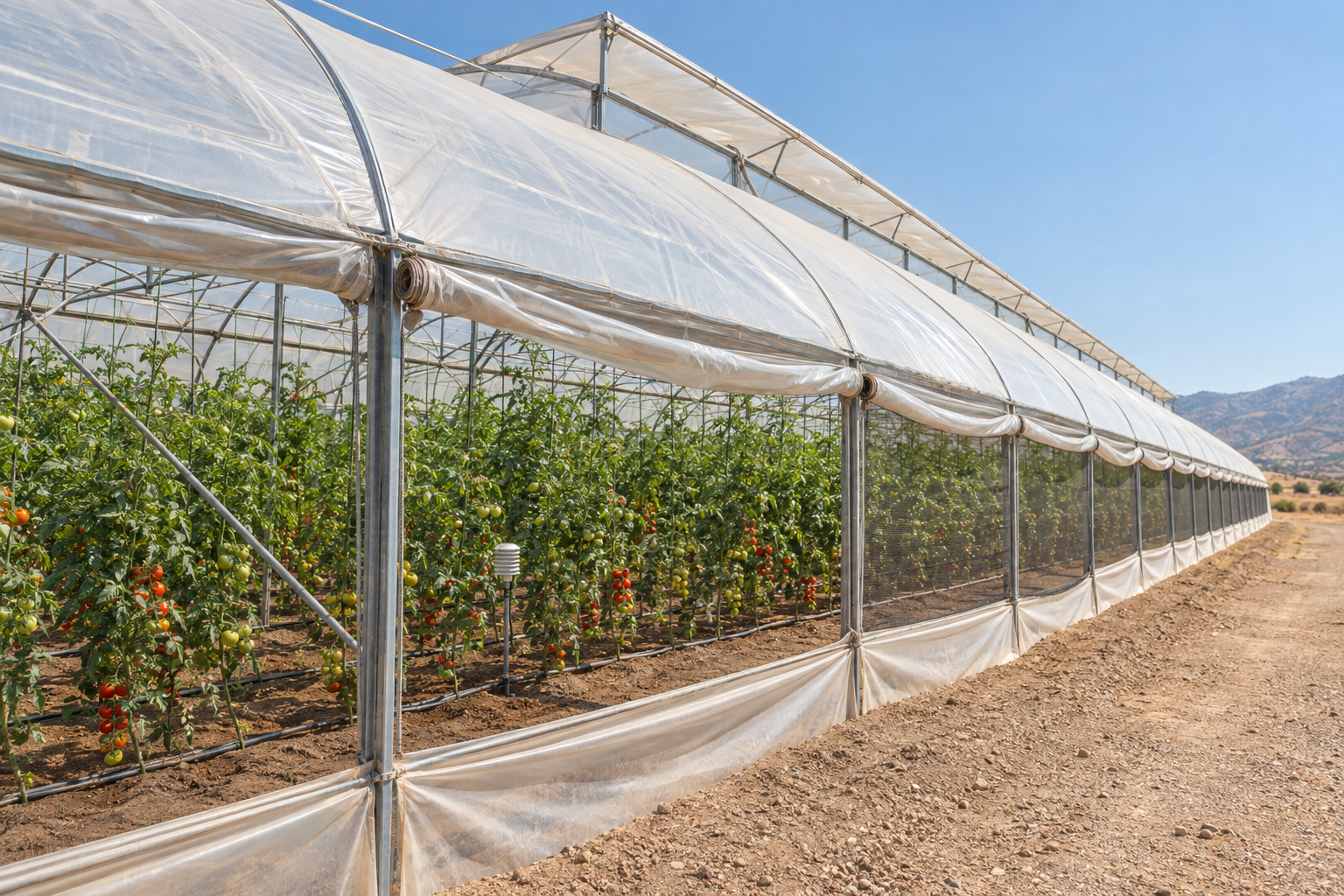
Greenhouse Film for Hot Climates: Light, Heat and Specification Checks
Choosing greenhouse film for hot climates starts with two questions: how much heat must the project manage, and how much light must still reach the crop? A film described as white, diffused, thermal or cooling does not answer both questions by itself.
Short answer: compare the actual film grade's light transmission and heat-management data against the crop, growing season and greenhouse cooling system. Start with the problem you need to solve:
- Excess daytime solar heat: request solar spectral data, including near-infrared (NIR) performance, alongside crop-light transmission.
- Uneven light exposure: compare scattering and total transmission together.
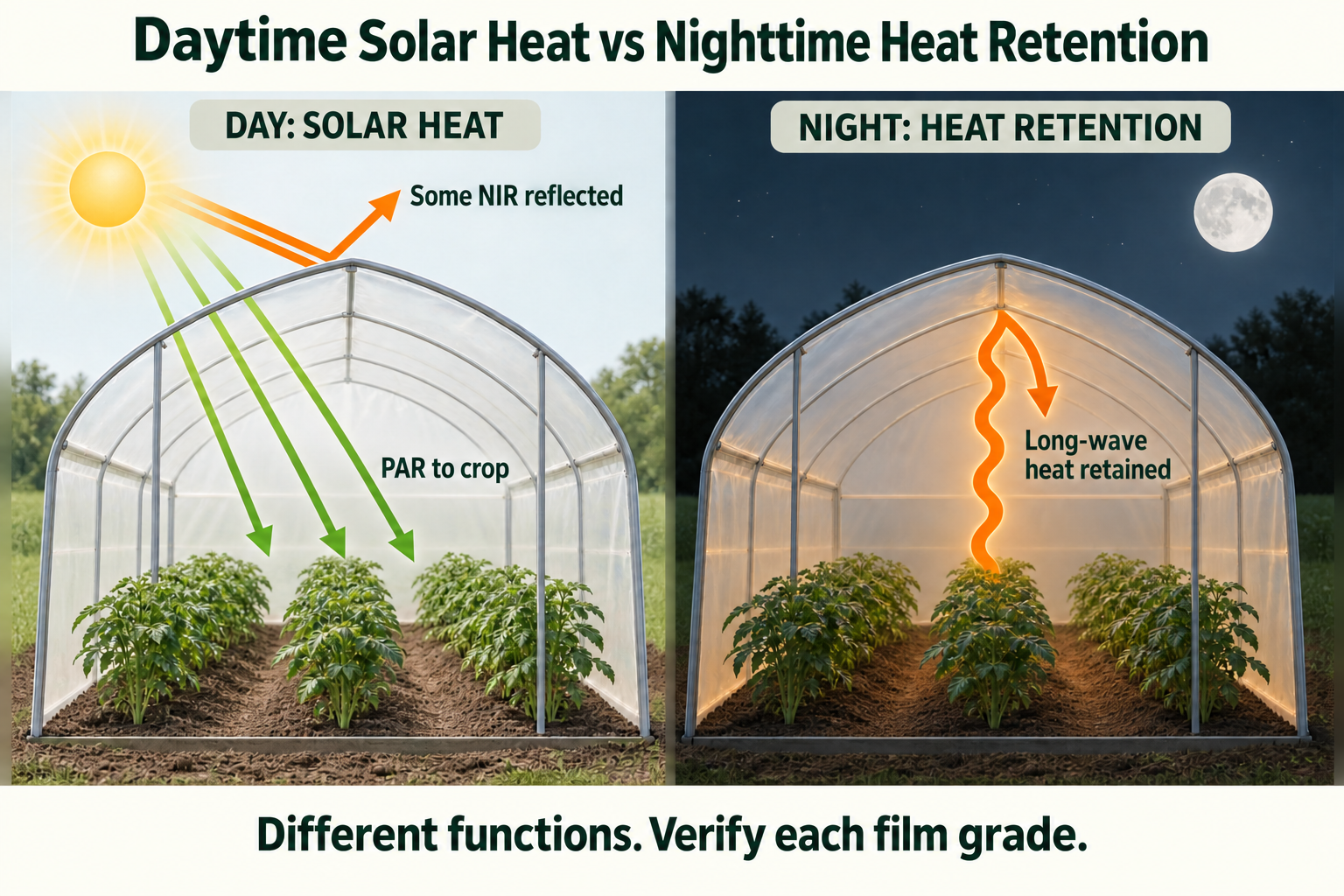
- Hot days and cool nights: confirm daytime solar control and nighttime heat retention separately.
Then confirm the specification with a representative sample and, where practical, a monitored trial before committing the whole project.
This guide helps growers, greenhouse project buyers and distributors turn those priorities into a comparable specification for flexible covers.
1. Define the heat problem before choosing a film
Replace a broad description such as “a very hot country” with the conditions during the actual crop cycle. A dry summer site, a humid tropical site and a location with hot afternoons but cool nights do not present the same design problem.
- Location and season: record the site, planting and harvest months, hot-weather temperature and humidity, and whether the cover stays in place through a darker season.
- Crop requirements: identify the crop, growth stage, production objective and acceptable temperature and light conditions with the grower or crop adviser.
- Structure and operation: describe the span, height, single or double cover, vents, screens, shade system, fans and any evaporative cooling.
- The observed problem: distinguish high air temperature, uneven crop exposure, a hot end of the house, or insufficient light during cloudy weather. Record where and when it occurs.
For basic material choices, use the greenhouse plastic selection guide. The additional task here is to turn a climate concern into a measurable cover specification.
2. Do not treat every “IR” or “diffused” film as a cooling film
UMass Extension distinguishes films that reduce daytime heat gain from films that reduce nighttime radiant heat loss. These are different functions. An “IR” label is therefore a reason to ask for details, not enough information to approve a warm-climate project.
On a small screen, scroll the table sideways to read all columns.
| Property | Question it helps answer | What it does not establish |
|---|---|---|
| PAR transmission | How much radiation in the stated photosynthetic waveband passes through the tested film? | The light received by every leaf, daily crop light exposure, or final greenhouse temperature. |
| Haze or light diffusion | How does the material scatter transmitted light under the stated method? | A high total transmission, a specific shading percentage, or automatic cooling. |
| Solar NIR performance | What near-infrared wavelengths are reflected, transmitted or absorbed? | A temperature reduction equal to the quoted optical percentage. |
| Thermal / long-wave IR performance | How does the cover affect outgoing radiant heat, particularly at night? | That incoming solar NIR is rejected during the day. |
Photosynthetically active radiation (PAR) is the light band commonly measured for photosynthesis; traditional PAR measurements cover 400–700 nm. Daily light integral, or DLI, adds up photosynthetic photon exposure over a day; it is not interchangeable with a single midday reading. Apogee's measurement guidance also distinguishes traditional PAR from extended-PAR instruments. Record the sensor's band and units when comparing results.
Haze and transmission must be read separately. ASTM D1003-21's public scope addresses haze and luminous transmittance, not a crop-specific PAR measurement. Do not relabel a luminous-transmittance result as PAR, or calculate shade percentage as “100 minus haze.” The applicable method must suit the material being tested.
If the immediate choice is between clear and white-looking covers, the white versus clear greenhouse film comparison explains that distinction. Appearance alone is not a substitute for optical data.
3. Read the sample identity before reading the performance claim
A useful report connects a result to a specific film. Ask for the grade, tested thickness, sample condition, test method and wavelength range. For transmission, clarify whether the result measures direct or total transmitted light. If a supplier provides only a headline percentage, keep the comparison open until its meaning is explained.
The public ASTM description shows why geometry and procedure matter for haze and luminous transmission. A number from a different method or specimen should not silently become a like-for-like ranking. This is a purchasing check, not a claim that all suppliers must use one test standard.
A published example—not a product specification
In a tropical-greenhouse film study, the industrially blown T3 sample, 120 micrometers thick, had 62.0% PAR transmission and 22.3% NIR reflectance under the authors' method. Their reported bands were 400–700 nm for PAR and 700–2500 nm for NIR. These were band-average optical results, not a temperature-reduction percentage.
The laboratory-laminated M8 sample with the selected formulation had different optical results. The commercial field comparison also differed in thickness and other properties. Check light transmission alongside the heat-control claim and use data for the actual supplied construction. These are research samples, not TIAN FENG specifications or a guaranteed field outcome. Read Petchsuk and colleagues' original study, especially Tables 4 and 7.
For a purchase, request the production-grade report rather than assuming that a development sample, a different thickness or another supplier's published trial represents the offered roll. Ask which values are typical, which are contractually specified and what tolerances apply.
A quick quote-review example
- The quote says only “IR film”: mark the function as unconfirmed and ask whether it refers to incoming solar radiation or outgoing long-wave heat.
- The report names a waveband but tests another grade: request evidence connecting that sample to the offered construction before using its values.
- Grade, thickness and method match the offered film: move on to comparing the values with your crop requirements and trial plan. A traceable report is a starting point, not proof of suitability by itself.
4. Match the cover to the climate and cooling system
Hot and dry conditions
Review solar heat control alongside the crop's light needs and the available cooling system. Direct evaporative cooling depends on the incoming air's wet-bulb temperature and system efficiency. UF/IFAS explains these limits; a film does not remove the need to size, operate and maintain the cooling equipment correctly.
Hot and humid conditions
At the same outside dry-bulb temperature, more humid air leaves less potential for direct evaporative cooling. Do not copy an arid-climate result onto a humid site. Ask the greenhouse designer to review airflow, cooling capability and crop conditions together before relying on a new cover.
Hot afternoons with cool nights or a cloudy season
Include night temperatures and lower-light months in the decision. Ask whether daytime heat management, nighttime retention or a combination is required, and request evidence for each claimed function separately. A fixed optical choice should not be judged only on the hottest afternoon of the year.
UMass ventilation guidance describes the roles of wind, vent openings and system operation. Have the actual vent and screen arrangement assessed; film selection cannot establish that air exchange is adequate.
Shading is a separate design decision. Its placement and operation affect both light and heat, so coordinate it with the cover and crop plan rather than automatically combining maximum shading with the lowest-transmission film. UMass's shade-for-cooling guidance discusses how shading is used within the greenhouse system.
5. Build a specification that suppliers can compare
Send the same project brief to each supplier. Keep missing information marked “to confirm” instead of treating it as zero or assuming that an attractive product name answers the question.
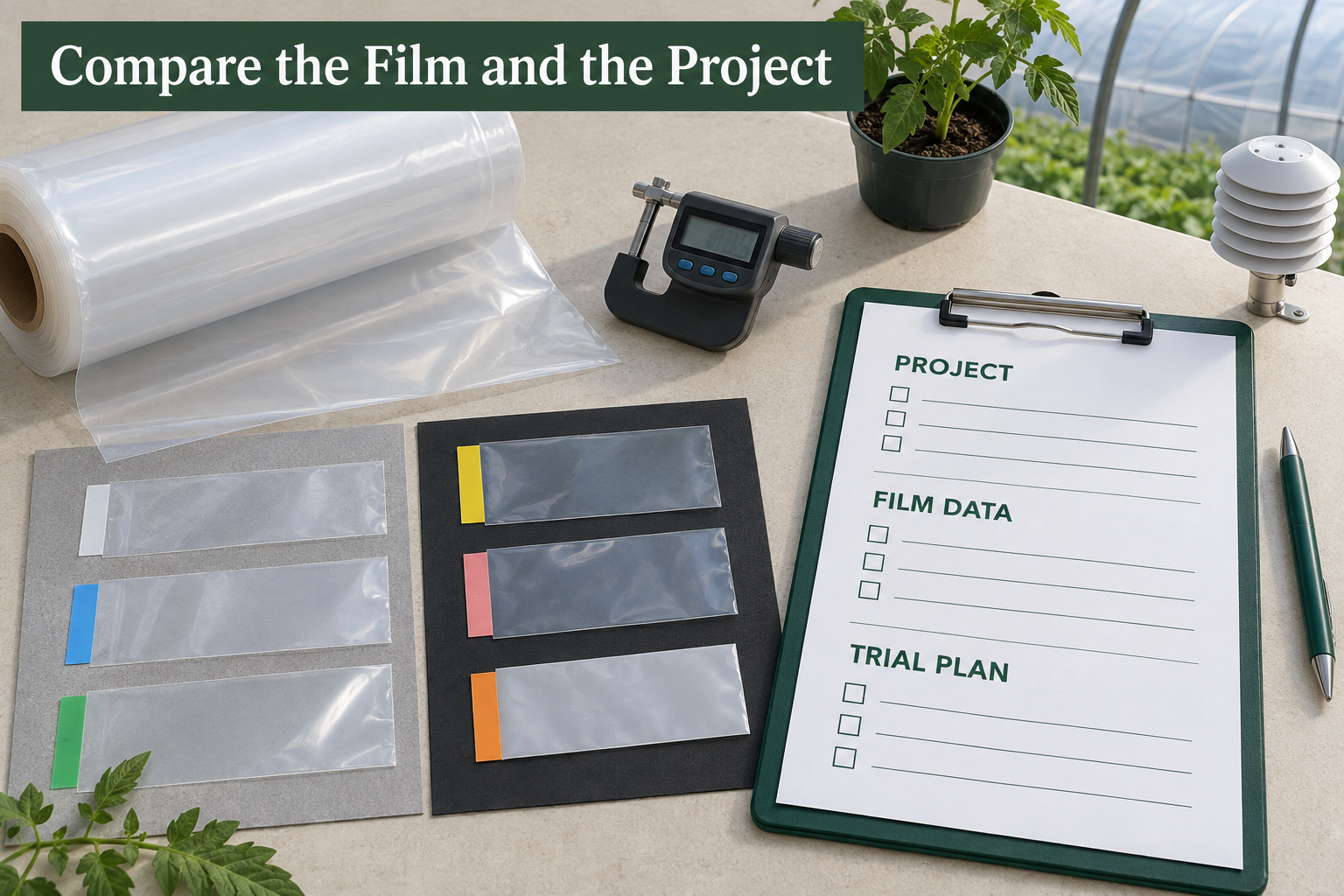
| Record | What to request or agree |
|---|---|
| Project and crop | Location, planting window, crop stage, temperature concerns, light requirements and existing climate-control equipment. |
| Film identity | Grade code, construction, nominal thickness and tolerance; confirmation that the report and sample represent the offered grade. |
| Optical evidence | PAR or other transmission band, method and geometry; diffusion or haze method; NIR reflection, transmission or absorption where claimed. |
| Thermal evidence | Meaning of any IR or thermicity claim, measurement method and intended daytime or nighttime function. |
| Service conditions | Intended exposure, supplier-defined service or warranty conditions, chemical compatibility, handling and cleaning restrictions. |
| Installation and supply | Film orientation, attachment requirements, finished width, roll length, core, roll weight, packing and required quantity. |
| Acceptance | Approved sample, agreed measurements and tolerances, trial observations, document revision and responsibility for resolving differences. |
Keep durability and cooling claims separate. UMass identifies sunlight, heat, structural contact and chemical exposure among relevant film-life considerations; a UV-stabilized designation does not establish a particular cooling result. The greenhouse film thickness guide covers thickness selection separately.
6. Plan a trial that can answer the purchase question
Before replacing the full cover, agree what the trial must show. A comfortable visit or one favorable thermometer reading is not a sufficient basis for a seasonal purchase.
- Identify the comparison. Record the reference cover and candidate grade, thickness, installation date and condition. Keep the structure, crop stage and operating settings as comparable as practical.
- Record the weather. Log outside temperature and humidity at the same times as greenhouse measurements. Where practical, also record outside PAR so changes in available sunlight are visible. Include challenging sunny periods and representative lower-light conditions.
- Measure where the crop is. Use suitable, radiation-shielded air-temperature sensors at consistent crop-level locations. Record positions rather than moving instruments to whichever spot gives the preferred reading.
- Track light over time. Use suitable quantum sensors and data logging to integrate readings across the day. Keep the sensor waveband, position and recording period consistent between comparisons. This describes crop light exposure in the greenhouse, not a laboratory measurement of film transmittance.
- Log system operation. Record vent and shade positions, fan and cooling operation, irrigation changes and unusual events alongside the measurements.
- Review both benefits and trade-offs. Compare heat management, crop light availability and operational demands. Investigate differences before approving the production order.
UF/IFAS documents temperature gradients between cooling pads and other parts of a greenhouse, and the importance of representative sensor placement. A pad-outlet reading should not be presented as the temperature throughout the crop. See the temperature-gradient and controls sections.
If covers are tested in different houses or on different dates, record that limitation. Observed differences may include weather, structure and management effects. This proposed trial checklist is not a report of tests already conducted by TIAN FENG.
7. Turn the findings into a useful inquiry
Start with the project requirements rather than asking for “the strongest cooling film.” You can adapt this brief:
We need greenhouse film for [crop and growth stage] at [location], used from [month] to [month]. Our concern is [daytime heat / uneven light / hot days and cool nights]. The greenhouse has [structure and vents] and uses [shade or cooling equipment]. Please identify suitable available grades and provide comparable optical data, tested thickness, installation instructions and applicable service conditions. We also need [width, length and quantity]. Please state any information still required and whether a representative sample is available.
If a performance field is unavailable, say so in the comparison. It is better to resolve a missing test definition before ordering than to discover that two attractive percentages described different measurements.
Discuss the cover and the project together
Use the greenhouse film overview to review the product scope, then send your project requirements. Include your location, crop cycle, greenhouse design, required dimensions and current cover data so available grades, evidence and quotation details can be reviewed together.
Frequently asked questions
What if the supplier cannot provide NIR test data?
Treat the claimed NIR function as unverified, not as automatic proof that the film is unsuitable. Clarify the intended use, available transmission data and what the supplier can document. Decide whether a representative sample and project trial can answer the remaining purchase question.
Does an IR greenhouse film always reduce daytime heat?
No. An IR claim may describe nighttime heat retention rather than rejection of incoming solar near-infrared radiation. Ask which function is being specified and which measurement supports it.
Does a high haze value mean the greenhouse will be cooler?
Not by itself. Haze describes scattering under a stated test method. It does not establish total PAR transmission or the temperature achieved in a greenhouse. Review the transmission data and operating conditions alongside it.
Can greenhouse cooling film replace ventilation or shade?
Do not assume it can. Assess the cover with the greenhouse's air-exchange capacity, crop light target and other cooling measures. Whether shade is needed, and when it operates, is a project decision rather than a universal instruction.
Should I specify a fixed temperature reduction in the order?
Only if the parties agree on a meaningful test, reference conditions, measurement locations and acceptance criteria. A general research result or marketing claim is not enough to guarantee the same temperature reduction at your site.
References and technical reading
These sources explain the principles and measurement boundaries used in this guide.
- UMass Extension: Plastic Greenhouse Film Update — film functions, optical properties and service considerations.
- Apogee Instruments: Daily Light Integral Measurement — PAR bands, photon measurements and daily exposure.
- ASTM D1003-21: public scope and significance — haze and luminous-transmittance measurement; not a reproduction of the full standard.
- Petchsuk et al. (2019): Development of Multifunctional Film for Greenhouse Applications in Tropical Regions — production-sample optical results and study conditions.
- UF/IFAS: Fan and Pad Greenhouse Evaporative Cooling Systems — humidity limits, temperature gradients and sensor placement.
- UMass Extension: Ventilation for Greenhouses — natural and mechanical ventilation considerations.
- UMass Extension: Shade for Cooling Greenhouses — coordinating shading with greenhouse climate management.