
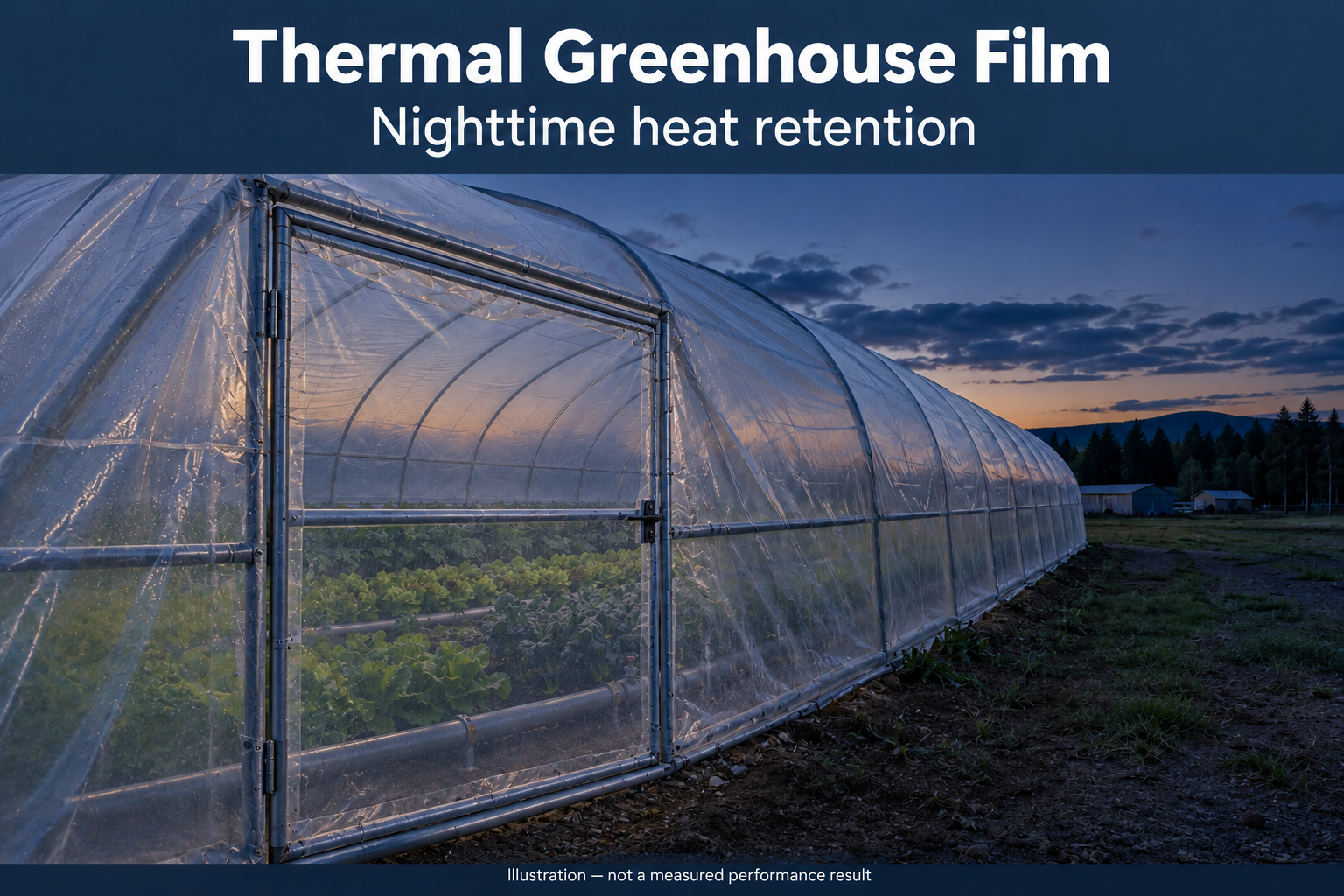
Thermal (IR) Greenhouse Film: Nighttime Heat Retention
Thermal, or IR greenhouse film, is intended to reduce the escape of longwave radiant heat. For a buyer, the useful question is which heat-loss mechanism the film addresses, what the reported measurement means, and whether the proposed installation matches the evidence.
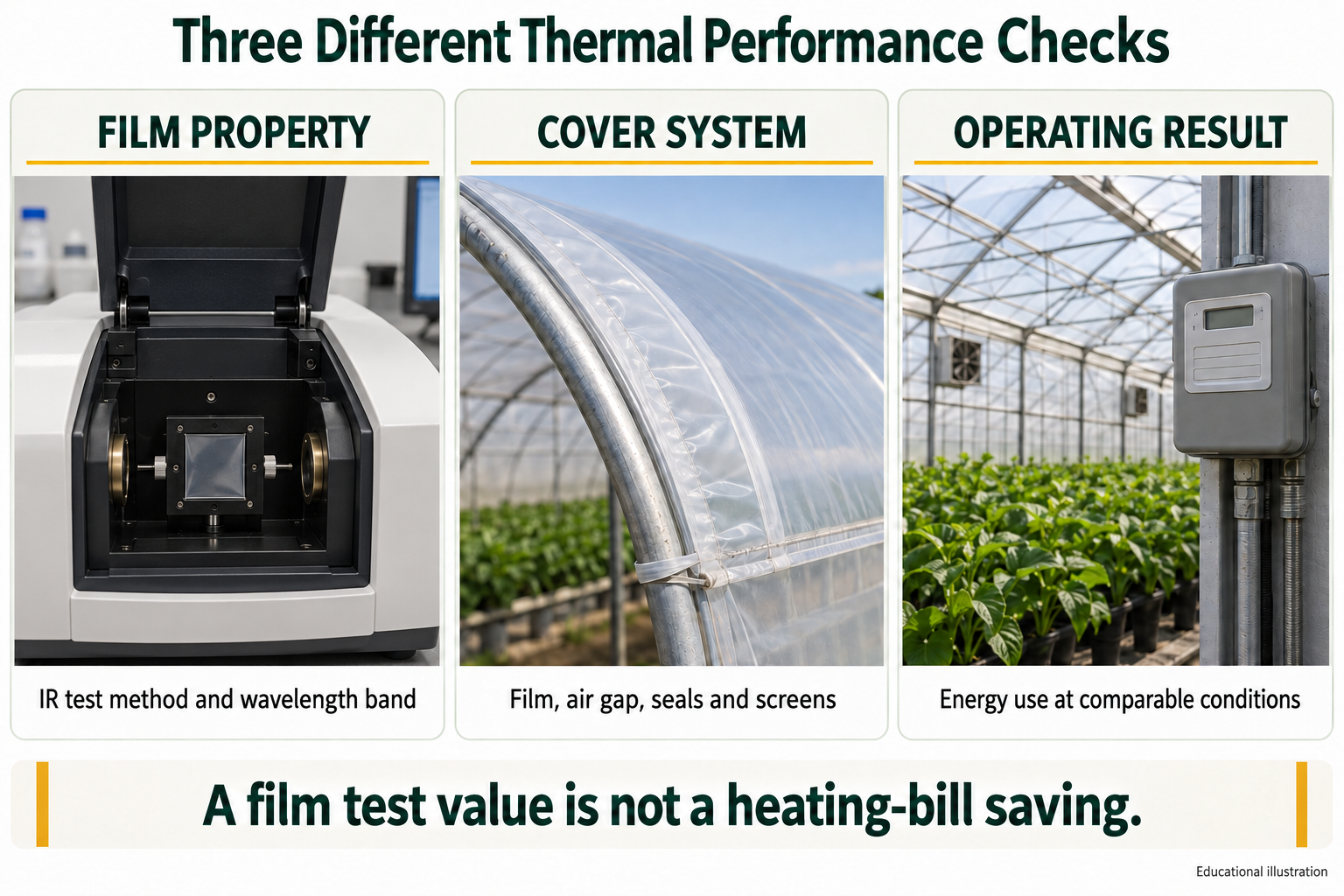
Buying takeaway: keep three things separate: the film's infrared optical properties, heat loss through the complete covering system, and measured heating energy. A thermicity figure cannot, by itself, establish fuel savings or a minimum overnight temperature.
This guide concerns greenhouse cover film for nighttime heat retention. It explains how to review a specification and plan a comparison; the suggested buying checks are not a certification standard.
1. What does thermal greenhouse film actually do?
Plants, soil and other surfaces exchange thermal radiation with their surroundings. An IR-retaining film changes how some of that radiation passes through the cover. It does not eliminate heat transfer through the structure, air leakage, ventilation or other routes.
UMass Extension distinguishes additives that reduce nighttime radiant heat loss from treatments that reduce daytime solar heat gain. The latter can reflect or absorb near-infrared solar radiation. Ask whether a quoted “IR” feature means nighttime retention, daytime NIR control, or a documented combination.
An original thermal-film study evaluated long-infrared absorbers alongside optical and mechanical properties. Its different formulations affected haze differently. The practical lesson is to request separate measurements rather than infer light transmission or thermal behavior from a resin name.
Likewise, a 6 mil thickness states a dimension, not proof of an IR function. Use the greenhouse plastic thickness guide for thickness questions, and request the thermal evidence separately.
2. Separate three levels of thermal evidence
A number can be accurate yet answer the wrong purchasing question. Before comparing quotations, identify what was tested and which conclusion the test can support.
On a small screen, scroll the table sideways to read all columns.
| Evidence level | What to request | What it cannot establish alone |
|---|---|---|
| Film IR properties | Defined wavelength band, transmittance or thermicity definition, test method, thickness and sample condition. | A whole-greenhouse energy saving or guaranteed crop temperature. |
| Complete covering system | Tested assembly, layer order, air gap or inflation conditions, and a defined heat-transfer result. | The actual heating consumption of a different greenhouse with different operation. |
| Heating energy in use | Metered energy over stated periods, comparison covering, temperature targets, weather and operating records. | A universal saving transferable to every crop, climate or installation. |
If a covering report quotes a U-value, ask which assembly and test conditions it represents. This is a heat-transfer coefficient, commonly expressed in W/m²·K, rather than an optical blocking percentage. Comparing a single-sheet optical result with a double-cover heat-transfer result does not establish that one product is better.
In a Rutgers experimental comparison, the researchers measured heat input and environmental conditions rather than relying only on film labels. They discussed location, wind and heating-system interactions when interpreting the results. Those are reasons to examine the comparison design before accepting an energy claim.
3. Heated and unheated greenhouses need different questions
In a heated greenhouse, the relevant question is whether the proposed covering reduces energy needed to maintain the agreed crop conditions. The comparison must retain the same temperature targets and account for changes in curtains, ventilation and heating operation. A lower bill after lowering the setpoint does not isolate the film's contribution.
In an unheated house, ask about the overnight temperature pattern and the conditions under which it was observed. The film supplies no heat. Available stored energy, outside conditions and other heat-loss routes still matter, so thermal film alone does not establish frost protection or eliminate a heating requirement.
Record plant-zone air temperature separately from any leaf or growing-medium measurements. Label each measurement accurately; one sensor near the roof cannot establish conditions throughout the crop.
4. Confirm layers, orientation and independent features
A coextruded multilayer sheet is one film product. A double-cover installation uses two separate sheets, commonly with an inflated space between them. More coextrusion layers do not automatically establish the insulation of a double-cover assembly.
UMass's installation guidance places the IR film inside a double-poly system. Treat that as a typical configuration to discuss, then obtain the instructions for the actual film pair. Confirm both layer position and which film surface faces the crop; these are separate questions.
The RKW manufacturer portfolio lists thermic behavior, cooling, anti-drip and diffusion separately. Its product matrix includes thermic films without anti-drip. This illustrates why one feature should not be inferred from another; it is not a specification for TIAN FENG products.
Discuss condensate behavior using the anti-drip greenhouse film guide. For material comparisons, the PE versus PO greenhouse film guide provides context, but a material label still cannot replace the selected product's thermal and optical data.
5. Read beyond the thermicity percentage
Ask the supplier to identify the tested product and explain the reported value. “Thermicity,” “IR blocking” and “IR transmission” should not be treated as interchangeable without their definitions.
- Identity: match the report to the quoted product, thickness and revision; record who performed the test.
- Method: obtain the wavelength range, calculation or averaging basis, test method and any stated deviations.
- Condition: establish whether the sample was new or aged, dry or otherwise conditioned, and whether one sheet or an assembly was measured.
- Light: request defined PAR transmission and diffusion information separately, with comparable methods and conditions.
- Installation: obtain the intended layer position, surface orientation and compatible cover-system instructions.
If two reports use different bands or definitions, ask for an explanation or comparable testing. Do not rank them simply by choosing the larger percentage. Also confirm whether listed values are typical measurements, acceptance limits or warranted performance.
A report on a development sample also needs a clear connection to the material offered for purchase. Ask which production specification it represents and how the supplier will identify the delivered roll. An impressive graph without that connection leaves the purchasing question unresolved.
6. Plan a useful nighttime comparison
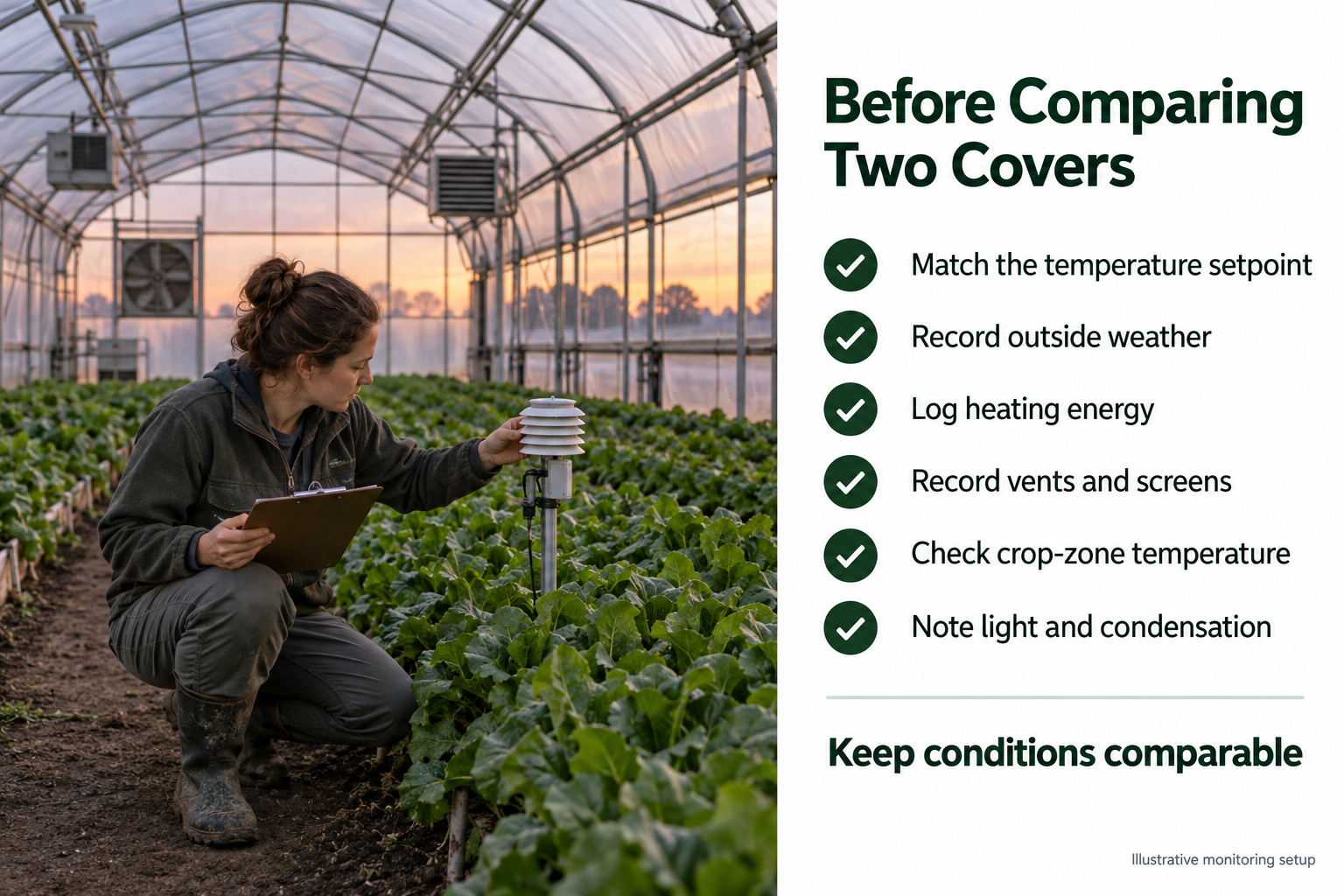
The following is a suggested project record, not a standardized test protocol. Agree the comparison and acceptance questions before changing the covering. Use matched measurement locations and consistent instruments, and retain raw readings alongside summaries.
A simultaneous comparison can help expose weather differences, but neighboring houses may still differ in shelter, leakage and equipment. A before-and-after comparison also changes dates and conditions. Record these differences instead of assigning every change to the film.
On a small screen, scroll the table sideways to read both columns.
| Record item | What to record consistently |
|---|---|
| Cover and baseline | Film identity, age, layer arrangement, inflation condition, comparison cover and any repairs or changes. |
| Weather and timing | Observation start and end, outdoor temperature, wind, sky conditions and rain or cover wetness. |
| Starting conditions | Prior daytime solar exposure and shading, conditions at the start of the observation, and soil or growing-medium temperature where stored heat is relevant. |
| Heating control | Night setpoint, scheduled changes, equipment operation and interruptions. |
| Curtains and ventilation | Curtain position and timing, vent and door operation, circulation fans, dehumidification operation if used, and unusual openings. |
| Energy input | Meter readings, units and measurement boundary; distinguish measured energy from fuel cost. |
| Crop conditions | Plant-zone temperature and relative humidity with sensor height and location; identify leaf or medium readings separately. |
| Exceptions and decision | Missing readings, control changes, faults, unmatched conditions and checks to repeat. |
Review multiple relevant nights rather than selecting the most favorable one. Compare energy while checking whether the intended crop temperatures were maintained. Ask a qualified greenhouse adviser to review any weather adjustment or heat-loss calculation before using it to support a purchase.
Keep the energy measurement boundary consistent. For example, identify whether electricity readings include only heating or also fans and other loads; fuel purchases alone may not represent fuel consumed during the observation period. Record tariff changes separately from consumption. If a curtain schedule, heater or sensor position changes midway, mark the affected nights and review them separately rather than treating the full period as one unchanged trial.
7. Set practical purchasing acceptance checks
These are suggested buyer checks, not mandatory industry thresholds. Agree project-specific requirements and responsibility for unresolved items.
- Pause an unsupported claim: do not accept an energy-saving claim backed only by a film optical percentage.
- Request traceability: resolve a mismatch between the tested film and the quoted product before approval.
- Clarify the assembly: do not approve a double-cover comparison without knowing which films and installation conditions it describes.
- Separate requirements: treat missing PAR, anti-drip or orientation evidence as an open item where that property matters to the project.
- Record the decision: keep the agreed specification, evidence, installation instructions and any trial follow-up together.
Prepare a project-specific inquiry
When reviewing greenhouse film options, provide the location, crop, heating regime, cover arrangement and required optical features. Contact the team to confirm the proposed configuration and available supporting data before ordering. Listing a desired feature in an inquiry does not confirm that it is supplied.
Frequently asked questions
Does IR greenhouse film always mean heat retention?
No. Ask which wavelengths and purpose are meant. Nighttime longwave retention and daytime near-infrared solar control address different parts of the greenhouse energy balance.
Does a thermicity figure equal heating-energy savings?
No. First establish what that figure measures. Operational savings require a defined comparison of energy use, crop conditions, weather and greenhouse operation.
Can thermal film keep an unheated greenhouse frost-free?
The label does not provide that guarantee. Film generates no heat, and the overnight minimum depends on the complete greenhouse and its conditions. Plan protection around the crop's requirements.
Should the IR film be the inside layer?
An IR inner sheet is a typical double-cover arrangement. Confirm the selected pair's instructions, including surface orientation; do not infer installation direction from a generic product name.
Is anti-drip included with every thermal film?
No. Check the specific configuration and installation instructions. Treat condensate control, heat retention and light transmission as separate purchasing requirements.
Does thicker greenhouse plastic prove better IR performance?
No. Thickness alone does not identify the formulation or measured infrared behavior. Compare traceable thermal data at the quoted thickness alongside mechanical and light requirements.
References and further reading
These sources explain mechanisms and evidence boundaries. Historical tests and other manufacturers' product information are not TIAN FENG performance claims.
- UMass Extension — Plastic Greenhouse Film Update. Nighttime IR, daytime heat gain, condensate control and double-cover guidance.
- Yilmazer, Bakar and Kioul, 1991 — Development of Thermal Films for Greenhouse Applications Using Long Infrared Radiation Absorbers. Publisher abstract; full text was not used.
- Simpkins and colleagues, Rutgers, 1984 — Evaluation of an Experimental Greenhouse Film with Improved Energy Performance. ASAE conference paper, not a refereed journal article; university-hosted copy.
- RKW — Greenhouse Films Portfolio. Manufacturer feature descriptions and comparison matrix; verify current product documentation separately.