
What Is Greenhouse Film? Materials, Uses and Key Functions
Quick Answer: What Is Greenhouse Film?
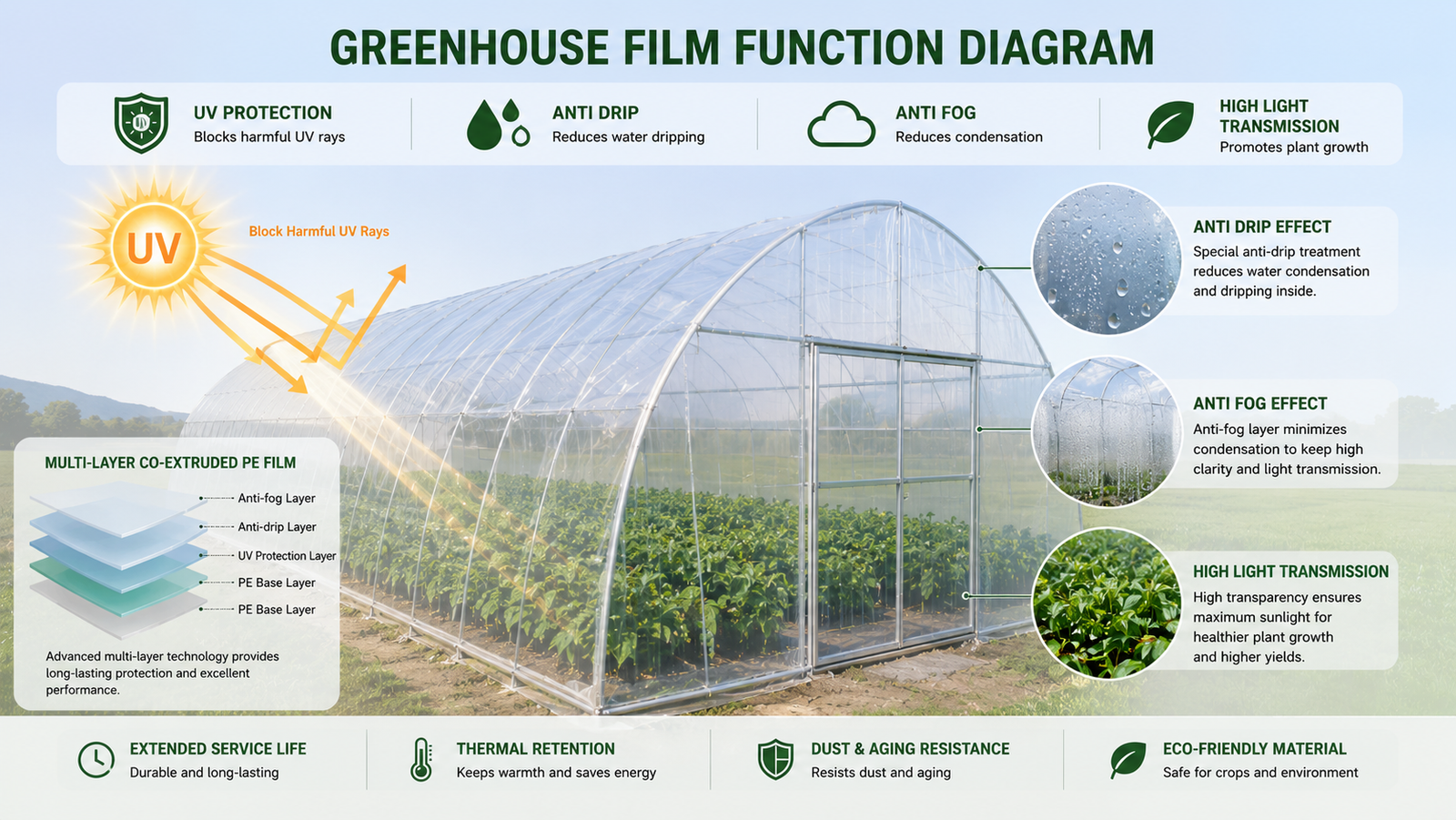
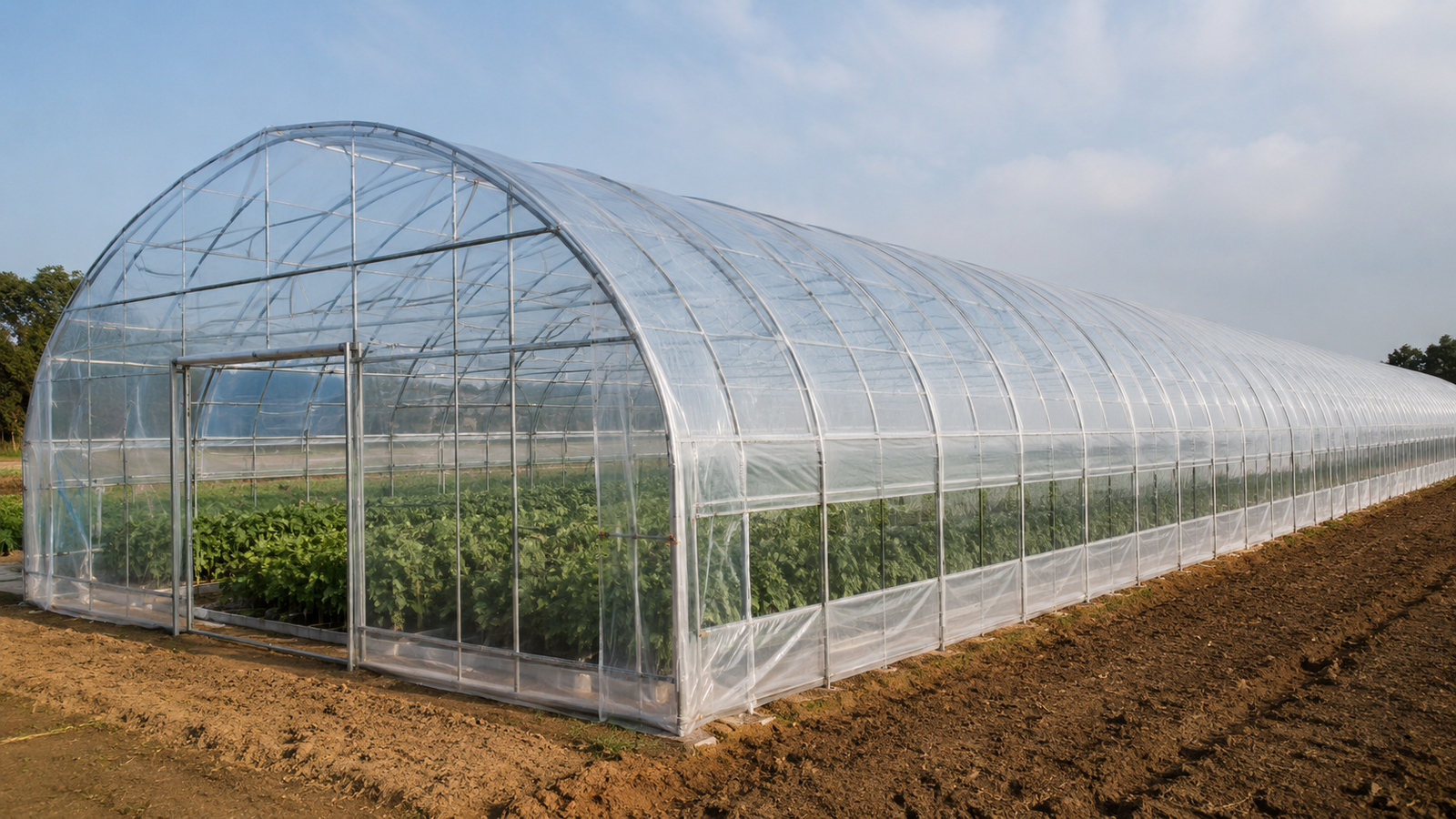
Greenhouse film is a flexible, greenhouse-grade agricultural plastic covering used on commercial greenhouses, high tunnels and crop-protection structures. It transmits usable sunlight while helping protect crops from rain, wind and direct outdoor exposure.
Most commercial greenhouse films are made from polyethylene-based materials and may include UV stabilizers, anti-drip, anti-fog, light-diffusion or thermal functions. Unlike ordinary construction sheeting, the covering should be selected by its material structure, UV package, optical targets, mechanical properties, finished dimensions and installation method—not by thickness alone.
| Item | Practical Meaning |
|---|---|
| Product type | Flexible plastic film for greenhouse covering |
| Common material | PE-based film, often LDPE, LLDPE, EVA or PO formulations |
| Main function | Light transmission, crop protection and controlled growing conditions |
| Common use | Commercial greenhouses, high tunnels, vegetable farms, nurseries and flower growing |
| Key checks | Thickness, UV stability, light transmission, haze, strength, width, length and additive functions |
Greenhouse Film vs Greenhouse Plastic vs Greenhouse Covering
These terms are often used together, but they do not always mean exactly the same thing. Understanding the difference helps avoid choosing the wrong covering material.
| Term | Meaning | Typical Use |
|---|---|---|
| Greenhouse film | A flexible greenhouse-grade plastic film for covering crop structures | Commercial greenhouses, tunnels and agricultural growing systems |
| Greenhouse plastic film | Another common name for greenhouse film, usually PE-based | Product pages, installation guides and supplier descriptions |
| Greenhouse covering film | A broader term emphasizing the film as a covering material | Greenhouse roof and sidewall covering |
| Plastic sheeting | A general plastic sheet or roll, not always made for greenhouse use | Construction, dust protection, temporary covering or low-cost projects |
| Polycarbonate panel | A rigid plastic sheet, not a flexible film | Permanent rigid greenhouses and insulated structures |
For greenhouse projects, the important point is not only the name. The material grade, UV package, thickness, optical performance and installation method are more important than the label alone.
What Is Greenhouse Film Made Of?
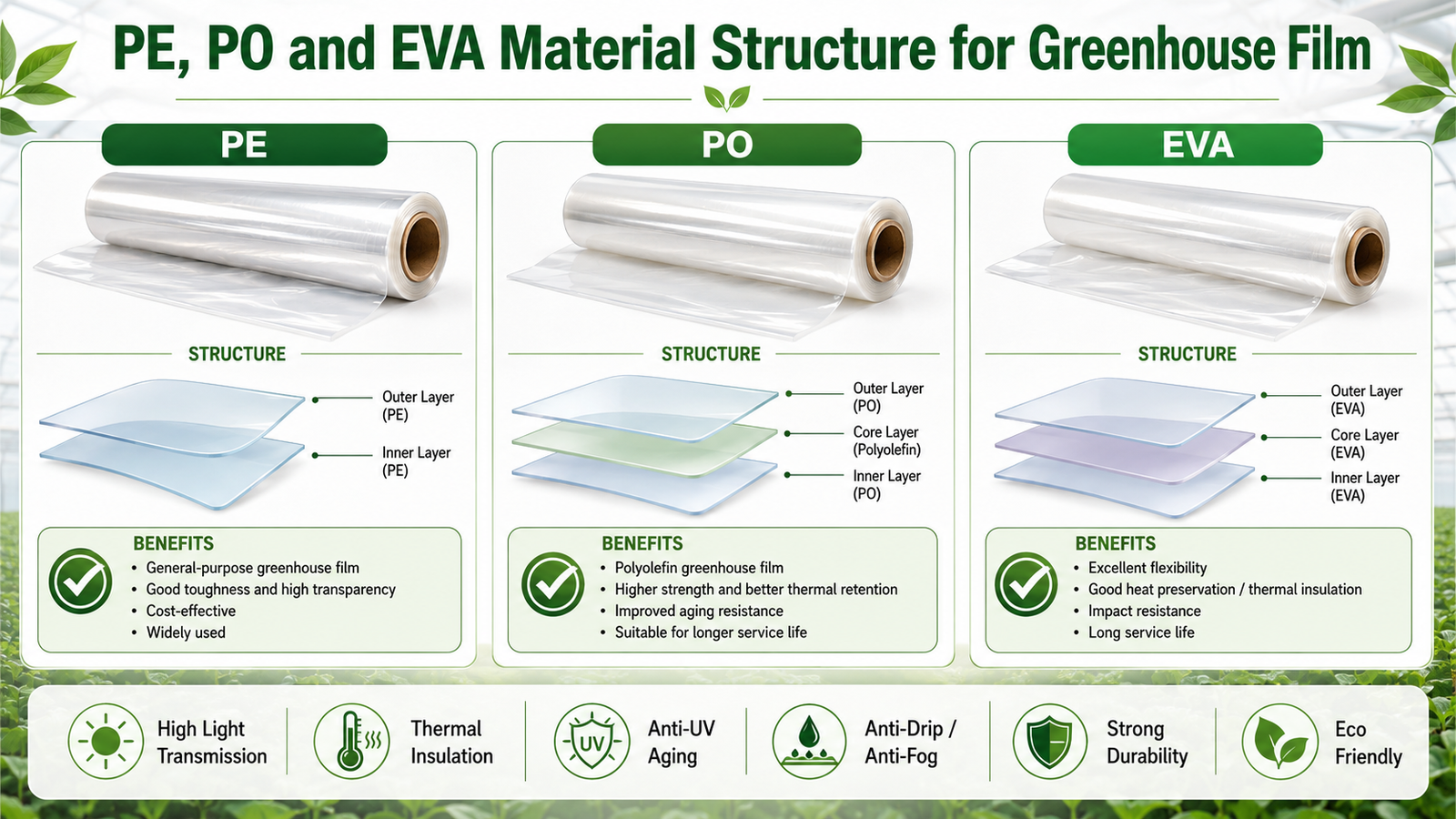
Most greenhouse film is made from polyethylene-based resins. Depending on the product design, the film may use LDPE, LLDPE, EVA, PO or blended formulations. Modern greenhouse plastic film is often produced as a multi-layer co-extruded film, which allows different layers to contribute different functions.
| Material or Structure | Role in Greenhouse Film | Notes |
|---|---|---|
| LDPE | Provides flexibility and processability | Common in agricultural film production |
| LLDPE | Improves toughness, tear resistance and puncture resistance | Often blended with LDPE |
| EVA | Can improve clarity, flexibility and thermal behavior | Used in some greenhouse film formulations |
| PO film | Used for high-clarity and high-performance greenhouse films | Often positioned for longer-term greenhouse covering |
| Multi-layer co-extrusion | Allows UV, anti-drip, strength and optical functions to be designed into different layers | Common in commercial greenhouse film manufacturing |
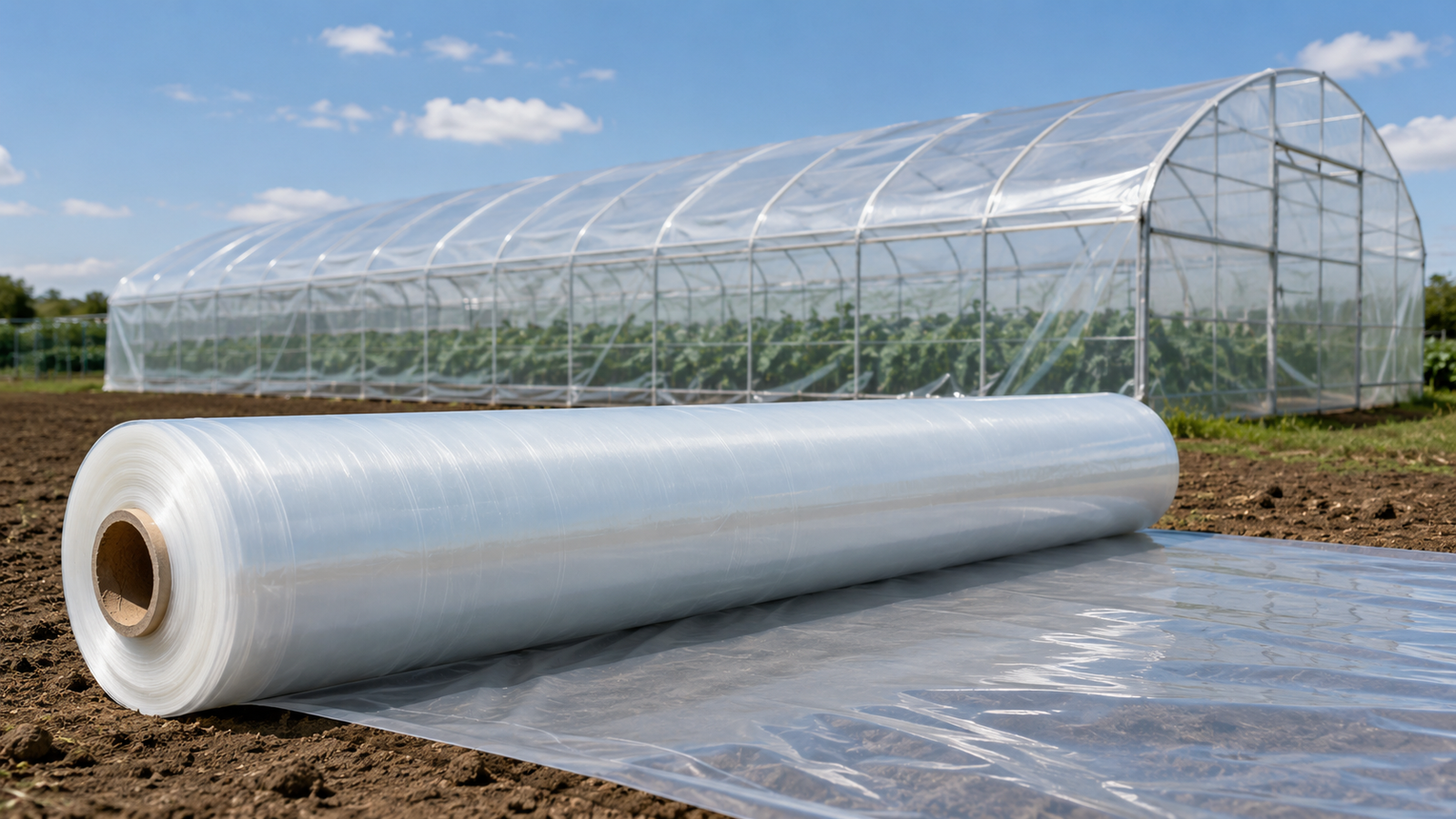
A greenhouse plastic roll may be customized by material, thickness, width, length, color, UV package, anti-drip function and packing method. For projects that require high clarity and long-term greenhouse covering, PO greenhouse film may also be considered.
How Does Greenhouse Film Work?
Greenhouse film works by covering the greenhouse frame and modifying the growing environment inside the structure. It allows useful sunlight to reach crops while reducing direct exposure to rain, wind and sudden weather changes. A properly selected film can also help manage condensation, temperature, light distribution and crop protection.
The actual performance depends on the film formulation and installation quality. A thin ordinary plastic sheet may look similar at first, but it may not have the UV stability, mechanical strength or optical properties needed for long-term greenhouse use.
How Do You Know If Greenhouse Film Is Good Quality?
After understanding the basic material and function, compare the best greenhouse film quality factors such as light transmission, UV resistance, anti-drip performance, thickness uniformity, mechanical strength and service life before choosing a final film specification.
Greenhouse Film vs Ordinary Plastic Sheeting
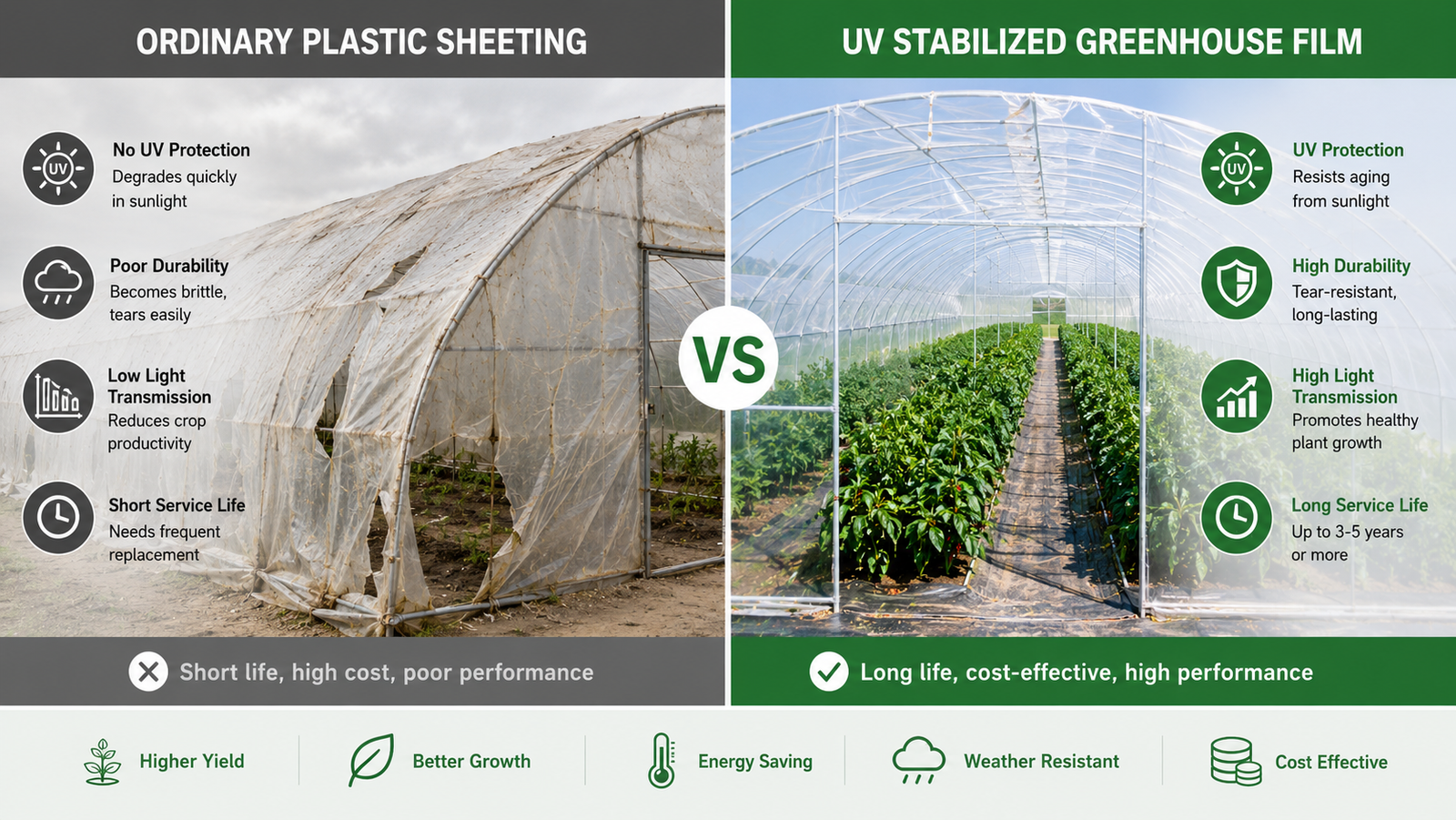
One of the most common mistakes is assuming that any clear plastic sheet can be used as greenhouse film. Ordinary plastic sheeting may provide temporary coverage, but it is usually not designed for agricultural light transmission, UV exposure, anti-drip performance or multi-season outdoor use.
| Comparison Point | Greenhouse Film | Ordinary Plastic Sheeting |
|---|---|---|
| Purpose | Crop growing and greenhouse covering | General protection, construction or temporary covering |
| UV stability | Usually designed with UV stabilizers | May degrade quickly outdoors if not UV treated |
| Light transmission | Designed for plant growth and greenhouse use | Not always controlled or tested for crop production |
| Condensation control | Anti-drip or anti-fog options may be available | Usually no greenhouse-specific condensation function |
| Service life | Depends on UV grade, thickness, climate and installation | Often shorter in outdoor agricultural exposure |
If the project is temporary and low-cost, plastic sheeting may be acceptable for short-term protection. For commercial growing, greenhouse-grade film is usually the more reliable choice.
For a more detailed application comparison, see our guide to greenhouse plastic sheeting vs greenhouse-grade film.
Greenhouse Film vs Polycarbonate Panels
Greenhouse film and polycarbonate panels are different covering systems. Greenhouse film is flexible, lightweight and suitable for curved greenhouse frames, hoop houses and high tunnels. Polycarbonate is rigid, more impact-resistant and often used in permanent structures where insulation and panel strength matter more than low initial material cost.
For a broader comparison between flexible greenhouse film, reinforced plastic and rigid panels, see our best plastic for a greenhouse guide.
Main Types of Greenhouse Film
Greenhouse film can be designed for different growing conditions. The best type depends on the greenhouse structure, crop, climate, service life and budget.
| Type | Main Purpose | Typical Application |
|---|---|---|
| Clear greenhouse film | High light transmission | Vegetable farms, tunnels and general greenhouse covering |
| Diffused greenhouse film | Distributes light more evenly | Greenhouses where reduced shadow and more uniform light are needed |
| UV resistant greenhouse film | Helps resist sunlight degradation | Outdoor greenhouse structures and long-term crop protection |
| Anti-drip greenhouse film | Reduces water droplets falling onto crops | High humidity greenhouses and crops sensitive to dripping water |
| Anti-fog greenhouse film | Helps reduce fogging on the inner film surface | Greenhouses that require better visibility and light transmission |
| Thermal or IR film | Helps reduce certain heat losses | Cooler regions or projects needing better nighttime heat retention |
| PO greenhouse film | High clarity and advanced greenhouse covering performance | Commercial cultivation, vegetable tunnels and longer-term projects |
Key Functions of Greenhouse Film
The value of greenhouse film is not only in thickness. A good greenhouse covering film should match the growing environment. UV resistance, anti-drip function, anti-fog performance, light diffusion and thermal behavior can all affect crop conditions.
| Function | What It Does | Why It Matters |
|---|---|---|
| UV protection | Helps slow film degradation under sunlight exposure | Important for outdoor service life |
| Anti-drip | Helps water form a thin layer instead of droplets | Reduces water dripping onto crops |
| Anti-fog | Helps reduce fogging on the inner surface | Improves visibility and may help maintain light transmission |
| Light diffusion | Scatters sunlight more evenly inside the greenhouse | Can reduce harsh shadows and improve light distribution |
| Thermal or IR retention | Helps reduce certain heat losses | Useful in cooler climates and protected growing systems |
| Anti-dust or surface treatment | Helps reduce surface contamination in some film designs | Supports more stable light transmission over time |
The term “UV protected” may refer to protecting the polymer or controlling the UV spectrum entering the greenhouse. See how UV stabilization differs from UV-blocking and UV-open greenhouse film.
Clear vs Diffused Greenhouse Film
Clear greenhouse film allows direct light to pass through with high clarity. Diffused greenhouse film scatters sunlight more evenly, which can help reduce strong shadows and improve light distribution across the crop canopy. The better choice depends on the crop, greenhouse type and local climate.
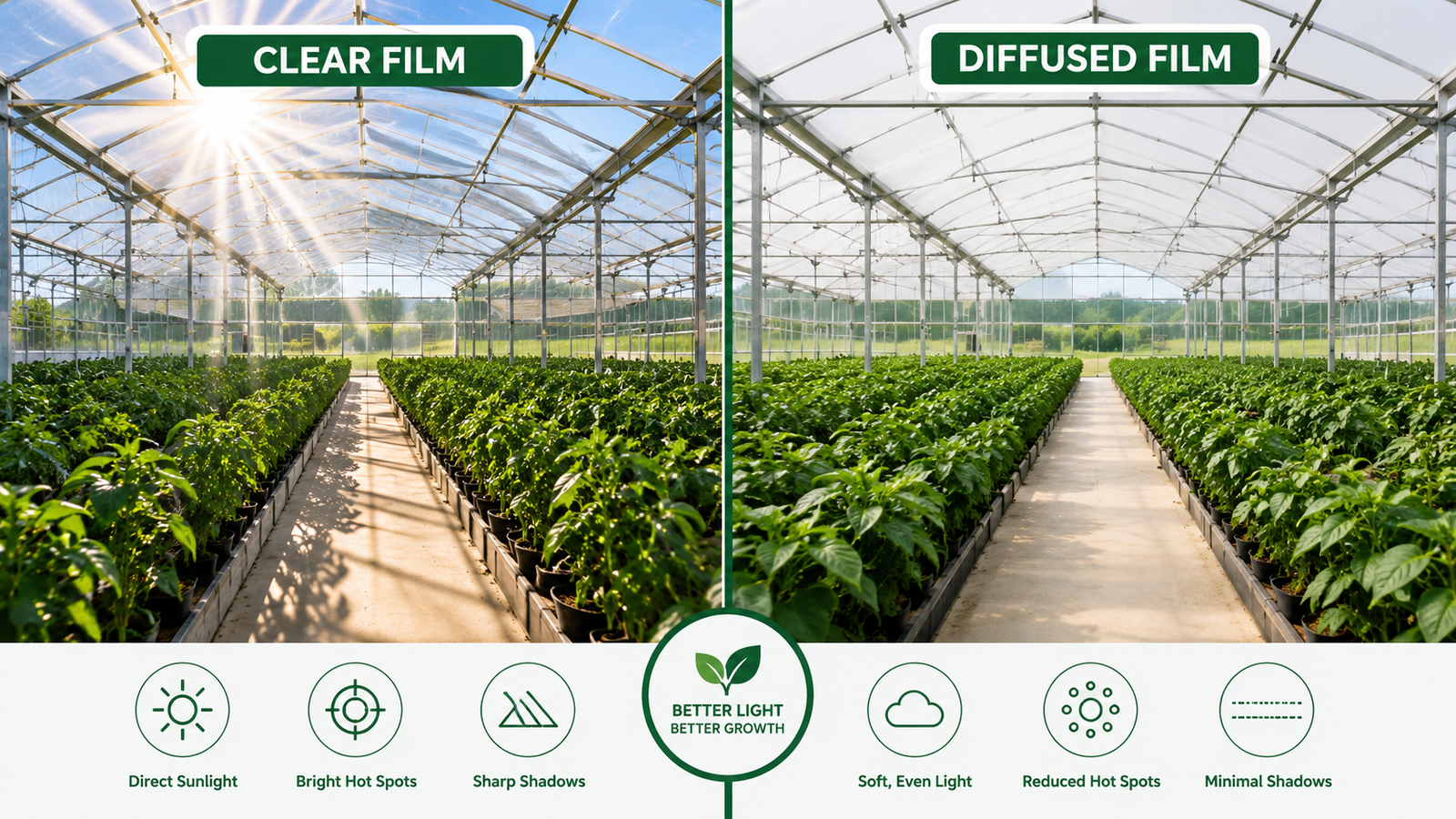
Clear film is often selected where maximum transparency is the main requirement. Diffused film may be preferred when growers want more even light distribution or reduced shadow zones. Both types can be combined with UV resistance, anti-drip or anti-fog functions depending on the film design.
Greenhouse Film Thickness and Roll Specifications
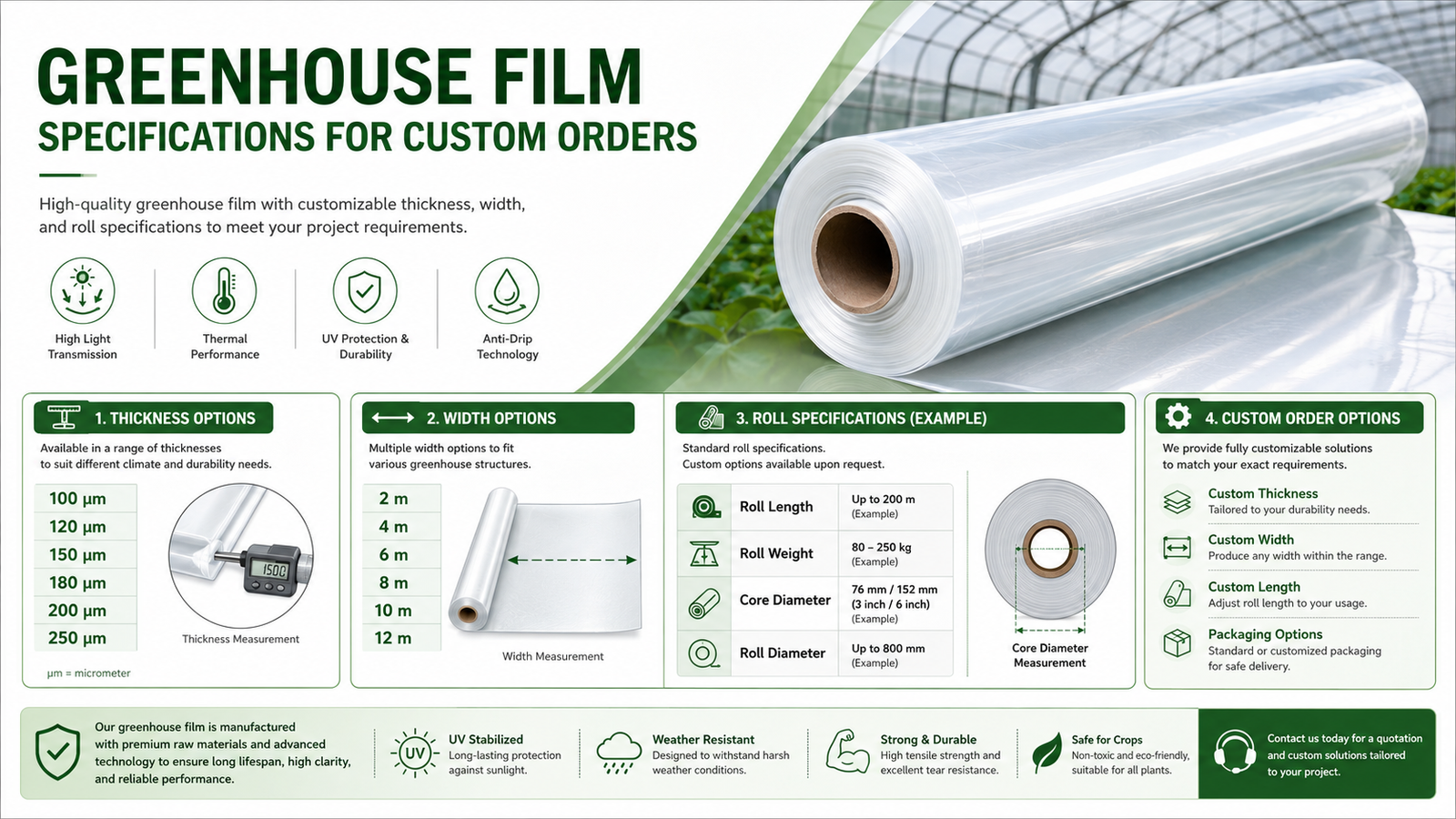
Thickness is one of the most visible greenhouse film specifications, but it should not be judged alone. A thicker film without suitable UV stabilization, good resin formulation or proper installation may still fail earlier than expected. A balanced specification should consider thickness, width, length, roll weight, optical performance and mechanical strength.
| Specification | Why It Matters |
|---|---|
| Thickness | Affects strength, handling, cost and expected service performance |
| Width | Must match greenhouse span, sidewall design and installation method |
| Length | Determines roll coverage and cutting plan |
| Light transmission | Affects the amount of useful light reaching crops |
| Haze or diffusion | Affects how light is distributed inside the greenhouse |
| Tensile and tear strength | Helps evaluate mechanical durability during installation and use |
| UV package | Important for outdoor exposure and expected film life |
| Packing method | Affects storage, loading, transport and installation handling |
If you are comparing 4 mil, 6 mil, 8 mil or thicker films, read our detailed greenhouse plastic thickness guide before confirming the final specification.
How Greenhouse Film Is Manufactured
Commercial greenhouse film is commonly produced by blown film extrusion or multi-layer co-extrusion. In a multi-layer structure, different layers can be designed for strength, UV resistance, optical behavior, anti-drip function or other performance requirements.
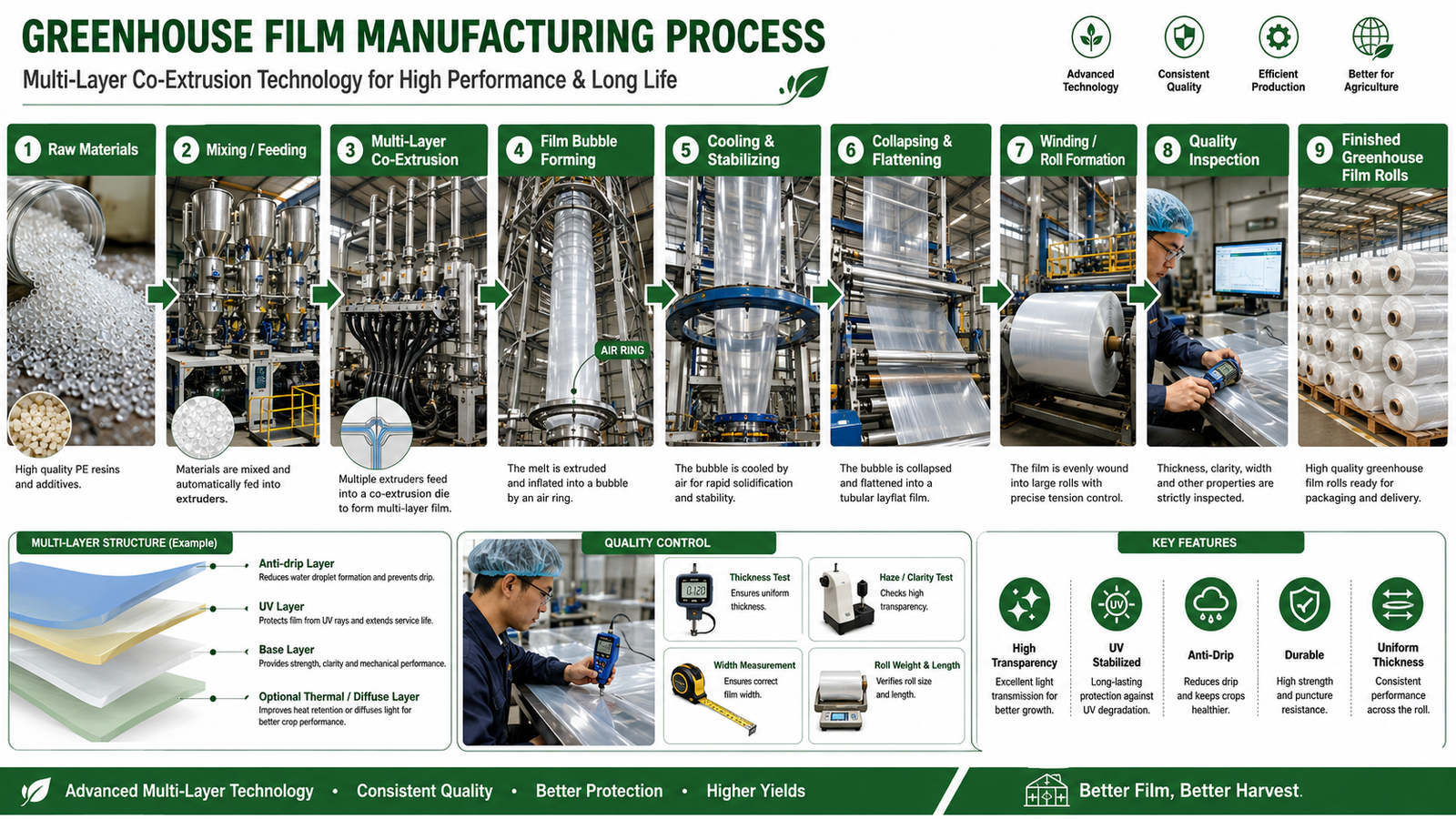
During production, important control points include resin selection, additive mixing, extrusion stability, thickness uniformity, roll winding, appearance inspection and packing. For agricultural film, consistent thickness and stable optical performance are important because the film must cover large greenhouse spans and perform under outdoor conditions.
Where Is Greenhouse Film Used?
Greenhouse film is used in many agricultural and horticultural applications. It is suitable for commercial growing systems where flexible covering, light transmission and custom roll dimensions are needed.
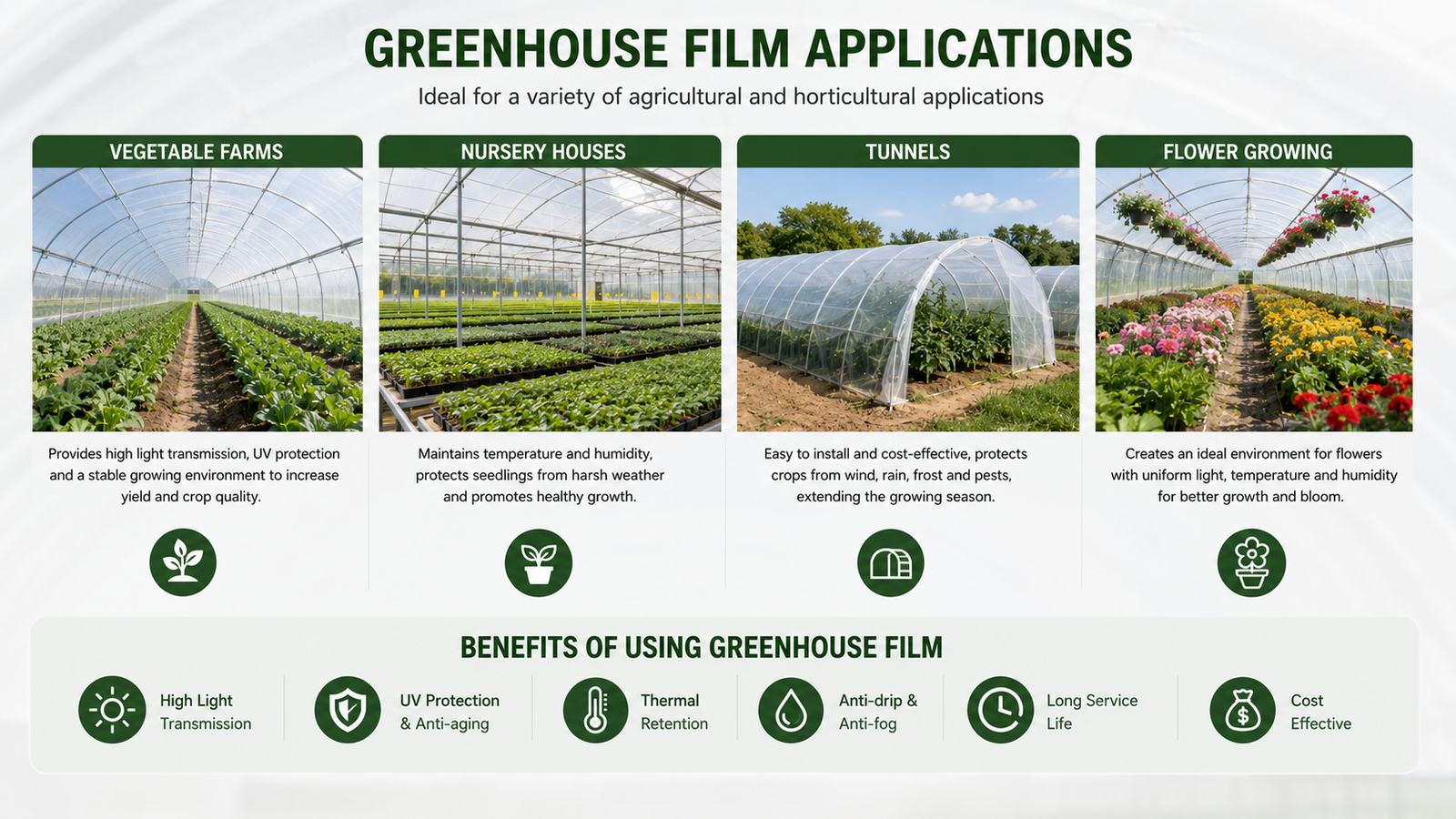
| Application | Typical Requirement |
|---|---|
| Commercial greenhouses | Stable covering, suitable roll width and long-term outdoor performance |
| Vegetable farms | Good light transmission, UV resistance and crop protection |
| Nursery houses | Controlled light, humidity and weather protection for young plants |
| High tunnels | Flexible film for curved frames and seasonal or multi-season use |
| Flower growing | Light quality, anti-drip and stable greenhouse conditions |
| Crop protection | Protection from rain, wind and sudden temperature changes |
How to Choose Greenhouse Film for Your Project
The right greenhouse film depends on the structure, crop, climate and service expectations. A film that works well in one region may not be the best choice for another greenhouse design or growing season.
- For high sunlight regions: Check UV stability, heat behavior and expected outdoor exposure.
- For humid greenhouses: Consider anti-drip and anti-fog functions.
- For colder climates: Consider thermal or IR retention options where suitable.
- For commercial vegetable farms: Balance light transmission, durability and cost.
- For long greenhouse spans: Confirm roll width, length, tensile strength and installation method.
- For custom projects: Confirm thickness, color, function, roll packing and required documentation before production.
After choosing the film, installation quality becomes critical. Poor fastening, sharp frame edges, excessive tension or wrong film orientation can shorten service life. For installation details, see our guide on how to install greenhouse plastic.
Common Mistakes When Choosing Greenhouse Film
Many greenhouse film problems are caused by specification decisions made before the film is even installed. The following mistakes should be avoided:
- Using ordinary construction plastic sheeting for long-term greenhouse covering
- Choosing film only by thickness without checking UV resistance
- Ignoring roll width, roll length and installation method
- Assuming anti-drip, anti-fog and UV functions are automatically included
- Not checking whether the film is suitable for the local climate
- Using sharp or abrasive frame parts without protection
- Over-tightening the film during installation
- Not confirming packing method for export, storage and handling
How Greenhouse Film Is Specified for Commercial Orders
In actual quotation work, the product name alone is not enough. Before recommending a film, the supplier normally needs the greenhouse type, finished covering width, cut or roll length, target thickness, installation region, crop environment, expected service period and required functions.
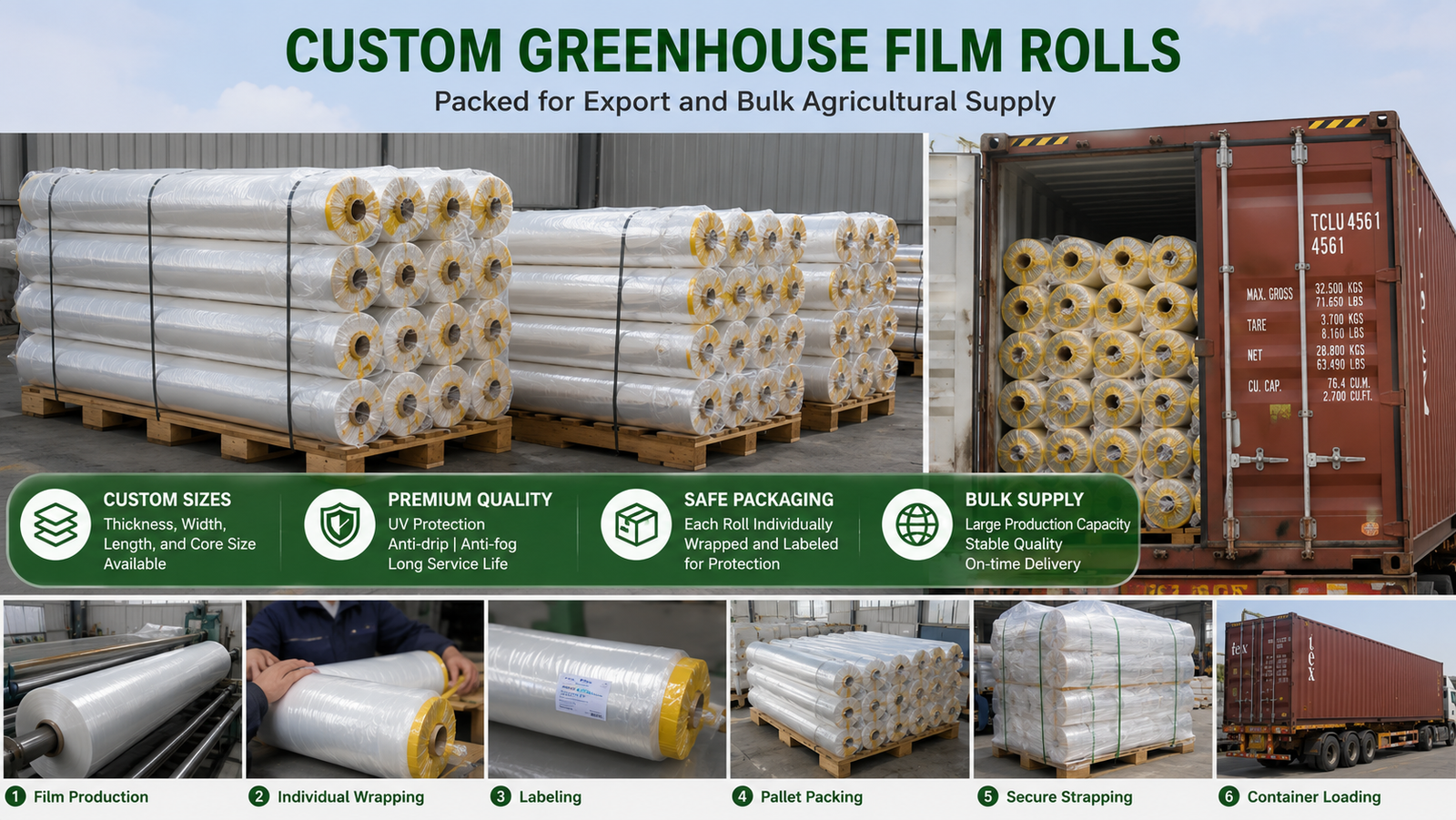
The factory then reviews whether the requested width, thickness, additive package, roll format and packing method are practical for production and site handling. For a custom order, the buyer and supplier should agree on the specification sheet, applicable TDS, sample or appearance reference, roll labels and packing requirements before bulk production.
For available PE and PO grades, functional options and project-based selection, review our commercial greenhouse film options.
Frequently Asked Questions About Greenhouse Film
Is greenhouse film the same as greenhouse plastic?
In many product descriptions, greenhouse film and greenhouse plastic mean the same general product: a flexible plastic film used to cover greenhouse structures. However, not every plastic sheet is greenhouse-grade film. A greenhouse film should be designed for agricultural covering, outdoor exposure and crop growing conditions.
What is greenhouse film made of?
Most greenhouse film is made from polyethylene-based materials such as LDPE, LLDPE, EVA blends or PO-based structures. Modern greenhouse film may be produced by multi-layer co-extrusion to combine strength, optical performance and functional additives.
Can I use regular plastic sheeting for a greenhouse?
Regular plastic sheeting may work for temporary covering, but it is usually not recommended for long-term greenhouse use unless it is UV stabilized and suitable for agricultural exposure. Ordinary sheeting may degrade faster under sunlight and may not provide proper light transmission, anti-drip or greenhouse-specific performance.
What thickness should greenhouse film be?
The right thickness depends on the greenhouse structure, climate, crop and expected service life. Many greenhouse projects use film around 6 mil or 150 microns as a common starting point, but thickness alone does not determine quality. UV stabilization, resin formulation, installation and mechanical strength also matter.
Is greenhouse film better than polycarbonate?
Greenhouse film is better when the project needs a flexible, lightweight and cost-effective covering for curved frames, hoop houses or high tunnels. Polycarbonate may be better for rigid permanent greenhouses where insulation, impact resistance and panel durability are more important than lower initial cost.
How long does greenhouse film last?
Greenhouse film service life depends on material grade, UV stabilization, thickness, climate, installation quality and maintenance. A product should not be judged only by thickness. Outdoor exposure, wind, frame abrasion, chemical contact and incorrect fastening can all shorten film life.
What information should I provide before ordering greenhouse film?
Provide the greenhouse type, width, length, required film size, thickness, crop, climate, UV requirement, anti-drip or anti-fog requirement, roll packing method and estimated quantity. For custom projects, these details help confirm whether the film should be produced as a roll, sheet or special greenhouse covering specification.