
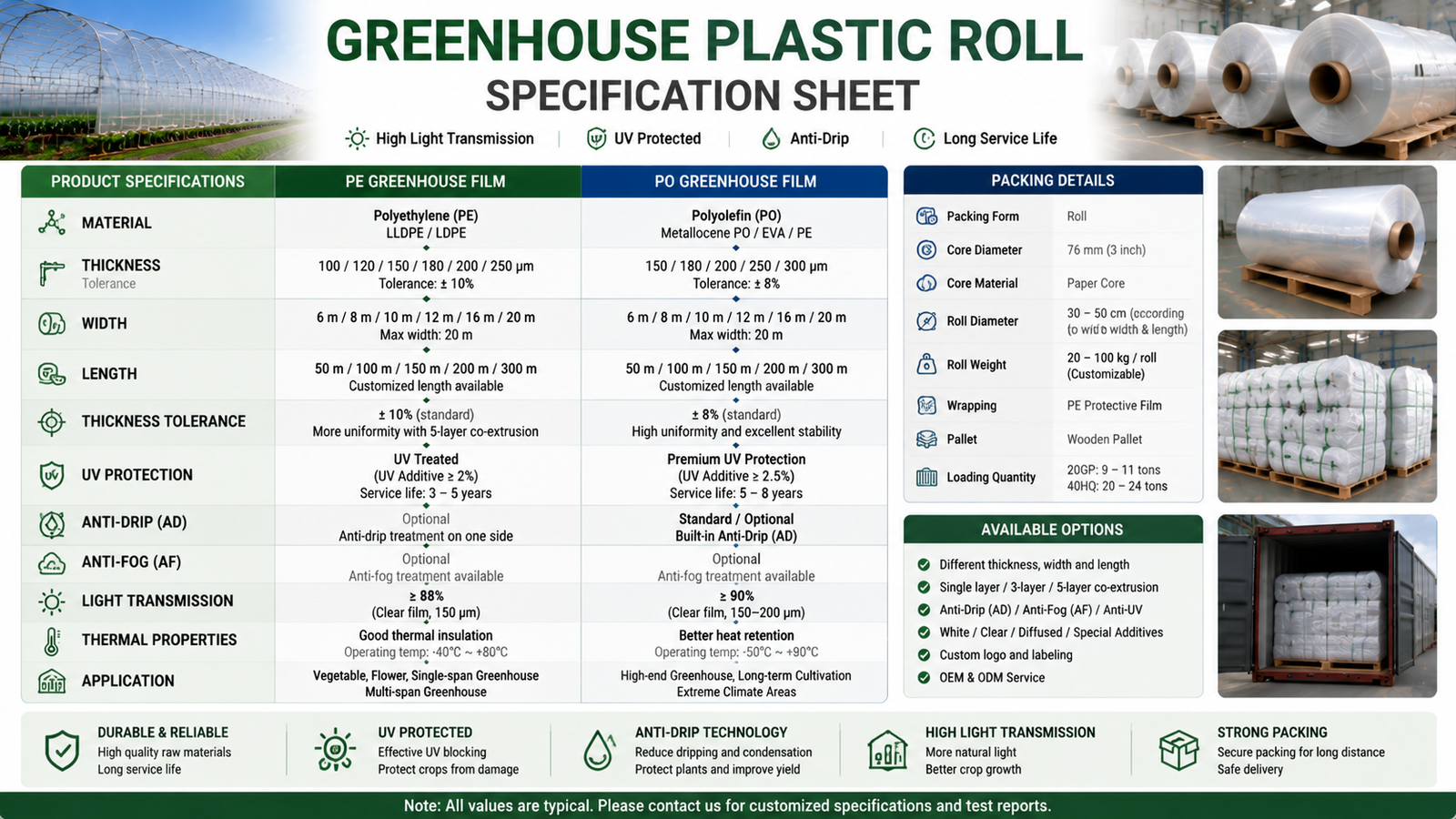
Greenhouse Plastic Roll Specifications: Order Checklist
Quick Answer: What Belongs in a Confirmed Film Specification?
Greenhouse plastic roll specifications should record the agreed film grade, nominal thickness and tolerance, unfolded width, roll length, functions, packing and inspection requirements. A usable specification separates what the buyer requests from what the supplier confirms, and identifies the document or measurement used to check each critical requirement.
This checklist is for turning a project brief into an order record. It is not a universal film recommendation: values marked “pending” still need agreement before the affected production work begins. If you are comparing suppliers or quotations, use the commercial greenhouse plastic roll buying guide. For the product itself, see our custom greenhouse plastic roll.
You do not need every answer to start an inquiry. Send the dimensions, location and intended use you know. Identify missing details as “supplier recommendation requested” instead of inventing values.
1. Set Up the Specification Record
Give the record a project name, product or roll-size identifier, revision number and date. Name the buyer and supplier contacts responsible for approval. Where several sizes are ordered, use one line per size and link each line to its quantity, label and greenhouse block.
- Buyer input: installation location, greenhouse type, crop, covering dimensions or drawing, fixing method, quantity and handling limits.
- Supplier confirmation: proposed film grade, achievable dimensions and tolerances, agreed functions, packing format and available inspection records.
- Joint approval: final values, unresolved exceptions, document references and the revision released for production.
Use explicit statuses: requested, pending confirmation, approved, or not required. An empty cell is ambiguous. A target service period is a buyer requirement, not automatically a supplier warranty. Record any warranty separately with its conditions.
2. Complete the Greenhouse Plastic Roll Specification Checklist
Copy these fields into your order sheet. For each row, add the supplier’s confirmed value, the supporting reference and the approval status. Do not treat the examples below as stock availability, standard tolerances or guaranteed factory performance.
On smaller screens, swipe the table horizontally. The table can also be focused and scrolled with a keyboard.
| Specification item | Buyer requirement | Supplier confirmation and evidence |
|---|---|---|
| Project and installation | Country, greenhouse type, crop, cover path, fixing method and site conditions. | Review the drawing or brief; list assumptions and unresolved installation questions. |
| Film grade and construction | Selected grade or recommendation requested; color and functional requirements. | Identify the grade and relevant technical data sheet (TDS). Record construction details available for the order. |
| Thickness | Nominal value, controlling unit, tolerance and any separate minimum requirement. | Confirm the acceptance limits, sampling procedure and measurement method. |
| Unfolded width and length | Finished flat width, length per roll, quantity per size and dimensional tolerances. | Confirm measurements refer to unfolded film; reference the approved cut schedule. |
| Roll format | Fold arrangement, core requirements, maximum handling weight and diameter where relevant. | Confirm folded roll dimensions and distinguish film net weight from packed gross weight. |
| UV and service conditions | Outdoor use conditions, desired service period, chemical exposure and any UV-transmission requirement. | Record the proposed grade, applicable restrictions and any written warranty terms. Do not combine aging resistance and UV transmission into one undefined “UV” field. |
| Condensation and thermal functions | Requested anti-drip, anti-fog or thermal behavior; operating conditions. | Confirm what each function means for the supplied grade, orientation instructions and any agreed duration or test evidence. |
| Optical and mechanical properties | Required property, unit, target or limit, test method and film direction where applicable. | Identify whether values are typical grade data or order acceptance limits; list the evidence available. |
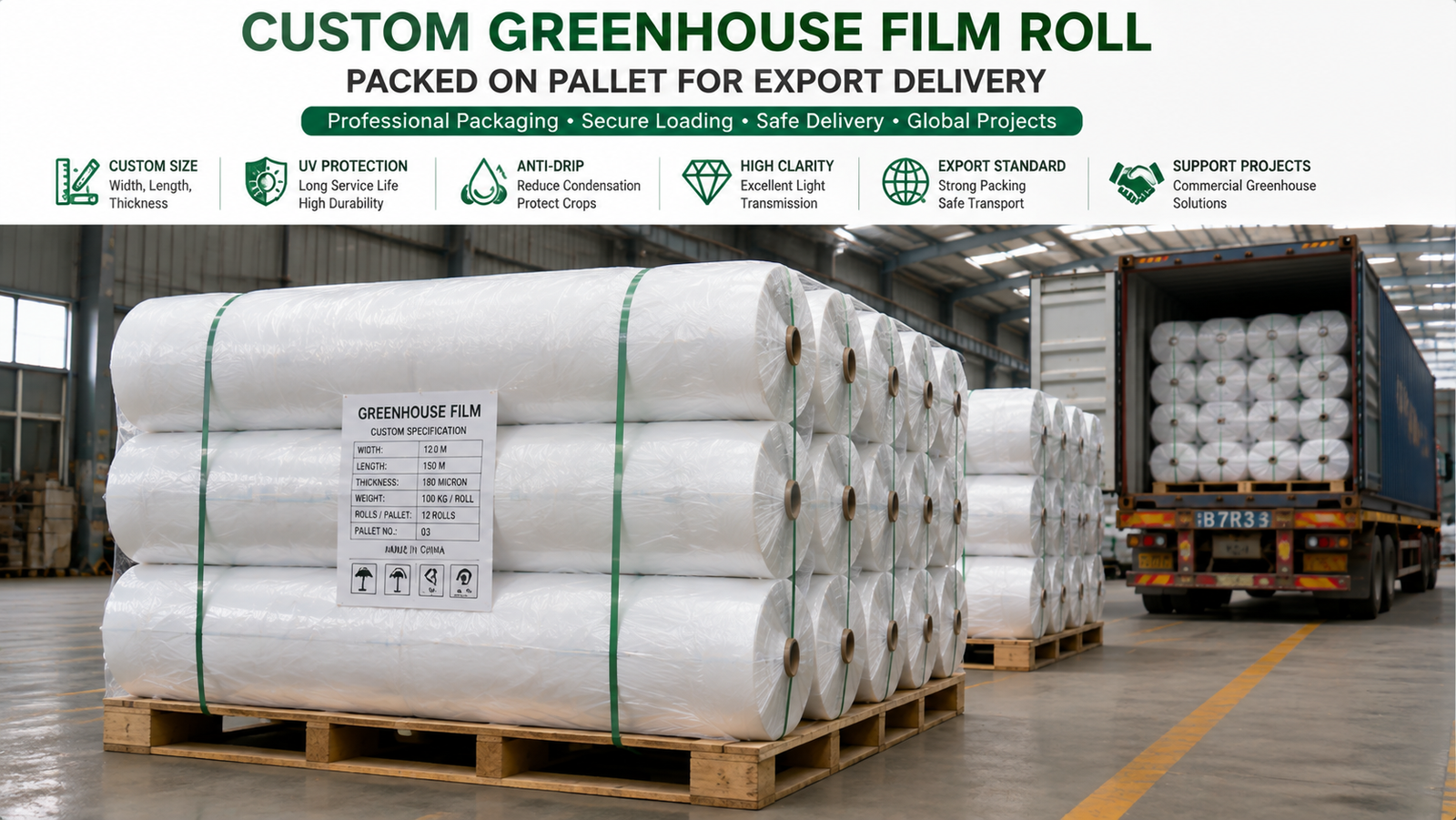
| Packing and identification | Wrapping, core, pallet requirements, roll labels and project or size identifiers. | Approve the packing description and label artwork; confirm unloading constraints. |
| Inspection and documents | Required records, timing, sampling and any third-party inspection. | Agree availability, scope, cost and document references before production, not after shipment. |
Download the editable specification confirmation sheet (CSV). Open it in spreadsheet software and add status, revision and approval fields for your order. The blank sheet is a starting template, not a completed purchase specification.
Identify the Grade, Not Just the Material Name
“PE” or “PO” alone does not establish optical performance, thickness tolerance or service life. Reference the selected grade and its agreed data. If selection is still open, compare the greenhouse film options or review the PO greenhouse film product details, then return to the sheet to record the chosen specification.
3. Record Thickness, Units and Acceptance Limits
Choose one controlling unit. 1 mil equals 25.4 microns, so 6 mil equals 152.4 microns. The common shorthand “about 150 microns” is useful in conversation, but it should not create two conflicting nominal values on an order. State which value governs; mark the other as an approximate conversion.
Also distinguish a nominal target from a minimum requirement. A tolerance around a target is not the same as a promise that every measured point equals or exceeds that target.
Illustrative tolerance calculation: a nominal thickness of 150 microns with a hypothetical ±10% tolerance produces limits of 135–165 microns. That does not satisfy a separate requirement of “minimum 150 microns.” This example explains the arithmetic only; it is not a recommended tolerance or a statement of our production capability.
Agree whether limits apply to individual readings, a calculated average, or another defined criterion. Record the sample locations, number of readings and measurement procedure. Do not substitute a roll-weight estimate for an agreed thickness inspection.
If you still need to choose a thickness rather than document it, read the greenhouse plastic thickness guide.
4. Confirm Dimensions and Roll Format
Write finished unfolded width, not just “roll width.” The width of a folded roll or its shipping package is a different measurement. Attach the approved covering layout and keep any fixing or trimming allowances visible in the dimensional record.
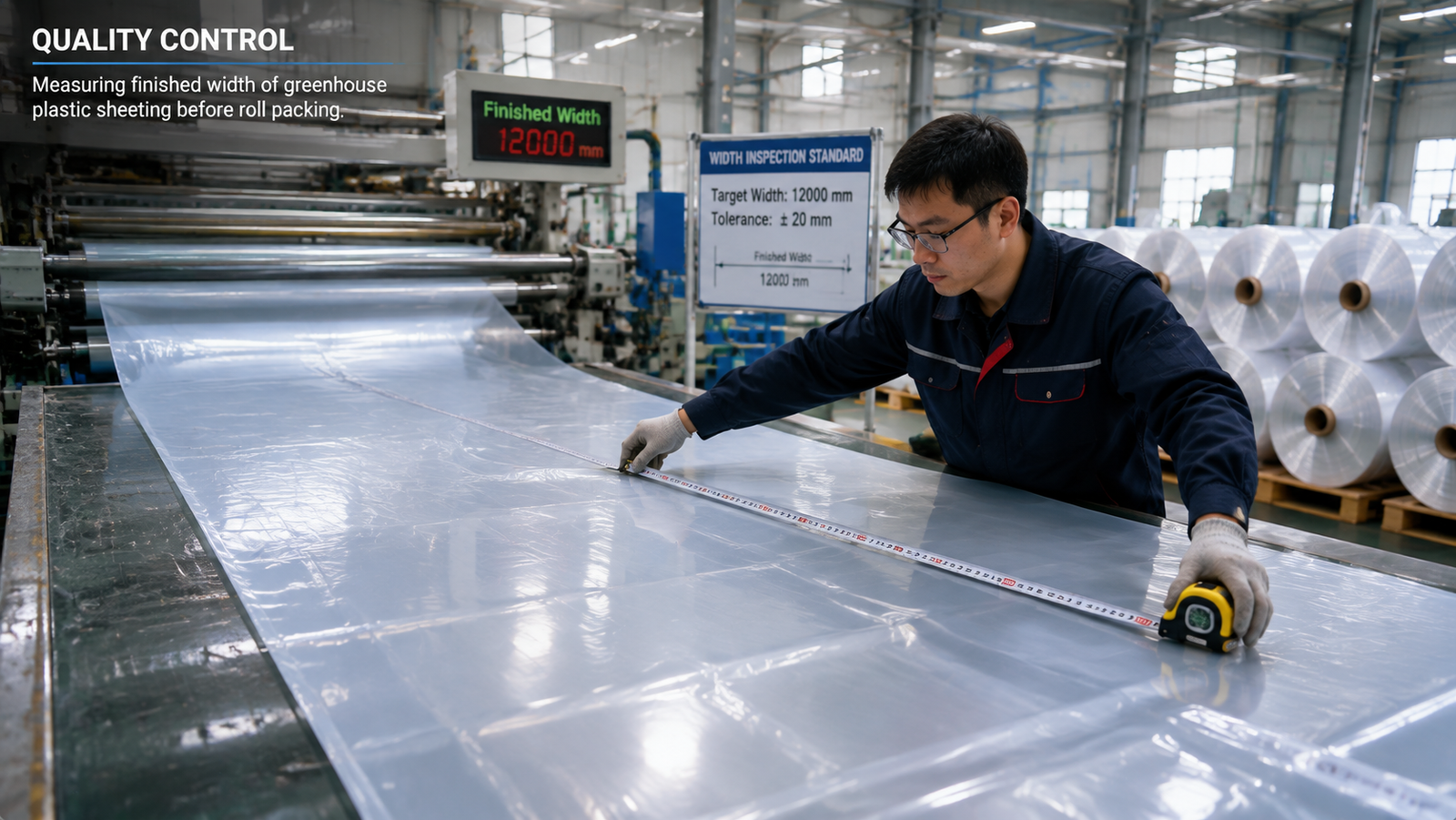
- Use the roll size and measurement guide to establish the covering dimensions before approving the cut schedule.
- List each width × length combination and its roll quantity separately.
- Confirm the fold arrangement and specify whether a core dimension means internal diameter or another measurement.
- Record maximum packed weight if unloading equipment is the limiting factor; film net weight alone is not enough.
- For asymmetric or direction-sensitive film, reference the supplier’s installation-side marking and instructions.
Include the Packing Record
Approve wrapping, roll labels, pallet requirements and destination handling limits alongside the film dimensions. A useful label connects the roll to the order, size, film grade and batch or lot identifier. Agree which identifiers will actually be supplied.
5. Match Each Requirement to Evidence
A grade data sheet, a batch result and a photograph answer different questions. Make the evidence requirement explicit rather than asking for a generic “quality certificate.” Review our quality documents page, then confirm which records are available and applicable to the selected order.
For a property-by-property review of test conditions, thickness uniformity, functional claims and batch evidence, use the greenhouse film quality checklist. Record the agreed requirements and evidence references in this specification before approval.
| Record | Use in the order | What to clarify |
|---|---|---|
| Technical data sheet | Identifies the grade and its stated technical properties. | Which figures are typical values and which, if any, are agreed acceptance limits? |
| Approved sample | Provides a reference for agreed visible or measurable characteristics. | Record sample ID and date. Appearance alone does not establish UV durability or long-term function. |
| Inspection or test report | Records results for the identified samples and tests. | Specify method, edition, units, sampling, acceptance limits and batch traceability. |
| Certificate of analysis, if agreed | Reports the properties included in that certificate. | Confirm actual tested items and the batch covered. Do not assume every requested property is included. |
| Packing list and photographs | Support checks of quantities, identification and visible packing. | They do not replace testing of thickness, strength or optical performance. |
Use Comparable Test Descriptions
For tensile properties, identify machine direction (MD) and transverse direction (TD), units and the agreed procedure. ASTM D882 addresses tensile properties of thin plastic sheeting. For haze and luminous transmittance, ASTM D1003 provides a relevant method reference. These are not interchangeable with every crop-light metric: name the optical quantity being requested.
A cited method is not a claim that the supplier has performed the test or holds certification. Confirm the applicable edition, report availability and acceptance criteria for your order.
Separate Service Targets from Warranties
Record the intended site, exposure, operating practices and requested service period. Ask the supplier to identify any exclusions or installation requirements. Do not turn a target service period or an accelerated test result into an unconditional field-life promise.
Define Functional Claims Before Approval
Terms such as “anti-drip,” “anti-fog” and “thermal” need a grade-specific description and, where required, agreed evidence. Do not assume that similarly named products use identical definitions, test conditions or durations. Record any orientation instruction with the roll label or installation document.
6. Worked Example: An Incomplete Specification Ready for Review
The following is hypothetical, not a customer case, offer or approved production specification. It shows how a buyer can provide useful information while leaving technical decisions visibly pending.
| Field | Example buyer entry | Status or next check |
|---|---|---|
| Project | Commercial vegetable tunnel; country, drawing and fixing details to follow. | Pending: installation brief. |
| Film | Greenhouse-grade PE; UV stabilization and condensation control requested. | Pending: supplier grade and function definitions. |
| Thickness | 150 microns nominal; microns govern. | Pending: tolerance, sampling and acceptance limits. |
| Dimensions | 10 m unfolded width × 60 m per roll; 20 rolls. | Pending: installer approval of width and length allowances. |
| Area | 600 m² per roll; 12,000 m² total nominal area. | Arithmetic based on requested dimensions; not a measured delivery quantity. |
| Packing | Individual protective wrapping; label each roll by order and size. | Pending: core, fold arrangement, packed weight and unloading limit. |
| Documents | Grade TDS, agreed dimensional inspection record and packing list requested. | Pending: document availability and inspection scope. |
This record is sufficient to begin a technical discussion. It is not sufficient to release the order: the open fields affect the product, inspection and handling arrangements. Keep those fields open until confirmed rather than replacing them with assumptions.
7. Approve the Production Revision
Before release, make the quotation, specification sheet, cut schedule, sample reference and label artwork refer to the same order and revision. If an email changes a dimension or function, update the controlled sheet rather than relying on a message buried in the correspondence.
- Resolve open fields. Each production-critical item must be approved, explicitly not required, or handled through an agreed exception.
- Reconcile the documents. Check grade, controlling units, dimensions, quantities and packing across the order records.
- Approve the inspection plan. Identify measurements, sampling, limits, reporting and what happens if a result falls outside the agreed limits.
- Record authorization. Keep the approved revision, date and responsible contacts with the order.
- Control later changes. Obtain written confirmation of any effect on production, cost and delivery before approving a replacement revision.
Three Ambiguities to Remove Before Release
- “150 micron / 6 mil” without a controlling unit: specify the nominal value that governs the order.
- “Width 10 m” without a measurement definition: state whether this means unfolded film width, folded width or package width.
- “Same as sample” without an ID or agreed criteria: identify the sample and the properties it is intended to confirm.
8. Specification Questions
Can I request a quotation before completing every field?
Yes. Send the information you have and mark unknown items clearly. Ask the supplier to state assumptions in any preliminary quotation. Confirm the missing production-critical details before the order is released.
Is 150-micron film exactly the same thickness as 6 mil?
No. Six mil equals 152.4 microns. They are often treated as approximate equivalents in discussion, but the specification should use one controlling nominal value and an agreed tolerance.
Does a technical data sheet prove that my batch was tested?
Not by itself. A TDS describes a grade and may show typical properties. If batch-specific results are required, agree the tests, sampling, report and batch identification separately.
Can finished film be made narrower after production?
Some rolls may be reduced in width by suitable slitting or conversion, subject to the film and equipment. That does not make a narrow roll wider and can affect waste, packing, cost and delivery. Ask the supplier before relying on post-production changes.
What should happen if an inspection result is outside the agreed limits?
Record the affected batch or roll identifiers and the result. Follow the agreed review procedure, which may include remeasurement, further sampling or corrective action. Do not silently change the limits or dispatch an affected lot without the required agreement.
Do I need a new specification for a repeat order?
Reference the previous approved specification and confirm whether it remains applicable. Recheck changes to dimensions, functions, installation location, packing or documents. A changed requirement needs a recorded revision.
Send What You Know for a Specification Review
Share the film size or drawing, installation country, intended use, quantity and any required functions. If a value is unknown, say so. The first step is to identify what still needs confirmation, not to make you complete every technical field alone.
Request a greenhouse film specification review or review the PE greenhouse plastic roll product details.
About the Author
Sean writes about greenhouse film specifications and B2B purchasing for commercial farms, greenhouse builders and agricultural distributors, with a focus on dimensions, quotation requirements, packing and quality documentation.
Technical References
- ASTM D882 — Tensile properties of thin plastic sheeting.
- ASTM D1003 — Haze and luminous transmittance of transparent plastics.
Agree the applicable test methods and editions with the supplier. References describe measurement methods; they do not certify a product or replace an order-specific acceptance agreement.