
Clear PE Greenhouse Film vs PO Greenhouse Film: Which One Should You Choose?
Quick Answer: Choose the Specification, Not Just the Label
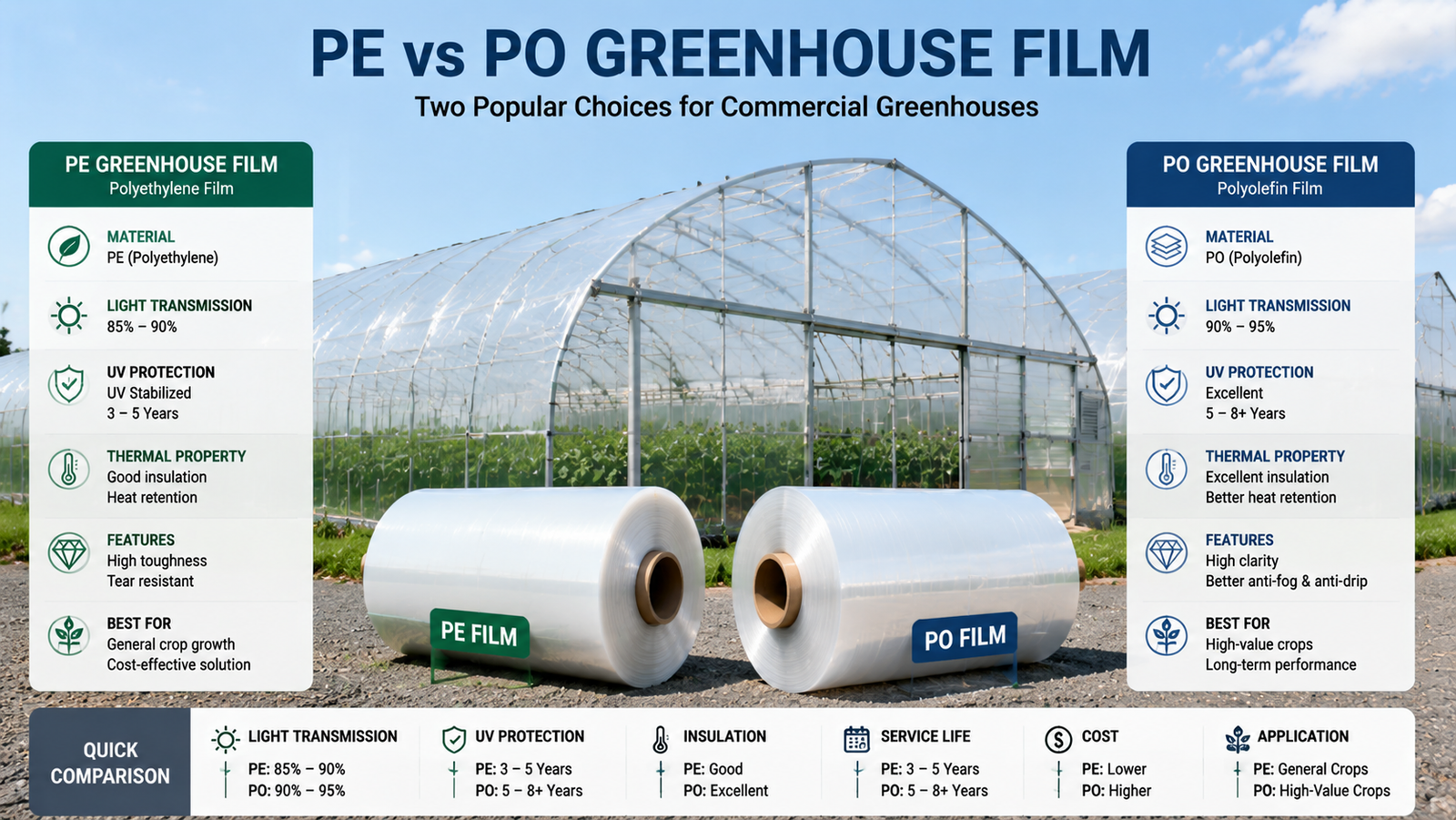
For seasonal tunnels, general vegetable production and projects with a shorter replacement cycle, clear PE greenhouse film is usually the safer economic starting point. PO greenhouse film becomes more relevant when high-value crops, persistent condensation, multi-year operation or fewer replacement interruptions justify a higher initial specification.
However, "PO" alone is not a performance guarantee. In actual quotation work, the useful comparison is not a generic polymer name against another polymer name. It is one supplier's clear PE film specification against one supplier's PO film specification. Compare the layer structure, thickness tolerance, optical data, UV package, anti-drip mechanism, mechanical results, expected service conditions and warranty wording before approving either option.
What Do Clear PE Greenhouse Film and PO Greenhouse Film Actually Mean?
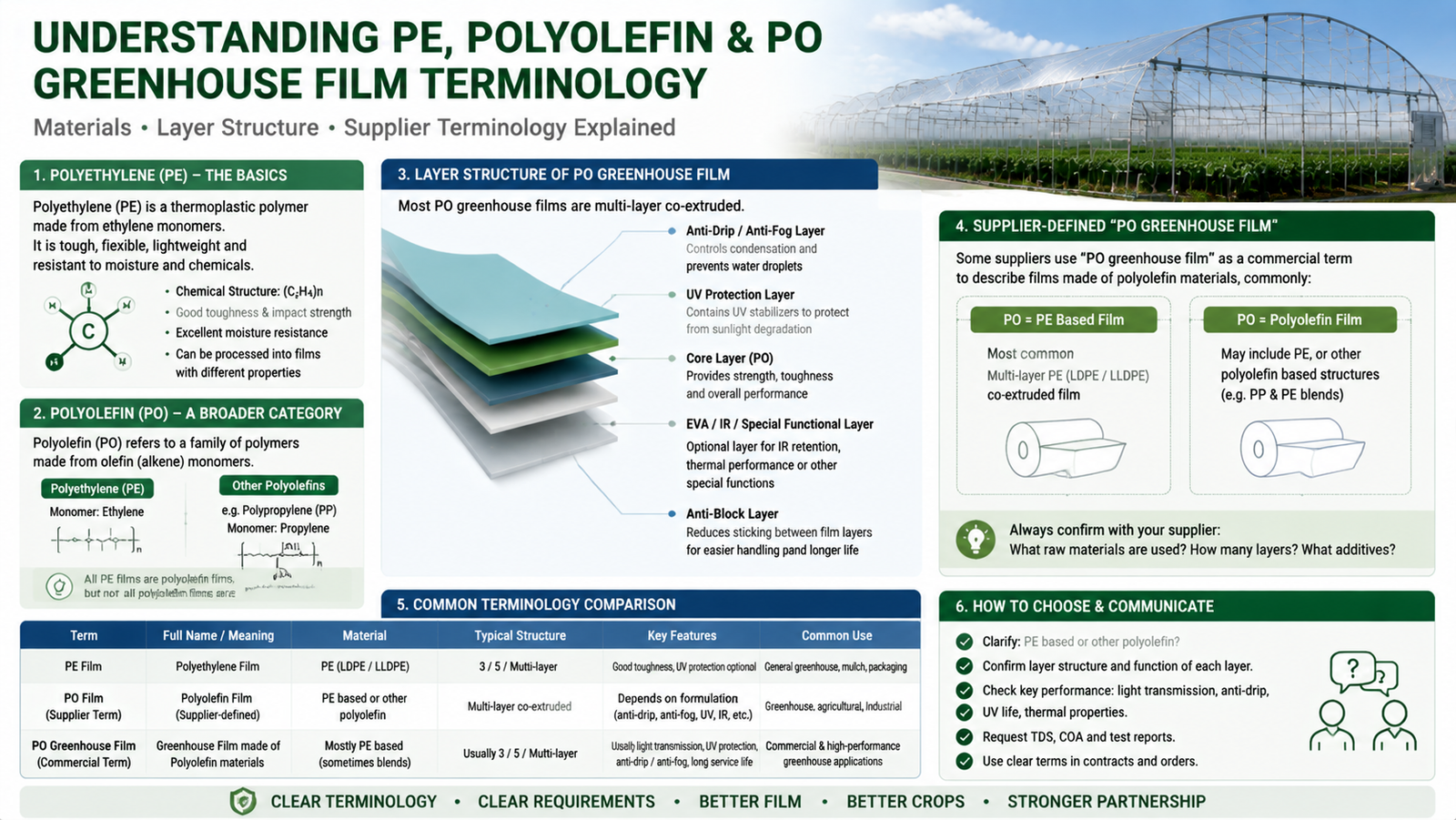
Clear PE greenhouse film is normally a flexible polyethylene-based greenhouse covering. Depending on the product, its formulation may include LDPE, LLDPE, EVA, metallocene polyethylene and functional masterbatches. It can be single-layer or multilayer, short-life or multi-year, basic or highly engineered. The letters "PE" do not tell a buyer how many layers the film has or how long its optical and anti-condensate functions will remain effective.
The term PO is even easier to misunderstand. Polyolefins are a family of thermoplastics that includes polyethylene and polypropylene. In other words, polyethylene is itself a polyolefin. The greenhouse-film trade often uses "PO film" as a commercial name for a premium multilayer film system, frequently associated with higher-clarity resins, functional layers, metallocene components or a durable surface treatment. That usage is commercially familiar, but it is not a universal formulation standard.
The practical consequence for buyers
Do not approve a purchase order that says only "clear PE film" or "PO film." Two suppliers can use the same label for products with different layer structures, additive packages, coatings, test values and warranty exclusions. Ask for a model-specific TDS and approved specification sheet.
For a broader explanation of greenhouse-film materials and functions, review what greenhouse film is and how engineered film differs from ordinary plastic sheeting. If you are already comparing purchasable rolls, the relevant product pages are the clear PE greenhouse plastic roll and the PO greenhouse film.
PE vs PO Greenhouse Film Decision Matrix
The table below is a purchasing starting point, not a universal material ranking. A verified PE specification can outperform a poorly defined PO product. The safer choice is the one whose data and service conditions match the greenhouse project.
| Project situation | Safer starting direction | Why | Confirm before ordering |
|---|---|---|---|
| Seasonal tunnel or short replacement cycle | Clear PE greenhouse film | Lower initial material commitment and easier alignment with a planned replacement cycle. | Greenhouse-grade UV stabilization, thickness, roll size, fastening method and expected season. |
| General commercial vegetable greenhouse | Compare actual PE and PO TDS data | The product name alone does not show whether the added PO cost produces a useful field advantage. | Light transmission, haze, diffusion, anti-drip duration, mechanical data and warranty. |
| High-value crop with persistent humidity | PO may be the stronger candidate | Stable optical and condensation-control performance can matter more than the lowest first cost. | Anti-drip mechanism, anti-fog claim, roof slope, ventilation, chemical exposure and service conditions. |
| Distributor building a repeat-stock range | Standard PE line plus a defined premium PO line | Standardized SKUs are easier to stock and explain than a different custom formula for every order. | Core widths, lengths, roll weights, labels, packing, MOQ and repeat-batch specification. |
| Greenhouse builder purchasing by project | Confirm the structure before selecting the film | An unsuitable roll width or handling weight can cause more immediate loss than a small material difference. | Frame span, arc length, fixing channels, installation allowance, openings, roll-up sides and lifting method. |
| Farm using sulfur or frequent crop-protection chemicals | Choose by chemical-resistance terms, not the PE/PO label | Chemical exposure can shorten film life or invalidate warranty conditions. | Permitted chemicals, concentration or frequency limits, cleaning method and warranty exclusions. |
Light Transmission, Haze and Diffusion: More Light Is Not the Whole Decision
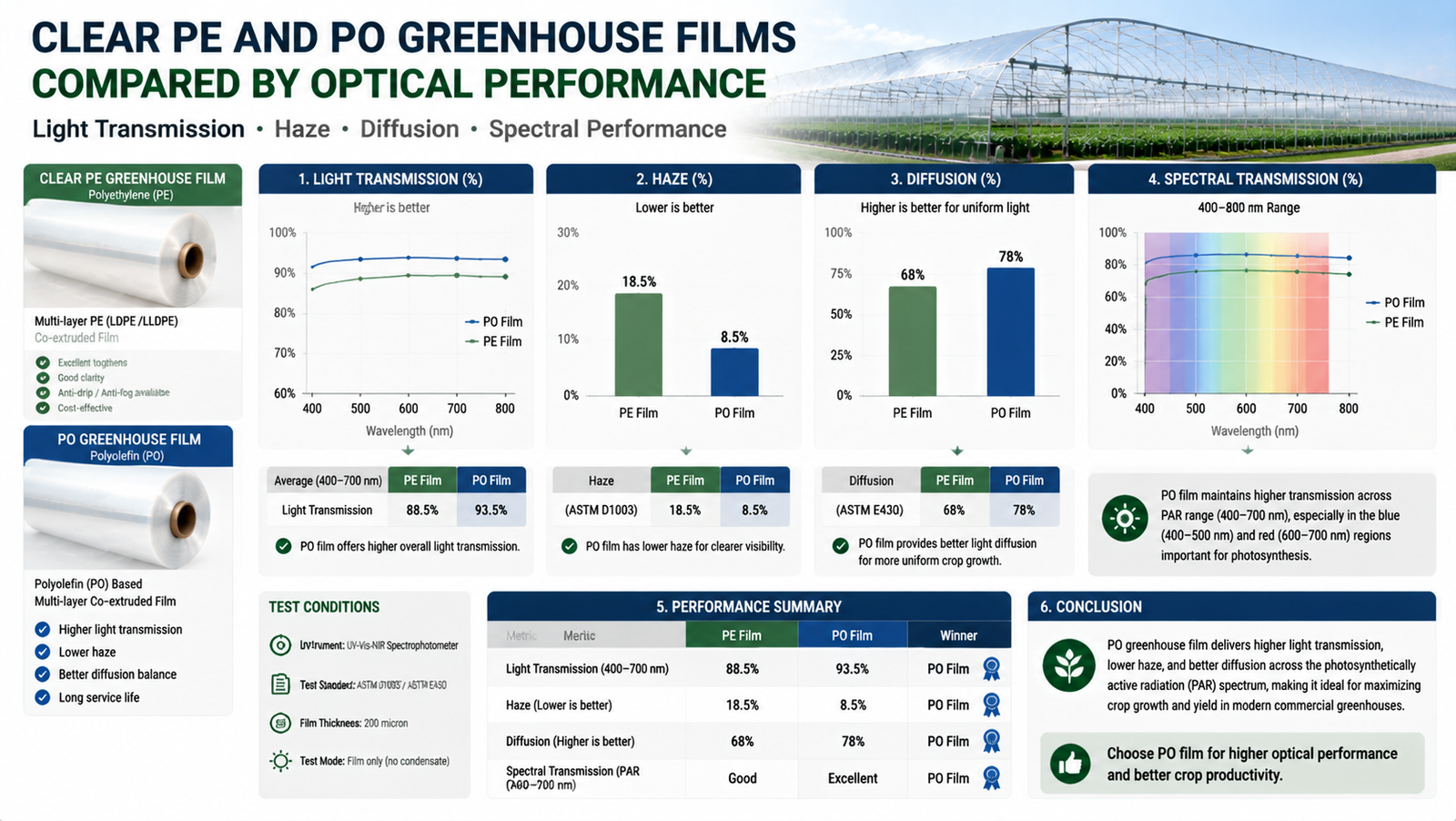
Buyers often ask which film is "more transparent." That question is incomplete. A greenhouse covering must be judged by total light transmission, haze or diffusion, spectral behavior and how those properties change during use. High initial transmission can help in low-light seasons, but some crops and climates benefit from diffused light that distributes radiation deeper into the canopy and reduces concentrated hot spots.
Additives also create tradeoffs. UMass Extension publishes different typical transmission ranges for UV-stabilized film, infrared/anti-condensate film and film with diffusion. The useful lesson is not that one range is always best. It is that thermal, condensate and diffusion functions can change the optical result, so two films of the same thickness should not be assumed to transmit the same useful light.
A common supplier comparison uses the best PO transmission number against a basic PE number. That is not a fair purchasing test. Ask both suppliers for values measured under a stated method and thickness. If a diffusion percentage or haze value is supplied, determine whether the crop needs direct clarity or more distributed light. The greenhouse film quality factors guide explains how optical data should be reviewed alongside mechanical and functional performance.
What the buyer should request
- Light transmission value and the test method used.
- Film thickness and conditioning state used for the test.
- Haze or diffusion value, if crop-light distribution matters.
- Whether the result describes a new film or retained performance after weathering.
- Any UV-blocking, UV-open or photoselective function separate from polymer UV stabilization.
UV Stabilization and Service Life: Thickness Does Not Create Weather Resistance
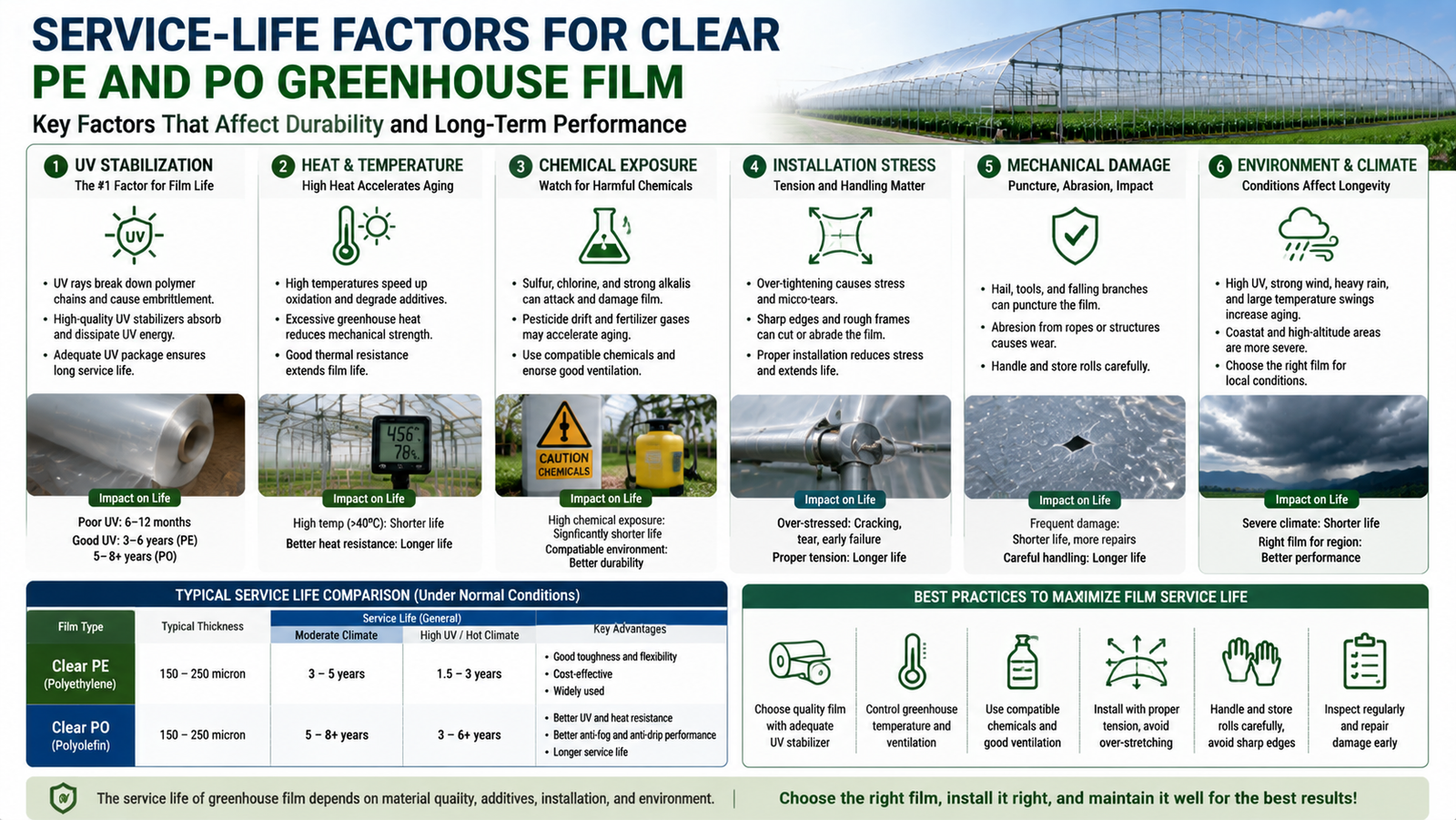
A thicker roll is not automatically a longer-life greenhouse film. Thickness contributes material and can affect mechanical robustness, but outdoor life also depends on stabilizer selection, resin quality, film structure, heat, solar exposure, installation stress and chemical contact. Construction-grade clear plastic may be thick enough to cover a frame yet still lack the UV package required for agricultural exposure.
This is where buyers sometimes overpay for the word PO or under-specify a PE film. A well-defined greenhouse-grade PE film may include a multi-year UV package. A product sold as PO may still have service-life conditions that depend on climate, sulfur use, pesticides, contact with hot structural parts and correct installation. The label does not remove those conditions.
Review how UV stabilization affects greenhouse film service life before comparing warranty language. UV stabilization protects the polymer from degradation; it is not the same as blocking UV radiation from entering the greenhouse. Pollination, pest management and crop morphology can make spectral requirements a separate purchasing decision.
Do not accept a service-life number without its conditions
Before production, the supplier should state what the service-life or warranty claim assumes. Location, solar radiation, greenhouse structure, chemical exposure and installation practice can all matter. If those limits are absent, treat the number as a sales description rather than an approved project specification.
Anti-Drip and Anti-Fog: Verify the Mechanism and Duration
Condensation forms when moist greenhouse air contacts a colder covering surface. Anti-drip treatment changes how that water behaves on the film. Instead of forming suspended droplets, a suitable wetting system encourages water to spread and run toward the edge or gutter. This can improve visibility and reduce overhead dripping, but it does not remove moisture from the greenhouse.
PE and PO comparisons often describe PE as having a temporary migratory additive and PO as having a permanent coating. That may describe two particular products, but it is not a universal material rule. PE products can use different additive systems, and commercial PO products can also use different coatings or functional-layer designs. Ask how the function is created and how long it is declared to remain effective under the intended use.
Anti-drip and anti-fog are also not interchangeable promises. Anti-drip concerns water behavior on the film surface. Anti-fog claims may relate to visibility and the formation of very small droplets. For a humid commercial project, use the anti-drip greenhouse film guide to review roof slope, film orientation, ventilation and runoff together with the film specification.
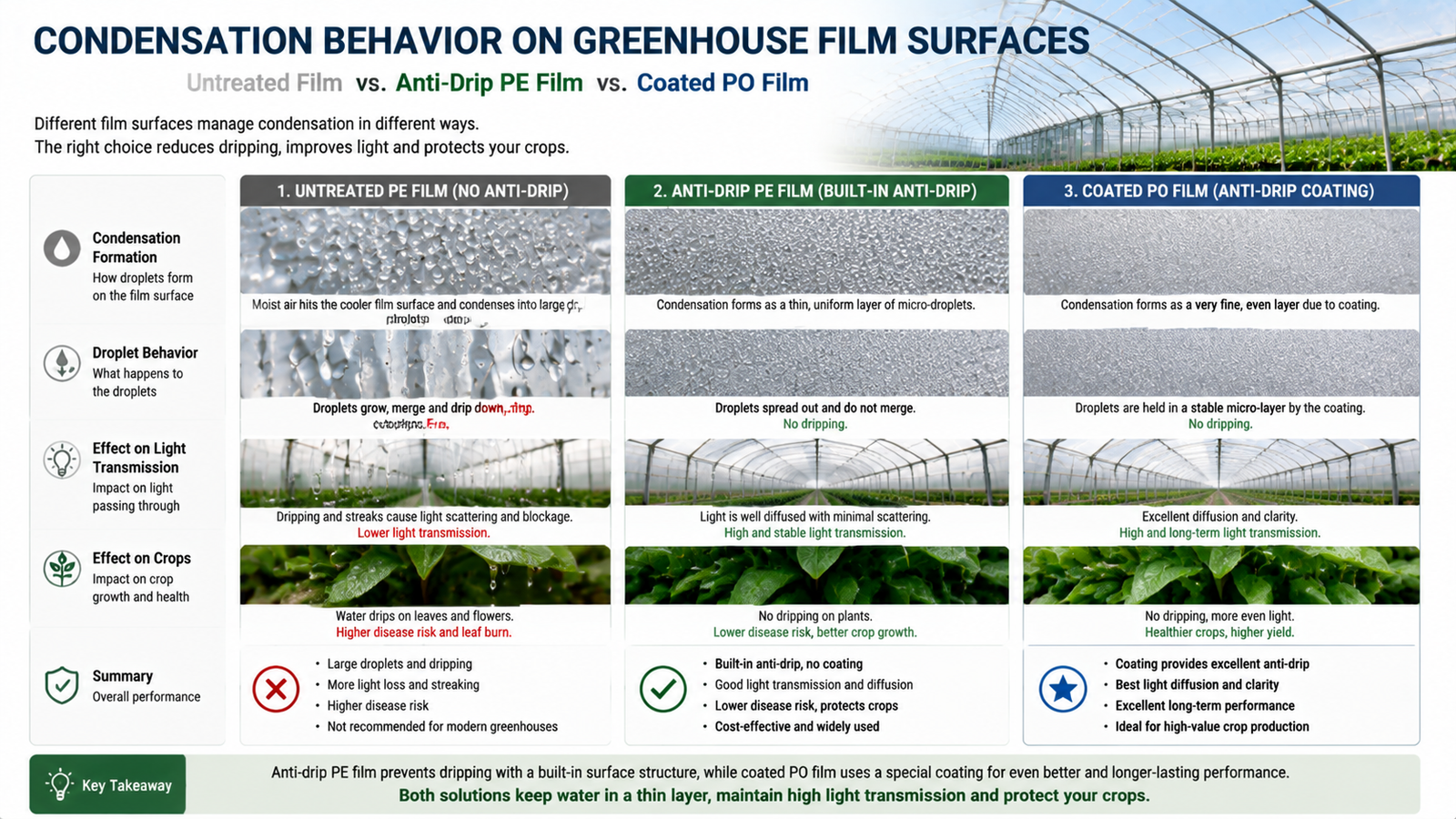
Why a good film can still drip
- The treated side is installed facing the wrong direction.
- The roof slope or film tension does not create a continuous runoff path.
- Dust, residues or chemical exposure interfere with the surface.
- Humidity and ventilation exceed what the covering alone can manage.
- The declared anti-drip period has ended before the film itself requires replacement.
Mechanical Strength, Thickness, Roll Size and Installation
Mechanical performance should be compared in both machine direction and transverse direction. Tensile strength, elongation, tear behavior and puncture resistance describe different failure risks. A single "stronger film" claim is not enough, especially when the test method, specimen thickness or direction is missing.
Thickness has practical tradeoffs. More thickness increases material use and usually increases roll weight. That can affect lifting, crew size, transport and the force applied during installation. It does not guarantee better light transmission, better anti-drip performance or longer UV life. Thickness tolerance is often more useful than nominal thickness alone because local thin areas can become early failure points.
Roll dimensions are equally important. A buyer who provides only the ground width of a greenhouse has not provided enough information to calculate the covering width. The film must follow the arch and include fixing or burial allowance. Openings, end walls and roll-up sides may require separate pieces. The greenhouse plastic roll size guide explains the measurement process before a custom roll is ordered.
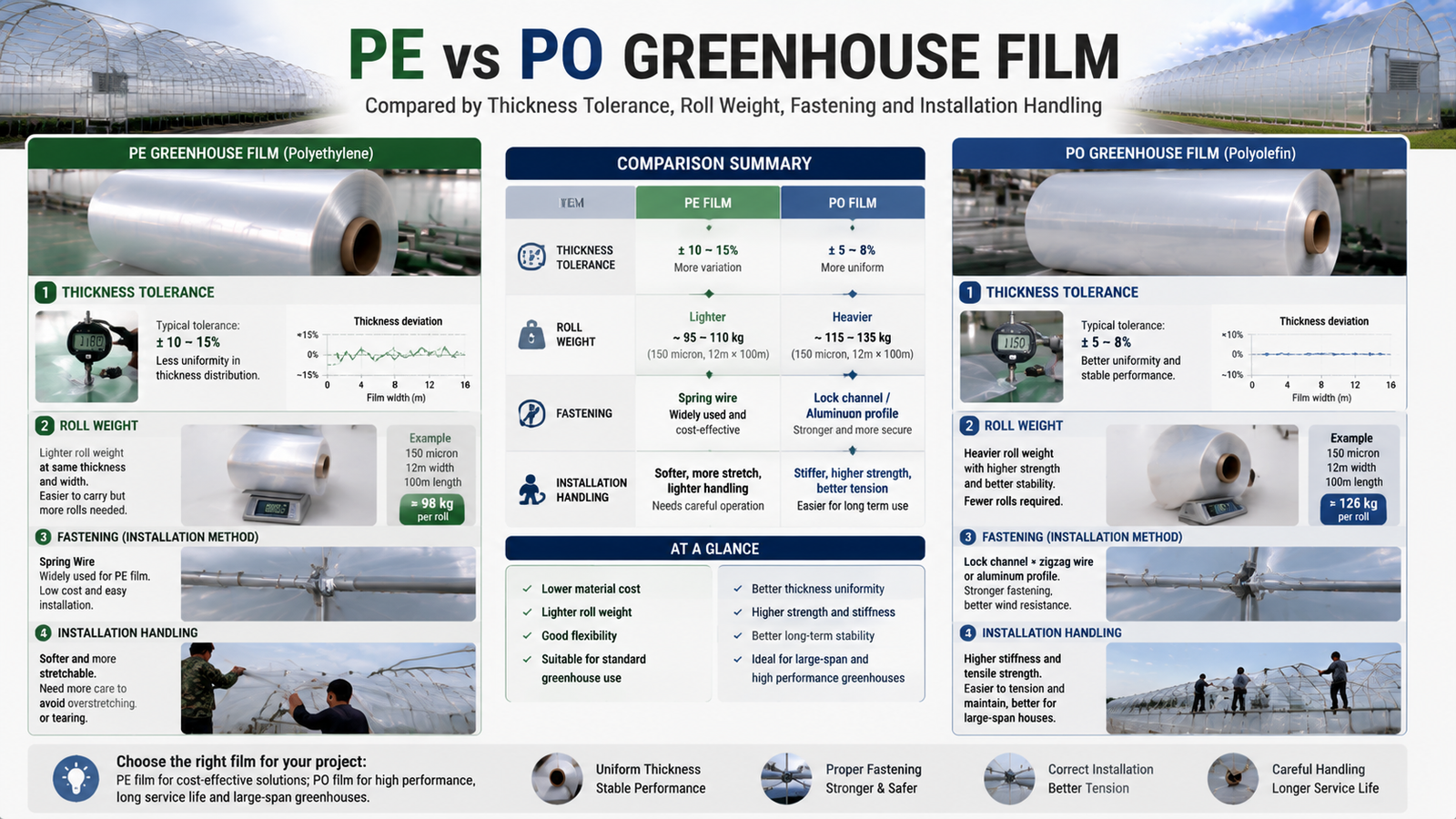
Initial Price vs Installed Service-Cycle Cost
Clear PE often has the lower initial purchase cost. PO is commonly positioned as the premium option. That does not mean PO always produces the lower long-term cost, and it does not mean PE is automatically the economical choice. The calculation depends on the real replacement interval and the cost of changing the covering.
A practical cost comparison
Installed service-cycle cost = film cost + freight + unloading + installation + removal + disposal + crop-interruption risk, divided by the verified service period.
For a small seasonal tunnel, replacement labor may be manageable and the lower PE cost may remain sensible. For a large multi-span greenhouse, a premature replacement can require a crew, lifting equipment, production interruption and new freight. In that situation, a verified premium specification may justify a higher purchase price. The calculation must use the declared conditions of the two actual products, not a generic claim that all PO film lasts a fixed number of years.
Three Commercial Buyer Scenarios
1. Seasonal vegetable farm
The farm wants a clear cover for a defined growing season and accepts a planned replacement cycle. A greenhouse-grade clear PE film with confirmed UV stabilization, thickness and roll size is normally the practical starting point. Paying for a premium PO system only makes sense if its functions solve a measured field problem.
2. Humid high-value crop house
The grower has persistent condensation and costly crop interruption. PO may be the stronger candidate, but the purchase should be approved against anti-drip mechanism, optical data, chemical limits and service conditions. "Premium PO" without those details is not enough.
3. Distributor or greenhouse builder
A distributor needs repeatable SKUs, while a builder needs project-fit dimensions. The distributor may stock a standard PE line and a clearly differentiated PO line. The builder should confirm frame geometry, fixing method and roll handling before choosing either material system.
These scenarios show why the best answer changes with the purchasing problem. The right question is not "Is PO better than PE?" It is "Which verified specification creates the lowest acceptable risk for this crop, structure and service cycle?"
Factory and Procurement Review Before Quotation
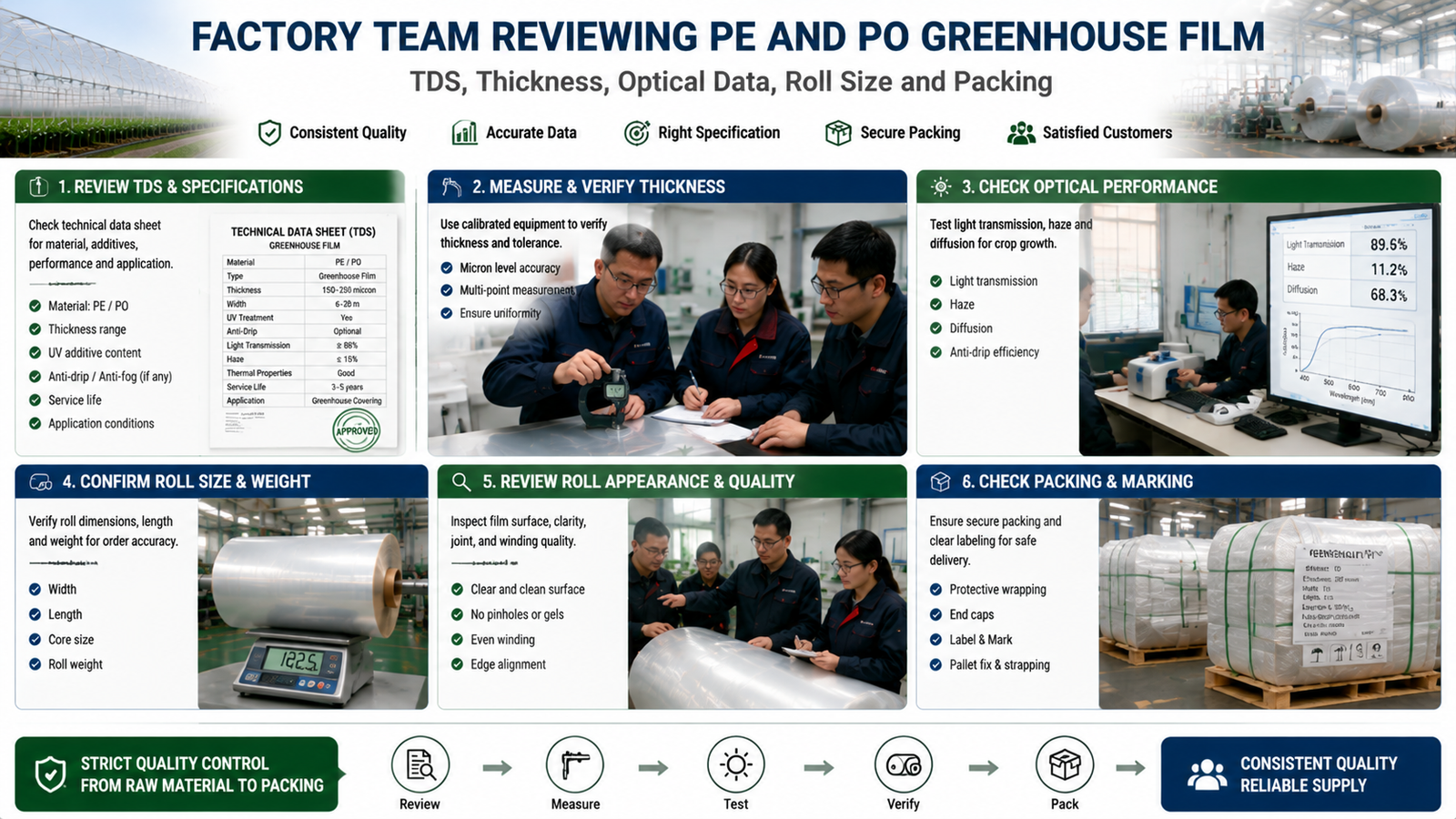
In actual quotation work, a supplier can calculate a price from incomplete information, but that does not mean the quoted roll is suitable for the site. Before production, the sales, technical and production teams should convert the buyer's use case into one approved specification.
| Information to confirm | Why the factory needs it | What it can affect |
|---|---|---|
| Greenhouse type, crop, location and season | Defines the exposure and functional priority. | Film family, UV package, diffusion, anti-drip and service expectation. |
| Material, layer structure and functional system | Prevents a commercial label from replacing a technical specification. | Formula, production route, quality plan and price. |
| Thickness and tolerance | Confirms material usage and minimum acceptable film consistency. | Roll weight, handling, mechanical performance and quotation. |
| Width, length, roll weight and core | Checks production capability and site handling. | Manufacturing setup, packing, freight and installation crew. |
| Optical and functional requirements | Aligns the additive or coating system with the crop environment. | Transmission, haze, diffusion, condensation control and cost. |
| Chemical exposure and installation method | Identifies preventable service-life and warranty risks. | Product approval, warranty terms and installation instructions. |
| Quantity, packing and destination | Confirms production planning and logistics feasibility. | MOQ, lead time, pallet plan, container loading and total landed cost. |
Documents to approve before mass production
- Model-specific technical data sheet rather than a general brochure.
- Approved product specification showing size, tolerance, color and functions.
- Sample or pre-production confirmation when appearance or function is critical.
- Packing and label confirmation for distributor or project orders.
- Inspection scope, acceptance method and warranty conditions.
Buyers who require supporting files can review the available plastic film quality documents. The supplier's plastic film quality-control process should also show how thickness, width, appearance, roll packing and order-specific checks are handled.
See the Review Process Applied to a Commercial Order
A documented 46-roll PO greenhouse film order shows how an initial 9.6 m covering request was corrected to 10.2 m, converted into a five-layer 180 micron specification, connected to batch inspection and recorded for 40HQ loading. Review the commercial PO greenhouse film order case study to see how the approved specification, production checks and loading record were tied to the same order.
Common Mistakes When Comparing PE and PO Greenhouse Film
| Mistake | Why it happens | Likely consequence | Correct approach |
|---|---|---|---|
| Treating PO as one standardized resin formula | The market uses PO as a familiar premium product label. | Products with different formulations and coatings are compared as if identical. | Request the actual material, layer and functional-system description. |
| Comparing only nominal thickness | Thickness is easy to quote and measure. | UV, optical, anti-drip and tolerance differences are missed. | Compare thickness together with the complete TDS and use conditions. |
| Confusing UV stabilization with UV blocking | Both are shortened to "UV protection." | The film may protect itself but deliver the wrong spectrum for the crop or pollinator. | Specify polymer weathering protection and greenhouse spectral requirement separately. |
| Assuming anti-drip and anti-fog mean the same thing | Sales descriptions often combine both terms. | Condensation behavior or visibility does not meet expectations. | Confirm each function, its mechanism, orientation and declared duration. |
| Comparing only new-film transparency | Initial transmission is easier to present than retained performance. | The chosen film may lose useful clarity earlier than expected. | Ask for weathering basis, retained values or realistic service conditions. |
| Ignoring sulfur, pesticides and hot structural contact | These conditions are not always included in the first inquiry. | Premature aging or a warranty dispute. | Disclose chemical and installation exposure before approval. |
| Ordering width from the ground span alone | The buyer has not measured the arch and fastening allowance. | The film is too narrow or creates unnecessary waste. | Use the frame profile, fixing points and installation allowance. |
| Comparing price per kilogram only | Material price is simpler than installed lifecycle cost. | Freight, labor and replacement interruption are overlooked. | Compare the complete installed service cycle under stated conditions. |
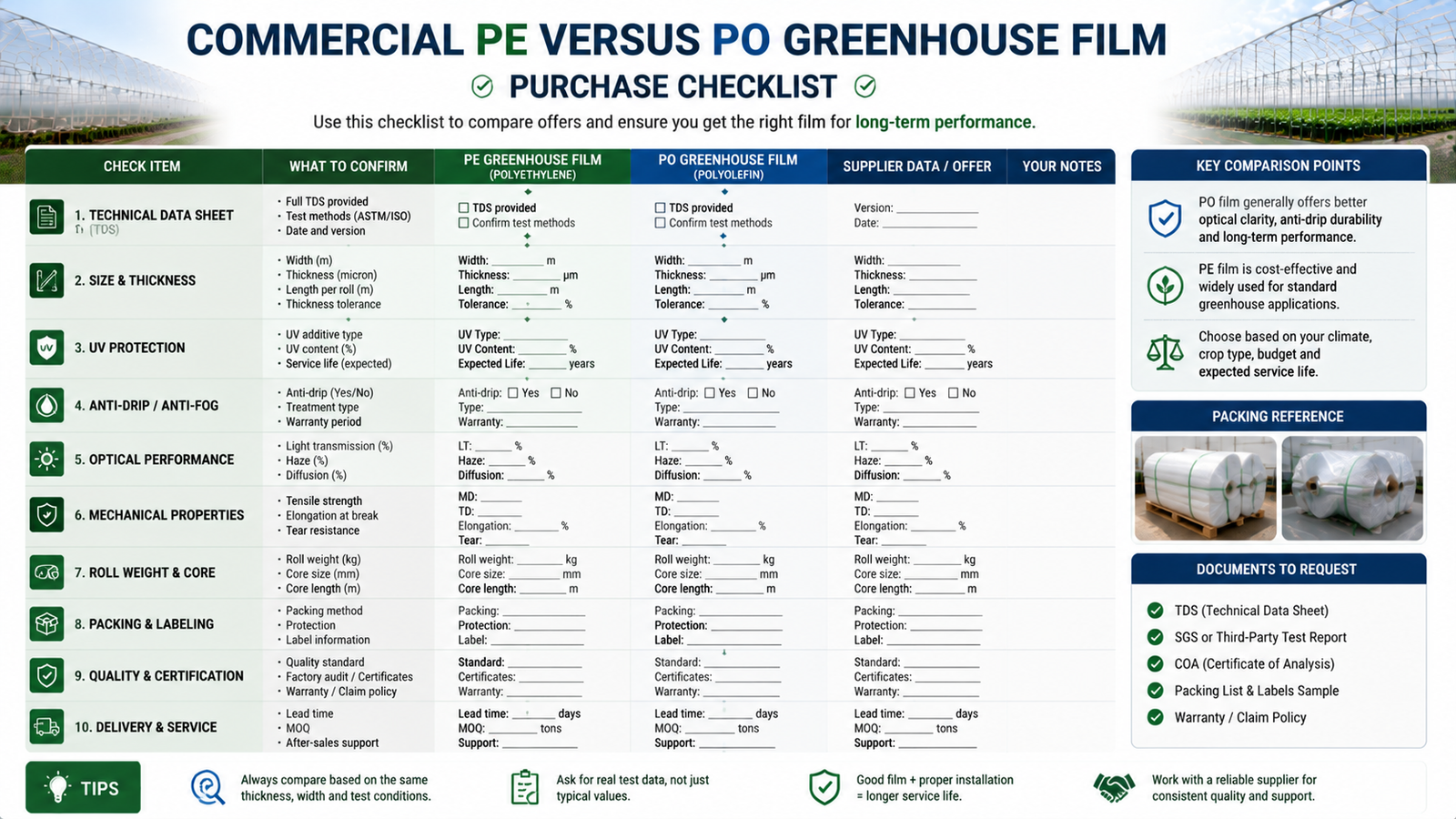
PE vs PO Greenhouse Film Order Checklist
- Product use: greenhouse type, crop, location and growing season.
- Preferred option: clear PE, PO or request for both model-specific quotations.
- Material and layer description stated on the supplier specification.
- Nominal thickness and acceptable thickness tolerance.
- Required width, length, core, maximum roll weight and quantity.
- Light transmission, haze or diffusion requirement where relevant.
- UV stabilization and any separate UV-blocking or UV-open requirement.
- Anti-drip and anti-fog mechanism, declared duration and correct film orientation.
- Mechanical test values and test directions where project risk requires them.
- Known sulfur, pesticide, cleaning and structural-contact conditions.
- Packing, label, pallet, container and unloading requirements.
- TDS, approved sample or specification, inspection scope and warranty wording.
Frequently Asked Questions
Is PO greenhouse film always better than PE greenhouse film?
No. PO is commonly used as a premium greenhouse-film label, but the actual formula and functional system vary by supplier. A verified PO specification may provide advantages for a demanding project, while a well-designed PE film may be the more sensible choice for seasonal or cost-controlled use.
Is polyethylene a polyolefin?
Yes. Polyolefins are a material family that includes polyethylene and polypropylene. In greenhouse-film purchasing, "PO film" is often a commercial product category rather than a precise opposite of polyethylene.
Which film is better for a commercial vegetable greenhouse?
For general or shorter-cycle production, greenhouse-grade clear PE is a practical starting point. For high-value crops, persistent humidity or projects where replacement interruption is expensive, compare a defined PO model against the PE model using TDS, function duration and service conditions.
Does thicker PO or PE film last longer?
Thickness alone cannot determine outdoor life. UV stabilization, resin quality, film structure, heat, chemicals, installation stress and local climate also affect degradation. Confirm the service-life basis and warranty instead of relying only on micron or mil thickness.
Does PO film always have permanent anti-drip performance?
No universal rule makes that claim safe. Some PO products use durable coatings or specialized functional layers, but the mechanism and duration must be verified for the exact model. Installation direction, roof slope, contamination and greenhouse operation also affect field performance.
Should I compare light transmission percentages directly?
Only when the values use comparable thickness, test methods and conditions. Also review haze, diffusion, spectral function and whether the data describes new or weathered film. The highest clear-light number is not automatically the best crop-light specification.
What information is needed for a PE or PO film quotation?
Provide the greenhouse type, crop, country or climate, expected service cycle, thickness, measured covering width, roll length, required functions, chemical exposure, quantity and packing. If some values remain uncertain, submit the frame dimensions and intended use for technical review.
Can clear PE and PO greenhouse film be customized?
Width, length, thickness, color, additive package, roll weight and packing may be customizable within the supplier's production limits. Confirm MOQ, allowable tolerance, lead time and any testing requirement before placing a custom order.
Authoritative References
- Plastics Europe: Polyolefins - material-family definition covering polyethylene and polypropylene.
- UMass Extension: Plastic Greenhouse Film Update - greenhouse-grade polyethylene, UV stabilization, condensate control and optical functions.
- Oklahoma State University Extension: High Tunnels - common polyethylene-film use in high-tunnel structures.
- FAO: Good Agricultural Practices for Greenhouse Vegetable Crops - greenhouse covering, light transmission and condensate-management context.
Prepare the Project Specification Before Requesting a Price
If the required dimensions and functions are already known, compare the clear PE greenhouse film roll with the PO greenhouse film using model-specific data. If the project is still being defined, prepare the greenhouse dimensions, crop, climate, service-cycle target, UV requirement, condensation conditions, quantity and packing method first.
For a custom project, send the film specification for quotation review. The factory can then confirm whether the requested width, thickness, functional package, roll weight and packing can be produced and handled consistently before the purchase order is approved.