
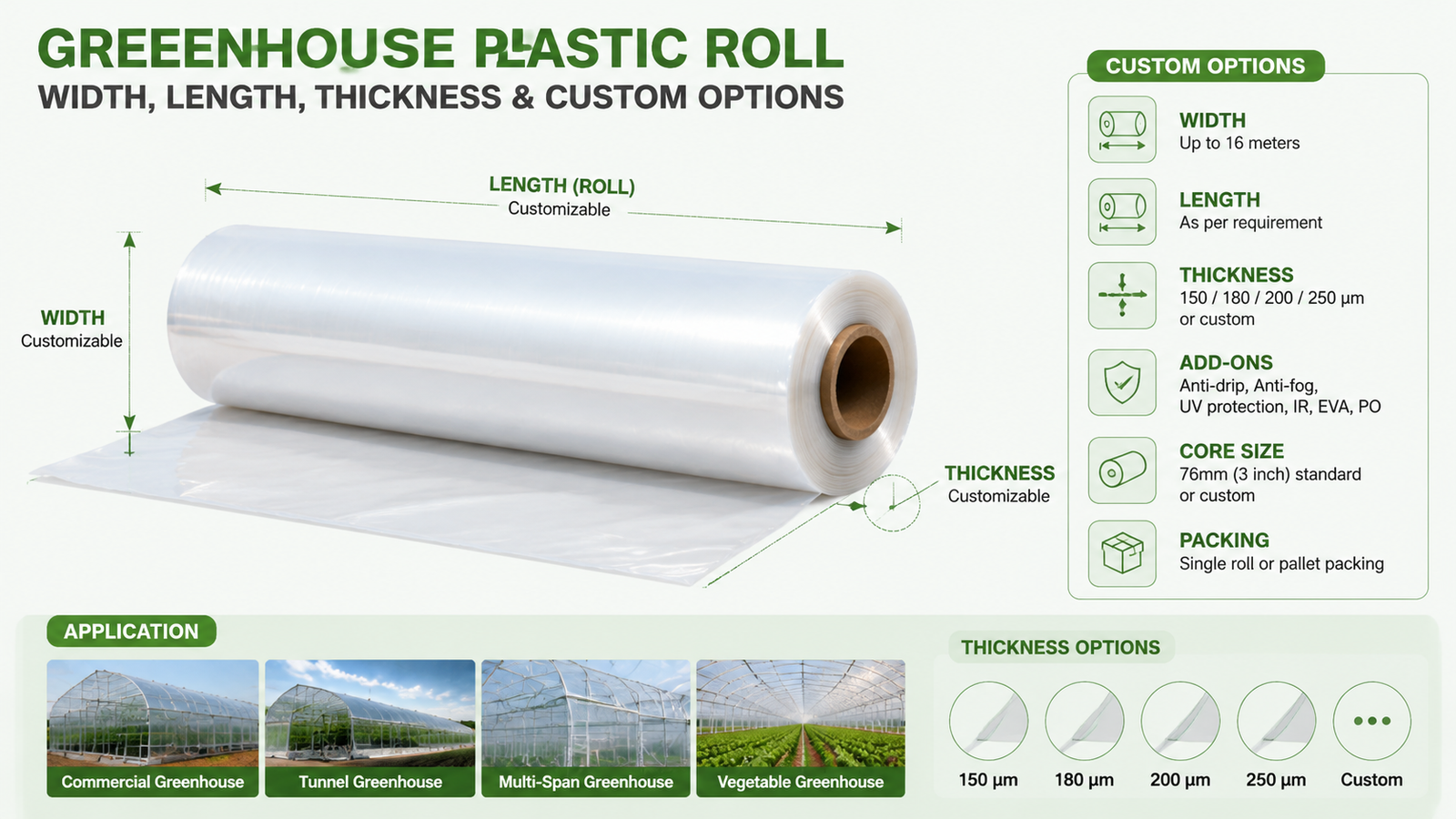
Greenhouse Plastic Roll Sizes: Width, Length, Thickness and Weight Guide
Greenhouse plastic roll sizes are not defined by a single number. For a commercial order, the size description normally includes finished width, roll or cut length, nominal thickness and tolerance, roll format, core, estimated net and gross weight, film orientation, labels and packing. The correct combination must fit both the greenhouse structure and the equipment available to unload and install the roll.
This guide covers dimensional calculation and roll handling. If the project still needs to choose between PE, PO and functional film options, review the main commercial greenhouse film selection page before finalizing the dimensional RFQ.
Contents
- Width and Length Formulas
- What a Complete Roll Size Includes
- Common Width References and Their Limits
- How to Measure Finished Width
- How to Calculate Roll Length
- How to Estimate Roll Weight
- Worked Project Calculation
- Farm, Builder and Distributor Scenarios
- Greenhouse Roll Size Decision Matrix
- Thickness Without Guessing Service Life
- Factory Size and Packing Review
- Common Sizing Mistakes
- RFQ Checklist
- Frequently Asked Questions
- References
Quick Answer: Calculate Width and Length from the Fixing Points
The fastening allowance is not universal. Lock channel and wiggle wire, timber battens, buried edges, roll-up tubes and inflated double-layer systems require different material beyond the visible roof area. The greenhouse builder or installer should define the fixing points; the film supplier should then confirm whether the requested finished width and roll format are producible.
What a Complete Greenhouse Plastic Roll Size Includes
In quotation work, "12 m × 100 m" is still incomplete. The buyer and supplier need to know whether 12 m is the finished usable width, whether the film will be folded, whether 100 m is a cut length or master-roll length, and how the roll will be weighed, labeled and handled. Thickness and formulation are separate specification items; they influence roll weight but do not replace dimensional confirmation.
| Specification | Meaning | Ordering Note |
|---|---|---|
| Finished width | The usable film width agreed for the supplied roll. | Base it on the measured covering path and fixing allowance; identify any folding method. |
| Roll length | The supplied master-roll or project cut length. | State the number of rolls and cut schedule; calculate end walls and side pieces separately. |
| Thickness | Film gauge, usually expressed in microns or mil. | State nominal thickness, unit and tolerance. One mil equals 25.4 microns. |
| Core and winding | Core diameter, roll orientation, winding direction and folding arrangement. | These details affect installation equipment, labeling and warehouse handling. |
| Estimated roll weight | Calculated film weight plus core, protective material and pallet where applicable. | Confirm forklift, hoist, crew and maximum pallet or roll limits before packing. |
| Identification | Product code, dimensions, greenhouse or bay number, orientation and batch mark. | Project labels reduce installation errors; distributors may need repeatable SKU labels. |
Common Greenhouse Plastic Width References and Their Limits
Buyers often search for a standard greenhouse plastic width before measuring the structure. That can help with early budgeting, but it is not a reliable purchase-order method. North American extension publications show retail examples from 12 ft to 54 ft, while factory-made project rolls may use different metric widths, folding arrangements and maximum roll weights. The useful question is not simply "Which widths are common?" but "Which finished width reaches the approved fixing points and can still be produced, packed and installed safely?"
| Published Width Example | Approximate Metric Width | How to Use the Reference | What It Does Not Prove |
|---|---|---|---|
| 12 ft | 3.66 m | Early comparison for narrow covers and smaller hoop profiles. | That the width fits the actual frame or is available in the selected formulation. |
| 20 ft | 6.10 m | Catalog reference for a modest single-span covering path. | That 6.10 m includes the required fixing and trimming allowance. |
| 24 ft | 7.32 m | A published example used in some hoop-house construction guides. | That another frame with the same ground span needs the same film width. |
| 32-40 ft | 9.75-12.19 m | Useful for checking whether a measured requirement is within familiar commercial roll bands. | Finished-width tolerance, folding, core, winding or manageable roll weight. |
| 48-54 ft | 14.63-16.46 m | Reference for wider covers where handling and folding become more important. | That every supplier can produce the width as one piece for every thickness and additive package. |
Procurement judgment: use these values only to recognize catalog conventions and convert imperial enquiries. For quotation, send the measured finished-width requirement in one agreed unit and ask the supplier to state the production width, tolerance and folded delivery width separately.
How to Measure Greenhouse Plastic Roll Width
Measuring greenhouse film width is one of the most common sources of ordering mistakes. The required roll width should not be calculated only from the straight ground width of the greenhouse. For hoop houses and curved structures, the film must cover the full arch curve.
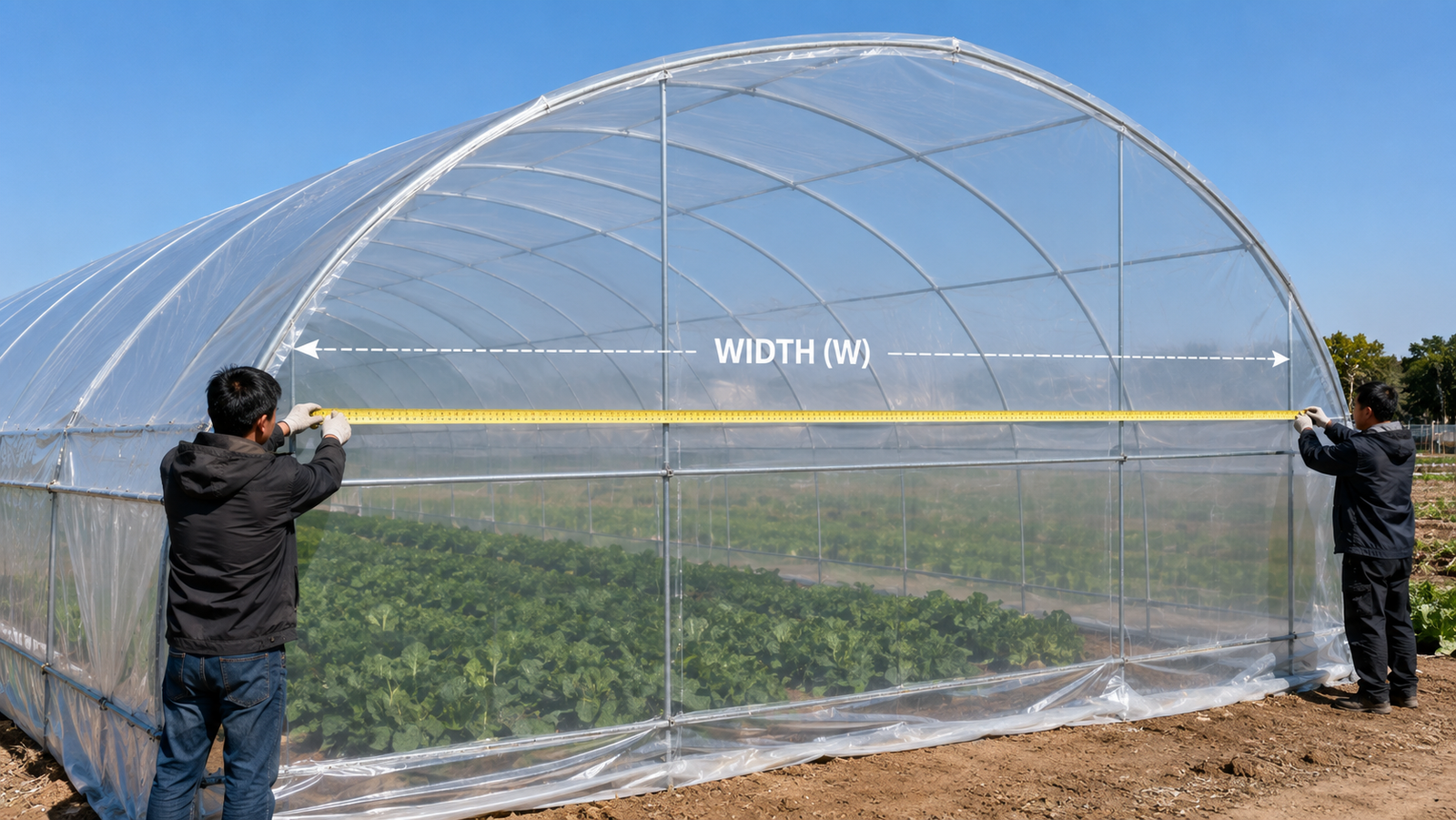
The safest method is to measure the actual structure with the intended fastening points already identified:
- Measure from one fixing point on one side of the greenhouse.
- Follow the curve over the roof to the fixing point on the opposite side.
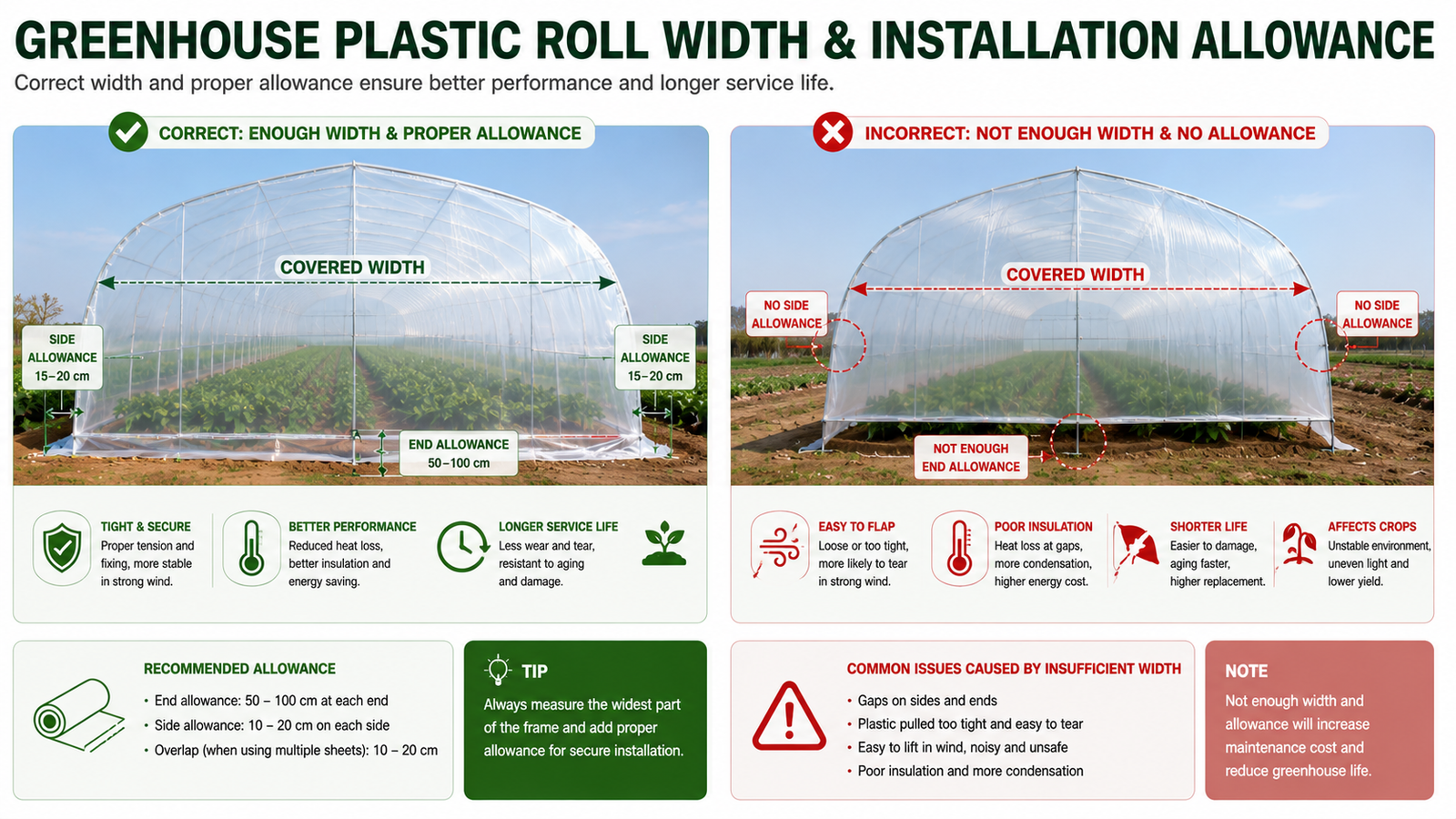
- Add extra allowance for locking channel, wiggle wire, buried edge, batten, roll-up side or trimming.
- If the greenhouse has side curtains or roll-up ventilation, measure those sections separately.
- If the structure uses a double-layer inflated cover, calculate the film needed for both layers.
Common farm error: a buyer sends only an 8 m ground span and requests an 8 m film. The quotation can be produced, but the film cannot follow the arch and reach both locks. Correcting the width after extrusion is impossible; the full covering path must be measured before order release.
How to Calculate Greenhouse Plastic Roll Length
Greenhouse plastic roll length is usually easier to calculate than width, but it still needs allowance. A roll that exactly matches the greenhouse length may be difficult to pull, align and fasten.
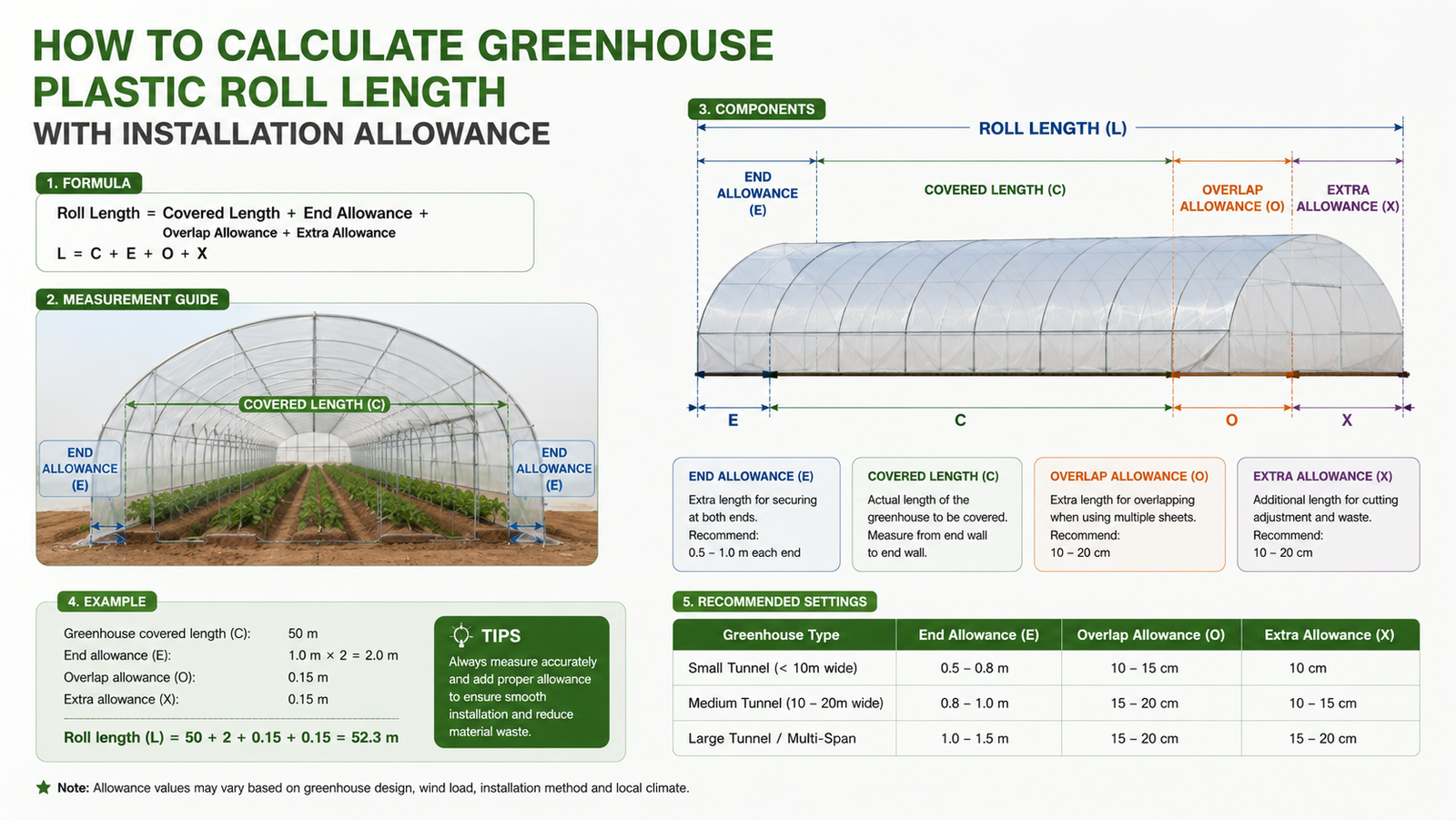
A simple calculation is:
For a 50 m greenhouse, the order length may need to be slightly longer than 50 m depending on how the film is pulled, fixed and trimmed. If the roll will also be used for end walls, doors, side ventilation areas or repair pieces, those sections should be calculated separately.
How to Estimate Greenhouse Plastic Roll Weight
Finished dimensions affect more than fit. They determine how much film is placed on one core and whether the buyer can unload, move and install it. A wide roll that is easy to quote may require a forklift, lifting beam or a different cut schedule at the jobsite.
This estimate excludes the core, protective wrap, bag, labels and pallet. It also does not replace the supplier's final weight. Buyers often miss this distinction and arrange labor for net film weight while the warehouse receives a heavier packed roll. Ask for both estimated net roll weight and packed gross weight when either unloading or manual handling is constrained.
Worked Project Calculation: From Frame Measurement to RFQ
Consider a single-span commercial greenhouse with a 60 m run length. The installer measures 10.8 m over the completed roof profile between the two final fixing points. For this fastening system, the installer specifies 0.4 m beyond each fixing point for gripping and trimming. The following calculation is a project example, not a universal allowance.
| Calculation Step | Project Input | Calculated RFQ Value | Supplier Confirmation Still Required |
|---|---|---|---|
| Finished width | 10.8 m measured path + 0.4 m left + 0.4 m right | 11.6 m requested finished width | Production feasibility, width tolerance and folded delivery width |
| Cut length | 60 m run + 1 m at each end + 0.5 m trimming reserve | 62.5 m requested cut length | Final cut-length tolerance and whether one project cut is preferable to a master roll |
| Preliminary net weight | 11.6 m × 62.5 m × 150 micron × assumed 0.92 g/cm³ | Approximately 100.1 kg of film | Actual formulation density, core weight and packed gross weight |
| Order release | One roof cut for each greenhouse; end walls calculated separately | Project roll schedule with house identification | Label layout, winding orientation, pallet plan and approval documents |
Why this matters in actual quotation work: a supplier can quote 11.6 m × 62.5 m × 150 micron, but the quotation is still incomplete if it does not state folding, core, roll orientation, net/gross weight and width tolerance. Those details determine whether the film can be unloaded, unfolded and installed as planned.
How Roll Format Changes for Farms, Builders and Distributors
Farm replacement cover
The farm should measure the installed covering path and identify existing locks, buried edges and roll-up sides. Reordering from the old invoice is risky if the frame or fastening points have changed.
Greenhouse builder
The builder normally needs revision-controlled drawings, a cut schedule and labels by greenhouse or bay. Project cut lengths reduce site cutting but increase order and packing coordination.
Distributor stock
The distributor usually needs repeatable master-roll SKUs, stable labels and manageable roll weights. Constant one-off widths can increase inventory complexity and make repeat orders harder to control.
Greenhouse Plastic Roll Size Decision Matrix
The table below assigns the dimensional work to the correct party. It does not prescribe a universal roll width or thickness.
| Greenhouse Situation | Buyer Measurement | Supplier Review | Release Evidence |
|---|---|---|---|
| Low tunnel or temporary crop cover | Bed covering path, buried edge and row length | Finished width, roll length, winding and manageable roll weight | Approved dimensions and quantity by row |
| Small hoop house | Path over the arch plus fixing and trimming allowances | Width feasibility, fold format, core and estimated roll weight | Measured sketch or drawing and approved roll specification |
| Commercial hoop house | Final fixing points, run length, end allowance and roll-up sections | Production width, cut plan, labels, packing and unloading method | Revision-controlled cut schedule and packing list |
| Multi-season greenhouse | Separate roof, sidewall, end-wall and ventilation measurements | Roll grouping, orientation, sequence labels and installation handling | Approved layout and roll identification plan |
| Roll-up side or curtain system | Fixed edge, moving edge, tube attachment and travel allowance | Separate roof and sidewall dimensions; do not infer from frame span | Approved sidewall cut length, orientation and tube allowance |
| Double-layer inflated system | Calculate outer and inner layers separately from their fixing paths | Layer identification, blower design interface, sealing and roll sequence | Approved inner/outer schedule and installation notes |
If you are still comparing film, reinforced plastic and rigid panels, read our guide to the best plastic for a greenhouse.
Thickness Changes Weight, Not the Width Calculation
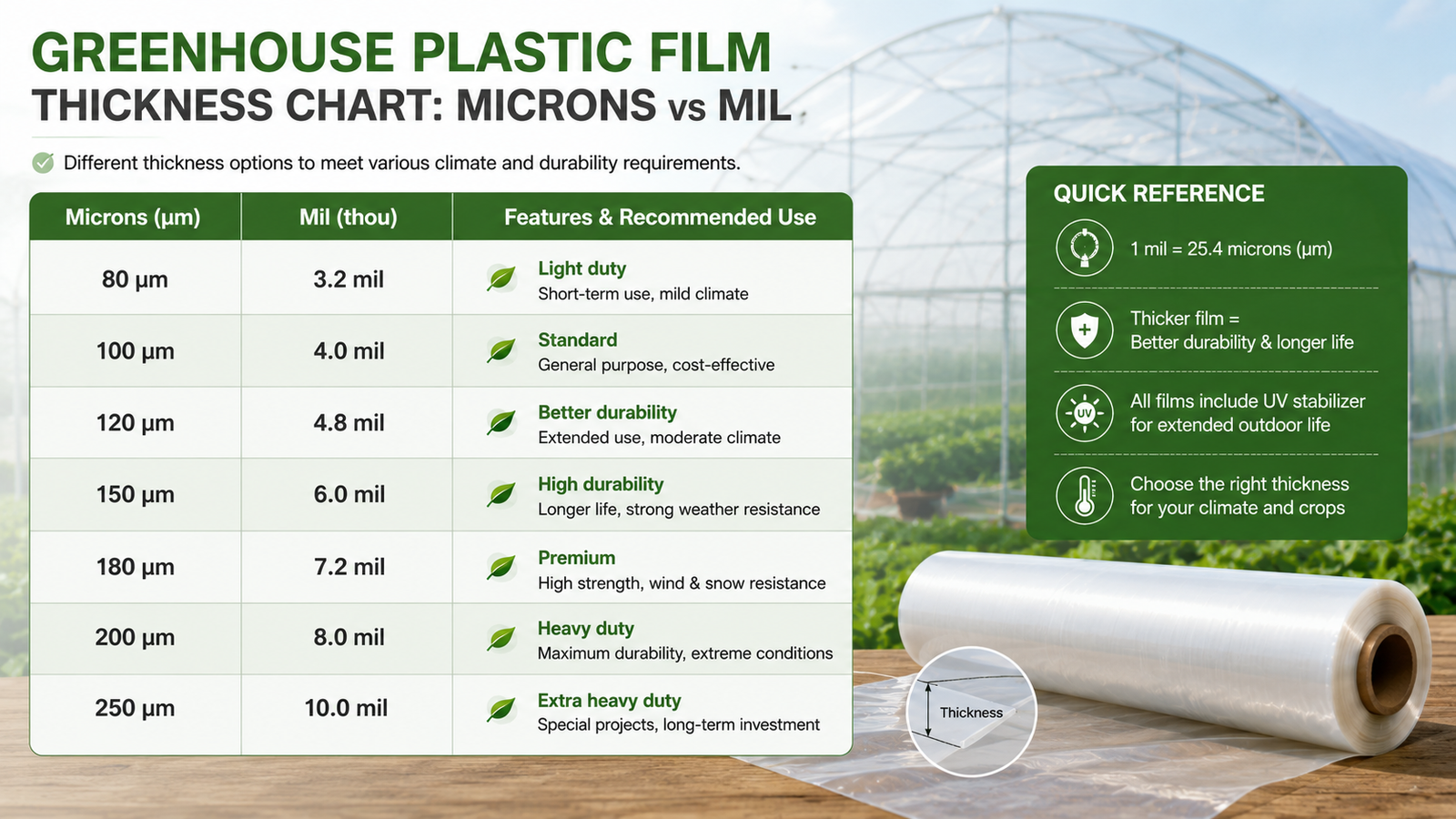
One mil equals 25.4 microns, so 6 mil equals 152.4 microns and is commonly discussed as approximately 150 microns. For many commercial greenhouse and high-tunnel projects, around 150 microns is a practical quotation starting point, but this sizing guide does not assign thickness by climate or promise service life.
A thicker film increases material and estimated roll weight. It may provide more material at a puncture or wear point, but it does not by itself establish UV stability, anti-drip duration, tensile performance or field lifetime. Confirm nominal thickness, tolerance, formulation, exposure and installation separately. For the full selection logic, use the greenhouse plastic thickness guide.
| Nominal Thickness | Exact Mil Conversion | Relative Material and Net Weight | Purchasing Interpretation |
|---|---|---|---|
| 80 micron | 3.15 mil | About 53% of a 150 micron roll with the same area and density | Lower roll weight and material use, but the supplier must still verify formulation, intended use and handling risk. |
| 100 micron | 3.94 mil | About 67% | Do not infer outdoor life from gauge; request UV and mechanical data for the actual product. |
| 150 micron | 5.91 mil | 100% comparison baseline | A practical commercial quotation starting point, not a universal specification or lifespan guarantee. |
| 200 micron | 7.87 mil | About 133% | More material and a heavier roll; confirm lifting, winding, light targets and whether the extra gauge solves the actual risk. |
| 250 micron | 9.84 mil | About 167% | Requires a project-specific reason and handling review; extra thickness alone does not substitute for UV stabilization or correct installation. |
Factory Review Before a Custom Roll Is Approved
Before production, the supplier should compare the requested dimensions with the selected film construction and order plan. "Custom" does not mean every combination can be produced without limits.
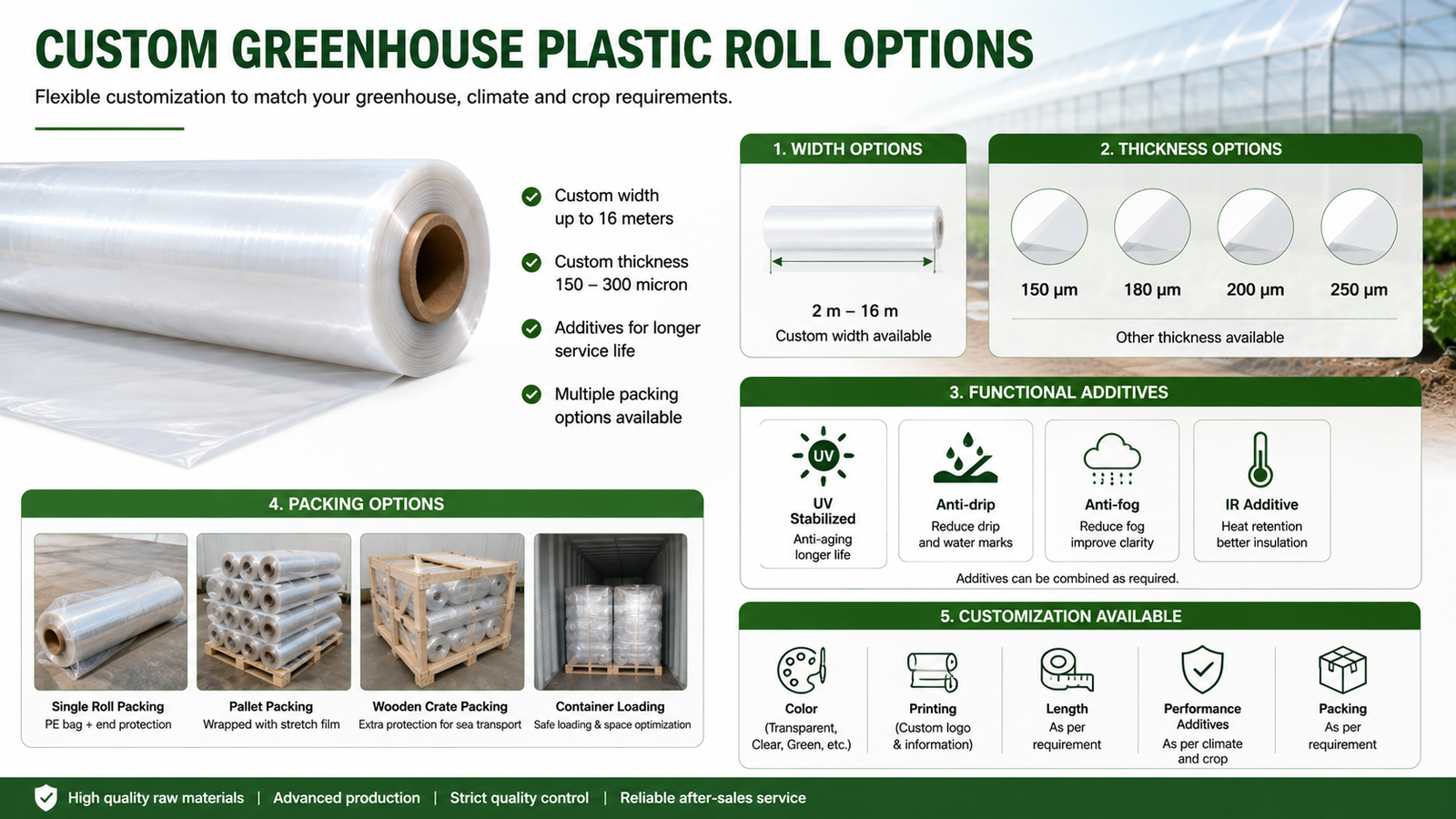
| Factory Review Point | Why It Changes Production or Delivery |
|---|---|
| Finished width and tolerance | Must match the measured covering path and available production configuration. |
| Cut length or master roll | Changes winding time, roll weight, cut schedule, labels and site handling. |
| Thickness and tolerance | Changes material consumption, weight and whether the requested width can be wound as planned. |
| Folding and winding | Wide film may be supplied folded; the buyer needs to understand unfolding and orientation. |
| Core and maximum roll weight | Must match lifting equipment, warehouse racks, pallet plan and installation crew. |
| Roll and project labels | Builders need bay-level identification; distributors need repeatable SKU information. |
| Packing and unloading | Protective wrap, bags, pallets, container plan and destination equipment affect gross weight and delivery. |
| Approval documents | Specification sheet, sample, label artwork and inspection requirements must be agreed before production. |
Functional requirements such as UV stabilization, anti-drip, anti-fog, diffusion or color should be stated in the RFQ, but their technical selection belongs in the approved product specification. For performance criteria, use the greenhouse film quality guide.
Once the dimensional plan is stable, use the greenhouse plastic roll specification checklist to review UV package, anti-drip requirement, optical targets, inspection documents and delivery terms without repeating the size calculation.
Common Mistakes When Choosing Greenhouse Plastic Rolls
Most sizing failures are not extrusion defects. They begin when a quotation uses an incomplete measurement or assumes that the supplier will infer the installation method.
| Mistake | Why It Happens | Consequence | Correct Action |
|---|---|---|---|
| Measuring only ground width | The span is easy to find on a basic drawing, while the covering path is not shown. | The roll cannot reach the final fixing points even though the quoted width matches the stated span. | Measure over the actual frame from fixing point to fixing point. |
| No fixing allowance | The buyer reports the visible roof area but omits gripping, trimming or buried material. | Installers lack enough film for the lock, batten, roll tube or buried edge. | Have the installer specify allowance for the exact fastening system. |
| Combining end walls and roof film without a cut plan | The total square metres appear sufficient, so all pieces are assumed to come from one roll. | Cutting losses or orientation requirements leave one section short. | Create a piece-by-piece cut schedule before totaling roll length. |
| Assuming thicker film needs the same handling | The dimensions stay unchanged, so roll weight is not recalculated. | The roll exceeds manual handling or available lifting capacity. | Estimate net weight, add packing, then agree a maximum roll and pallet weight. |
| Ordering "custom width" without supplier approval | Custom is treated as unlimited production capability. | The requested width may require folding, a different roll format or redesign. | Approve finished width, tolerance, folding and core in writing. |
| Using one label for several project rolls | Packing is planned only for shipment, not installation sequence. | Correct rolls arrive but are opened or installed in the wrong bay. | Use greenhouse, bay, layer and orientation labels tied to the cut schedule. |
A correctly sized film is easier to install, tension and maintain. For installation details, read our greenhouse plastic installation guide.
RFQ Checklist Before the Factory Reviews Roll Size
Send measured dimensions and handling limits, not only the greenhouse model name. The factory can review production feasibility but cannot infer the actual fixing points or take responsibility for structural calculations.
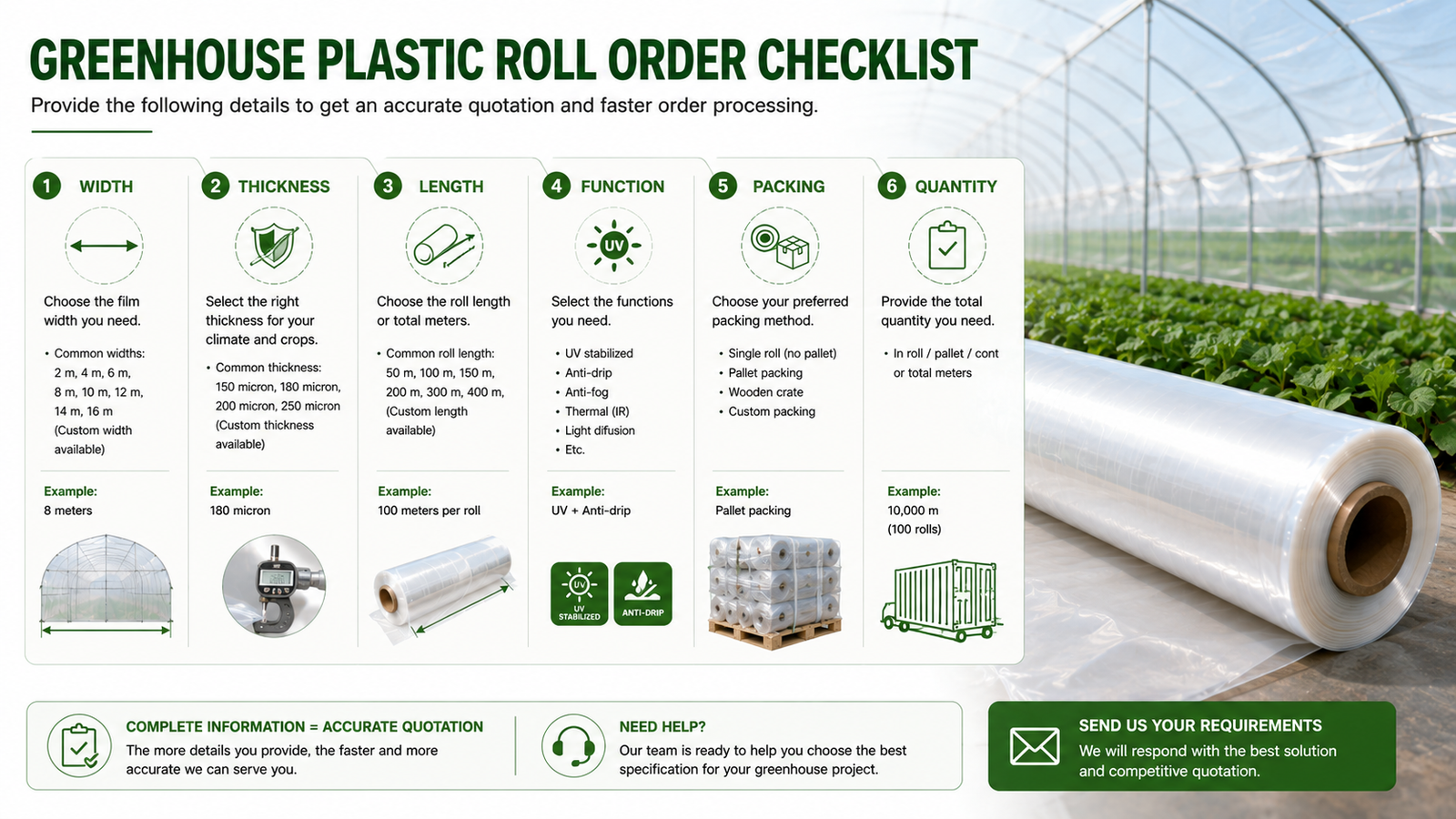
| Information | What the Buyer Provides | What the Supplier Confirms |
|---|---|---|
| Greenhouse type | Hoop house, multi-span house, roof, sidewall, end wall or double-layer cover | Applicable roll arrangement and any information still missing |
| Finished width basis | Measured path between final fixing points plus named allowances | Producible finished width, tolerance and folding method |
| Length and cut plan | Run length, end allowances, pieces, number of houses and waste plan | Master roll or cut-roll configuration and project labels |
| Thickness | Nominal micron or mil, tolerance and required minimum if applicable | Available production specification and inspection basis |
| Handling limits | Maximum roll or pallet weight, forklift or hoist availability and manual handling limits | Estimated net roll weight, core, packed gross weight and pallet plan |
| Packing and delivery | Destination, storage, unloading, sequence labels and delivery terms | Protective wrap, bags, pallets, container plan and packing list |
| Approval evidence | Required specification sheet, sample, label artwork and inspection documents | Which documents are included and when approval is required |
Frequently Asked Questions
How do I calculate greenhouse plastic roll width?
Measure the complete path over the actual frame from one final fixing point to the other, then add the fastening and trimming allowance required on each side. Do not use ground span alone. Have the supplier confirm finished-width feasibility, tolerance and folding before production.
How much extra greenhouse plastic should be added?
There is no universal allowance. It depends on lock channel, battens, buried edges, roll-up tubes, end pulling and trimming. The installer or greenhouse builder should define the fixing points and allowance for the actual system.
How is greenhouse plastic roll length calculated?
Add the greenhouse run length, front-end allowance, back-end allowance and trimming allowance. Calculate end walls, doors, vents, side curtains and repair pieces separately unless an approved cut plan includes them.
How can I estimate greenhouse plastic roll weight?
For preliminary planning, multiply finished width in metres by roll length in metres, thickness in microns and film density in grams per cubic centimetre, then divide by 1,000. Add the core, protective packing and pallet to obtain packed gross weight, and confirm the final values with the supplier.
Can a supplier calculate film width from greenhouse span and arch height?
Those dimensions may support an early estimate, but they should not replace a measured covering path or an approved drawing. Frame profile, sidewall height and final fixing points can change the required width.
Can any greenhouse plastic width be custom made?
No. Custom width remains subject to equipment, film construction, thickness, folding, winding, roll weight, core, order quantity and packing limits. Obtain written production-feasibility confirmation before releasing the purchase order.
What thickness is commonly specified with greenhouse plastic roll sizes?
Around 150 microns, commonly discussed as about 6 mil, is a practical starting point in many commercial enquiries. It is not a universal requirement. The final specification should also define thickness tolerance, UV stabilization, expected exposure, installation method and required functional additives.
Are 6 mil and 150 micron greenhouse film the same thickness?
Not exactly. Six mil converts to 152.4 microns, so 150 micron film is commonly treated as a close metric equivalent. The purchase order should state one agreed unit together with nominal thickness and tolerance rather than assuming the two labels are identical.