
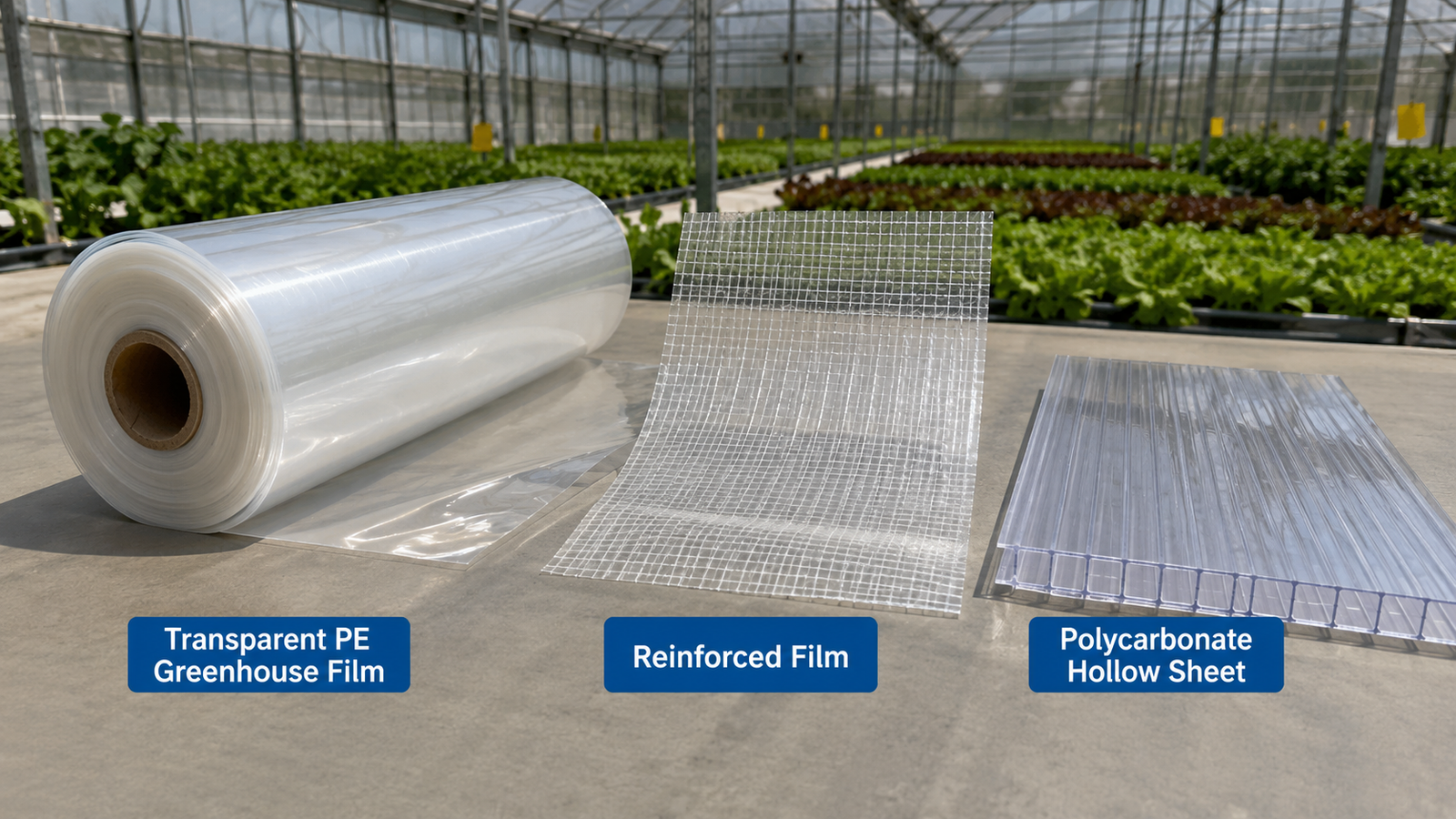
Best Plastic for a Greenhouse: PE Film, Polycarbonate and Other Covers Compared
Quick Answer: Which Plastic Is Best for a Greenhouse?
For most hoop houses, high tunnels and large commercial greenhouses, start with UV-stabilized greenhouse-grade PE film. It fits curved frames, is available in wide rolls and keeps material and installation costs practical. A 150-micron (approximately 6-mil) film is a common multi-year starting specification, but thickness alone does not determine life: verify the UV package, minimum thickness, climate rating, chemical exclusions, fastening method and written warranty. UConn Extension likewise identifies 6-mil greenhouse-grade film as a multi-year covering.
Choose multi-layer PE/EVA or a properly specified PO greenhouse film when a commercial project needs several controlled functions together, such as diffusion, anti-drip behavior, thermal retention and a destination-specific UV package. "PO" is a commercial category, not proof of performance, so compare the technical data sheet and warranty rather than the label alone.
Choose twin-wall or multi-wall polycarbonate for a permanent rigid greenhouse where insulation, impact resistance and a longer replacement interval justify the higher material, framing and installation cost.
For buyers comparing the best plastic for greenhouse projects, there is no universal material. Choose by greenhouse structure first and climate and crop conditions second. Then compare installation, maintenance and replacement cost. Commercial buyers comparing flexible systems can review our commercial greenhouse film options before defining the final specification.
Before comparing different greenhouse covering materials, it is useful to understand what greenhouse film is and why it is different from ordinary plastic sheeting.
Reinforced polyethylene can be preferable where puncture and abrasion are the main risks, while thermal, diffused and anti-drip film options solve different climate and crop problems. The comparison below treats each option as a covering system, not only as a polymer name.
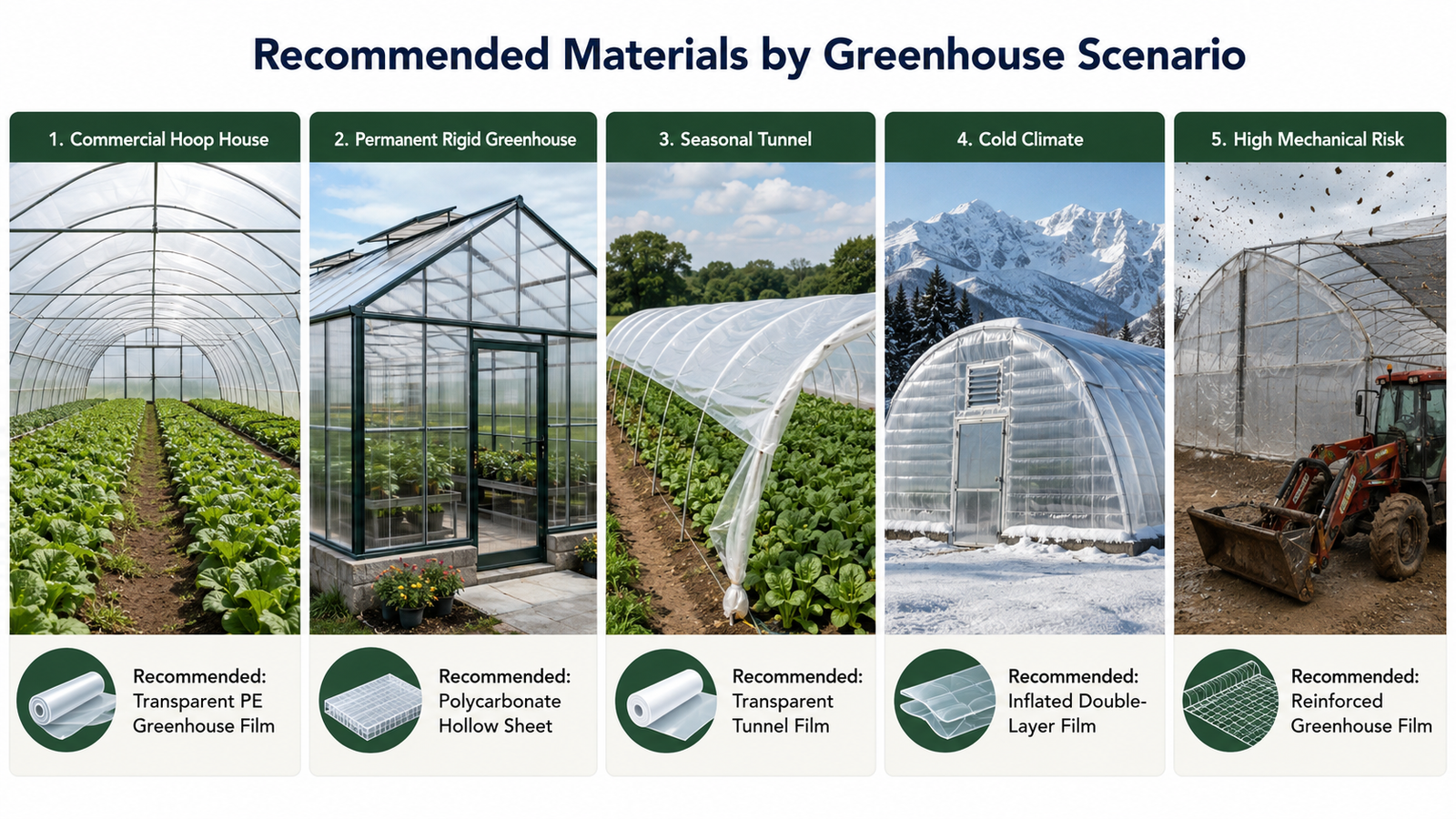
| Greenhouse Situation | Recommended Starting Point | Why | Check Before Buying |
|---|---|---|---|
| Commercial hoop house or high tunnel | UV-stabilized greenhouse-grade PE film | Fits curved frames, comes in wide rolls and keeps initial covering cost manageable | UV rating, thickness tolerance, roll width, tear strength and fastening method |
| High-value crop house needing diffusion, anti-drip and thermal control | Multi-layer PE/EVA or specified PO greenhouse film | Functional layers and additives can combine optical, condensation and heat-retention goals | Layer structure, transmission, haze, anti-drip duration, thermal test basis, UV rating and warranty |
| Permanent rigid hobby greenhouse | Twin-wall polycarbonate | Rigid, impact resistant and more insulating than single-layer film | Panel thickness, UV-protected side, framing, expansion allowance and warranty |
| Seasonal low-cost tunnel | Rated seasonal PE film | Low material cost and easy removal after the growing season | Do not assume construction plastic is greenhouse grade |
| Cold, heated greenhouse | IR/thermal double-layer PE film or multi-wall polycarbonate | Air spaces and thermal designs reduce heat transfer | Heating economics, inflation system, light loss and local energy cost |
| High puncture or abrasion risk | Reinforced PE film or engineered rigid panels | Better resistance to localized mechanical damage | Light transmission, foldability, attachment hardware and repair method |
What "Best" Should Mean
The word "best" is meaningless until the project defines what must be optimized. A cover that is ideal for a 30-meter commercial tunnel may be a poor choice for a small rigid backyard greenhouse, even if both products are high quality.
1. Structure Compatibility
Flexible film conforms to Quonset, gothic and hoop frames. Rigid panels need continuous support, compatible profiles, allowance for thermal expansion and a frame designed for panel dimensions. Structure compatibility should be decided before comparing polymer names.
2. Usable Light
Initial light transmission matters, but so do diffusion, condensation, dust and aging. Maximum direct transmission is not always the same as the most useful crop light. High-wire crops and intense-sun locations may benefit from a more even, diffused light distribution.
3. Thermal Performance
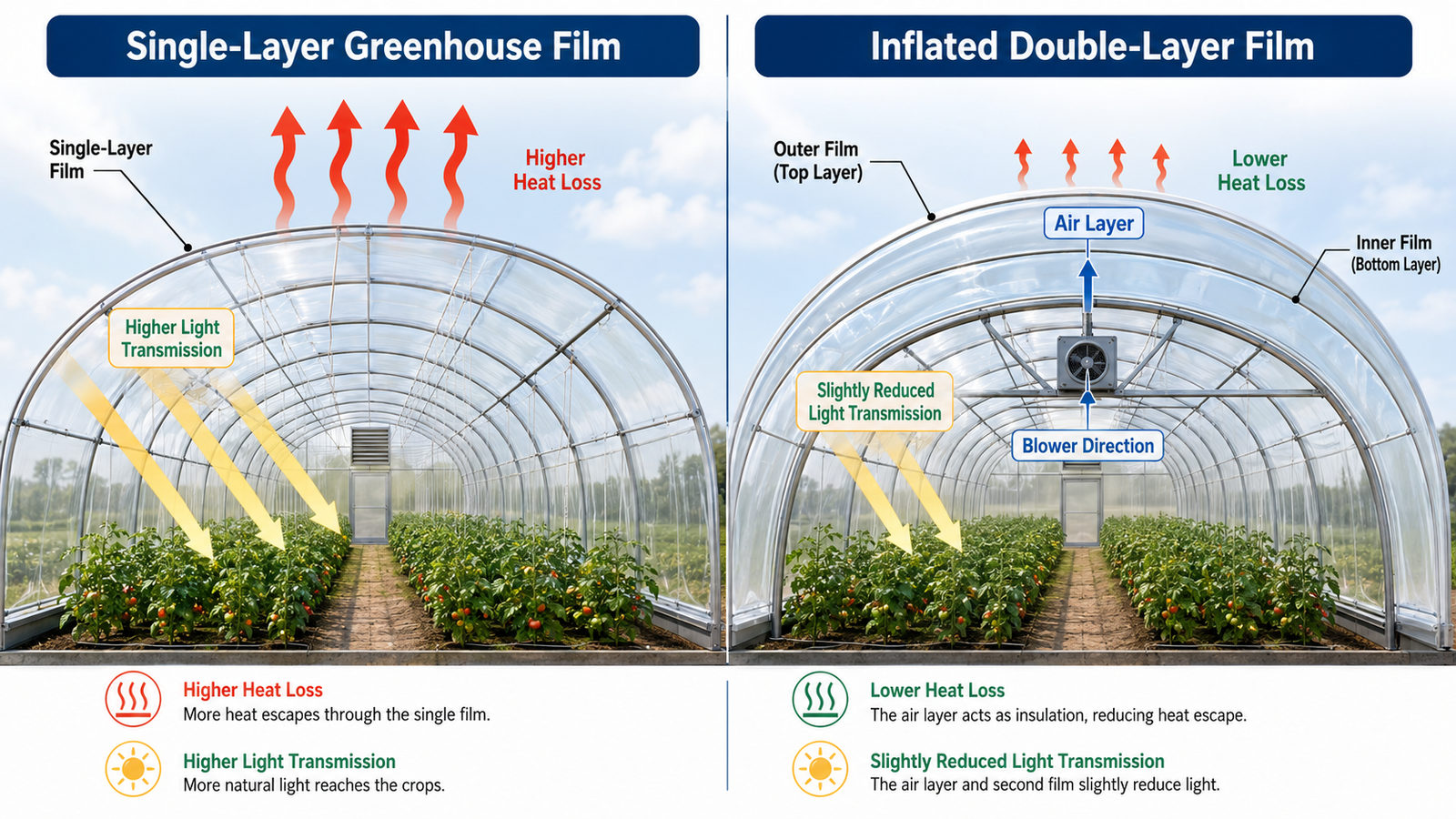
A single thin sheet has limited resistance to heat flow. Air spaces in inflated double film or multi-wall panels improve insulation. Thermal or IR additives can reduce radiative heat loss, but they do not eliminate the need to evaluate the entire greenhouse envelope, ventilation and heating system.
4. Mechanical Durability
Wind flexing, hail, snow, abrasion, installation handling and frame contact create different failure modes. Thickness helps with some mechanical risks, but resin formulation, tear behavior, reinforcement and fastening are equally important.
5. Service Life
Service life depends on UV stabilization, climate, temperature, chemicals, installation and maintenance. A rated warranty is more useful than a vague "long-lasting" claim, but buyers must still read its conditions and exclusions.
6. Total Installed Cost
The cheapest square foot is not always the lowest-cost system. Hardware, structural support, installation labor, heating, cleaning, replacement downtime and disposal all change the result.
Flexible Greenhouse Film vs Rigid Plastic Panels
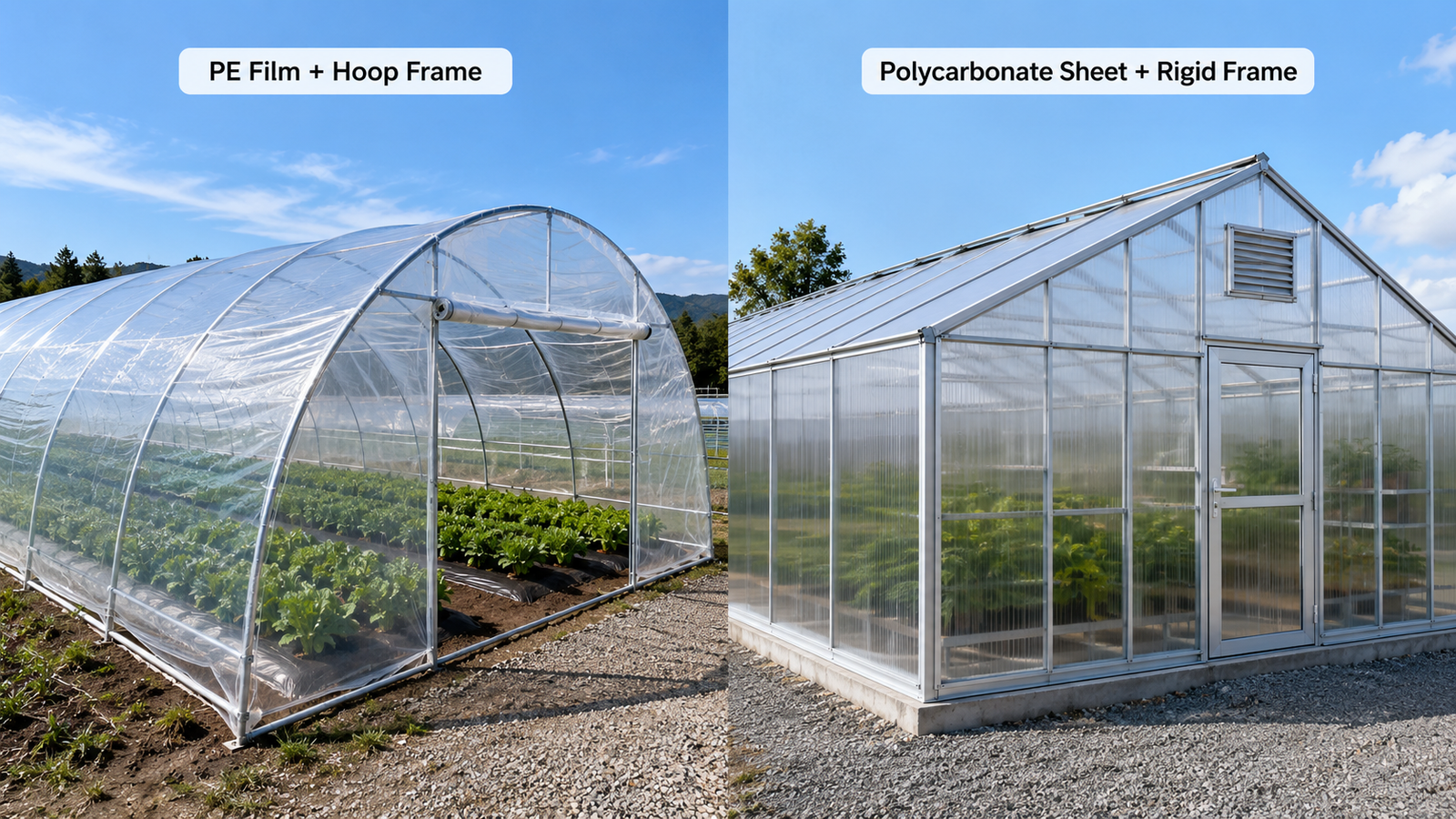
The most important division is not PE versus polycarbonate. It is flexible film versus a rigid panel system.
| Decision Factor | Flexible Greenhouse Film | Rigid Plastic Panels |
|---|---|---|
| Best frame type | Hoop, Quonset, gothic arch and large-span film structures | Rigid framed greenhouses with panel-compatible supports |
| Installation | Large sheets are pulled over the structure and tensioned | Panels are cut, joined and fastened with expansion and sealing details |
| Initial material cost | Generally lower | Generally higher |
| Replacement | More frequent but the frame normally remains in place | Less frequent, but damaged or unavailable panel sizes can complicate replacement |
| Insulation | Limited as one layer; improved with an inflated second layer and thermal film | Improved with twin-wall and multi-wall constructions |
| Impact behavior | Flexible but vulnerable to puncture and sharp objects | Polycarbonate offers strong impact resistance but can scratch |
The University of Arkansas describes polyethylene film as especially adaptable to Quonset structures because of its flexibility, low weight and easy installation. Oklahoma State University notes that multi-wall polycarbonate has higher initial cost but provides impact resistance and a longer expected life.
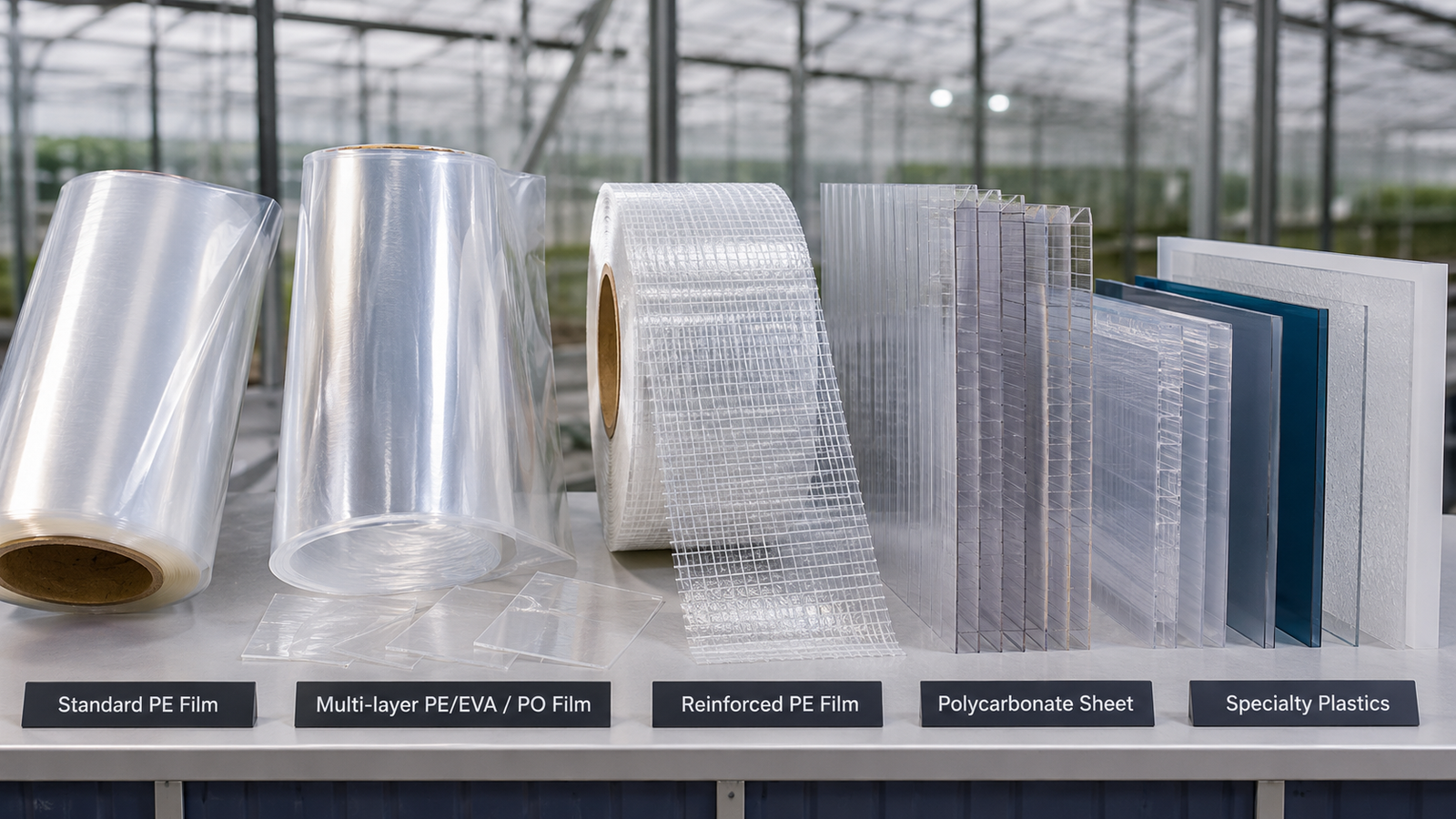
Five Greenhouse Plastic Options Compared
1. UV-Stabilized Polyethylene Greenhouse Film
Polyethylene is the standard flexible covering for commercial film greenhouses, hoop houses and high tunnels. Greenhouse grades commonly use LDPE, LLDPE or blends manufactured as one or more functional layers.
Main advantages:
- Low weight and relatively low initial cost
- Wide rolls that reduce seams on large structures
- Good initial light transmission
- Easy fit over curved frames
- Available with UV, anti-drip, diffusion and thermal functions
- Custom thickness, width and roll length are practical for bulk projects
Main limitations:
- Shorter replacement interval than engineered rigid panels
- Puncture and abrasion risk
- Single-layer insulation is limited
- Performance varies substantially between construction-grade and greenhouse-grade film
University of Arkansas guidance gives initial light-transmission examples of approximately 85-87% for standard single-layer polyethylene and 74-77% for a double layer. These are general examples, not guaranteed values for every film. A product specification and test method should control purchasing decisions.
Once you have selected flexible PE film, see how to attach greenhouse plastic to metal and wood frames while measuring the cover correctly, preparing contact surfaces, controlling film tension and choosing compatible fasteners.
2. Multi-Layer PE/EVA or PO Greenhouse Film
Multi-layer co-extrusion allows a manufacturer to place different functions across the film thickness. A layer may support mechanical strength, UV stability, thermal performance, anti-drip behavior or processing stability.
EVA can be incorporated into greenhouse film formulations to influence flexibility and thermal properties. "PO greenhouse film" is a commercial term often used for premium multi-layer polyolefin systems. Because polyethylene itself belongs to the polyolefin family, the label "PO" alone does not prove a specific performance level. Buyers should request the layer structure, optical data, weathering basis and warranty.
This option is best when the project needs a controlled combination such as UV plus anti-drip, thermal retention and diffusion rather than simply a thicker clear sheet. Buyers evaluating premium multi-layer structures can compare the available PO greenhouse film options and request product-specific optical, mechanical and aging data.
3. Reinforced or Woven Polyethylene
Reinforced film uses a woven or scrim structure to improve resistance to tearing and puncture propagation. It can be useful for high-wind areas, temporary end walls, livestock or storage applications, and projects where handling damage is frequent.
Reinforcement can also change light transmission, foldability, sealing and visual clarity. A buyer should not assume that the strongest-looking sheet is best for crop production. Review optical performance and joint details as carefully as tensile or tear strength.
4. Twin-Wall or Multi-Wall Polycarbonate Panels
Polycarbonate is the leading rigid plastic option. Internal walls create air spaces that improve insulation, while the polymer provides strong impact resistance. Panels are commonly used for end walls, rigid hobby greenhouses and permanent structures.
Main advantages:
- Good impact resistance
- Better insulation in twin-wall and multi-wall forms
- Longer replacement interval than flexible film in many applications
- Diffused light from many multi-wall products
Main limitations:
- Higher material and framing cost
- Requires compatible profiles, closures and fasteners
- Incorrect orientation can expose the unprotected side to sunlight
- Thermal expansion and internal condensation channels must be managed
- Surface scratching and long-term optical change remain possible
Oklahoma State Extension gives an expected life of roughly 10-15 years for polycarbonate in its greenhouse-covering guidance. Product warranties, panel construction and UV-protected surface design vary, so a project should use the actual manufacturer's data.
5. PVC, Acrylic and Other Specialty Plastics
PVC or vinyl film, acrylic panels, fiberglass-reinforced plastic and specialty fluoropolymer films can all be used in greenhouse construction. They are less common as the default commercial covering because cost, available width, structural needs, weathering, dust attraction, fire behavior or chemical compatibility can outweigh their benefits.
Acrylic can provide high clarity and long life but normally requires a rigid panel system. PVC film may offer good clarity and heat retention, yet formulation, temperature and chemical compatibility require careful review. These options should be selected for a defined engineering reason rather than because they appear on a generic list of plastics.
Complete Greenhouse Plastic Comparison
| Covering | Compatible Structure | Light Behavior | Insulation | Service-Life Category | Relative Initial Cost | Best Use | Main Limitation |
|---|---|---|---|---|---|---|---|
| Greenhouse-grade PE film | Hoop, Quonset, gothic and multi-span film houses | High initial transmission; clear or diffused grades | Low as one layer; improved as inflated double layer | Multi-year when properly UV stabilized | Low | Large agricultural structures and high tunnels | More frequent replacement and puncture risk |
| Multi-layer PE/EVA or PO film | Commercial film greenhouse structures | Can be engineered for transmission, diffusion or thermal goals | Product-specific; thermal grades available | Product- and climate-specific | Low to medium | Projects needing combined functional additives | Marketing labels are not substitutes for test data |
| Reinforced PE film | Frames with compatible attachment and seam systems | Varies with scrim and coating | Product-specific | Product-specific | Medium | High puncture, handling or wind risk | Optical tradeoffs and more complex joining |
| Twin/multi-wall polycarbonate | Rigid engineered frames | Good transmission with useful diffusion in many panels | Medium to high depending on wall structure | Long-term rigid covering | High | Permanent structures, cold climates and impact resistance | Higher structural and installation cost |
| PVC, acrylic and specialty plastics | Product-specific | Ranges from very clear to selective transmission | Product-specific | Product-specific | Medium to high | Niche optical, architectural or engineering needs | Cost, width, compatibility or availability |
The categories above are intentionally qualitative. Exact light transmission, R-value, lifespan and cost depend on construction and brand. Comparing a single sheet of PE with a 16 mm multi-wall panel without identifying those constructions would produce a misleading result.
Best Plastic by Greenhouse Structure
High Tunnels and Hoop Houses
Greenhouse-grade PE film is normally the practical starting point. It conforms to curved frames, is available in large widths and allows the structure to remain relatively light. Seasonal tunnels can use an appropriately rated short-life film; permanent houses need a UV-stabilized multi-year grade.
Commercial Multi-Span Greenhouses
The decision is often between advanced film systems and rigid roof/wall systems. Film can reduce initial covering and structural cost, while multi-layer, anti-drip, diffused and thermal formulations can be tailored to the crop. The design must account for fastening, wind loads, ventilation, inflation and replacement access.
Rigid Hobby Greenhouses
Twin-wall polycarbonate is often the strongest all-around choice when the frame is designed for panels. It offers insulation and impact resistance without the weight and breakage risk of glass. For a small curved DIY structure, greenhouse film may still be more practical.
Temporary and Seasonal Structures
A rated seasonal PE film can minimize cost and simplify removal. Construction-grade plastic is not an equivalent substitute unless its manufacturer provides suitable outdoor UV, mechanical and optical performance.
Nursery, Vegetable and Flower Houses
The crop changes the optical priorities. A low-light winter vegetable crop may prioritize high transmission. Tall crops in intense sun may benefit from diffusion. Flowers and disease-sensitive crops may justify more precise anti-drip, thermal and spectral specifications.
Best Greenhouse Plastic for Winter, Heat and Wind
Cold or Heated Greenhouses
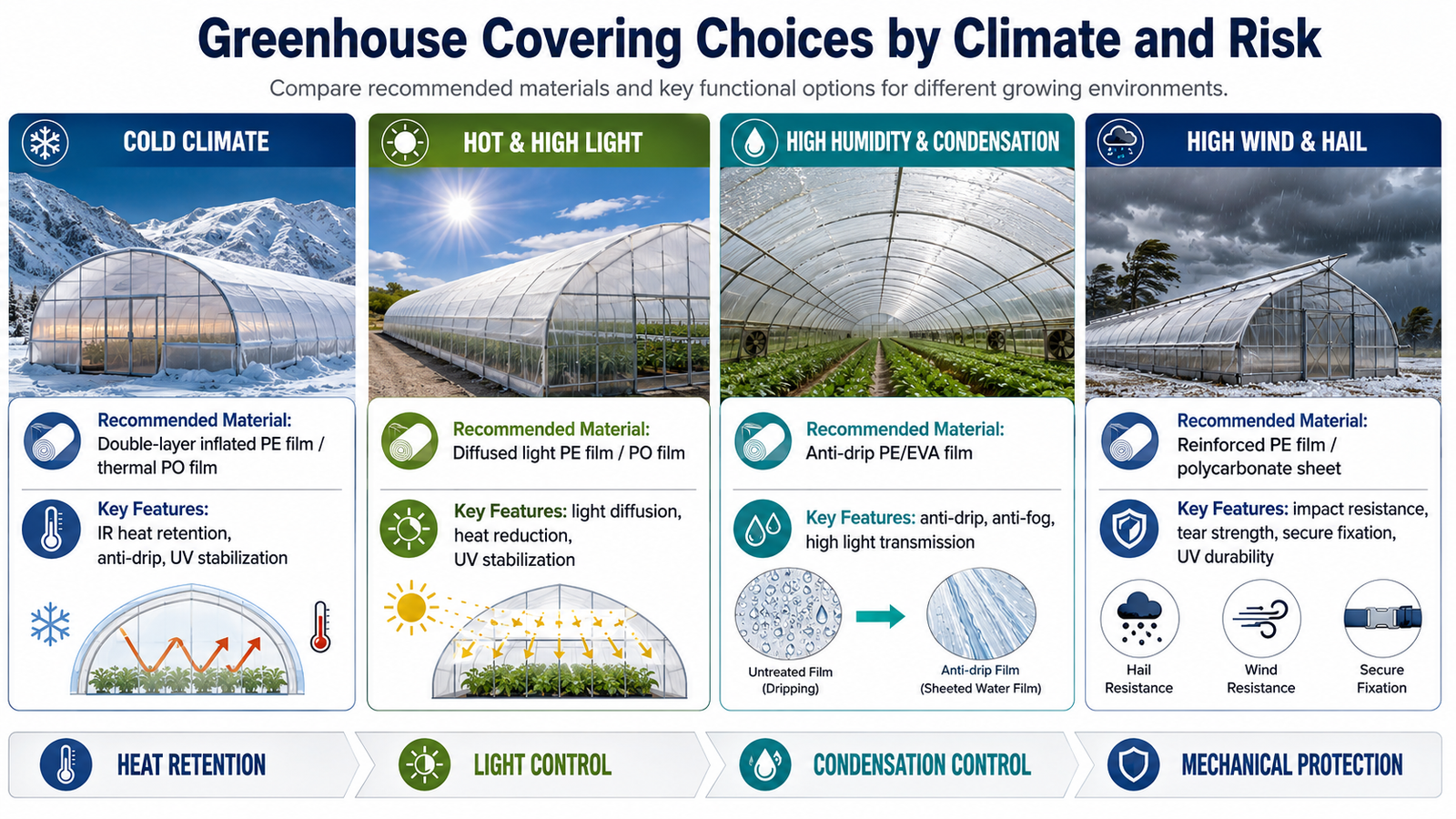
Compare an inflated double-layer thermal film system with multi-wall polycarbonate. UF/IFAS reports that the cited double-poly system reduced heat loss or gain by approximately 35-40% compared with single polyethylene, with about a 10% reduction in light transmission. That is a system-specific engineering reference, not a guarantee for every installation.
A double layer needs a reliable blower, outside-air intake, pressure control and sealed perimeter. Polycarbonate needs correctly sealed channels and panel joints. Local fuel cost and winter solar availability should be part of the calculation.
Hot, High-Sun or High-UV Locations
Choose a film with a UV package rated for the destination and consider controlled diffusion to reduce hot spots and deep canopy shadows. Diffusion should be selected together with total light transmission; excessive shading can reduce production when light is already limited.
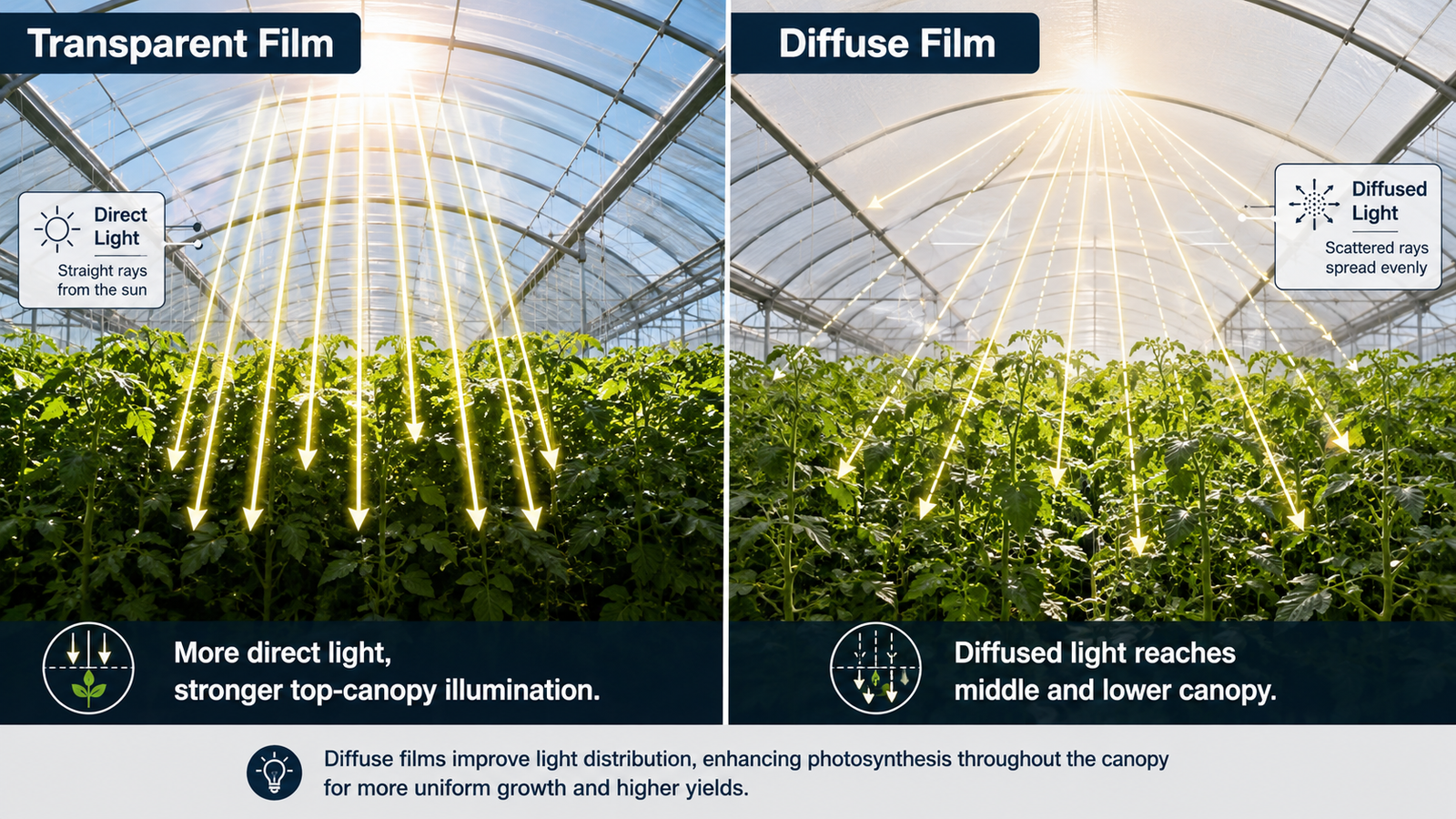
Wageningen University research with diffuse greenhouse glass found deeper, more uniform canopy light and higher tomato yield in the studied system. This supports the principle that diffusion can improve light distribution, but it does not guarantee the same yield response for every crop, climate or plastic film.
Humid or Condensation-Prone Greenhouses
Anti-drip or anti-condensate treatment reduces surface tension so water forms a film that runs down the covering instead of large droplets that fall on crops. Ask how long the anti-drip function is expected to remain effective; its functional period may be shorter than the structural life of the film.
Wind, Hail and Abrasion
Start with the structural design and fastening system. A thicker film cannot correct an under-designed frame, loose cover or sharp contact point. Reinforced film can reduce tear propagation, while polycarbonate offers strong impact resistance on a compatible rigid frame. Hail, wind and snow design must follow local engineering and building requirements.
Clear, Diffused or Thermal Greenhouse Film?
Clear Film
Clear film is a strong choice where maximum direct light is important, especially in cool seasons and cloudy regions. "Clear" should still be supported by a measured transmission value and test method.
Diffused Film
Diffused film scatters incoming light, helping reduce harsh shadows and distribute light through the canopy. Haze and total transmission are different measurements: a film can be highly diffusing while still transmitting a useful amount of light.
IR or Thermal Film
Thermal films are designed to reduce long-wave infrared heat loss. This is different from visible-light transmission and different again from UV stabilization. Buyers should request the thermal test basis rather than relying only on the abbreviation "IR."
Anti-Drip Film
Anti-drip treatment manages condensation behavior. It does not make the greenhouse waterproof, remove the need for ventilation or guarantee disease control.
Thickness, UV Stabilization and Warranty
Thickness Is Not a Complete Quality Grade
Thickness affects material quantity, handling, puncture resistance and some mechanical behavior. It does not automatically determine UV life, insulation, clarity, diffusion, anti-drip duration or resin quality.
A properly formulated 6 mil greenhouse film may outlast a thicker sheet that lacks the correct stabilizers. Review the greenhouse plastic thickness guide for a detailed mil-to-micron comparison.
UV Stabilization and UV Transmission Are Different
UV stabilizers protect the polymer from sunlight-induced degradation. UV transmission or blocking describes which wavelengths enter the greenhouse. Those optical choices can influence insects, pollinators and crops. A film can be weather-resistant without blocking every UV wavelength.
Read the Warranty Conditions
Check climate or geographic restrictions, chemical exclusions, installation requirements, permitted frame materials and the property-loss threshold used for a claim. Sulfur, chlorine, copper, pesticides, treated lumber, PVC contact and incompatible coatings can shorten film life or affect warranty coverage.
Replacement planning should consider the film rating, loss of flexibility, repeated damage and declining light performance rather than age alone.
How to Compare Total Greenhouse Covering Cost
Do not compare only purchase price per square foot. Use:
Annualized covering cost = material + hardware + installation labor + crop downtime + maintenance + disposal, divided by expected service years
Then evaluate heating and cooling separately. A more insulating panel may reduce fuel use but require a stronger frame and higher initial capital. Film may be economical over a large area but require planned replacement labor. The correct result depends on local energy, labor, crop value and weather.
Avoid false precision: a cost table copied from another country, year or greenhouse size is not a reliable project estimate. Request installed quotations for the same area, frame and performance requirement.
Common Mistakes When Choosing Greenhouse Plastic
Most purchasing errors occur before installation because quotations are compared on different assumptions. The following checks prevent a low headline price from becoming an installation, performance or warranty problem.
| Common Mistake | Why It Happens | Likely Consequence | Better Practice |
|---|---|---|---|
| Choosing only by thickness | Mil or micron is treated as a complete quality grade | A thick film may still have unsuitable UV stability, optical properties or thickness uniformity | Compare thickness, tolerance, UV package, mechanical data and warranty together |
| Comparing only purchase price | Film and rigid panels are quoted on different installation bases | Hardware, labor, downtime and replacement costs are missed | Compare total installed cost and a credible service period |
| Using greenhouse floor width as film width | The roof curve and fastening allowance are ignored | The finished roll may be too narrow for installation | Measure between final attachment points and include pulling and fastening allowance |
| Assuming UV and anti-drip are automatically included | Product names do not always define the additive package | The film may age early or perform poorly in humid conditions | State each required function separately in the RFQ |
| Accepting a product label without technical documents | Similar names may cover different formulations | Quotations cannot be compared on the same basis | Request a specification sheet, TDS, warranty conditions and agreed inspection items |
Supplier-Specific Example: 150-Micron Clear PE/EVA Film Data
The following example shows the level of detail a buyer should expect for one specified clear greenhouse film. These values are product-specific supplier data, not universal averages for all PE film or an independent laboratory certificate.
| Property | Specified Value | Test or Interpretation |
|---|---|---|
| Material structure | Virgin LDPE and EVA, three-layer co-extruded with UV stabilizer | Identifies resin and manufacturing structure |
| Nominal and minimum thickness | 150 microns (0.15 mm); average-thickness tolerance +/-10%; separately stated minimum-point thickness of 120 microns | Confirm the sampling method and which measurement the tolerance governs; do not treat 120 microns as the lower edge of a +/-10% nominal range |
| Visible light transmission | At least 91% | Supplier specification; confirm specimen and optical test method |
| Haze | No more than 4.5% | Low-haze clear-film specification |
| MD / TD tensile strength | At least 22 / 19 MPa | Machine- and transverse-direction performance |
| MD / TD elongation at break | At least 420% / 360% | Helps assess ductility before aging |
| Supplier-rated outdoor life | 3-5 years | Actual result depends on climate, chemicals, installation and warranty terms |
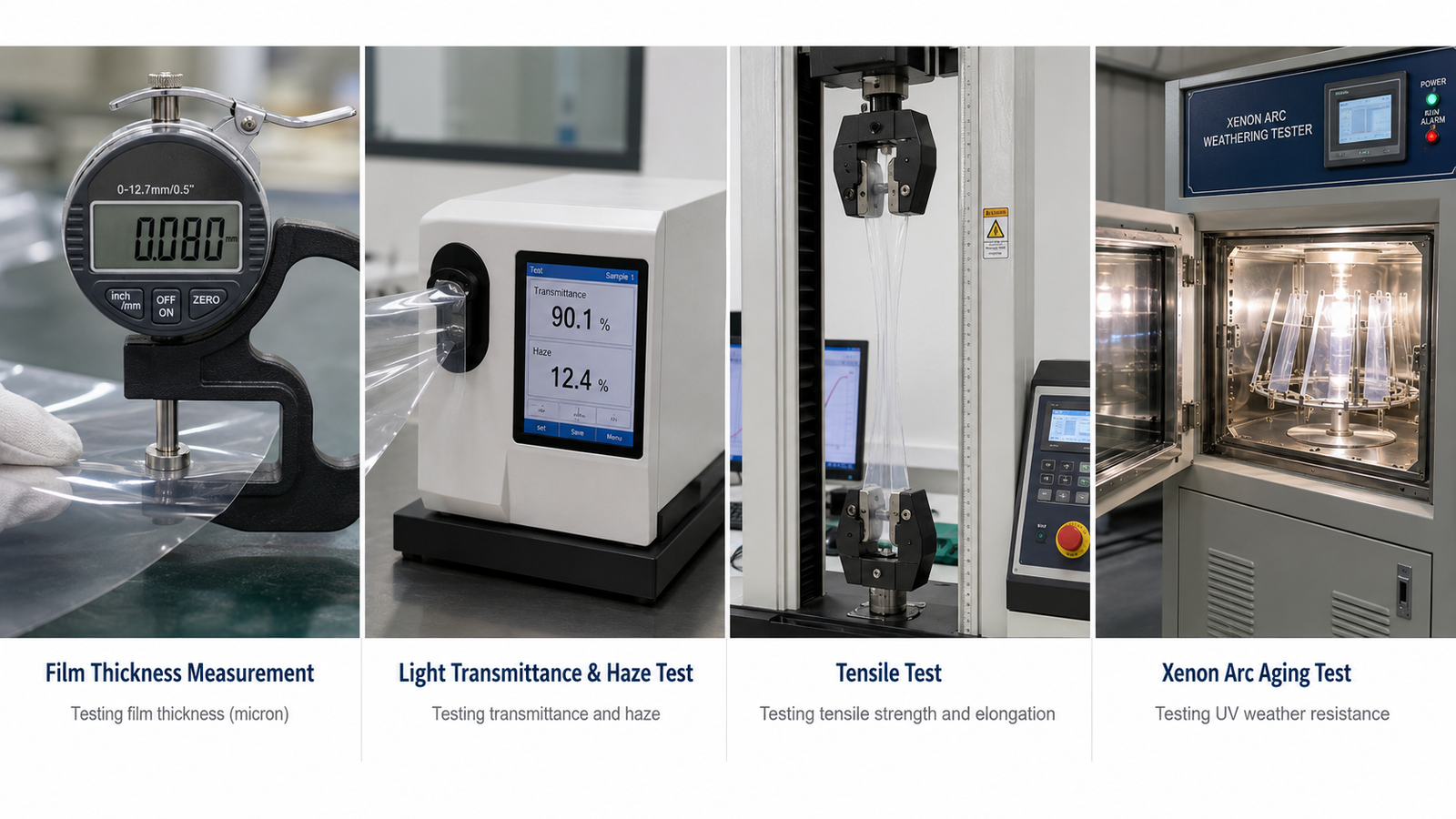
| After 1,000-hour xenon exposure | Tensile retention at least 82%; elongation retention at least 78%; transmission decline no more than 9% | Controlled comparative aging result, not a universal conversion into field years |
Optical values should identify the method used. ASTM D1003 covers haze and luminous transmittance of transparent plastics, while ASTM D882 addresses tensile properties of thin plastic sheeting. Xenon-arc results should report the exposure conditions; ASTM G155 and ISO 4892-2 describe controlled weathering procedures but do not create one universal hours-to-years conversion.
What a Supplier Needs Before Quotation
Before a supplier can compare PE film, reinforced plastic and polycarbonate on the same basis, the buyer needs to define the greenhouse structure, dimensions, frame and fastening method. The project location, climate exposure, crop environment, expected covering period and installation plan are also required.
For a film quotation, the supplier normally reviews finished width, roll length, nominal thickness and tolerance, UV and condensation-control functions, maximum roll weight, production feasibility, packing method and shipment restrictions. Even when the material grade appears unchanged, these details can affect price, lead time, handling and freight.
Before bulk production, both parties should agree on the specification sheet or TDS and an approved sample when required. They should also define the thickness and width inspection method, optical or mechanical test documents, roll labels, packing marks and warranty conditions. Use the commercial greenhouse plastic ordering checklist to prepare a complete RFQ.
Review Greenhouse Plastic Roll SpecificationsGreenhouse Plastic Buyer Specification Checklist
Send the supplier enough information to engineer the correct covering:
- Greenhouse type, dimensions and frame material
- Rigid panel or flexible film construction
- Country, climate, altitude and expected UV exposure
- Crop and growing season
- Single-layer or inflated double-layer design
- Target service period and replacement schedule
- Nominal thickness, tolerance and minimum thickness
- Roll width, roll length, roll weight and permitted seams
- Material and layer structure
- Initial light transmission and haze
- Clear, diffused or photoselective light requirement
- IR/thermal and anti-drip requirements
- Tensile, elongation, tear and puncture properties
- UV or accelerated-weathering method and conditions
- Exposure to sulfur, chlorine, copper, pesticides or disinfectants
- Frame-contact materials, paint and protective tape
- Warranty duration, exclusions and claim procedure
- Batch traceability, retained samples and inspection documents
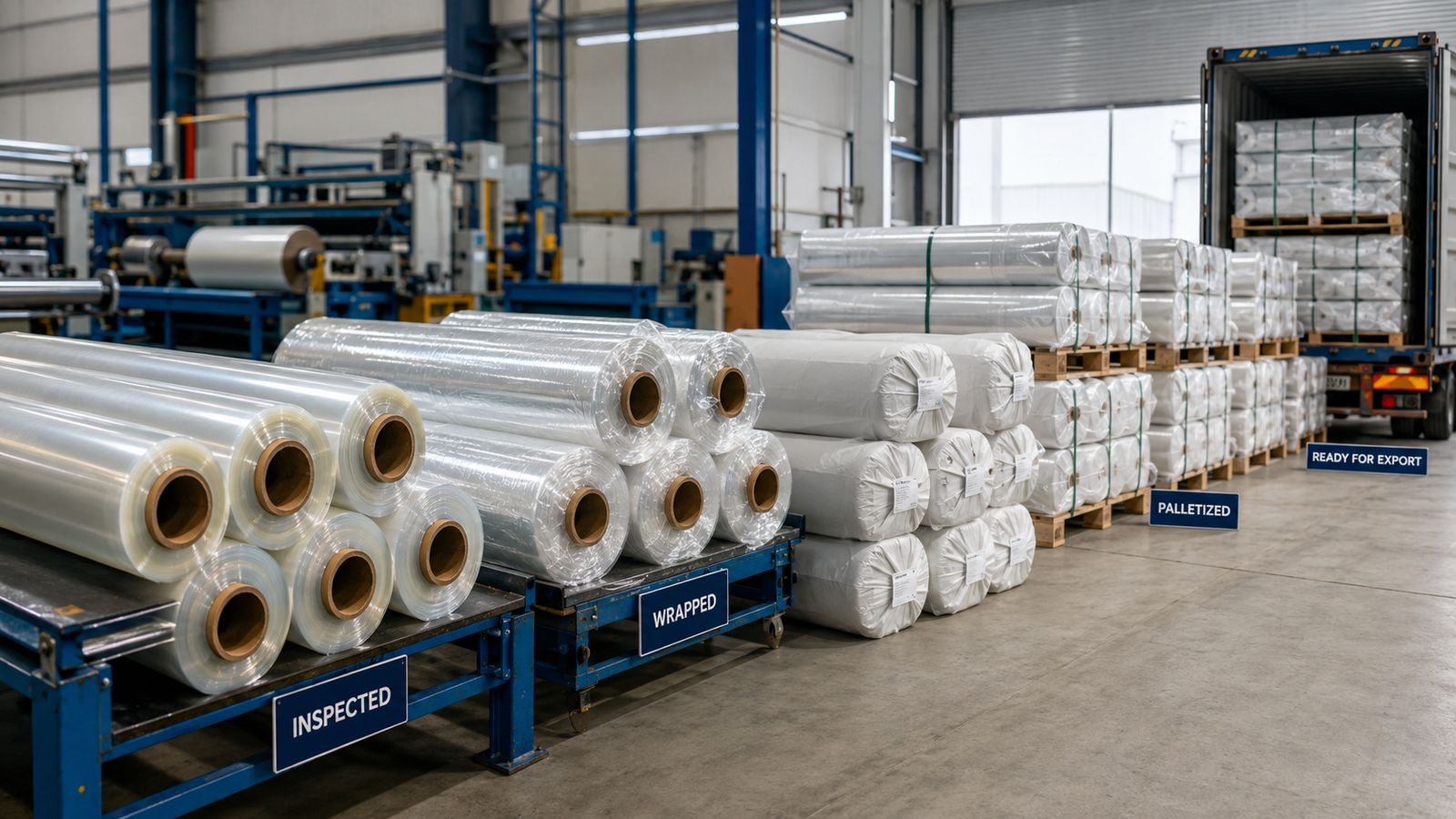
- Roll, woven bag, pallet and export packing requirements
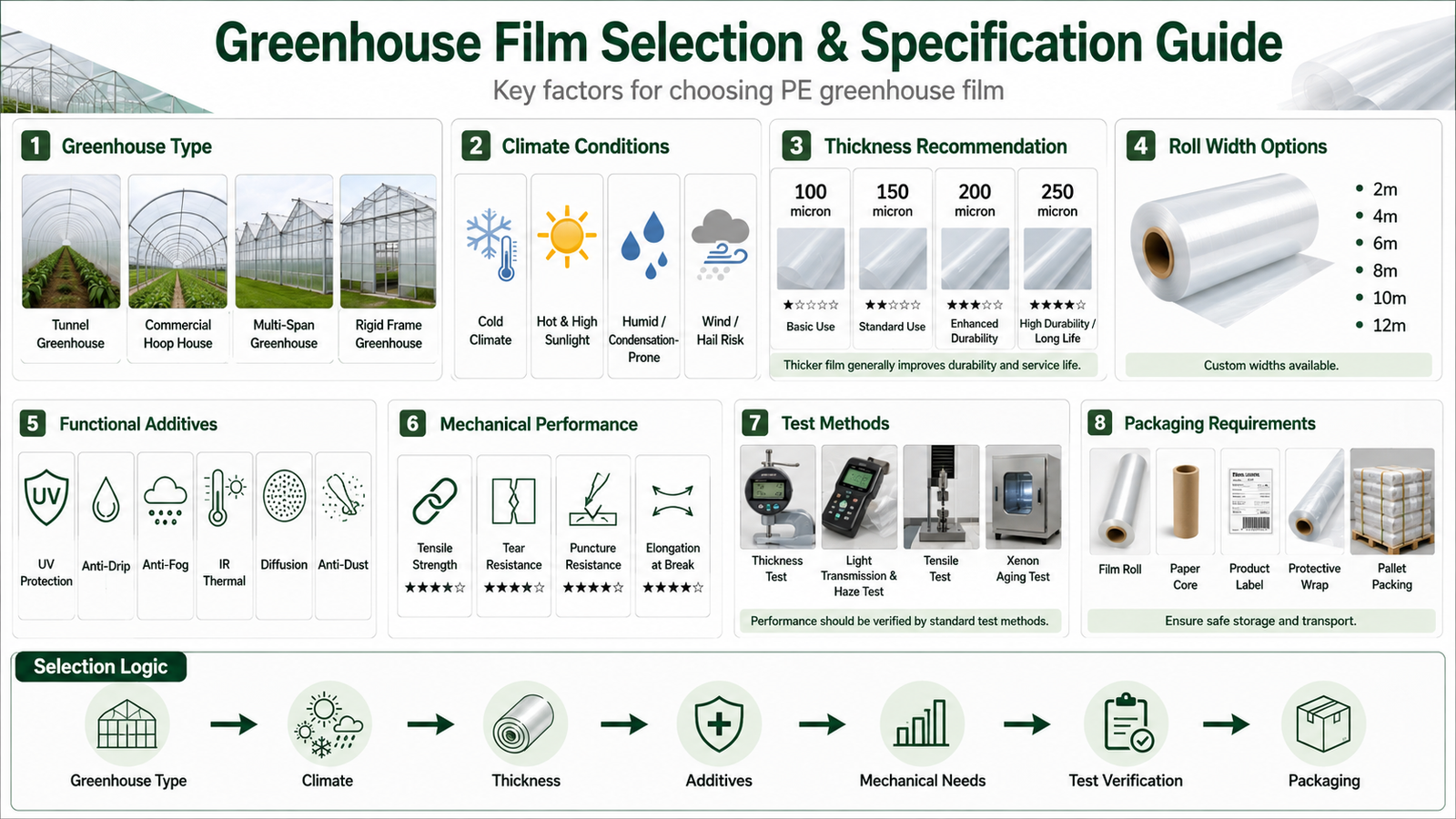
Final selection rule: choose the covering that fits the frame and delivers the required light, thermal and mechanical performance at the lowest credible total cost. Do not select by thickness, clarity or price alone.
Frequently Asked Questions
What is the best plastic to use for a greenhouse?
UV-stabilized greenhouse-grade polyethylene film is usually the best-value option for hoop houses, high tunnels and large agricultural greenhouses. Twin-wall polycarbonate is often better for a permanent rigid-frame greenhouse that prioritizes insulation and impact resistance.
Is 6 mil plastic best for a greenhouse?
Six mil, or approximately 150 microns, is a common starting thickness for multi-year greenhouse film. It is not automatically the best for every project. UV formulation, minimum thickness, tear strength, climate, warranty and installation are also required.
What is the best greenhouse plastic for winter?
For a heated film greenhouse, compare an IR/thermal film installed as an inflated double layer with multi-wall polycarbonate. The choice depends on frame type, available winter light, heating cost, snow and wind design, and replacement labor.
Is polycarbonate better than greenhouse film?
Polycarbonate is better for some rigid permanent structures because it offers impact resistance, insulation and a longer replacement interval. PE film is better for many large curved agricultural structures because it is lightweight, wide, customizable and economical. Neither is universally superior.
Can regular construction plastic be used for a greenhouse?
It can provide temporary protection, but it should not be treated as multi-year greenhouse film unless the product has suitable UV stabilization, optical and mechanical data, and an outdoor service rating.
Is clear or diffused greenhouse plastic better?
Clear film is useful when maximum direct light is the priority. Diffused film can distribute light more evenly and reduce hot spots in intense sun or tall crop canopies. Compare total transmission and haze rather than selecting by appearance.
Does thicker greenhouse plastic provide more insulation?
A small increase in film thickness does not provide the same insulation improvement as creating a sealed air space. An inflated double layer, thermal film or multi-wall panel has a larger effect on heat transfer than choosing film by thickness alone.
How long should greenhouse plastic last?
UV-stabilized greenhouse-grade PE film is commonly planned around a three-to-five-year range, but regional UV, heat, wind, chemicals and installation can change the result. Use the product rating and inspect mechanical and optical condition before deciding when to replace it.
References and Technical Sources
- University of Arkansas: Common Greenhouse Glazing Materials
- University of Arkansas: Glazing Comparison Table
- University of California, Davis: Greenhouse Structure and Glazing
- University of Connecticut Extension: Plastic Film Update
- Oklahoma State University Extension: Greenhouse Structures and Coverings
- University of Florida IFAS: Physical Greenhouse Design Considerations
- Michigan State University: Greenhouse Glazing
- Wageningen University & Research: Understanding How Diffuse Light Increases Yield in Tomato
- ASTM D1003: Haze and Luminous Transmittance of Transparent Plastics
- ASTM D882: Tensile Properties of Thin Plastic Sheeting
- ASTM G155: Xenon Arc Exposure of Non-Metallic Materials
- ISO 4892-2: Plastics Exposed to Xenon-Arc Light