
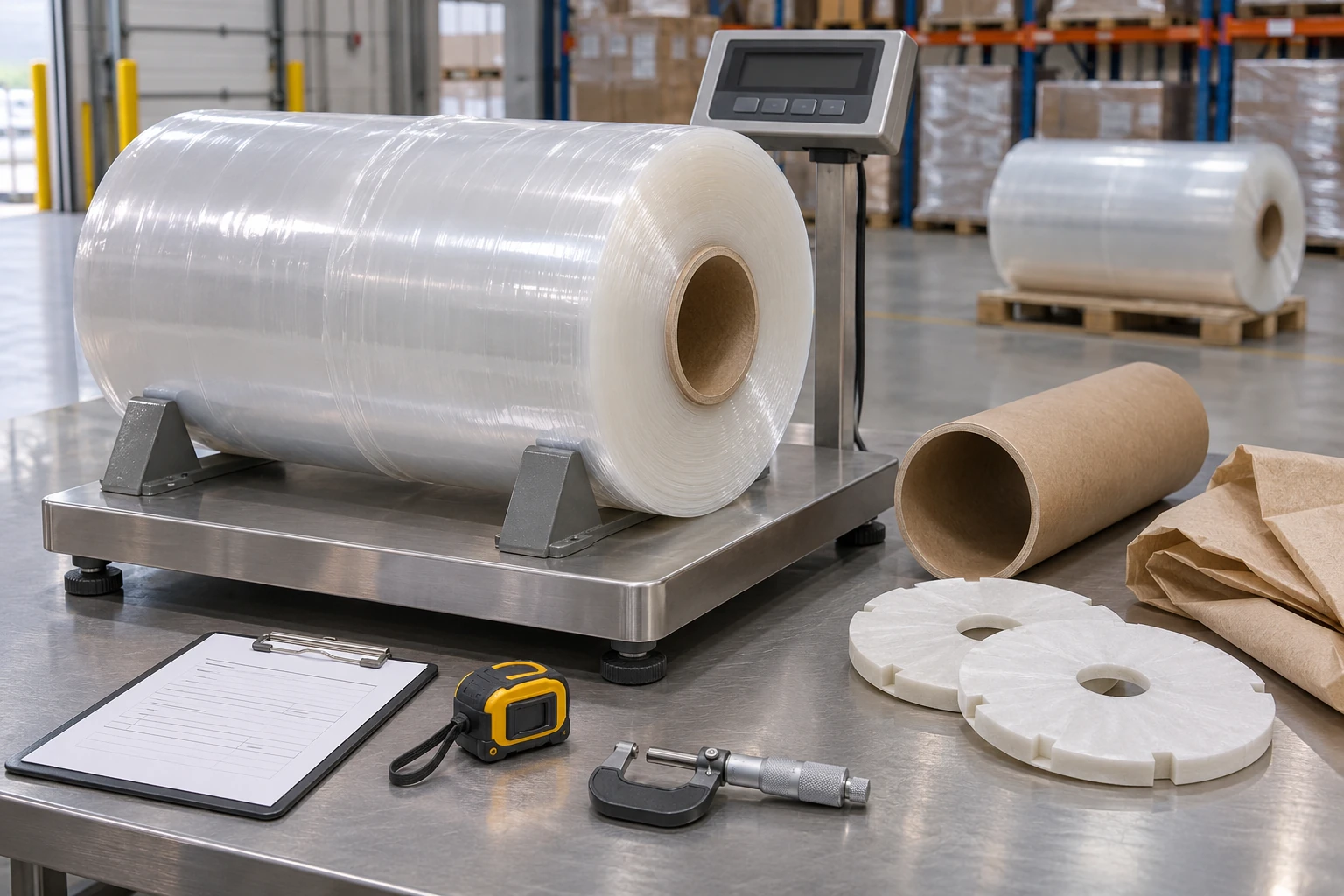
Poly Film Roll Length and Net Weight: Checking a Packing List
Check poly film roll length against net film weight, not the weight of the packed roll. First reconcile the film, core and packaging weights. Then use the correct material width, thickness and density for a reasonableness calculation. If those inputs are nominal or uncertain, the calculated length is an estimate, not proof of a shortage.
This guide is for buyers and receiving teams checking industrial PE film packing lists. For measuring a greenhouse structure before ordering, use the separate greenhouse roll-size guide. It explains how to investigate inconsistent roll figures and agree on evidence with a supplier. It is not a substitute for an agreed length-measurement or sampling procedure, and it does not apply one PE density to every blend, coating or laminate.
1. Define gross, tare and net before subtracting
A packing list may use “net weight” for film alone, for a roll including its core, or for a shipping unit excluding its pallet. Request definitions beside the figures. The same word on two documents does not ensure that they count the same things.
| Item | Mass | How it is used |
|---|---|---|
| Individually packed roll | 24.60 kg | Starting gross mass: film, core and the stated protective packing. |
| Core | 1.10 kg | Tare belonging to this roll or a documented representative core. |
| Protective packing | 0.50 kg | End discs, wrap and other included removable packing. |
| Net film | 23.00 kg | 24.60 − 1.10 − 0.50 = 23.00 kg. |
Do not subtract tare twice. If a scale was zeroed with the empty core or container already on it, record that operation. A display marked “net” needs a known tare setting, not an assumption. Similarly, do not subtract a shipping pallet from every roll when the pallet belongs to the shipment total.
For twelve identical example rolls, film mass is 12 × 23.00 = 276.00 kg. Their individually packed mass is 12 × 24.60 = 295.20 kg, before adding a shared pallet or other shipment packing. A total of 295.20 kg described as “film weight” would therefore need clarification. These values demonstrate reconciliation; they are not TIANFENG stock-roll specifications.
Retain the scale reading, equipment identification, roll label and applicable tare record. If empty-core weight varies, a single convenient core may not represent every roll. Agree how many cores and rolls to check and how results will be linked to the shipment.
2. Use the width of material, not just the folded roll
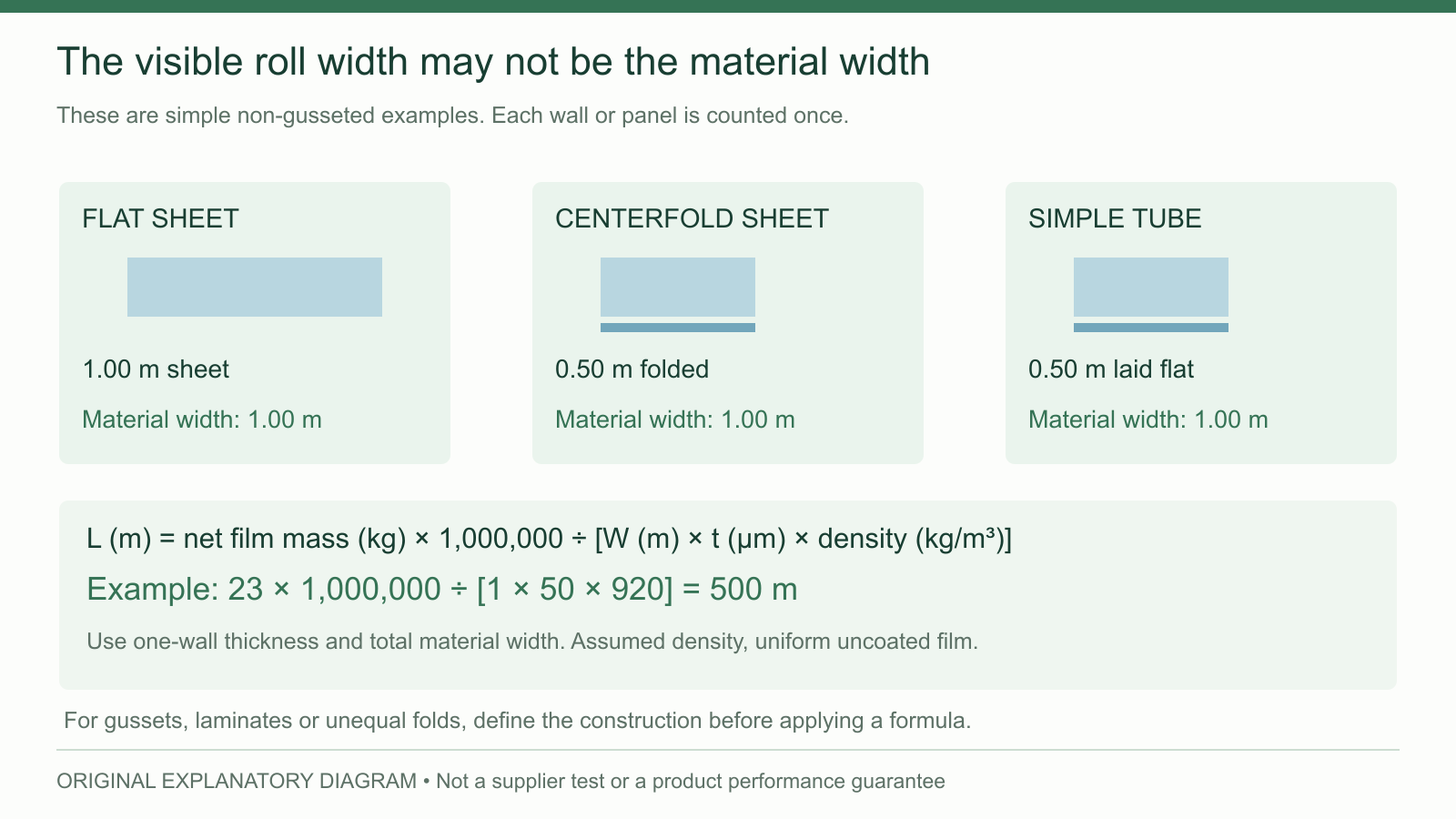
Mass depends on the total area of film. A folded or tubular web contains more material per running meter than its visible roll width suggests. Identify the web construction before entering numbers into a calculator.
| Web construction | Visible or laid-flat width | Width used in the mass equation |
|---|---|---|
| Single flat sheet | 1.00 m | 1.00 m |
| Centerfold sheet with two equal panels | 0.50 m folded | 1.00 m when fully opened |
| Simple tube with two flat walls | 0.50 m laid flat | 1.00 m total around the tube |
For these examples, thickness means one wall of film. Do not combine doubled thickness from measuring two walls with doubled material width; that would count the same material twice. Slit-open tube dimensions and descriptions also need to be recorded consistently.
Gusseted, multiply folded or unevenly folded material requires a drawing or an unfolded measurement. Do not apply “twice the roll width” to every construction. Count each distinct film panel once. Separate layers in a laminate likewise need either a suitable total mass-per-area value or an appropriate construction calculation.
The Inteplast Engineered Films calculator distinguishes sheet and tube inputs and asks for density, gauge and width. Those input choices are useful reminders that a result is only as meaningful as the construction and dimensions entered.
3. Calculate poly film roll length and test the assumptions
For a uniform, uncoated film of known effective density, mass equals length multiplied by total material width, thickness and density. With thickness expressed in microns, use:
Length (m) = net film mass (kg) × 1,000,000 ÷ [material width (m) × single-wall thickness (µm) × density (kg/m³)]
Example inputs: 23.00 kg net film, 1.00 m material width, 50 µm thickness and an assumed density of 920 kg/m³.
23 × 1,000,000 ÷ (1 × 50 × 920) = 500 m.
The unit conversion is essential: 50 µm is 0.000050 m, and 0.920 g/cm³ is 920 kg/m³. Reversing the example gives 500 × 1 × 0.000050 × 920 = 23 kg. The assumed density is used to explain the calculation; obtain a suitable value for the actual film construction.
Nominal thickness is not automatically the measured average. At the same 23 kg, width and density, 45 µm would imply about 555.6 m, while 55 µm would imply about 454.5 m. Thus a possible thickness range of ±10% creates a substantial length range even before considering weighing, width or density uncertainty.
This is an illustration of sensitivity, not a proposed thickness tolerance. If the purchase order promises a minimum length and a thickness range, the supplier must meet both requirements. A plausible mass calculation does not waive either condition.
Equal net weight can also conceal different discrepancies. With a 1.00 m material width and an assumed density of 920 kg/m³, both a 500 m roll at 45 µm and a 450 m roll at 50 µm contain 20.70 kg of film. Against an order requiring at least 500 m and a 50 µm nominal thickness, investigate the first roll against the agreed thickness tolerance and the second against the minimum length. Weight alone cannot distinguish them.
ASTM’s public D4321-24 scope on plastic-film yield distinguishes nominal yield based on nominal thickness and density from actual yield. Yield expresses area per unit mass. The public scope supports that distinction; it is not the complete test procedure, and this article does not claim an ASTM-compliant test.
For filled, printed, coated or multilayer films, using a generic resin density may misstate the length. Where appropriate, an agreed measured mass per unit area can support the check: length = net film mass ÷ (material width × mass per area), with consistent units. The sample must represent the finished film and its average construction.
4. Investigate a difference with traceable evidence
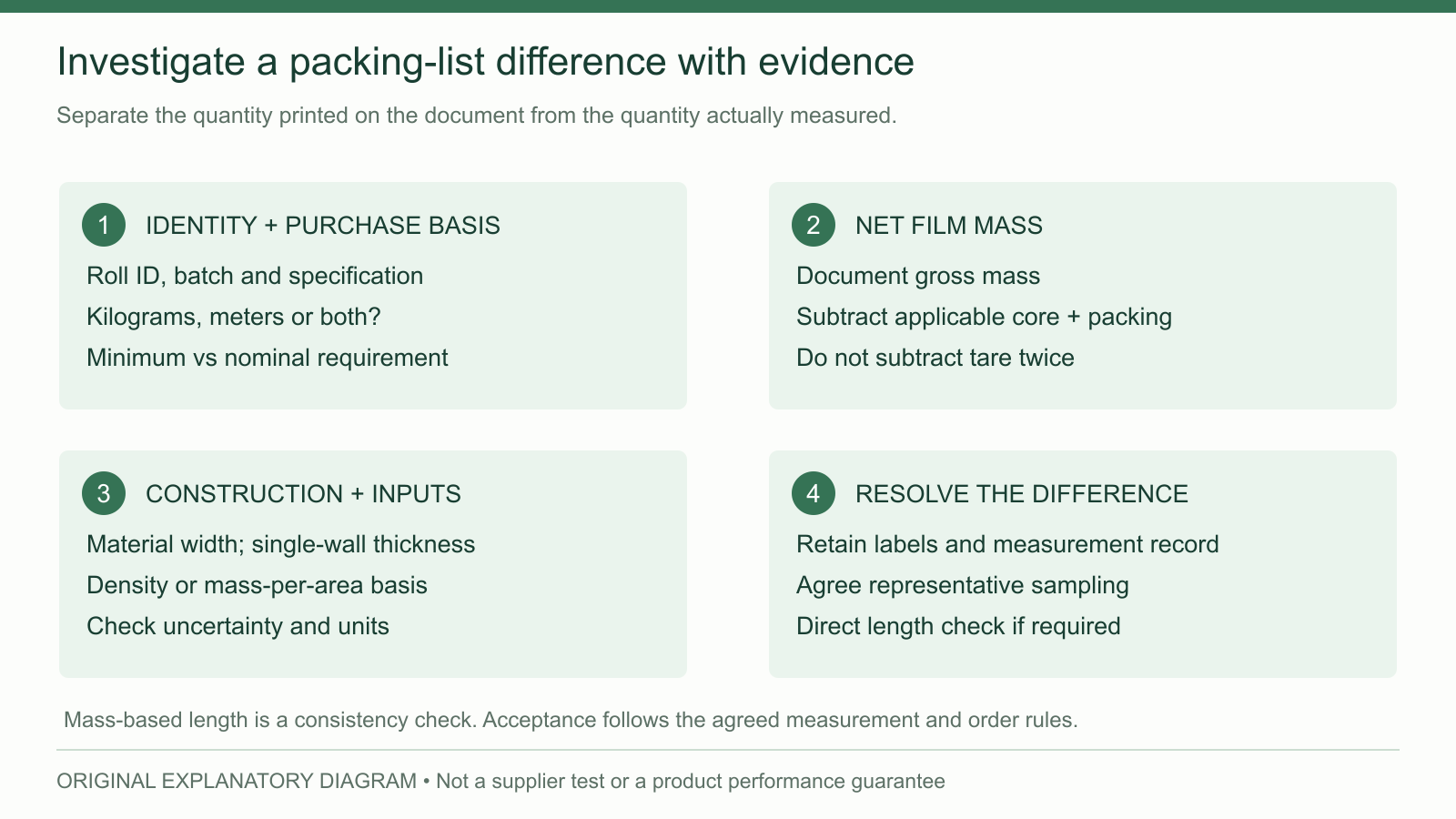
Start with the simplest explanation: an inconsistent unit, omitted tare, mixed roll SKU or different width convention. Compare the purchase order, roll labels, packing list and invoice. Determine whether the commercial unit is kilograms, meters, rolls or a combination with separate tolerances.
Select identified rolls using an agreed sampling plan. Photograph labels and packaging before opening; record gross mass and the pieces removed. Preserve the core and packing where practical. Record whether any film was already used, trimmed or damaged, since that changes the mass available for comparison.
Check width on the actual web and confirm the thickness measurement method and averaging procedure. One reading near an edge does not establish the roll’s average thickness. Record the density basis or representative mass-per-area measurement instead of silently accepting the calculator’s default.
If the disagreement remains material, agree on a direct length check with suitable measuring equipment, its verification status and a controlled handling procedure. Winding tension, slip, stretching, splice treatment and end waste can affect what is counted. Define whether the result is total running length or usable conforming length; the same roll can have different values for those two quantities.
Send the supplier a concise evidence packet: roll IDs, order requirements, measurements, tare records, calculation and the specific question to resolve. “The roll feels light” is difficult to investigate. A documented mismatch between a promised minimum length and an agreed measurement can be addressed directly.
5. Agree the purchase basis before the next shipment
Specify the film construction, fully defined width, single-wall nominal thickness and agreed tolerance, roll length requirement, core dimensions and quantity unit. Distinguish minimum length from nominal length. State how splices, damaged sections and short end rolls are declared and whether they count toward usable ordered length.
Ask for a packing-list layout that identifies each specification and separates net film from core and other packing. If individual roll weights are required, state that before production. Decide which measurement records accompany the shipment and how an incoming discrepancy will be reviewed.
TIANFENG supplies industrial PE packaging film. Confirmed general terms are a 1 metric ton minimum order, a usual production lead time of around 20 days and custom sampling generally about US$100, with sample freight paid by the buyer. Confirm specification grouping, sample scope and the lead-time starting conditions in the quotation.
To request a comparable film quotation, attach a web drawing and describe the quantity basis your warehouse will inspect. Clear definitions make it easier to compare suppliers and investigate delivery differences without treating every estimated meter as a measured meter.
6. Common questions
Can I use the supplier’s packed roll weight as net film mass?
Only if its definition explicitly excludes all core and packaging tare. Otherwise reconcile those components first. Preserve the original figures and label each subtraction.
Does roll diameter prove the stated length?
No. A diameter-based estimate depends on core size, thickness, winding and other assumptions. It can be another reasonableness check, but it should not replace an agreed direct length method.
Does a lighter roll always mean fewer meters?
No. Thickness, width, density, tare and consumed material may explain a difference. Check those factors before concluding that the roll is short; also verify any separately promised thickness or width requirements.