
Stretch Wrap vs Shrink Wrap for Pallet Loads
Stretch wrap is tensioned around a pallet load; shrink wrap is a suitable film heated so it contracts around the load. Neither process is automatically the better choice. Start with the load, the protection it needs and the equipment available, then test a compatible film and process against an agreed acceptance plan.
This guide is for packaging buyers comparing pallet-scale options. It covers spiral stretch wrapping and heat-shrink pallet hooding, with a separate explanation of stretch hooding. Retail multipacks and shrink labels need different specifications. TIANFENG’s confirmed stretch-film supply is blown film; this comparison does not establish availability of shrink film or hooding equipment.
1. Compare stretch wrap vs shrink wrap by process
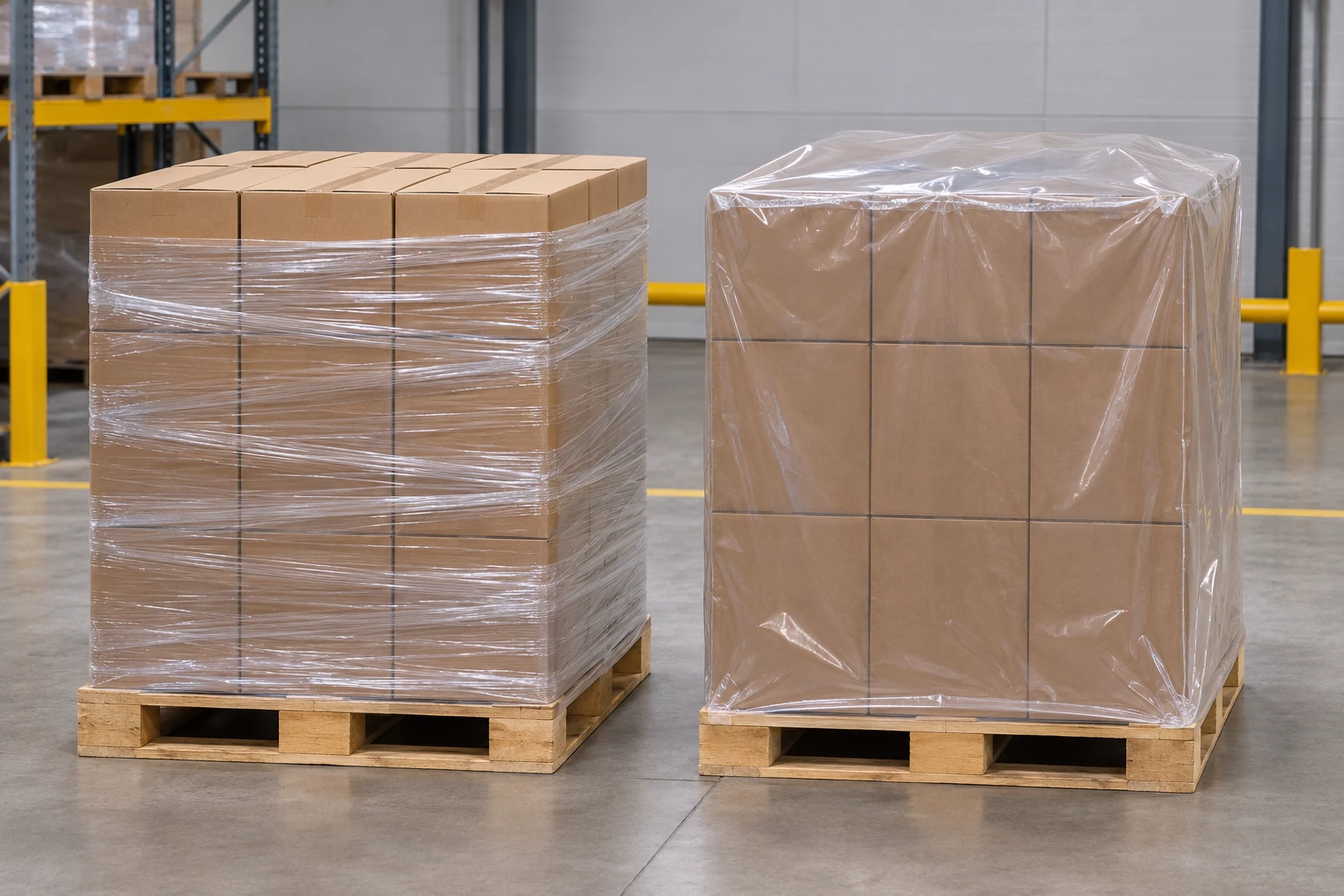
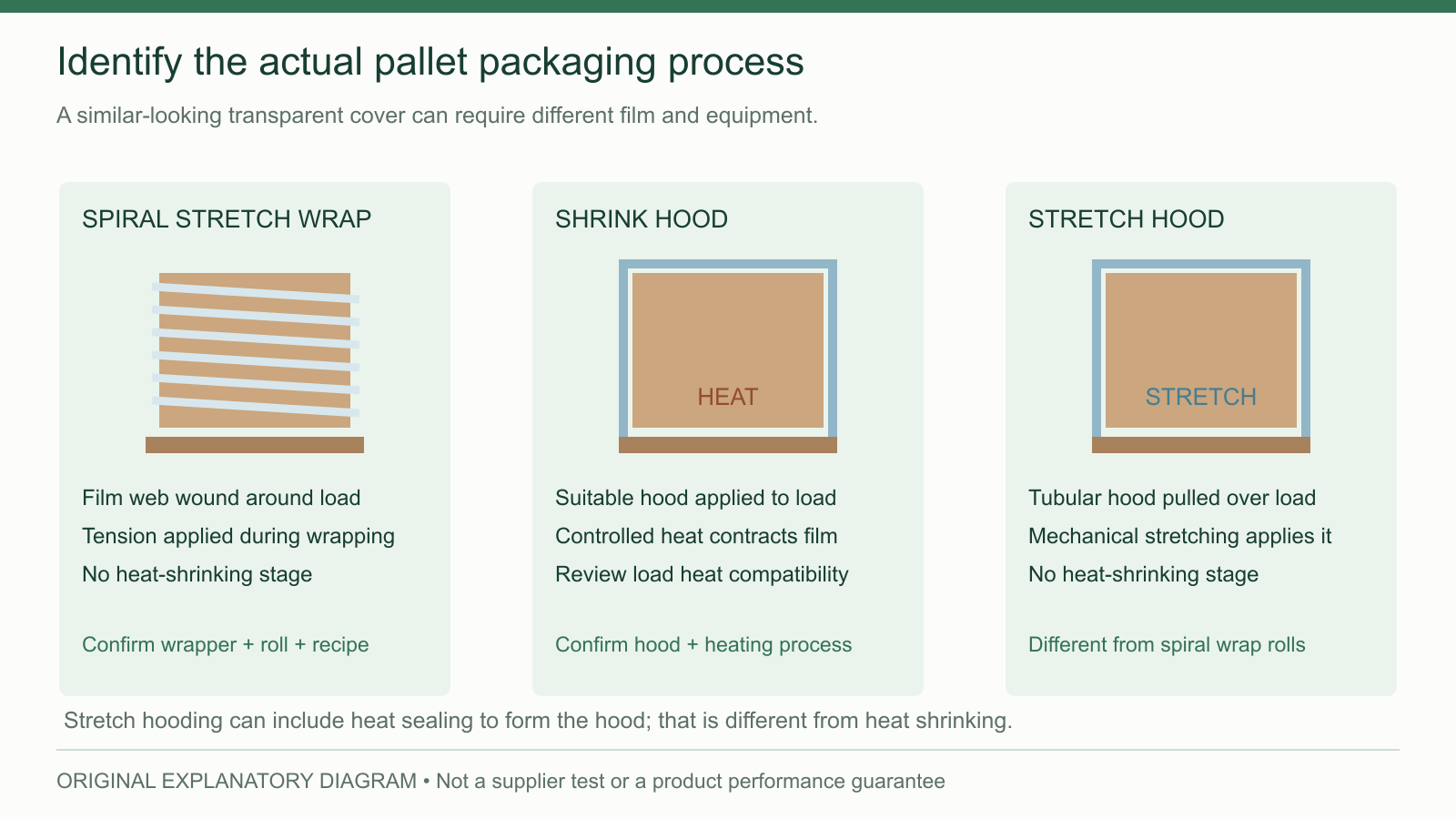
The words “pallet wrap” and “shrink wrap” are often used loosely. Ask whether the line winds a film web around a load, heats a hood after application, or stretches a hood over the load. Those are different operations, even when all three use transparent plastic.
| Process | How the cover is applied | What the buyer must identify |
|---|---|---|
| Spiral stretch wrapping | A film web is stretched during wrapping around the load. | Hand or machine application, roll specification, wrapper carriage and wrapping program. |
| Heat-shrink pallet hooding | A suitable hood or film arrangement is applied, then contracted using controlled heat. | Shrink-film grade and geometry, sealing arrangement, heating system and load compatibility. |
| Stretch hooding | A tubular hood is mechanically stretched and pulled over the load. | Hood-film grade, tube or gusset geometry, machine range and hood dimensions. |
MSK documents both shrink-hood systems and stretch-hood equipment. These show why “no shrinking heat” does not mean “ordinary spiral stretch film.” Stretch hooding may still involve a heat-sealing operation to make the hood; it does not use the subsequent heat-shrinking stage of shrink hooding. A BEUMER process description, for example, distinguishes hood sealing and seam cooling from mechanical application.
Do not select a substitute by resin name alone. A PE sheet, stretch-film roll and shrink-hood film can differ in construction, behavior and intended machine. The film supplier and equipment supplier need to confirm the proposed combination.
2. Separate environmental coverage from load restraint
A covered pallet and a stable pallet are not the same requirement. Coverage concerns openings, seams and exposure. Restraint concerns how the packaged load behaves during handling and transport. A neat transparent surface does not demonstrate either result.
| Requirement | Question to answer during selection |
|---|---|
| Top coverage | Must the top be covered? Spiral wrapping may leave it open unless a top sheet or another arrangement is added. |
| Water and dust exposure | Where could material enter: overlap, top seam, vent opening, puncture or the pallet base? Check the complete packaging arrangement. |
| Load-to-pallet connection | How is the product load secured to the pallet while preserving fork access? |
| Changing load shape | Will cartons settle, bags deform, corners move or an uneven stack puncture the film? |
| Identification and access | Can the required labels be read, and can receiving staff remove the cover without damaging goods? |
Lantech’s effective stretch-wrapping guide emphasizes containment, the load-to-pallet bond and film-tail control. Its guidance supports checking the completed unit load, not choosing solely by the number of wraps. Its particular tooling and settings should not become universal specifications for another wrapper.
For ordinary loose covers rather than engineered hooding, see the pallet cover and stretch-wrap comparison. A top-covering hood can address an exposure requirement, but seams, openings and handling damage still matter. If weather protection is essential, specify the exposure conditions and the acceptance check. Do not replace those details with an unqualified “waterproof” claim.
3. Match the load and the available line
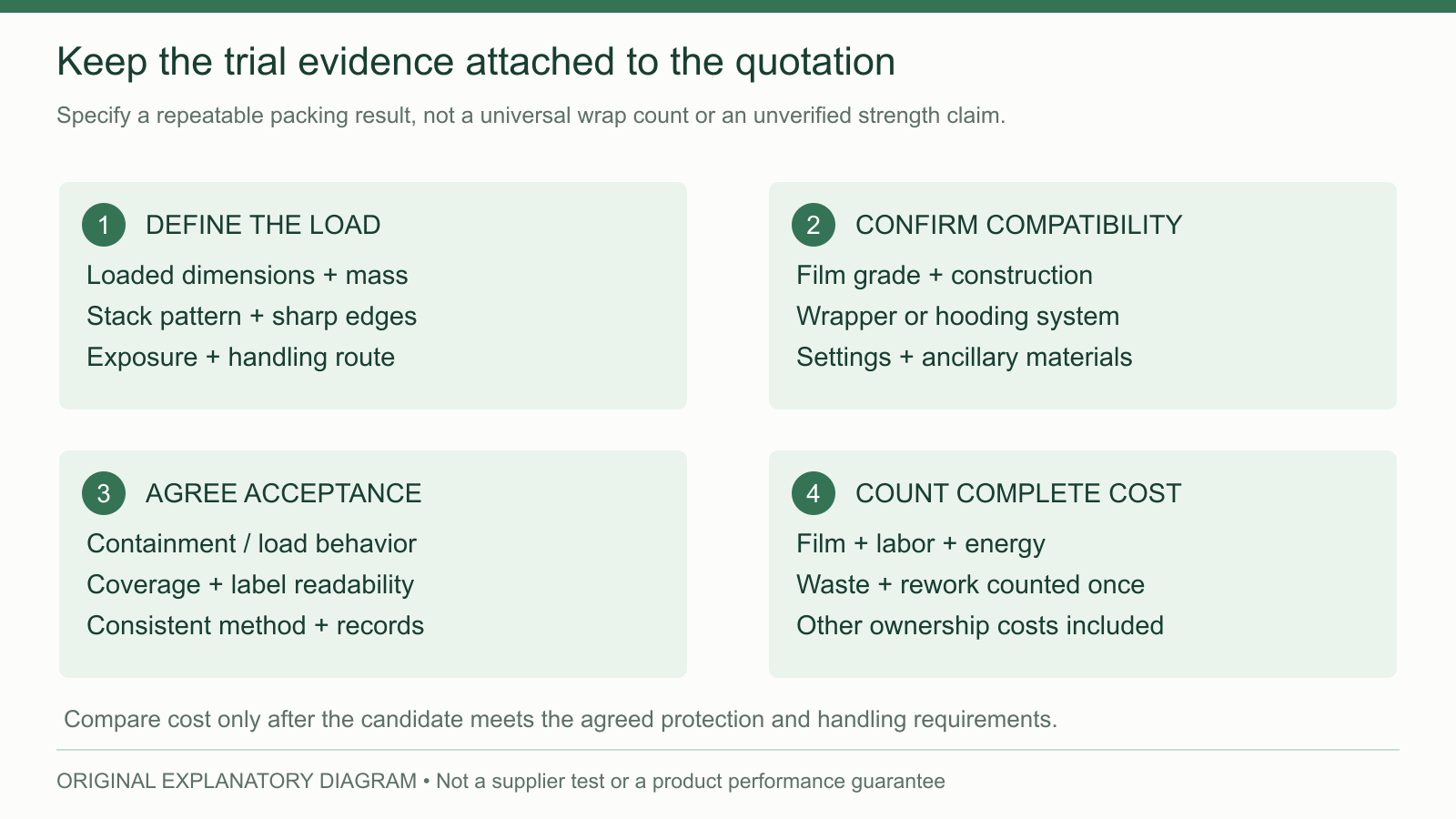
Describe the product stack before asking for a price. Include loaded pallet length, width and height, mass, overhang, sharp edges, loose components and the surfaces the film will contact. Include mixed loads and the least stable normal load, not only a convenient rectangular demonstration pallet.
For stretch wrapping, confirm the wrapper model and carriage, film roll width, core dimensions, allowable roll mass and intended settings. A film’s elongation statement does not by itself establish that it will run at the chosen machine setting. Keep grade, equipment and wrapping recipe together in the trial record.
For shrink hooding, the equipment supplier must address the loaded product’s response to the actual heating process, clearances and operating controls. Heat-sensitive contents or surfaces deserve explicit review. This article does not prescribe a heating temperature, dwell time or handheld heating procedure.
Evaluate the whole cycle: bringing a pallet into position, applying any additional sheet, wrapping or hooding, clearing faults and moving the finished load away. A machine’s advertised wrapping speed is not necessarily the output of the complete packing station. Ask who supplies the machine-compatible film and who owns commissioning and acceptance.
4. Compare complete, repeatable trials
Agree on a trial plan before comparing quotations. Use representative loads, record their condition and define what counts as acceptable after the intended handling assessment. State which loads need separate recipes. Do not hide a failed irregular load inside an average from easier loads.
Record film grade and batch, roll or hood dimensions, settings, interruptions, film consumed, working time, waste and rework. For stretch wrapping, record the selected containment measurement method and locations. Lantech notes that results from different containment tools may not correspond, so keep the method consistent when comparing candidates.
Follow the packaging team’s validation plan for handling and distribution checks. A short trial can reveal application problems, but it is not automatically a transport certification. If one option fails the agreed protection or handling criteria, a low material cost does not qualify it for use.
| Cost for 100 accepted pallets | Option A | Option B |
|---|---|---|
| Film actually consumed | $50 | $62 |
| Direct working time, valued as labor | $20 | $10 |
| Measured operating energy | $2 | $8 |
| Additional rework cost, not counted above | $8 | $0 |
| Subtotal in this limited example | $80 | $80 |
| Subtotal per accepted pallet | $0.80 | $0.80 |
This is arithmetic, not a market quotation or a claim that either process normally costs this amount. Each option has 100 accepted pallets, and each cost is counted once. Add equipment ownership, maintenance, space, ancillary materials and any other relevant costs before making a commercial decision. Failed-load product losses require separate treatment if not already included.
The example shows why film price alone can reverse the apparent comparison. Report both the trial’s acceptance outcome and the accounting boundary. Use measured consumption, including discarded film, instead of comparing one supplier’s net film use with another supplier’s packed roll weight.
5. Turn the selected process into a useful film inquiry
For a blown stretch-film inquiry, provide the application method, wrapper details where relevant, roll width and length, nominal thickness, core specification and destination. Include the loaded pallet dimensions and the problem the film must solve. Send the approved trial requirements rather than asking for “the strongest film.”
TIANFENG’s confirmed blown stretch-film minimum order is 1 metric ton per specification. The usual production lead time is around 20 days; confirm its starting conditions and the delivery schedule in the quotation. Custom sampling is generally about US$100 per specification, with freight paid by the buyer. Confirm sample scope and current availability before arranging a trial.
For available supply, review TIANFENG stretch film or send a film specification for quotation. If the project actually needs a heat-shrink hood, stretch hood or complete wrapping line, identify that requirement separately; the confirmed blown stretch-film offer should not be treated as proof that those items are supplied.
6. Common questions
Can I heat ordinary stretch wrap to make shrink wrap?
Do not assume interchangeability. Use film explicitly specified for the intended shrink process, and have the equipment supplier confirm compatibility. A transparent PE appearance is not a process specification.
Is shrink wrapping only for individual products?
No. Retail shrink packaging is one application, but dedicated pallet shrink-hood systems also exist. Select the pallet-scale process rather than applying a retail-packaging comparison to the whole load.
Can a cover replace stretch wrapping?
A cover may provide useful coverage without providing the required load restraint. Determine how the entire load is stabilized and connected to the pallet, then validate the complete arrangement.