
How to Size PE Christmas Tree Bags for Seasonal Retail Programs
Choose a Christmas tree disposal bag size from the tree’s packed shape, its widest perimeter and the usable bag length needed to cover and close it. Tree height alone is insufficient. For a simple non-gusseted PE bag, twice the laid-flat opening width gives its nominal opening circumference; the final size still needs clearance and a sample fit.
This guide is for seasonal retailers, tree growers and distributors ordering flexible PE bags for fresh-cut tree handling and post-season removal. It does not size zippered fabric cases for disassembled artificial trees, and it does not establish that a bag can lift a tree.
Define when and how the bag will be used
A tree taken home in netting presents a different shape from the same tree after its branches have opened indoors. A bag selected around the netted delivery shape may not pass over the expanded tree at removal. Record whether the bag must cover an unrestrained tree, a netted tree or a tree restrained by an agreed method.
Also decide the loading direction. Some removal bags are positioned around the base before the tree is decorated and pulled upward later. Other packing methods insert the tree into an already opened bag. The opening, bottom and available material must suit that specific sequence. A tree stand included inside the bag changes the lower envelope and may consume usable length.
| Retail program | What must be defined before sizing |
|---|---|
| Fresh-cut tree takeaway | Whether branches remain netted, which end enters first, whether a stand is included and how the tree is supported during handling. |
| Post-season fresh-tree removal | The expanded branch envelope, how the bag is positioned, how it passes over branch tips and where it closes. |
| Artificial-tree storage | A separate packed-shape and material requirement. Do not reuse a fresh-tree height label as proof of fit for a disassembled artificial tree. |
TIANFENG’s current plastic Christmas tree bag product page lists PE/LDPE bags with custom dimensions, color, printing and packing options. The article below develops a measurement brief for that kind of flexible bag. A particular stand arrangement, closure or carrying use still requires confirmation against the proposed construction.
Measure the opening: circumference is not diameter
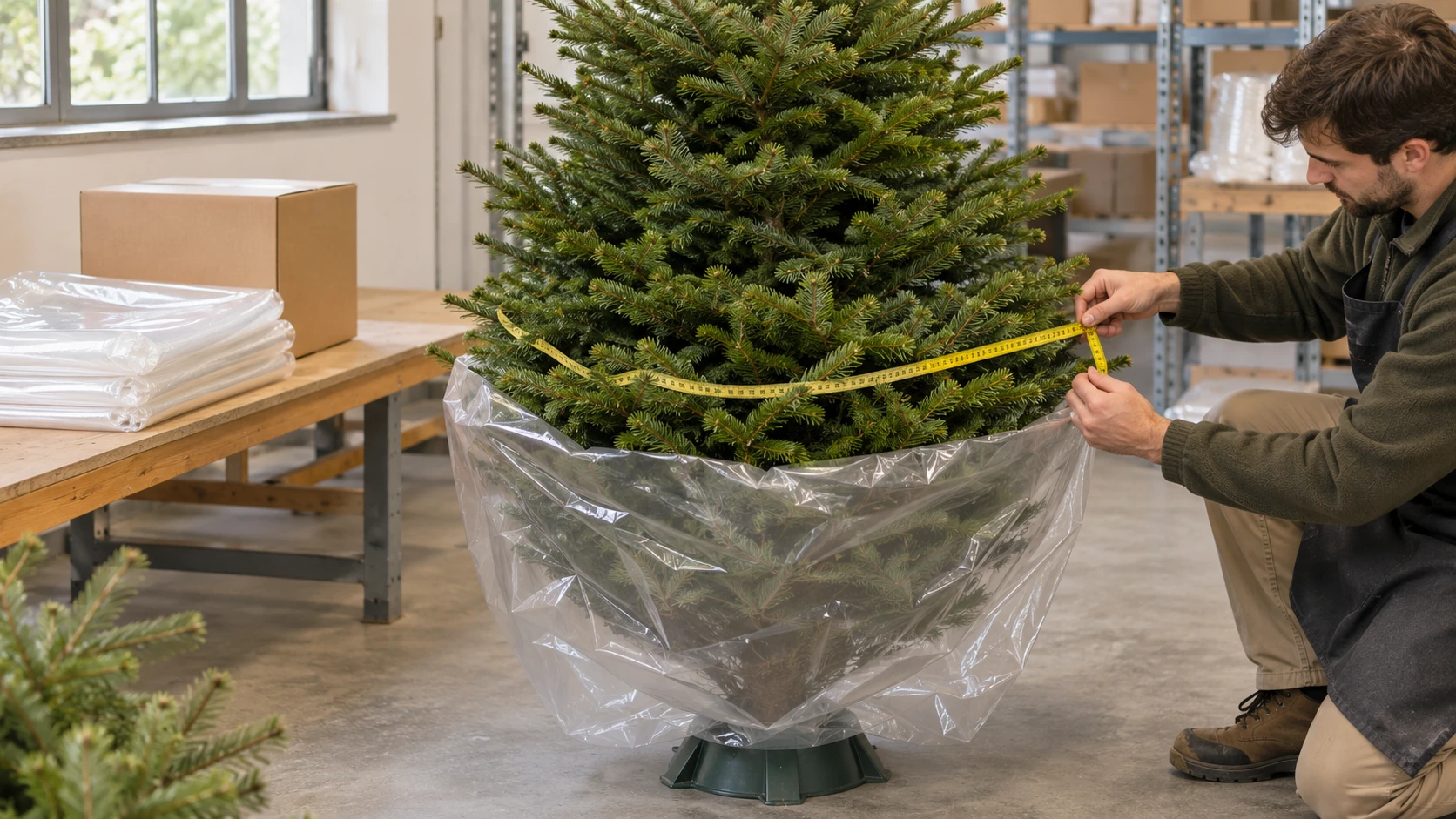
Measure around the widest section that the bag must pass over, using the tree’s agreed packing condition. Record the perimeter without tightening the tape enough to compress branches unless that compression is part of the approved packing method. Include branch tips and any stand or base that must pass through the same opening.
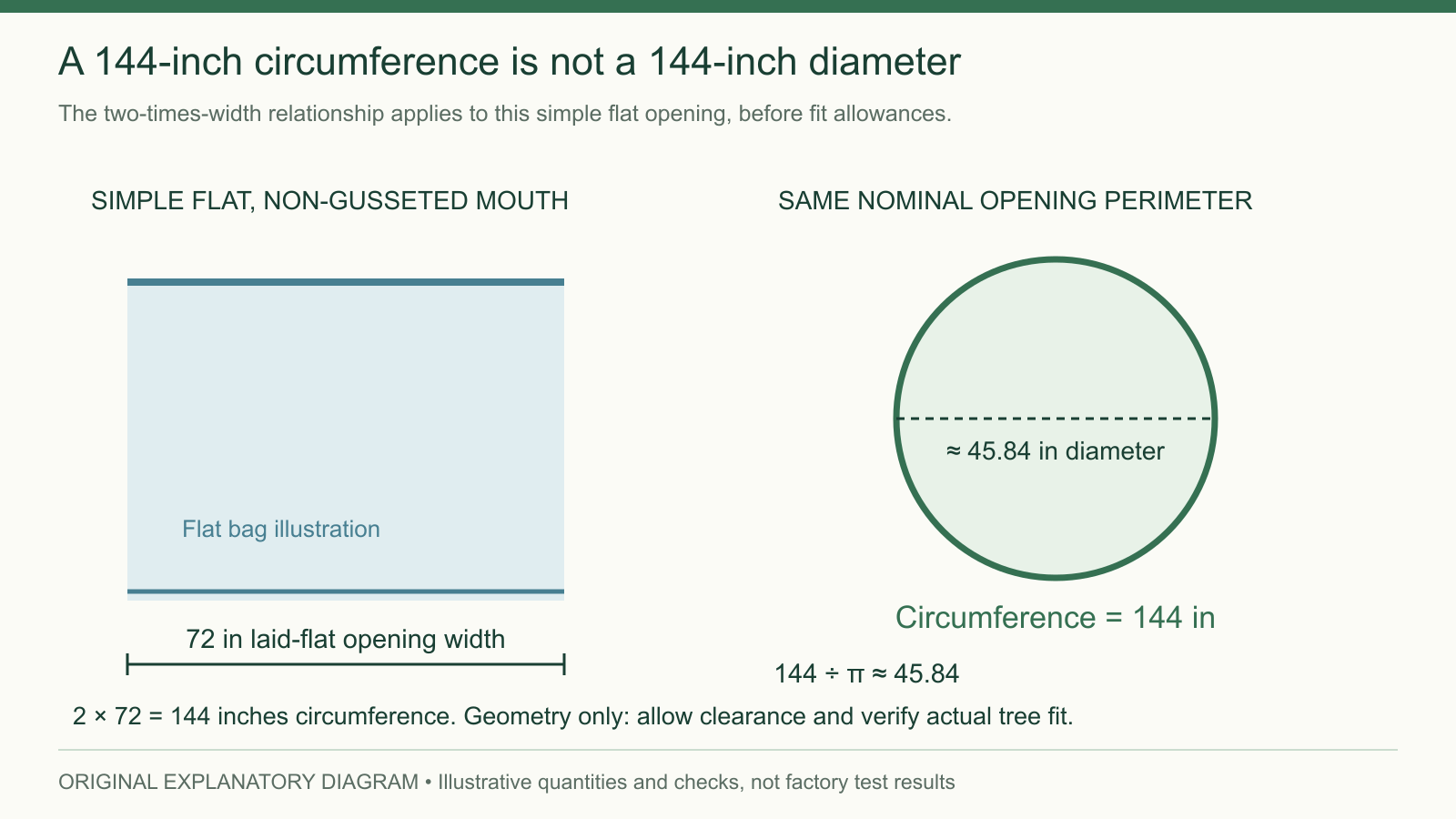
Ask the supplier to show the bag laid flat on a drawing, with the mouth, seal and dimension arrows marked. “Width” should mean a defined finished dimension. For a simple non-gusseted bag with an unrestricted mouth, the geometric relationship is:
Nominal opening circumference = 2 × laid-flat opening width.
Therefore, ideal flat width = required perimeter ÷ 2, before fit allowances.
If the opening were a circle, its diameter would be circumference ÷ π. An actual tree is irregular, so this circular diameter is only a way to interpret units; it is not a promise of tree fit.
For example, dm-folien’s Christmas tree bag catalog lists an 800 mm width with a 1,600 mm circumference, illustrating the flat-width convention. Another supplier, Peak Seasons, lists a tree-removal bag with a 144-inch circumference. That figure means about 45.84 inches of circular diameter, not a 144-inch-wide tree. For the simple flat-bag geometry described here, a 144-inch mouth circumference corresponds to a 72-inch laid-flat opening.
Do not apply this two-times-width rule to an unspecified gusseted construction, a restricted drawstring mouth or a dimension measured only across one face. Get the finished opening perimeter from the supplier’s drawing instead. A top hem, taper or closure can reduce the usable opening.
Allow for the bottom and closure as well as height
Finished bag length and usable covering length are not necessarily interchangeable. Agree whether the quoted length is measured to the outside edge or from the bottom seal to the mouth. Then check how much material is taken up when the flat bottom opens around the lower tree or stand, and how much remains to gather or close above the tree.
The following example keeps the assumptions visible. It is a way to prepare a sample request, not a standard bag size or a universal allowance:
| Illustrative measurement | Value | Interpretation |
|---|---|---|
| Widest measured tree perimeter | 2.40 m | Tree in the agreed packing condition; excludes any unmeasured compression. |
| Ideal flat-mouth width | 2.40 ÷ 2 = 1.20 m | Geometric equality only; no sliding or handling clearance. Do not order directly from this result. |
| Prototype width to investigate | 1.35 m laid flat | A proposed trial size, not a recommended allowance. It gives a nominal 2.70 m mouth perimeter, 0.30 m more than the assumed tree perimeter. |
| Vertical envelope to cover | 2.10 m | Assumed measured height of the contents to be enclosed. |
| Additional length used at the bottom | 0.35 m | Hypothetical allowance for this example, beyond the vertical envelope; measure the actual take-up during the sample fit. |
| Material reserved for closure | 0.30 m | Assumed amount required by the chosen closure method. |
| Candidate usable seal-to-mouth length | 2.10 + 0.35 + 0.30 = 2.75 m | A trial specification to verify physically; any supplier-defined seal allowance must be reconciled separately. |
The 0.30 m opening-perimeter difference is not 0.30 m of clearance on every side. Nor does it establish puncture resistance. If the prototype snags at the widest branch section, changing width may help; if the mouth reaches the top but cannot close, the missing allowance may be length. Record where the failure occurs rather than increasing every dimension without a reason.
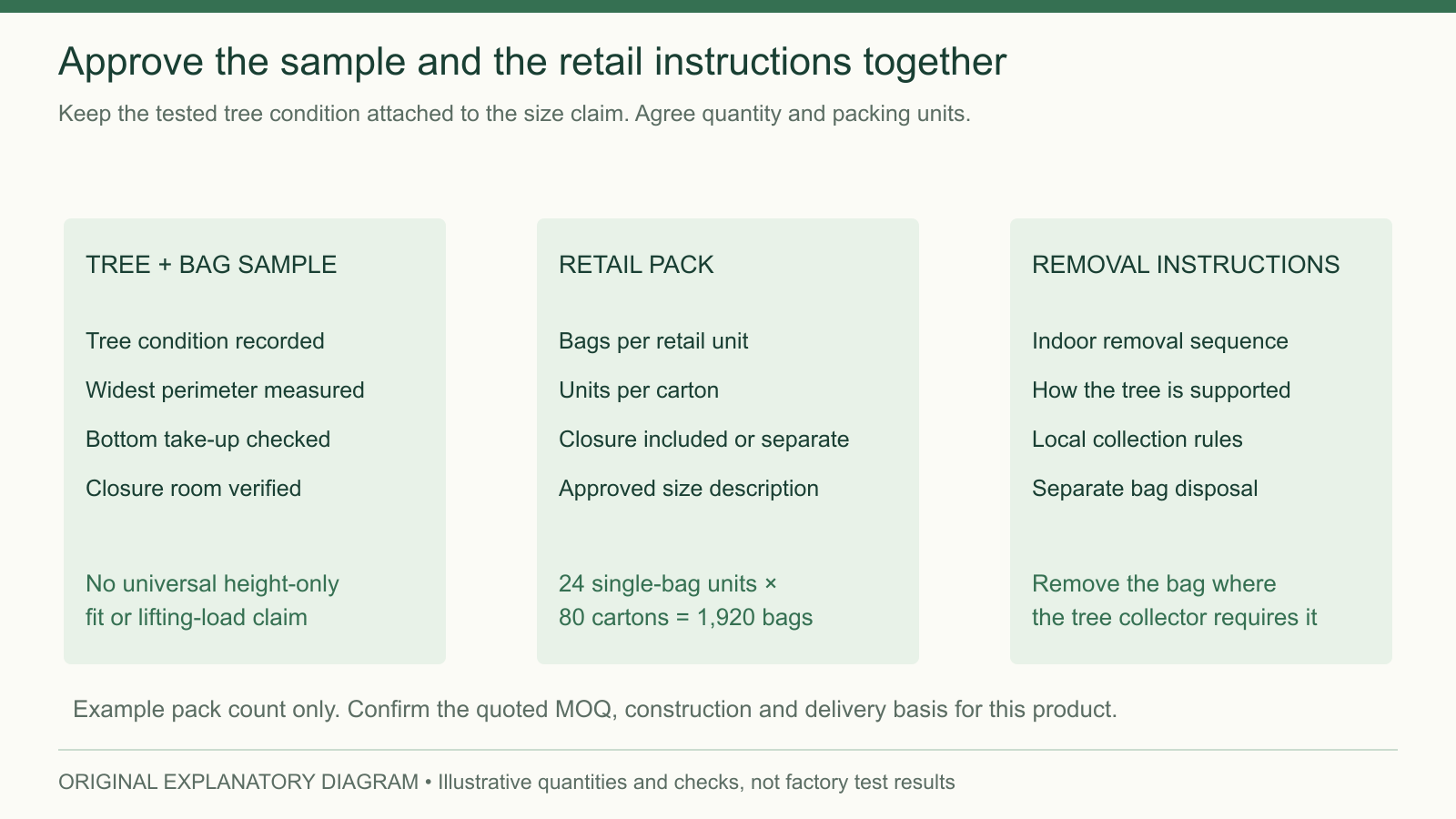
For a retail size range, test more than one convenient tree. Include the broad, dense or awkward shapes near the intended size boundary. Keep the tested tree condition attached to the size claim: “fits a restrained tree of this measured envelope” is a different promise from “fits any tree up to this height.”
Check Christmas tree disposal bag size with a repeatable fit trial
Use a prototype with the proposed film, nominal thickness, seal and opening. A paper perimeter calculation cannot show whether branches catch, a bottom seal is overstressed or the chosen closing method uses more material than expected.
- Record the specimen. Note tree height, widest perimeter, branch condition, stand inclusion and any netting or restraint.
- Follow the customer’s sequence. Position or insert the bag as intended, observing access around the stand and the narrowest opening along the path.
- Check the limiting points. Inspect contact with branch tips, the bottom seal and the area gathered for closure. Distinguish superficial marks from holes or seam damage.
- Check handling with the tree supported. Confirm that the bag remains usable during the intended removal route. Do not treat a successful cover fit as evidence that the bag is a lifting sling.
- Document the decision. Keep the drawing revision, sample identification, dimensions, photos and the specific change required before approving production.
Choose nominal thickness with the proposed film grade and trial conditions, not from tree height alone. No verified TIANFENG puncture, carrying-load or repeated-use results are supplied with this guide, so it does not assign a universal thickness or load rating.
Turn the approved sample into a seasonal order
A seasonal program needs a clear connection between the sample, the retail label and the bulk shipping pack. Keep the finished bag’s width, length, nominal single-wall thickness and construction on the specification. Put the consumer’s size description on the retail artwork only after deciding what the sample fit supports.
Specify bags per retail unit, retail units per display or inner pack, and inner packs per shipping carton. A hypothetical program of 24 single-bag retail units per carton × 80 cartons = 1,920 bags is not the same as 24 multi-bag packs per carton. If ties or another closure are included, list them separately and confirm whether they are supplied with each bag.
Send the intended sales country, required arrival date, artwork languages and the planned pack arrangement with the inquiry. Production completion and arrival at the distribution center are different milestones; have the supplier state the quotation’s production and transport assumptions. TIANFENG’s Christmas tree bag page states that MOQ depends on the specification. Obtain this product’s quoted quantity and timing rather than borrowing terms from another film or bag product.
Request a sample-based Christmas tree bag quote: provide the intended use, tree condition, measured perimeter and height, candidate flat width and usable length, proposed closure, seasonal quantity and retail packing plan. Ask TIANFENG to confirm construction, sample availability, MOQ and delivery basis for the custom PE Christmas tree bag. Use the quotation request page to send the specification.
Match the removal instructions to the destination
A bag that contains needles during indoor removal may need to be removed before a tree enters a local collection stream. For example, New York City’s Christmas tree disposal guidance tells residents to remove stands and decorations and to leave trees out of bags for compost collection. This is a local example, not a rule for every destination.
Confirm the current instructions where the trees will be collected, and make the retailer’s leaflet clear about when to remove the bag. A PE material description does not establish that the used bag is compostable or accepted in a local recycling program. Keep the tree-disposal instruction separate from the bag-disposal instruction; do not carry another supplier’s environmental claim onto your own product.
Sizing questions
Will a bag marked for an 8-foot tree fit every 8-foot tree?
No. Trees of the same height can differ in branch spread, restraint and stand arrangement. Ask what measured envelope and loading method the size claim covers, then confirm the intended use with a sample.
Is laid-flat bag width the same as tree diameter?
No. For the simple flat, non-gusseted mouth described here, twice the width gives the nominal opening circumference. A circular equivalent diameter is that circumference divided by π. An irregular tree still needs clearance and a fit trial.
Can the same PE bag specification be used for artificial-tree storage?
Only after checking that separate use. Disassembled sections, sharp connectors, storage duration and closure needs create a different brief. A successful fresh-tree removal trial does not validate artificial-tree storage.