
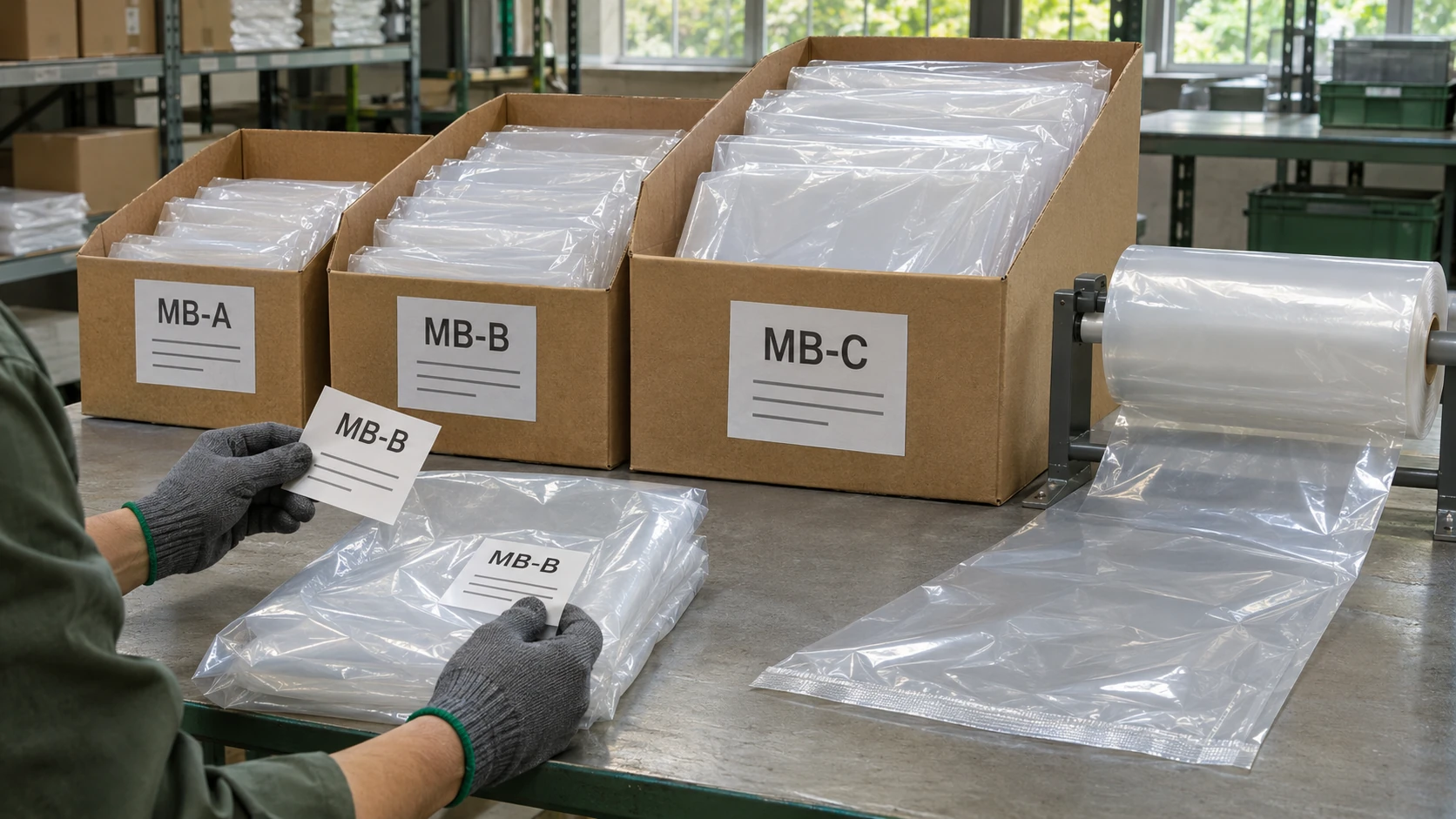
How to Specify Carton Labels for Multiple Mattress Bag Sizes
Mattress bag carton labels should identify the approved bag SKU, finished dimensions and drawing revision, then state exactly how many bags are inside. Add the production lot and the packing arrangement. A description such as “Queen — 100 pieces” is not enough when two grades, gusset depths or roll counts share that name.
For distributors, mattress factories and moving-supply buyers, the practical aim is to keep the purchase order, carton contents and warehouse record in agreement. This guide covers that label-and-count workflow; it does not replace a mattress fit trial or a retailer’s barcode specification.
Start with the finished-bag identity
Build one approved item record for each ordered variant before designing the carton artwork. The record should connect the buyer’s SKU to the supplier’s item code and the current drawing. Use a short commercial name for recognition, but keep dimensions and construction visible.
Write dimension names, their order and units. A flat bag’s laid-flat width and length are different from a gusseted bag’s face width, gusset and length. Neither is automatically the same as the mattress dimensions. If a label has limited space, show the agreed dimension notation and drawing reference; keep the full drawing available to receiving staff.
As an external catalog example, ULINE’s mattress bag range distinguishes model number, cover dimensions, mattress-size description, film thickness and bags per roll. That is a useful starting point. A custom order also needs a revision and a traceable connection to the actual packed batch.
| Item-record field | What the approved record should resolve |
|---|---|
| SKU and description | One defined finished-bag variant, rather than a mattress-size nickname used for several constructions. |
| Finished dimensions | Named dimensions, units, flat or gusseted construction, and the drawing revision that defines the measurement method. |
| Film and features | Agreed nominal single-wall thickness, color, venting, seal and opening. Put tolerances and inspection methods in the specification. |
| Supply format | Individual bags or preformed tear-off bags on a roll. Record bags per inner pack or roll separately from packs or rolls per carton. |
| Traceability | The supplier’s lot reference and its agreed connection to manufacturing and packing records. A shipping date alone may not identify the production lot. |
If the bag itself still needs sizing, settle that through the mattress bag selection and measurement guide first. Label design should reproduce an approved specification, not become the place where dimensions are guessed.
Show the packing level and reconcile the counts
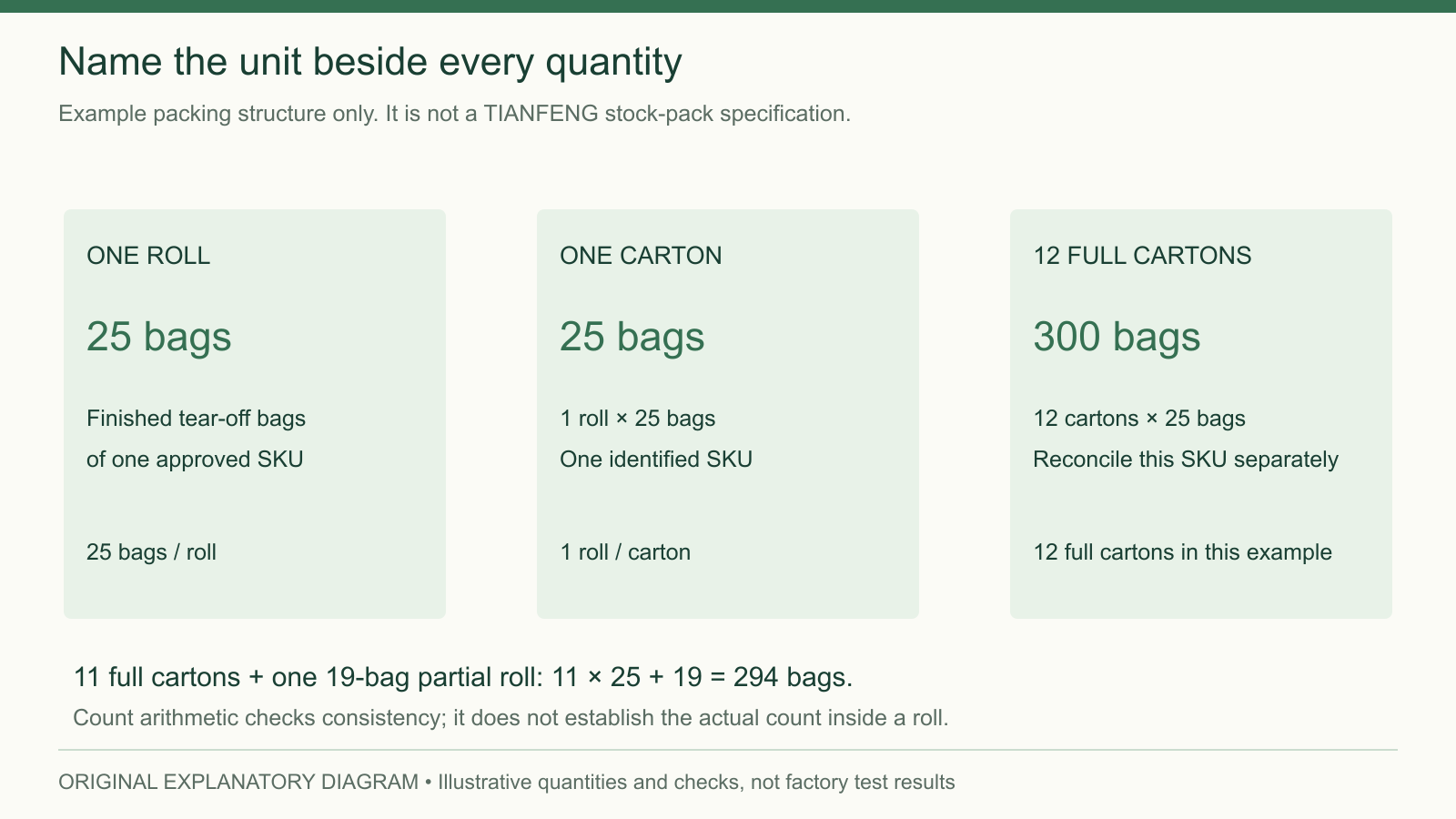
Separate the saleable unit from the shipping unit. “25” could mean bags on one roll, rolls inside a carton or cartons on a pallet. Put the noun next to each number. For individual bags, replace “roll” with the agreed inner-pack unit rather than keeping an irrelevant roll field.
Not every roll arrives in a carton. For example, Primepac’s mattress bag specification sheet describes an outer label and poly wrapping, with the carton count marked not applicable. Apply the identification to the shipping unit actually ordered. If the order is boxed, confirm the carton dimensions and gross weight before settling its pack count.
Illustrative count check — not a TIANFENG standard pack:
25 finished bags per roll × 1 roll per carton = 25 finished bags per carton.
12 full cartons × 25 bags = 300 finished bags.
If the final roll contains only 19 bags, its carton contains 19 bags. Eleven full cartons and that partial carton contain 11 × 25 + 19 = 294 bags, not 300.
This arithmetic checks consistency; it does not prove that a roll actually contains the stated count. Agree how the packed quantity will be checked, how a short roll is identified and how the final partial carton is recorded. Do not infer finished-bag quantity from gross carton weight without a validated counting method.
For a purchase order covering several SKUs, reconcile each line separately. Adding every bag into one shipment total can conceal a shortage of one size and an excess of another. Quote comparisons should use the same finished-bag basis; the separate bulk mattress bag quotation guide covers that calculation.
Approve mattress bag carton labels with a filled proof
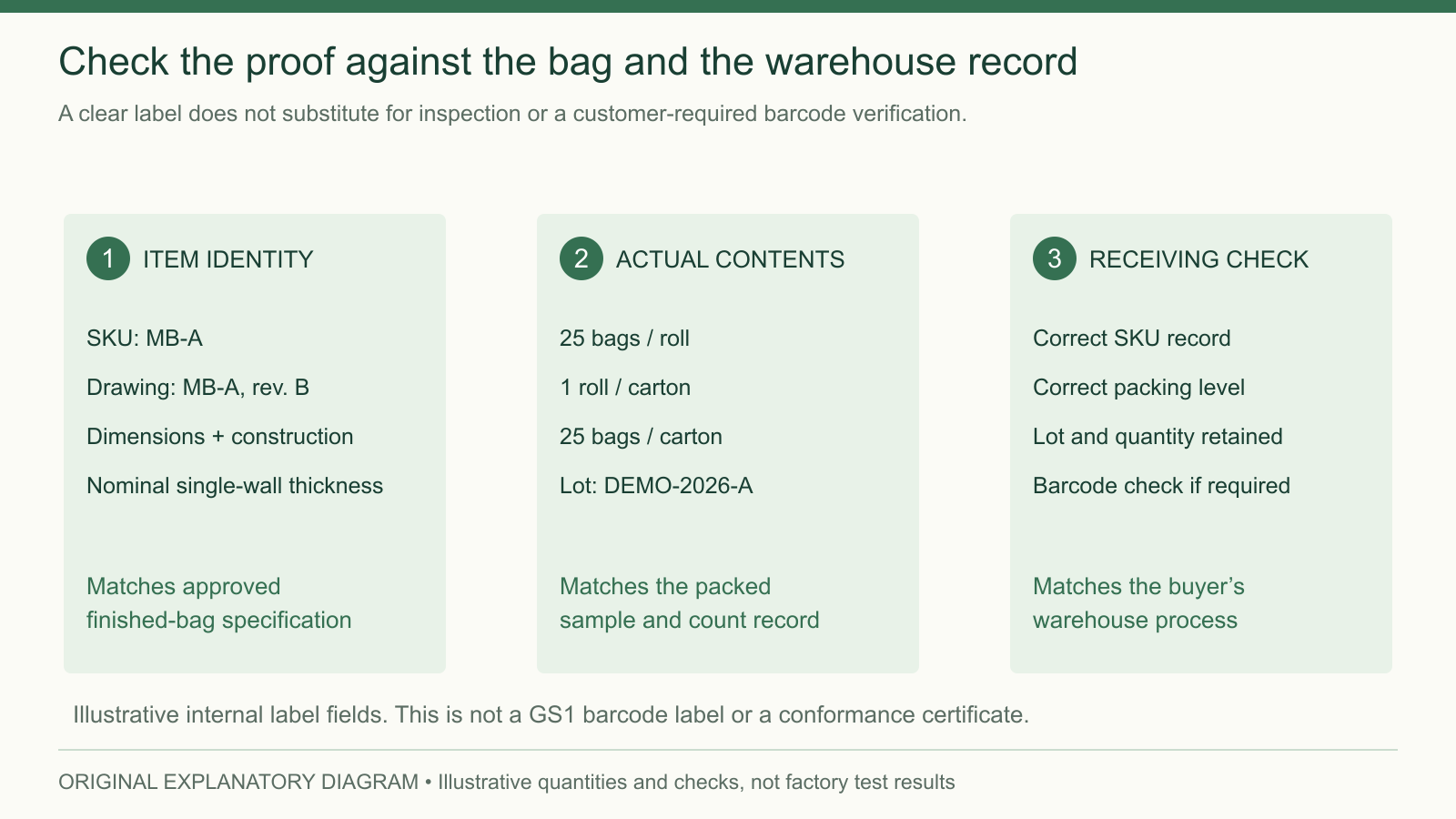
Review a realistic filled proof, not only a clean artwork template. Long item names, revision letters and actual lot-code lengths are where a readable layout can fail. The following is an internal identification example; it is not a GS1 barcode label and its dimensions do not establish mattress fit.
| Example label field | Illustrative completed value |
|---|---|
| Buyer SKU / supplier reference | MB-A / SAMPLE-MBA |
| Product | Clear flat mattress bag; preformed tear-off roll |
| Finished dimensions | Laid-flat width 1,800 mm × finished length 2,400 mm; measurement convention per drawing |
| Specification | Drawing MB-A, revision B; nominal single-wall film thickness 50 microns |
| Packed quantity | 25 bags/roll × 1 roll = 25 bags/carton |
| Lot / carton reference | DEMO-2026-A / carton 03 of 12 |
| Artwork status | Illustrative proof only; all values require approval for a real order |
Keep the large identification fields easy to read at the receiving distance. Color can help a picker, but the SKU and text must still work on a monochrome print and for someone who cannot reliably distinguish the chosen colors. Confirm label position on a packed carton; pallet wrapping, strapping or the stacking pattern should not hide the information the receiver needs.
Agree which fields remain fixed and which are printed for each packing run. The approved drawing and SKU normally come from the item record; lot, packed quantity and carton sequence come from the actual run. A change in drawing, pack count or item identity should trigger a deliberate proof review. Do not silently overwrite a saved label file.
Handle mixed and partial cartons explicitly
Prefer a single clearly identified variant per carton when that matches the order and warehouse process. If mixed cartons are agreed, label the carton as mixed and show a contents breakdown. Keep inner rolls or packs identifiable after the outer carton has been opened.
| Illustrative mixed sample carton | Packing unit | Finished bags |
|---|---|---|
| MB-A sample set | Individually folded bags | 5 bags of MB-A |
| MB-B sample set | Individually folded bags | 4 bags of MB-B |
| Carton total | Two separately identified sample sets | 9 bags total; keep the 5 / 4 breakdown |
This is a separate, hypothetical sample carton, not a repacking instruction for the roll order above. Its 9-bag total is useful for reconciliation but cannot identify which size to pick. If the contents include several production lots, preserve the association between each SKU, lot and quantity in the agreed contents record. A repacked carton also needs its new actual quantity; the old full-carton label should not remain as an apparently valid count.
A packing list can carry detail that will not fit clearly on a carton, provided the carton has an unambiguous reference to that record and the receiver accepts the method. Decide the exception process before shipment: who can authorize a mixed carton, who changes the record and how the receiver is notified.
Keep internal labels and GS1 logistics labels distinct
An internal SKU identifies your stock variant. A GTIN identifies a trade item in the GS1 system; an SSCC identifies an individual logistics unit. GS1 states that the SSCC is the compulsory identifier on a GS1 Logistic Label. This does not mean every ordinary carton label automatically requires that system. See GS1’s explanation of the SSCC requirement.
When a customer requires GS1 labels, obtain their receiving specification and use properly assigned identifiers. The GS1 Logistic Label Guideline distinguishes mixed logistics units from units that are themselves trade items. A predefined assortment can have its own trade-item identity; an ad hoc mixed carton is not automatically such an assortment. Content counts must match the identified packing level, and multiple production lots must not be presented as one lot.
Check the actual encoded data and the receiver’s system response, not only whether a phone can read the symbol. Barcode verification, customer acceptance and the human-readable carton proof are different checks. This article does not supply a compliant barcode, allocate identifiers or certify label conformance.
Release the order with a practical receiving check
- Lock the item mapping. Match purchase-order SKU, supplier reference, drawing revision and supply format.
- Approve the filled proof. Check units, dimensions, thickness wording, count hierarchy, lot field and the customer’s required marks.
- Compare proof with a packed sample. Open the carton, identify an inner pack or roll, and check that its bag specification and count agree with the label.
- Test the receiving workflow. Have the warehouse identify and record the item using the actual label. Where barcodes are required, test the correct packing level in the intended system.
- Control changes and exceptions. Record who approves a revised label, partial carton or mixed contents. Remove superseded labels from the packing run.
Preparing a multi-size mattress bag order? Send TIANFENG the bag drawing for each SKU, quantities by size, individual or roll format, preferred packing breakdown and the customer’s label specification. Ask for the carton-label and packing requirements to be confirmed with the quotation. Review the individual versus roll-format guide if the packing format is still undecided, or request a specification-based quote.
Carton-label questions
Can we use “Queen” as the only size description?
It is useful as a secondary picking description. Keep the finished-bag dimensions, construction and SKU tied to an approved drawing, because the same mattress-size name can appear on different bag specifications.
Should bags per roll or bags per carton be printed?
For a roll-packed order, both are useful, together with rolls per carton. They should multiply to the actual finished-bag count. If a carton is partial, state its actual contents rather than the standard full-carton quantity.
Does a carton label prove that the bag is the correct size?
No. It identifies the specification that should be inside. Dimensional inspection and the approved mattress fit trial establish whether the supplied bag meets that specification and intended use.
Reference materials
- GS1 Logistic Label Guideline — trade items, logistics units, contents and mixed loads
- GS1 customer guidance — the SSCC on a GS1 Logistic Label
- ULINE mattress bag catalog — example of model, dimension, thickness and roll-count fields
- Primepac mattress bag specification — example of labeled, poly-wrapped roll supply