
How Much Plastic Mulch per Acre? Quantity and Cost Guide
How much plastic mulch per acre should you order? Start with the production area and the distance between bed centers, then check the actual bed lengths against the rolls you can buy. Acreage alone cannot tell you the final roll quantity or material cost.
Quick answer: for one continuous mulch strip per bed, preliminary film length in feet equals 43,560 × net production acres ÷ bed-center spacing in feet. One net acre at 5 ft centers requires 8,712 ft before end allowances and other project-specific requirements; at 6 ft centers, it requires 7,260 ft. Convert that estimate into a cutting plan before ordering whole rolls.
There is no single reliable cost of plastic mulch per acre. Use a current quotation for the approved film specification, calculate the rolls the job actually needs, and keep material purchases separate from installation and end-of-season costs.
1. Define the acreage and bed-center spacing
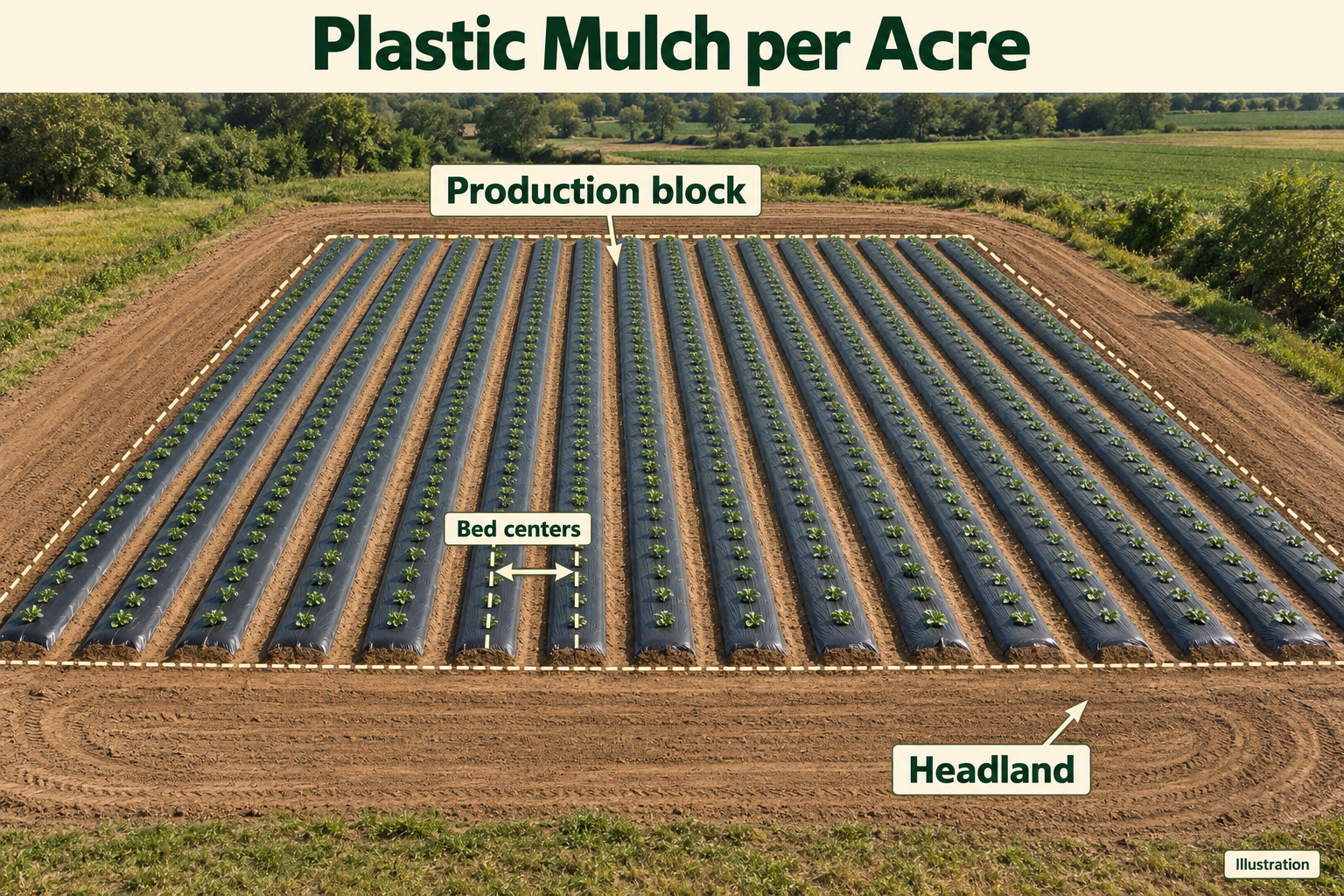
Use the net production area arranged in regular beds, not automatically the acreage on the property record. This bed-layout area includes the normal spaces between beds. External headlands, access roads, ditches and unplanted blocks do not belong in it.
Do not subtract the normal between-bed paths and then also divide by bed-center spacing: that would remove the same spacing twice. For irregular boundaries, mixed spacings or incomplete rows, use measured bed lengths instead of treating the acreage formula as an exact layout.
Bed-center spacing is the distance from the center of one covered bed to the center of the next. It is not the film width, bed-top width or distance between two plant rows on the same bed. The UF/IFAS plasticulture case study calculates linear bed feet from cropped area and bed spacing, while distinguishing plant rows and drip-tape lines.
Choose film width separately to suit the bed profile, side coverage and anchoring method. The plastic mulch roll-size guide explains that measurement; a wider sheet does not automatically reduce the linear length needed for the same beds.
2. Calculate plastic mulch length per acre
Preliminary film length (ft) = 43,560 × net production area (acres) ÷ bed-center spacing (ft)
The calculation assumes one strip of film per covered bed and a regular layout. NC State Extension gives the same 8,712 linear feet per net acre for 5 ft spacing. The following values are geometry estimates, not recommended crop spacings or final purchase quantities.
On a small screen, scroll the table sideways if necessary.
| Bed-center spacing | Calculation | Base film length |
|---|---|---|
| 4 ft | 43,560 ÷ 4 | 10,890 ft |
| 5 ft | 43,560 ÷ 5 | 8,712 ft |
| 6 ft | 43,560 ÷ 6 | 7,260 ft |
| 7 ft | 43,560 ÷ 7 | Approximately 6,223 ft |
| 8 ft | 43,560 ÷ 8 | 5,445 ft |
For several blocks, calculate each area with its own spacing, then add the lengths. Keep the unrounded values until the final calculation. In metric units, use 10,000 × net production hectares ÷ bed-center spacing in meters to obtain meters of film. For example, 1 net hectare at 2 m centers gives 5,000 m before allowances.
Film area is a different measurement. Film width multiplied by film length gives sheet area. It includes film running down the bed sides and buried edges; it does not describe the same area as the production block and its paths.
3. Turn the estimate into a bed list and whole-roll order
Record how many beds you will cover and the actual length of each group. Add start and end allowances only if they are not already included in the measured cutting length. Record any additional setup or permitted overlap requirement separately; do not insert a universal waste percentage.
Dividing the total planned length by the usable length of one roll and rounding up gives only a starting lower bound. It can understate the order when each bed needs an unjoined strip and short remainders cannot complete another bed. Check actual cuts, approved joins and usable existing stock before deciding how many new rolls to buy.
The Washington State University dimensions-and-costs factsheet relates mulch length to bed centers and discusses roll changes. Its fractional roll equivalents are planning values, not permission to round a purchase down. For cutting layouts and mixed row lengths, use the detailed roll-length and cutting-plan guide.
4. Compare material quotations on the same basis
A price per roll is meaningful only after the specification and usable length are known. Match the film material and construction, color, width, thickness and tolerance, punching requirements, and acceptance criteria. Also match the currency, order quantity, quotation validity and included charges.
For approved like-for-like film, normalize the material quotation as follows:
Material price per 1,000 usable ft = quoted roll price × 1,000 ÷ usable roll length (ft)
Use 1,000 meters instead when all inputs are metric. If a quote is by weight, obtain the agreed net film weight and usable length; gross shipment weight can include cores and packing. Do not convert dollars per kilogram into dollars per acre from an assumed roll weight.
A longer roll may reduce the number of changes, but it must still fit the laying equipment and job. Compare the film thickness and measurement basis before treating two different products as interchangeable.
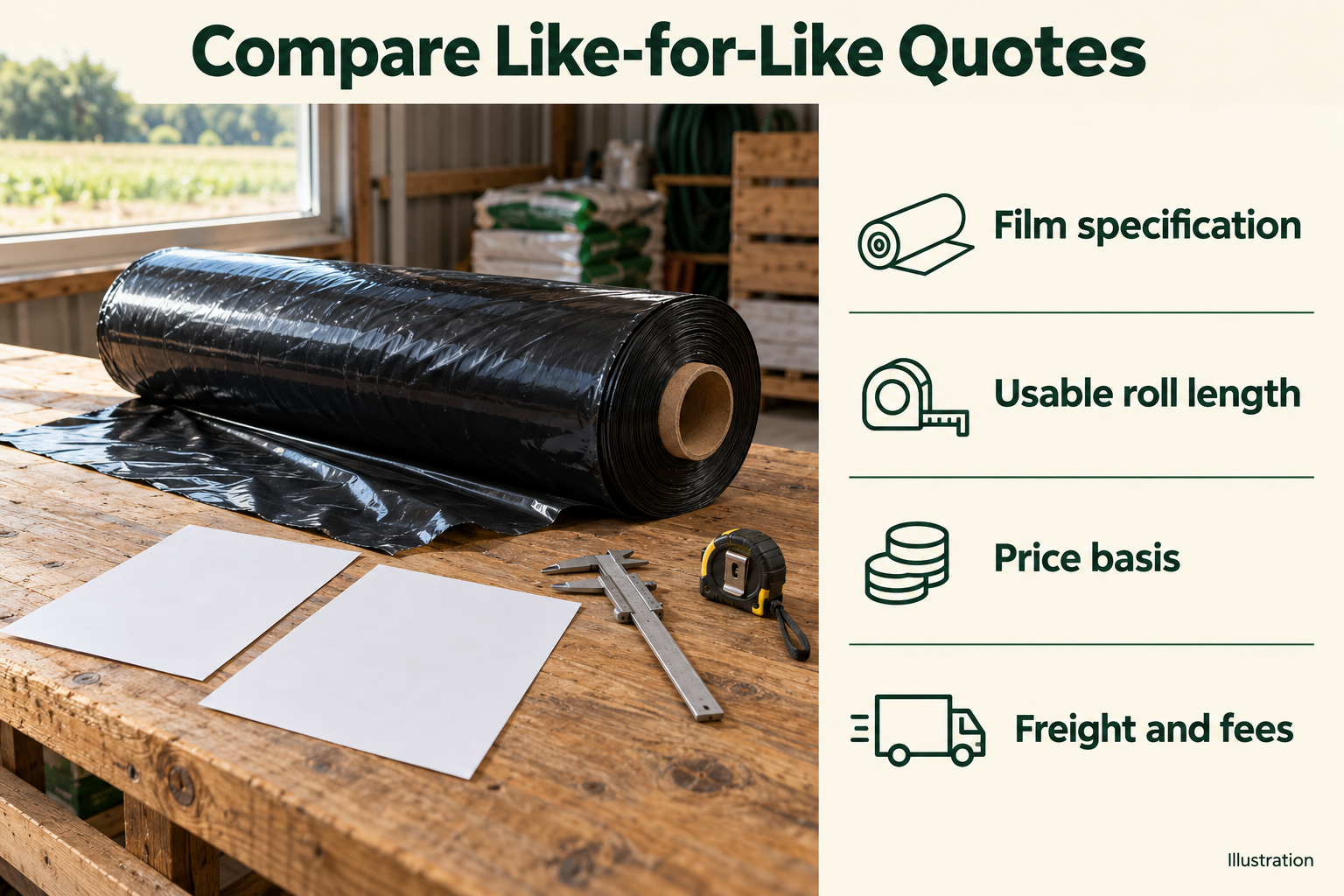
Use a current quote, not a historical price range. The university references support the calculation method. Their dated costs, and the hypothetical prices below, are not today's market prices or TIAN FENG quotations.
5. A one-acre example: unit price versus purchase cash
Illustrative inputs only: consider 22 beds, each 330 ft long, on 6 ft centers. Their regular layout footprint is 22 × 330 × 6 = 43,560 sq ft, or one net production acre. External headlands are outside this area.
For this example only, allow 2 ft at each end, making each complete strip 334 ft. Total planned film is 22 × 334 = 7,348 ft. The 2 ft allowance is not an installation recommendation. No further setup or damage allowance is modeled; add the actual requirements for a real job.
Assume no starting inventory, no joins within a strip, two otherwise equivalent approved films, and the usable roll lengths below. Both roll prices are invented to demonstrate the calculation, excluding freight, tax, labor and equipment.
| Comparison item | Option A | Option B |
|---|---|---|
| Usable roll length | 2,000 ft | 3,000 ft |
| Hypothetical price per roll | US$80 | US$126 |
| Material price per 1,000 usable ft | US$40 | US$42 |
| Complete 334 ft strips per roll | 5 | 8 |
| Whole rolls needed for 22 beds | 5 | 3 |
| Total length purchased | 10,000 ft | 9,000 ft |
| Material purchase cash for this job | US$400 | US$378 |
| Planned film used, including ends | 7,348 ft | 7,348 ft |
| Unallocated remaining length | 2,652 ft in separate remainders | 1,652 ft in separate remainders |
Option A needs five rolls because four rolls yield only 20 complete strips, even though 8,000 ft is greater than the total planned length. Under this cutting plan, its remaining pieces are four lengths of 330 ft and one of 1,332 ft. Option B leaves two lengths of 328 ft and one of 996 ft.
Option A has the lower price per unit length, while Option B needs US$22 less purchase cash for this specific job. That is not a universal saving: the two purchases leave different stock, and future usable remainders may have value. The arithmetic does not establish that either option has a lower full-season cost.
6. Keep purchases, job use and remaining stock separate
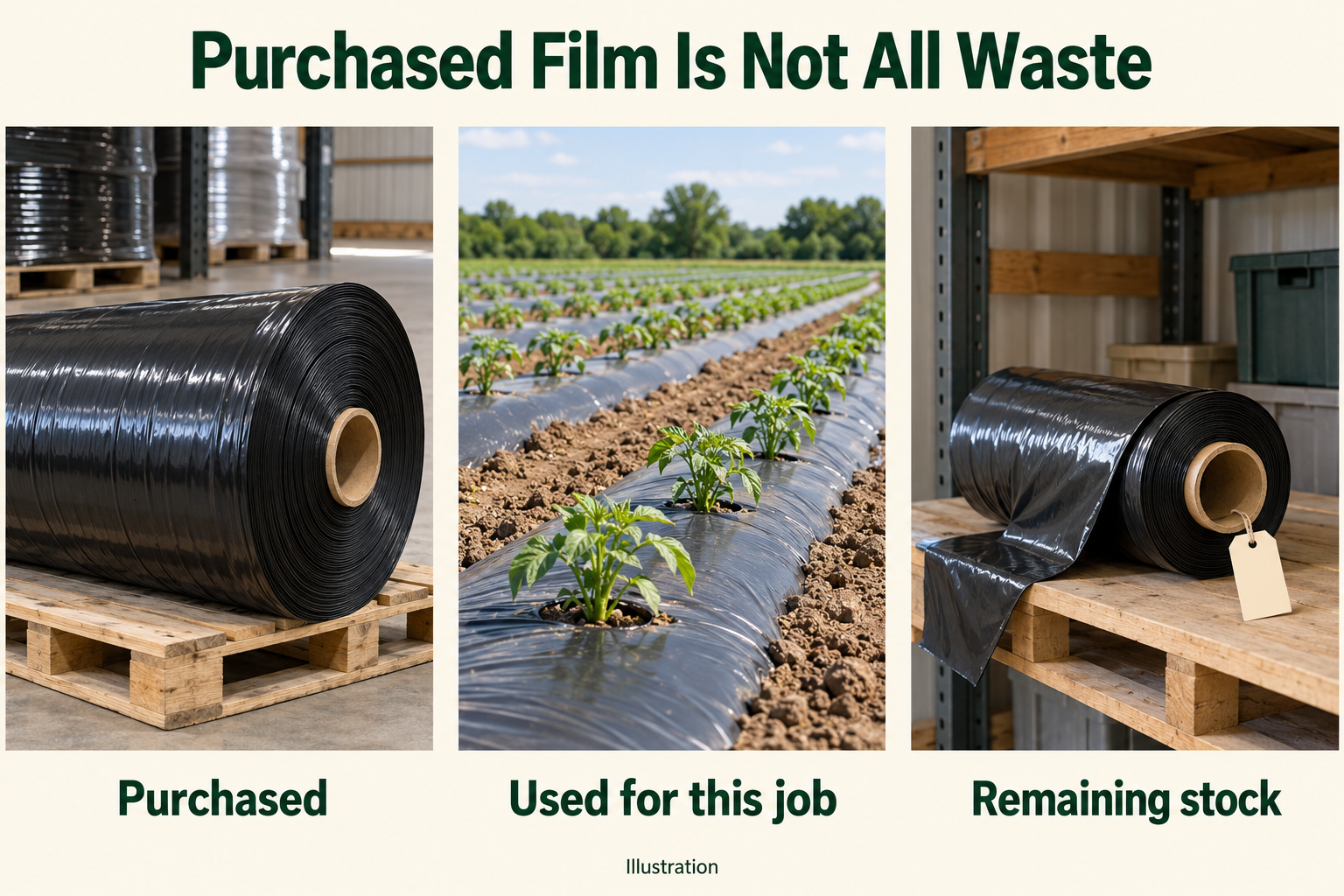
For the same specification, keep three distinct records:
- Purchase cash: new rolls bought multiplied by the quoted price, with freight and other charges identified separately.
- Film allocated to this job: the planned or actual length consumed. A unit-length cost allocation can support an internal material-use estimate, but it is not the cash paid for whole rolls.
- Remaining stock: each roll or piece left, its usable length, condition and specification. A total length alone cannot prove it will fit the next job.
For example, a clean 330 ft remainder cannot provide the example's 334 ft unjoined strip, but it may suit a shorter bed later. Do not automatically call it waste, and do not automatically credit it as usable inventory without checking its condition and likely use. Film recovered after a crop is a separate material stream from clean, unused roll stock.
State the denominator on every per-acre figure: purchase material cost per net production acre is purchase material cost divided by net production acres. Dividing by the whole property acreage produces a different measure, not a lower quotation.
7. Add the costs that a film-only estimate leaves out
A film-material budget is not a complete plasticulture budget. Depending on the scope, record delivery, bed preparation, laying labor and machinery, drip irrigation, maintenance, and end-of-season removal, transport and accepted disposal or recycling separately. Do not add them again if a contractor's quotation already includes them.
The university research team's Mulch Calculator introduction distinguishes material, machinery, labor and cleanup costs and explains that its default figures are examples. Replace historical defaults with the actual job inputs.
Film choice also changes the management plan. Compare biodegradable and PE mulch requirements on documented product suitability and end-of-season handling, not on an assumed fixed saving. For installation preparation, see the plastic mulch laying guide.
Send these inputs with a quotation request
We need mulch film for [crop and location], covering [net production area and unit]. Our layout has [bed count, measured bed lengths and center spacing]. We need [film specification] with [usable roll length or equipment limits]. Each strip must be [unjoined / joined only under the agreed method]. Existing usable stock is [lengths and specification]. Please state the quoted unit, quantity, currency, validity, and whether freight, taxes and other charges are included.
If the specification is not final, provide the layout and intended use first. Confirm the material and cutting plan before converting the quotation into an order.
Frequently asked questions
How many rolls of plastic mulch do I need per acre?
There is no fixed number. Bed-center spacing determines the base linear length; actual bed lengths, end allowances, usable roll length, allowed joins and existing stock determine the purchase. At 6 ft centers, one net production acre starts at 7,260 ft before those adjustments.
Do two rows of plants on one bed double the film quantity?
No, not when one film strip covers the entire bed. Count covered beds, not plant rows. Two drip-tape lines can change irrigation-tape quantity without doubling the mulch length.
Can I multiply one acre's rounded roll count by ten?
Not reliably. Pool the actual bed requirements and compatible inventory, then check the overall cutting plan. Rounding each acre independently may buy more rolls than a coordinated plan needs; total length alone still does not resolve unjoined-strip constraints.
What is the current cost of plastic mulch per acre?
Obtain a current quote for the approved film and the whole-roll quantity your layout requires. Divide the defined material purchase cost by net production acres. Include other charges only when the budget label says so; the hypothetical prices in this guide are not current offers.
Is leftover roll length always waste?
No. Identify the separate remaining lengths and check their specification, condition and fit for later work. An unusable short piece and a clean, suitable partial roll should not automatically receive the same treatment.
Does this calculation include laying and removal?
No. The worked example is a film-only material purchase. Add the applicable labor, machinery, delivery, irrigation and end-of-season costs to build a broader project budget, without double-counting bundled charges.
References and calculation notes
The sources below support the measurement and budgeting principles. The worked quotation comparison is an original illustrative calculation, not a field trial or a supplier offer. Historical prices, product listings and unrelated regulatory claims from these documents are not adopted here.
- NC State Extension — Plasticulture for Commercial Vegetables. See the section on plastic required per acre for the 5 ft center-spacing relationship. Whole-roll quantities in this guide are calculated separately.
- Washington State University Extension — Dimensions and Costs of Polyethylene, Paper and Biodegradable Plastic Mulch. April 2016 factsheet; used for the bed-spacing and roll-planning framework, not current prices.
- UF/IFAS Extension — Converting from Seepage Irrigation to Plasticulture for Vegetable Production: A Case Study. Used for the relationship between cropped area, bed spacing and linear bed feet, and the distinction between bed and drip-line counts.
- Chen and colleagues — Mulch Calculator, Report No. LCA/SC-2018-01. June 2018 introduction, hosted by the University of Tennessee; used for cost categories and the need to replace illustrative defaults with actual inputs.
Confirm the layout before requesting the roll quantity
Review the plastic mulch film options, then send your bed layout and required specification. A useful comparison starts with the same area definition, an achievable cutting plan and a clearly scoped quotation.