
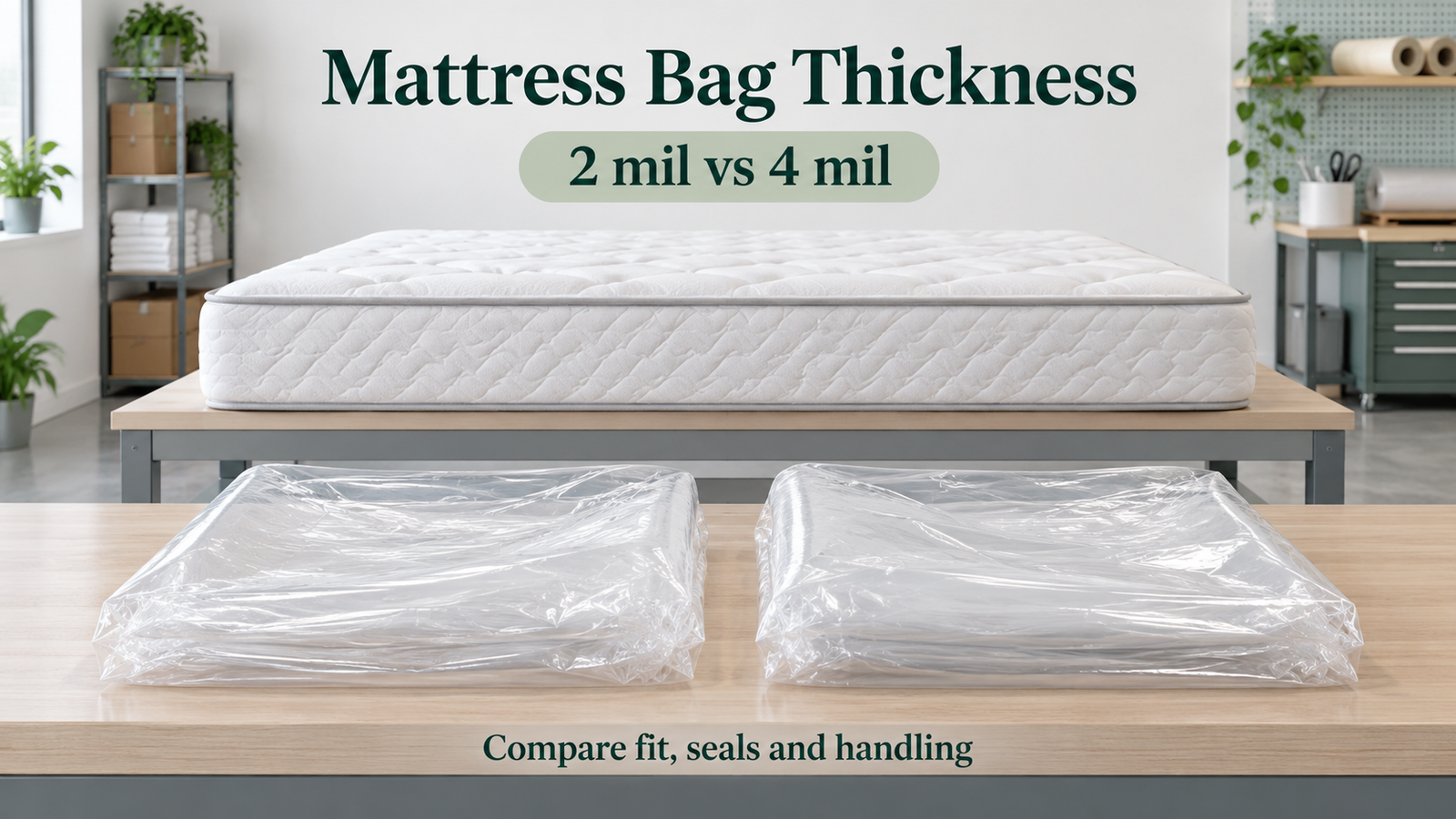
Mattress Bag Thickness: 2 Mil vs 4 Mil and What to Test
Mattress bag thickness is an important specification, but a thicker label alone cannot tell a mattress manufacturer, delivery company or packaging buyer which bag will work. The decision also depends on finished dimensions, film construction, seals and the route the packed mattress follows.
The short answer: 2 mil is 50.8 micrometres and 4 mil is 101.6 micrometres. A 4 mil bag has twice the nominal film thickness of a 2 mil bag—not automatically twice the strength, usable life or protection. Compare samples with the same finished-bag dimensions on the same actual mattress and handling route, then agree the single-wall thickness, tolerance and acceptance checks.
2 mil vs 4 mil mattress bags: what the numbers establish
A mil is one thousandth of an inch, not one millimetre. One mil equals 25.4 micrometres, often written as microns. Put both the value and unit on the quotation so “2” cannot mean two different specifications.
| Film thickness | Micrometres / microns | Millimetres |
|---|---|---|
| 1 mil | 25.4 µm | 0.0254 mm |
| 2 mil | 50.8 µm | 0.0508 mm |
| 3 mil | 76.2 µm | 0.0762 mm |
| 4 mil | 101.6 µm | 0.1016 mm |
This is a conversion table, not a statement that every listed thickness is available for every TIANFENG bag. Requested construction, dimensions and thickness must be confirmed together.
Real catalogues illustrate the distinction: U-Haul lists a 2.0 mil queen mattress cover, while Danco lists 4 mil bags with specified vent holes and roll quantities. These are different finished products, not a controlled comparison proving that one gauge always performs better.
A 4 mil specification is numerically twice 2 mil. However, puncture, tear and seal performance also depend on the material and finished-bag design. Do not convert that thickness ratio into a strength ratio without relevant testing. Likewise, “heavy duty” is a supplier description, not a complete acceptance specification. Commercial catalogues use several thickness grades, not a universal two-grade system.
Confirm one wall, nominal thickness and the checking method
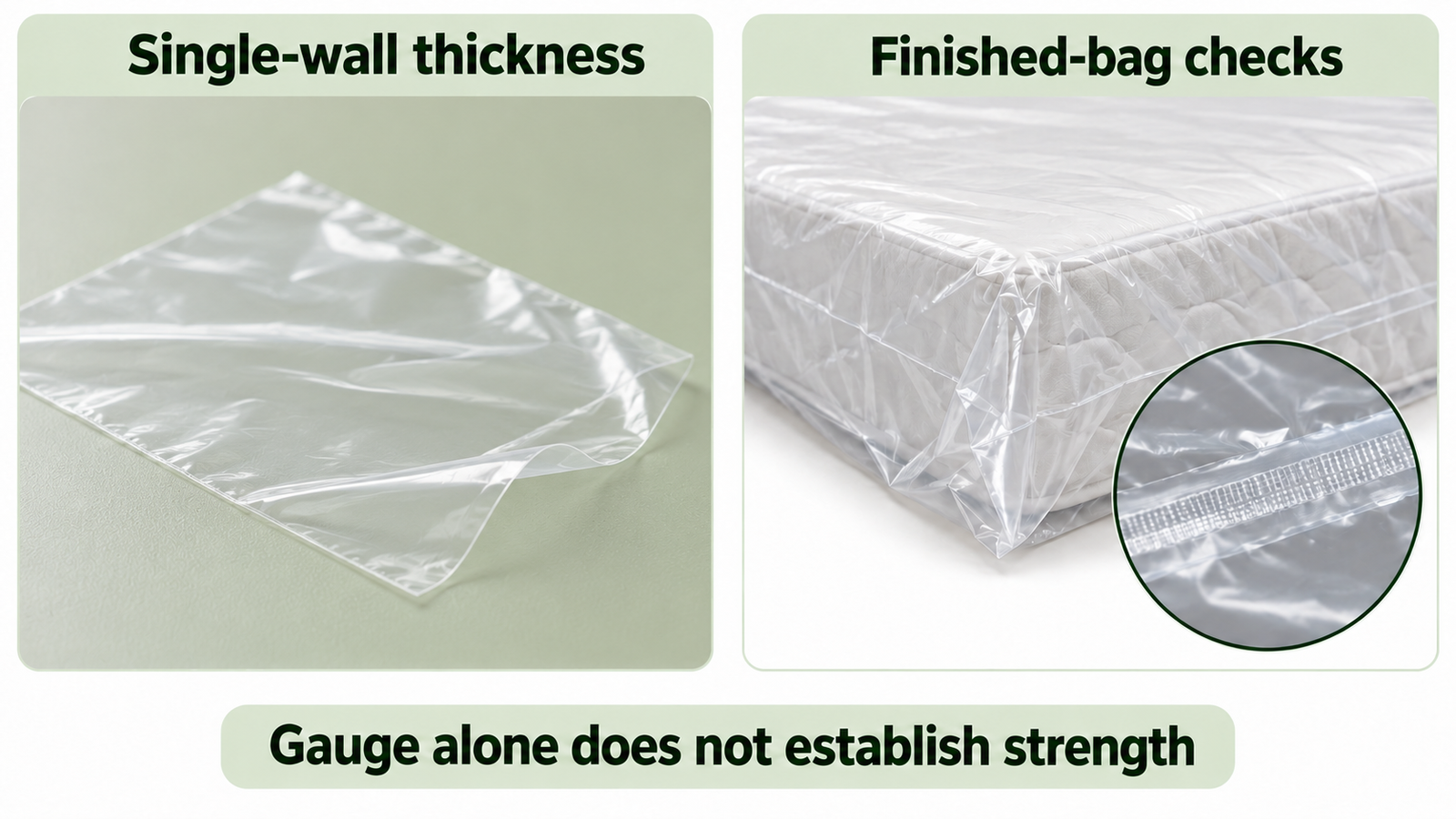
A flattened bag normally places its front and back walls together. A reading through both walls is not the thickness of one wall. Folds, gussets and seals can introduce additional layers or locally different geometry; identify exactly what is being measured before comparing results.
For procurement, distinguish nominal single-wall thickness from actual measurements and the permitted variation. Ask the supplier and receiving team to agree:
- The measurement method and equipment appropriate to the flexible film.
- How a single-wall specimen is obtained and which locations are checked.
- The agreed sampling plan, result reporting and acceptance tolerance.
- How seams, folds or other areas outside the stated film-thickness measurement are assessed separately.
Do not assume a universal percentage tolerance, infer an entire batch from one reading, or divide an unexplained stacked reading by two. Record the specimen and method with the result. A supplier's nominal declaration and a buyer's measurement are comparable only when they refer to the same thing.
Laboratory specimen measurement and incoming-bag acceptance are also different tasks. The public scope of ASTM D6988 addresses film thickness for calculating test properties, not commercial classification or quality-control sampling. It does not provide a complete bag-order acceptance plan. Agree the purchasing measurement method, sampling and acceptance criteria separately.
Identify what the bag must survive before choosing a gauge
Write down the real packing and delivery sequence. A bag used for controlled factory packing may encounter different contact points from one passing through repeated loading and unloading. Neither setting justifies an automatic 2 mil or 4 mil prescription.
| Condition | What to check with samples |
|---|---|
| Packing and closing | Enough loading and closure space; no forced stretching around the actual mattress or pillow top. |
| Repeated transfers | Contact with carts, vehicle surfaces and other packaging; record where damage first appears. |
| Prominent corners or fittings | Local contact, bag fit and any approved additional protection—not thickness alone. |
| Storage before delivery | Mattress condition, storage environment and the specified opening, closure and vent arrangement. |
If a bag is too tight, correcting the dimensions may be more relevant than increasing gauge. Use the mattress bag sizing and types guide for width, length, depth and drawing conventions rather than ordering by a bed-size name alone.
Surface behavior also matters. Dana Poly lists different slip options and vent patterns for its own products, showing why thickness is not the only question. Those options are not automatically TIANFENG specifications. Describe any sliding, opening or packing difficulty and ask what construction can actually be offered.
A protective bag is not lifting equipment. Support and move the mattress using an appropriate handling method. Do not lift it by ordinary film, drag it as a bag-strength test, or assume thicker PE is suitable for vacuum compression.
Compare samples on the same mattress and route
The useful question is whether each candidate works in the defined process—not which sample feels thickest. Keep the comparison fair and record differences that cannot be controlled.
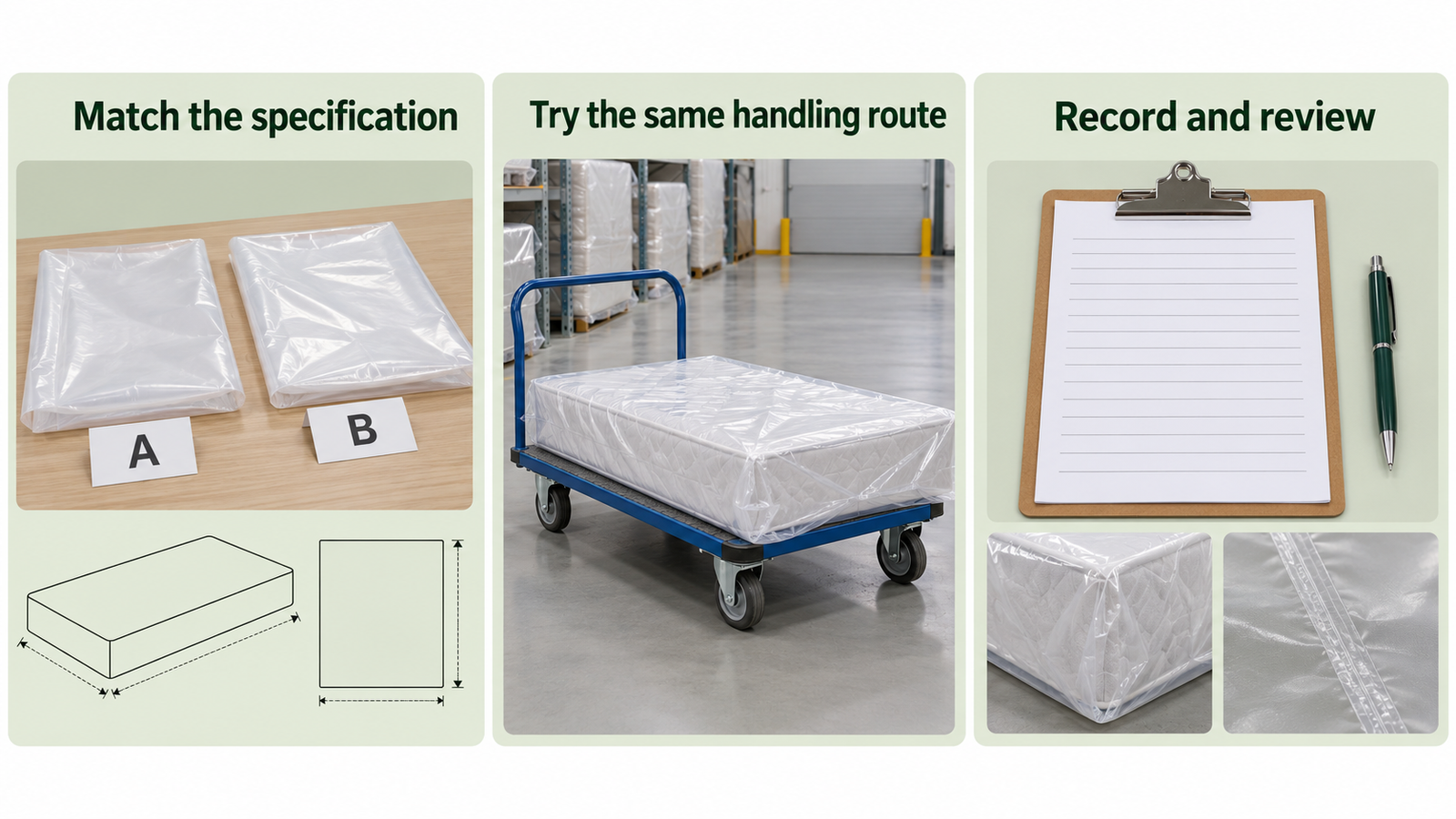
- Identify A and B. Record supplier, sample or batch ID, construction, nominal single-wall gauge and finished dimensions. To isolate thickness as far as practical, request the same bag design and material family.
- Hold fit constant. Use equal finished-bag dimensions and the same actual mattress or equivalent documented units. A loose 4 mil bag and a tight 2 mil bag are not a thickness-only comparison.
- Define the route. Use the normal loading, closing and supported handling steps, equipment and number of transfers. Record route changes and use fresh samples for each agreed run.
- Agree acceptance first. Define required coverage and which body, seal or closure defects are unacceptable. Agree sample quantities and review responsibility rather than deciding what counts after seeing results.
- Inspect at defined stages. Check after loading, closing and the agreed transfers. Photograph the location of any change and retain the sample for review when practical.
This is a proposed purchasing trial, not a standardized laboratory test, certification or report of work already performed. A small trial cannot guarantee every future shipment. Use its observations to refine the specification and any further validation needed for the intended route.
A blank record to use for each candidate
| Record field | Candidate A | Candidate B |
|---|---|---|
| Sample ID, construction and finished dimensions | To record | To record |
| Declared gauge; method and measurement record | To record | To record |
| Mattress ID; loading and closure observations | To record | To record |
| Route and number of transfers completed | To record | To record |
| Damage location, stage, photo and disposition | To record | To record |
| Reviewer, date and next action | To record | To record |
Record the failure location without guessing the cause
Distinguish a puncture in the film body, a split along a seal, stretching at a corner and an opening at the final closure. Note when it appeared. These patterns guide investigation, but do not by themselves prove weak resin, inadequate thickness, faulty sealing or operator error.
If both samples fail at the same protrusion, review that contact and the fit before simply ordering thicker film. If a seal opens, examine the seal specification and loading conditions. Change one relevant variable where practical and repeat the agreed check; otherwise the reason for an improvement remains unclear.
Compare cost per accepted usable bag, not gauge alone
Make each candidate’s gauge and tolerance explicit. Hold non-gauge specifications constant where practical—finished dimensions, construction, seals, holes and closure—or record the differences. Compare packing quantities and delivery terms on the same basis. A cheaper carton or roll can contain a different number or size of bags.
Cost per accepted usable bag = agreed cost total ÷ accepted usable bag count. Define the cost scope: bag purchase alone, or purchase plus identified freight and other included charges. Use the same basis for both offers. Record rejects, credits and replacements consistently; do not include replacement bags in the count while ignoring associated charges.
For acquisition cost, count bags accepted under the agreed incoming checks. Record bags that complete the handling route successfully separately; do not mix the two counts. Keep measured packing time and rework separate until there is enough evidence to include them consistently. A few successful sample runs are not a forecast of the bulk order’s reject rate.
There is also a limited material relationship: with equal total developed film area and density, doubling actual film thickness approximately doubles film mass. That area includes all bag walls and gussets. It does not mean a 4 mil finished bag must cost exactly twice a 2 mil bag; conversion, printing, packing, quantities and delivery also affect the quote.
Turn the sample decision into an order specification
Send the supplier the conditions that matter, not only “heavy-duty mattress bags.” A useful inquiry includes:
- Actual mattress dimensions and an agreed finished-bag drawing, including loading and closure space.
- Purpose, normal handling route and the issue the new bag should address.
- Requested material, nominal single-wall thickness and the tolerance or checking points still to agree.
- Seal, opening, vent and closure requirements; identify unknowns rather than assuming them.
- Sample observations, expected quantity, packing format and delivery destination.
Keep the approved sample identity, drawing revision and written acceptance terms with the purchase record. A sample approval should identify what was accepted; “same as sample” alone leaves room for misunderstanding.
Request a mattress bag specification review
TIANFENG supplies custom PE mattress bags. Share known dimensions, the handling route, approximate quantity and any sample problems. Requested thickness, construction, packing and acceptance requirements can then be reviewed for the actual order. You can leave undecided technical fields for confirmation.
Mattress bag thickness FAQ
Is 2 mil thick enough for a mattress bag?
There is no universal answer. Check the actual mattress fit, bag construction, seals and handling route. A sample may be unsuitable because it is too tight or encounters a damaging contact point, not only because of nominal gauge.
Is a 4 mil mattress bag twice as strong as 2 mil?
Not automatically. It has twice the nominal film thickness. A strength comparison needs a defined property, relevant test method and comparable samples; the thickness ratio alone does not establish it.
Does thicker film make a bag waterproof or reusable?
Thickness alone establishes neither. Openings, vent holes, seals, closure and actual condition matter. Do not infer watertightness, pest exclusion, safe lifting, vacuum suitability or repeated-use capability from a mil label.
Can I compare two bags if their dimensions differ?
You can compare complete packaging options for your process, but cannot attribute the result to thickness alone. For a gauge-focused comparison, keep finished dimensions and mattress fit consistent and record other construction differences.
References and further reading
The ASTM public scope clarifies a measurement boundary. The commercial sources illustrate product variables and supplier terminology; their specifications and marketing claims are not TIANFENG test results or guarantees.
- ASTM International. ASTM D6988-26: Guide for Determination of Thickness of Plastic Film Test Specimens. Public scope and application limits for test-specimen thickness measurement.
- U-Haul. Mattress Bag (Queen). A product-specific example of a declared 2.0 mil cover, not a universal gauge recommendation.
- Dana Poly. Custom Mattress Bag Manufacturer. Examples of material, surface-behavior and vent-pattern options.
- Danco Packaging Products. 4 mil mattress bag catalogue. Examples of finished-bag specifications and different bag counts per roll.
- Aurora Plastics & Packaging. Mattress bags. Examples of supplier-defined thickness grades and packaging configurations.