
Mattress Bags on a Roll vs Individual Bags: A Bulk Buying Guide
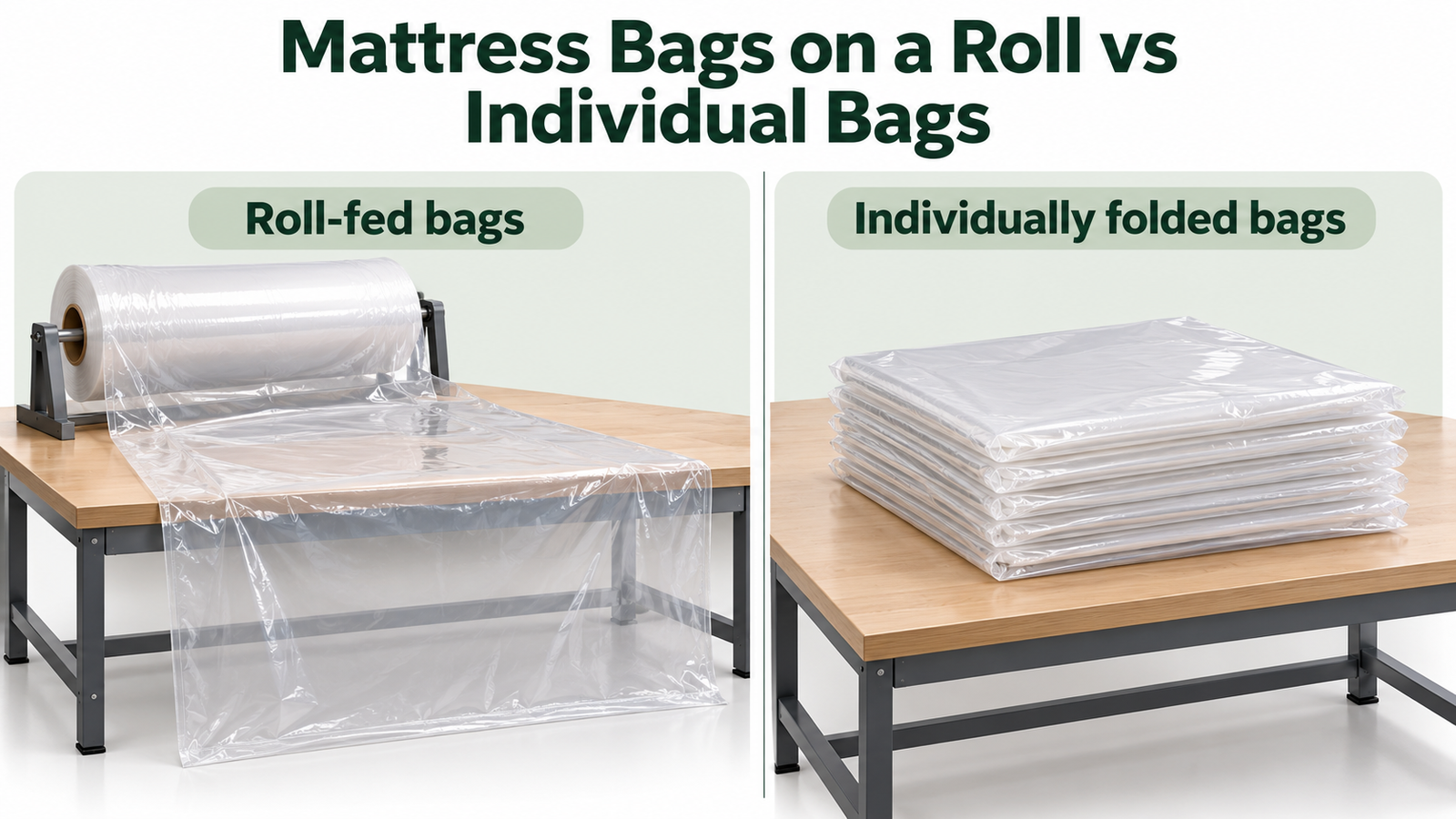
Mattress bags on a roll change how a packing station receives and dispenses bags. They do not, by themselves, change the mattress into a compressed roll or establish better protection. For mattress manufacturers, furniture distributors and delivery teams, the useful comparison is the complete workflow: select the correct bag, dispense it, open it, load the mattress, close the opening and replenish the supply.
The short answer: pre-made mattress bags on a roll are joined by tear-off perforations and separated for use. Individual bags arrive already separated, often folded. Choose between them by the station's size mix, available space, dispensing arrangement and sample performance—not by roll price alone. Confirm the finished-bag drawing, separation line, roll dimensions, support interface and accepted usable bag count before ordering.
Bag-on-roll, individual bag, tubing or rolled mattress?
These descriptions can appear in similar searches, but they do not describe the same product or packing process.
| Format | What it means | What to confirm |
|---|---|---|
| Pre-made bags on a roll | Finished bags with a specified pre-made seal, joined at tear-off lines and wound for dispensing. | Bag geometry, opening, seal and perforation positions, winding and station compatibility. |
| Individual or loose bags | Pre-made bags supplied separately, for example folded and packed in a carton. | Folding, opening presentation, bag count, labeling and clean storage at the station. |
| Continuous plastic tubing | Continuous tubular material that may require cutting and sealing to form the required bag. | The additional conversion steps and equipment; do not assume pre-made bottoms or tear-off bags. |
| Compressed or rolled mattress packaging | A mattress compression and packing process, not merely bags dispensed from a roll. | A separately specified packaging system. Ordinary protective bags are not automatically suitable. |
Here, the comparison is between pre-made protective bags on rolls and pre-made individual bags. It does not cover equipment for compressing mattresses into bed-in-a-box products.
Separate four features on the bag drawing
“Perforated mattress bags” is incomplete wording. It can be misunderstood unless the supplier knows what the perforation is intended to do.
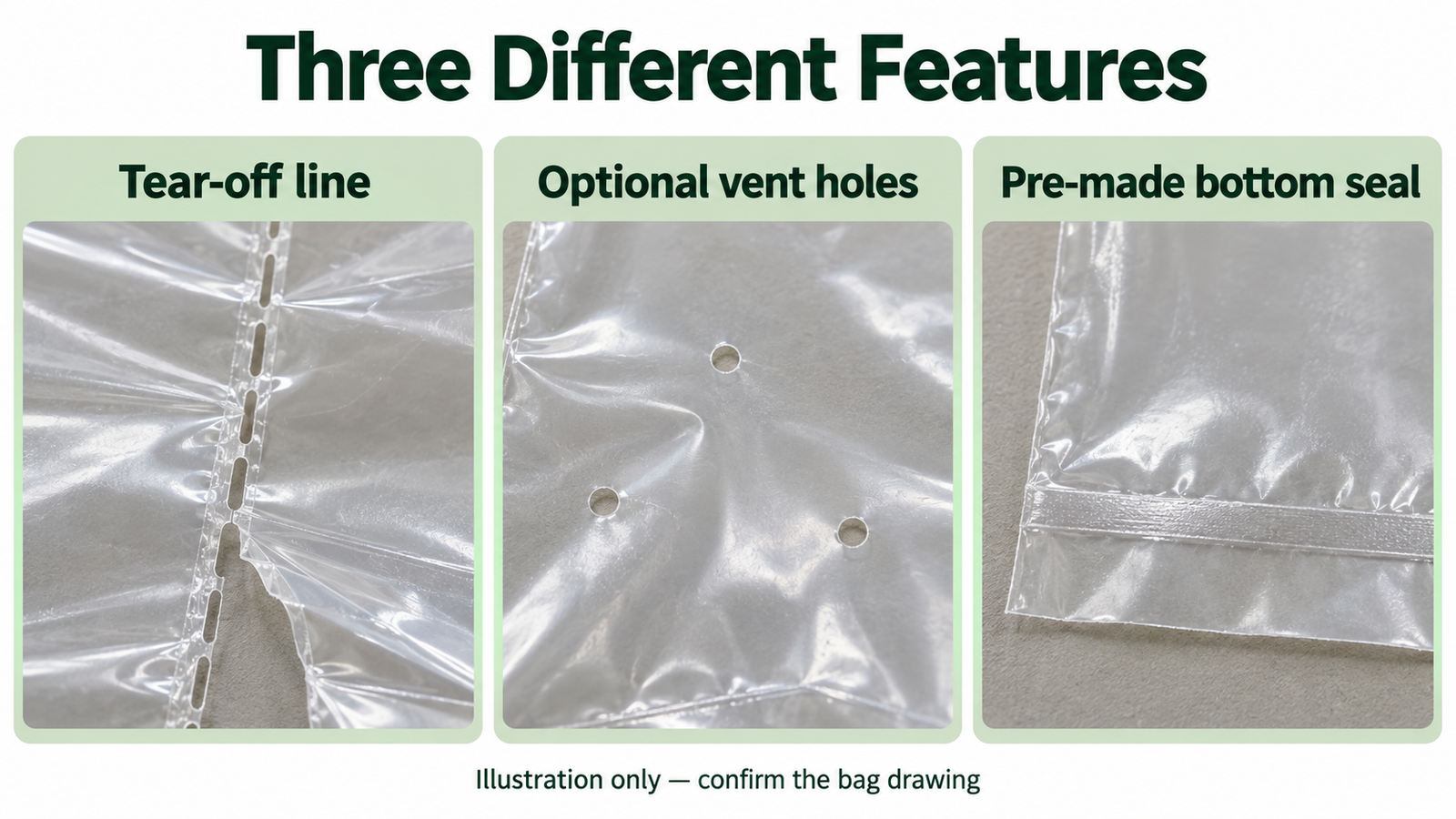
- Tear-off perforation: the separation line between successive bags on the roll. Dispensing should separate the intended bag without damaging its body or required seal.
- Vent holes: openings in the bag body intended to release packing air where specified. Their presence, pattern and location are separate order details.
- Pre-made bottom seal: the closure formed during bag manufacture. Its position relative to the tear-off line must be clear on the drawing.
- Closure after loading: how the remaining opening is closed once the mattress is inside. A pre-sealed bottom does not define this step.
Danco's mattress-bag catalogue describes vent holes and bags perforated on a roll separately. That is a useful purchasing distinction, not a reason to copy its particular hole pattern or bag count into another order.
Ask for a drawing showing the relationship between the opening, seal, separation line and any vents. A photograph of an unopened roll rarely communicates all four. Neither “perforated” nor “sealed bottom” establishes a watertight finished package.
Match the supply format to the packing station
A repeated size at a dedicated station and a dispatch area switching among many mattress sizes have different material-handling questions. Compare both formats where they will actually be used.
| Station condition | Bags on a roll | Individual bags |
|---|---|---|
| Repeated use of one size | Check consistent dispensing and presentation from the installed roll. | Check access to the next bag and the amount of stock staged nearby. |
| Frequent size or SKU changes | Evaluate roll changes, identification and storage of partly used rolls. | Evaluate separation and labeling of stacks or cartons to avoid selecting the wrong bag. |
| Limited work space | Check the stand, roll envelope and safe access for replenishment. | Check carton or stack space, unfolding area and protection from dirt. |
| Different operators or shifts | Check repeatable separation and opening, not just one experienced operator's result. | Check repeatable single-bag selection and unfolding. |
| Machine-assisted operation | Confirm the actual machine's feed and support requirements; roll format alone proves no compatibility. | Confirm whether the process can accept separately supplied bags and how they are presented. |
Neither format is automatically faster or less wasteful. A useful roll can still be inconvenient when the size mix changes; a useful individual bag can still be difficult to separate from a poorly presented stack. Record the actual interruptions, wrong picks, damaged bags and replenishment steps before choosing.
Film surface behavior can also affect handling. Dana Poly lists different slip and vent options for its own mattress bags. Treat these as variables to discuss, not proof that TIANFENG supplies every listed construction or that one surface is best for every station.
Order the finished bag and the dispensing roll as two linked specifications
Begin with the actual mattress and finished-bag drawing. For dimensions and fit allowances, use the mattress bag sizing guide. Then specify how that bag is folded and wound into a roll.
| Specification | Information to agree |
|---|---|
| Finished bag | Open dimensions and gusset notation, length, construction, nominal single-wall thickness and tolerance. |
| Bag features | Opening, pre-made seal, separation line, repeat length and any vent-hole requirements. |
| Folding and orientation | Folded width, unwind direction and how the next bag's opening is presented. |
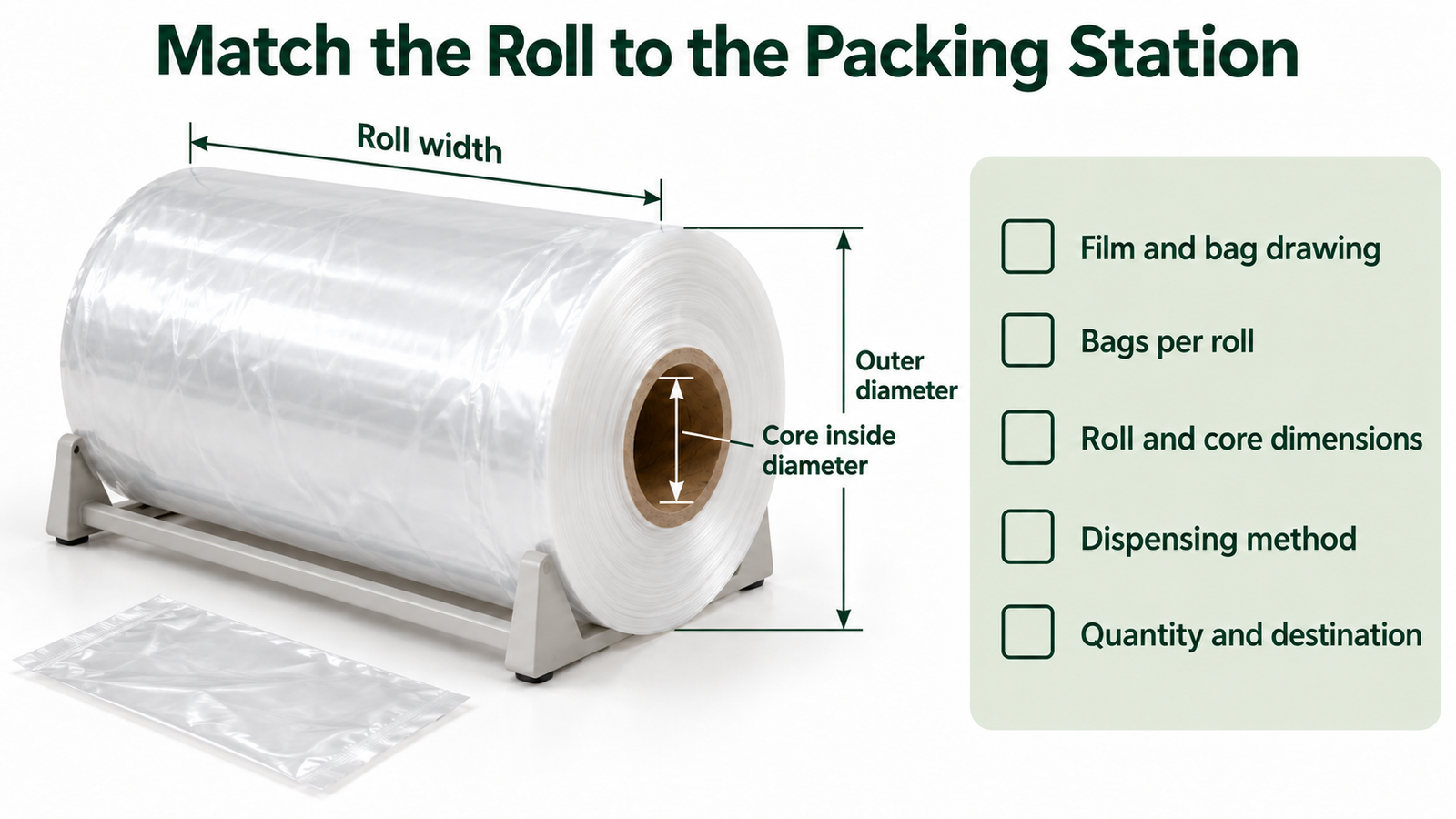
| Roll envelope | Roll width, maximum outer diameter and roll mass, with net and gross quantities distinguished. |
| Support interface | Core internal diameter and, if used, core-plug bore and support arrangement. |
| Count and packing | Bags per roll, rolls per carton, labels, size identification and any required carton information. |
The unfolded bag width is not necessarily the roll width. A core's internal diameter is also not necessarily the hole through a fitted core plug. Aurora's catalogue provides an example of separately stated core and plug dimensions; its values are not universal requirements or TIANFENG defaults.
Give the supplier the stand or machine details, including its relevant limits. A roll that fits a support shaft can still conflict with the available diameter, width, mass or unwind arrangement. Do not resolve that by assuming every mattress-bag roll uses the same core.
For gauge selection and sample assessment, see the mattress bag thickness guide. Moving the same bag design from a carton to a roll does not independently establish puncture resistance or usable life.
Run a comparison at the same station
Use equivalent finished-bag dimensions and construction where practical, the same mattress or documented equivalent units, and the same normal packing route. Record any differences; otherwise an apparent format advantage may actually come from bag fit or film properties.
- Identify the samples. Record supplier, sample or batch ID, bag drawing and the roll or individual-pack specification.
- Dispense one bag. For rolls, observe unwinding and separation. For individual bags, observe picking and unfolding. Note double picks, incorrect separation or time spent finding the opening.
- Inspect before loading. Check the separated bag's body, pre-made seal and intended opening. Do not treat a tear into the seal or bag body as normal just because it occurred while dispensing.
- Pack and close. Use the approved method and properly support the mattress. Record fit, closure access and interference at the work station.
- Include replenishment. Check the agreed roll-change or carton-restocking procedure and, where relevant, behavior as the supply is used up.
Keep a short record for each run: sample ID, size selected, operator, dispensing result, opening and loading observations, damage location, replenishment event and reviewer decision. Agree sample quantities and acceptable outcomes before testing; this checklist does not prescribe a universal sample size or certify performance.
If timing is useful, define whether it includes picking, separation, opening, loading, closure and replenishment. Compare the same work content, record interruptions and do not project a small trial into an unsupported bags-per-hour promise.
Handling boundary: an ordinary protective bag is not a lifting device. Do not lift or drag a mattress by the film, or assume roll-supplied bags are suitable for vacuum compression. Format alone does not establish those capabilities.
Compare accepted usable bags, not the price of a roll
First align finished dimensions, material, nominal gauge and tolerance, seals, holes, packing quantities and delivery terms. A roll containing fewer larger bags is not directly comparable with a roll containing more smaller bags.
Cost per accepted usable bag = the defined cost total divided by the accepted usable bag count for that same supply. State the currency, period and scope: purchase cost alone, or identified delivery and other charges as well. Use the same basis for both formats.
For a receipt-based calculation, use the incoming accepted bag quantity under the agreed acceptance process. Do not substitute the number of bags that passed a separate handling trial. Record rejected or pending bags, credits and replacements consistently, and avoid counting replacements while ignoring related charges.
For a station trial, separately report bags presented, bags successfully dispensed, bags accepted after the defined route and incomplete runs. These are different counts. A successful tear-off does not prove that the packed bag met every later requirement.
Labor, replenishment and rework can be compared only after their scope and actual observations are defined. Neither a larger roll nor fewer cartons automatically establishes a lower total packing cost.
Send a packing-station brief with the inquiry
A useful quotation request connects the bag to its use. Include:
- The actual mattress dimensions, finished-bag drawing or existing sample, and size mix.
- The required format: separate bags or pre-made, bottom-sealed bags joined by tear-off perforations on a roll.
- Known opening, seal, vent, nominal single-wall gauge and tolerance requirements.
- The work-station arrangement, stand or machine details, folding and unwind needs.
- Requested bags per roll or carton, roll-size and mass limits, identification and packing.
- Approximate order quantity, destination and the sample checks needed before approval.
Unknown values can remain open for confirmation. Keep the approved sample identity and drawing revision with the final order so that “bag on a roll” is not the only written description.
Discuss roll-packed or individual mattress bags
For TIAN FENG individual bags or pre-made tear-off rolls, MOQ is 1 metric ton (1,000 kg) per specification. The corresponding bag count depends on the approved dimensions and film construction. Review the current production and sample terms, and provide quantity, unit and destination with the packing-station details.
TIANFENG can manufacture pre-made bottom-sealed mattress bags connected by tear-off perforations on a roll. Individual-bag packing can also be discussed for your application. Dimensions, bag construction, roll count, core and packing details require order-specific confirmation.
Share a drawing, an existing sample or a description of the packing station. Film supply does not imply that a dispenser, automatic packing machine or universally compatible roll specification is included.
Mattress bags on a roll FAQ
Are bags on a roll the same as continuous mattress tubing?
No. The pre-made bags discussed here already have their specified seal and separate at a tear-off line. Continuous tubing may require cutting and sealing. Confirm the drawing and the steps your packing station must perform.
Does “perforated” mean the bag has ventilation holes?
Not necessarily. Tear-off perforations between bags and vent holes in a bag body are different features. Specify both independently, including their position relative to the opening and pre-made seal.
How many mattress bags should be on each roll?
There is no universal count. Bag dimensions, folding, gauge and the permitted roll diameter and mass all matter. Agree the count together with the roll and station specifications rather than copying another supplier's SKU.
Will roll-packed bags work on my automatic packing machine?
Roll packing alone does not establish compatibility. Provide the machine's requirements and test the proposed bag, support interface, orientation, separation and feed arrangement through the agreed approval process.
Which format is cheaper for mixed mattress sizes?
Compare the same finished bags and cost scope, then examine actual size changes, dispensing, replenishment and rejects. Individual bags or rolls may suit a particular station; neither format has a guaranteed cost advantage without that comparison.
Further reading
These commercial references illustrate product features and terminology, not TIANFENG test results, stock specifications or performance guarantees.
- Danco Packaging Products. 4 mil mattress bags. Separate descriptions of vent holes, roll perforations and SKU-specific bag counts.
- Aurora Plastics & Packaging. Mattress bags. Product-specific roll, core-plug and vent details.
- Dana Poly. Custom Mattress Bag Manufacturer. Examples of selectable film-surface and vent features.