
Plastic Mulch Roll Sizes: Width, Length and Ordering Guide
Plastic mulch roll sizes must match the bed profile, the length of the covered rows and the laying equipment. Choose film width from the surface it must cover, including the anchoring allowance. Choose roll length from the row plan and handling limits, then check whether the required row sections can actually be cut from each roll.
This guide covers dimension planning and order information. For available structures and a specification review, visit our plastic mulch film range. The calculations below are illustrative planning examples, not a stock list or a universal installation specification.
Is there a standard plastic mulch roll size?
There is no single roll size for every production system. NC State Extension's commercial vegetable guide gives examples of several polyethylene films in widths of 3–6 feet and lengths of 2,000–8,000 feet. Other listed constructions have different width ranges. These examples describe options in that guide, not a requirement for your farm or a promise of our availability.
For a repeat order, use the approved roll specification and equipment settings as the starting reference. For a new field layout, measure first. A familiar product name such as “four-foot mulch” is not enough to establish roll length, core size, perforation or compatibility.
Measure the bed profile, not only its top width
The film has to follow the actual covered profile. A measurement across the flat bed top omits any covered side slopes and the material needed for anchoring.
Tamil Nadu Agricultural University's mulching guide treats width and edge anchoring as installation considerations. Its example dimensions should not be copied as a universal allowance: use the selected laying system and local installation guidance.
- Identify where the film will sit on the finished bed.
- Measure across that surface, following the top and both covered sides.
- Add the required anchoring allowance at each edge, unless it is already included in the measurement.
- Check the resulting width against the laying equipment and proposed roll.
Planning width = covered surface path + left anchoring allowance + right anchoring allowance.
Illustrative width example
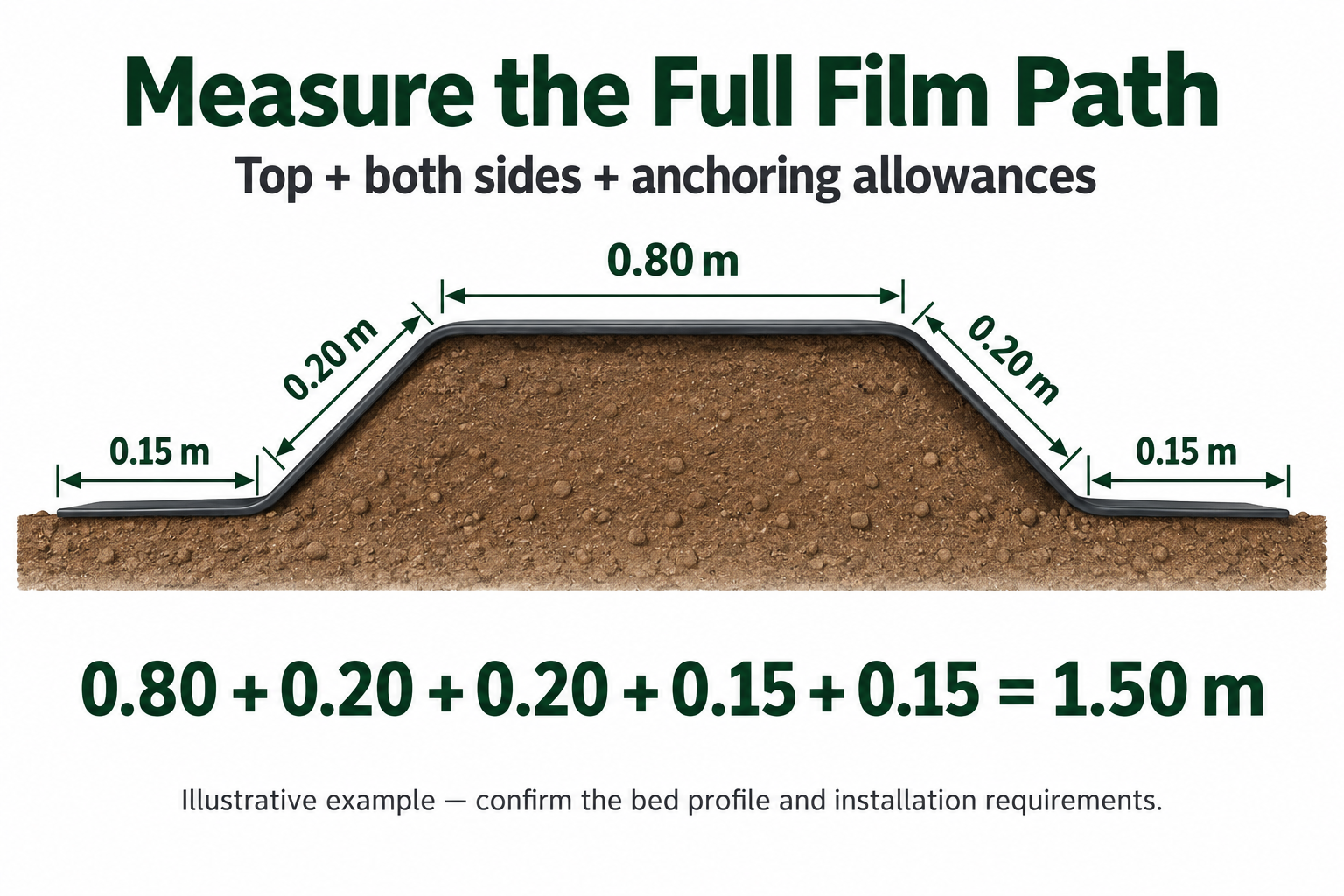
A simplified bed has a 0.80 m flat top and two covered side slopes measuring 0.20 m each along their surfaces. Assume, for this example only, an agreed anchoring allowance of 0.15 m at each edge.
Film path: 0.80 + 0.20 + 0.20 + 0.15 + 0.15 = 1.50 m.
This is a geometric starting value. It is not approval to order a 1.50 m roll without checking bed variation, installation requirements and the agreed width tolerance.
For a crowned or irregular bed, measure the actual contour rather than forcing it into this simplified shape. Do not substitute vertical bed height for side-slope length, or count the anchoring allowance twice. NC State also emphasizes bed preparation and shape as important to proper film installation.
For bed preparation, drip-tape checks and edge anchoring during installation, see our guide on how to lay plastic mulch.
Calculate row length first, then check the cutting plan
Count the covered beds, not the individual plant rows. Two plant rows beneath one continuous strip of mulch require one bed-length of film, not two.
List the length of each required strip, including agreed end allowances. Add any separately justified setup or contingency quantity. Do not apply a fixed waste percentage simply because another project used it.
Step 1: Find the total required length
For beds of equal length:
Required length = bed count × (bed length + allowance at both ends).
For mixed bed lengths, calculate each group separately and add them. Dividing that total by the usable length per roll, then rounding up, gives a preliminary minimum—not necessarily the final order quantity.
Step 2: Check whether complete strips fit on each roll
Illustrative roll-quantity example
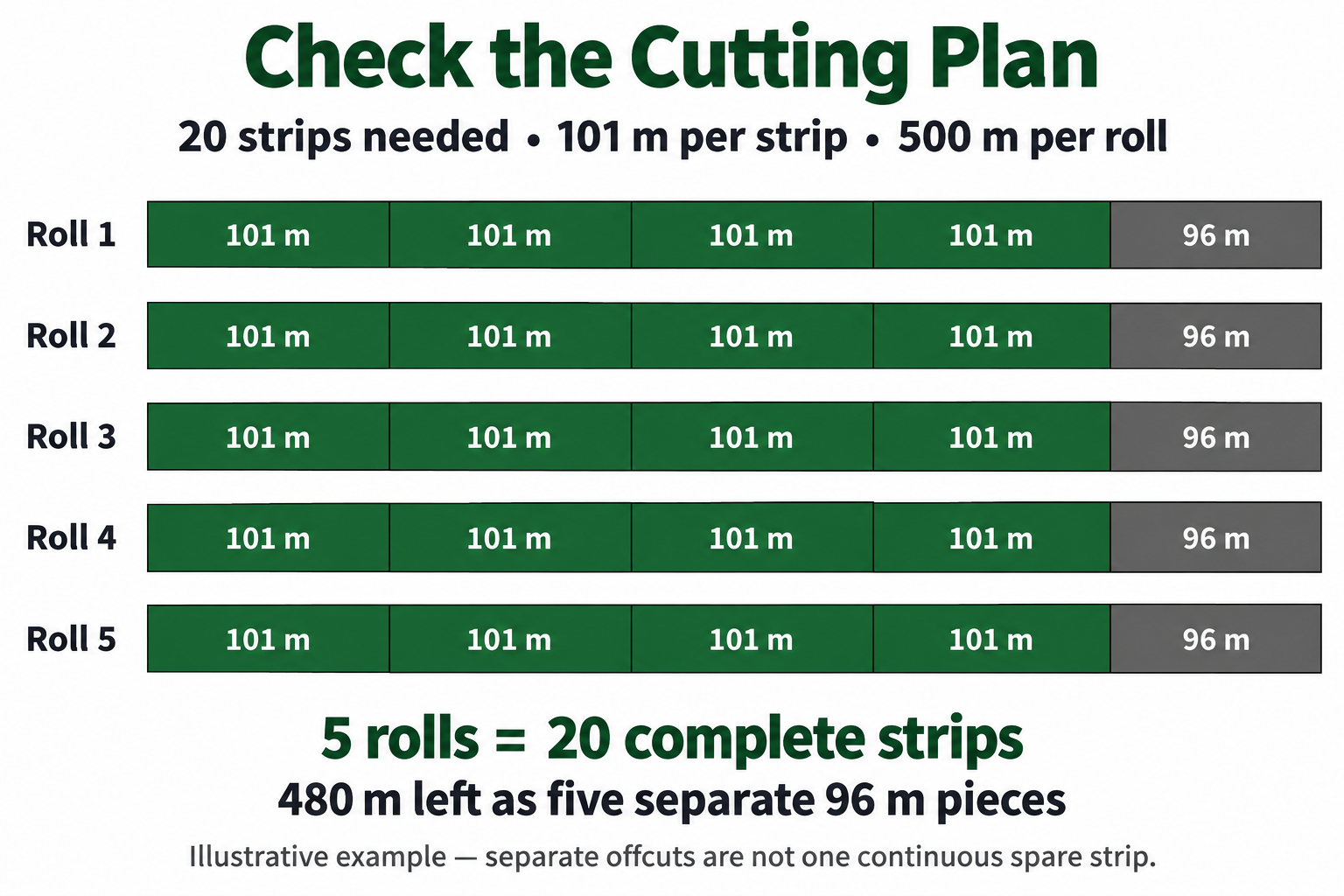
Assume 20 covered beds, each 100 m long, with an agreed 0.5 m allowance at each end. Each strip therefore requires 101 m.
Total required length: 20 × 101 = 2,020 m.
With 500 usable meters per roll, simple division gives 2,020 ÷ 500 = 4.04, rounded up to 5 rolls.
Check the cut plan: each roll provides four complete 101 m strips, leaving 96 m. Five rolls provide the required 20 strips. Total purchased length is 2,500 m; the remaining 480 m is distributed across five separate pieces, not one continuous spare strip.
The cutting check matters when joins are not acceptable. For example, three continuous 600 m strips require three 1,000 m rolls, even though their combined 1,800 m length is less than two rolls. Unused sections cannot automatically be joined or counted as usable replacements.
Ask whether a different offered roll length would reduce unusable offcuts without exceeding equipment or handling limits. Confirm the usable length, any joins in the supplied roll and the length acceptance criteria before approval.
Film area is not the same as planted field area
Nominal sheet area = finished film width × film length.
A 1.50 m × 500 m roll contains 750 m² of nominal sheet area before accounting for holes or losses. That does not mean it serves exactly 750 m² of land: some film covers sides or is buried, while paths and spaces between beds are not covered.
A planted layout of 20 beds, each 100 m long on 1.80 m centers, represents a simplified row-layout footprint of 3,600 m², excluding headlands and boundary adjustments. The film requirement must still be calculated from the 20 covered beds and their individual strip lengths.
Use the bed plan when requesting an order estimate. If only the total hectares are known, tell the supplier that row spacing, bed count and usable row lengths remain unconfirmed.
To estimate film length from production area and bed-center spacing, then distinguish purchased rolls, field use and remaining stock, use our plastic mulch per acre quantity and cost guide. Check the resulting order quantity against the complete-strip cutting plan above.
Check more than the roll's film width
Ask the equipment manufacturer or operator to confirm the following against the actual machine. This is an order-review checklist, not a replacement for its operating manual.
- Working width: the finished film width the machine can accept and lay.
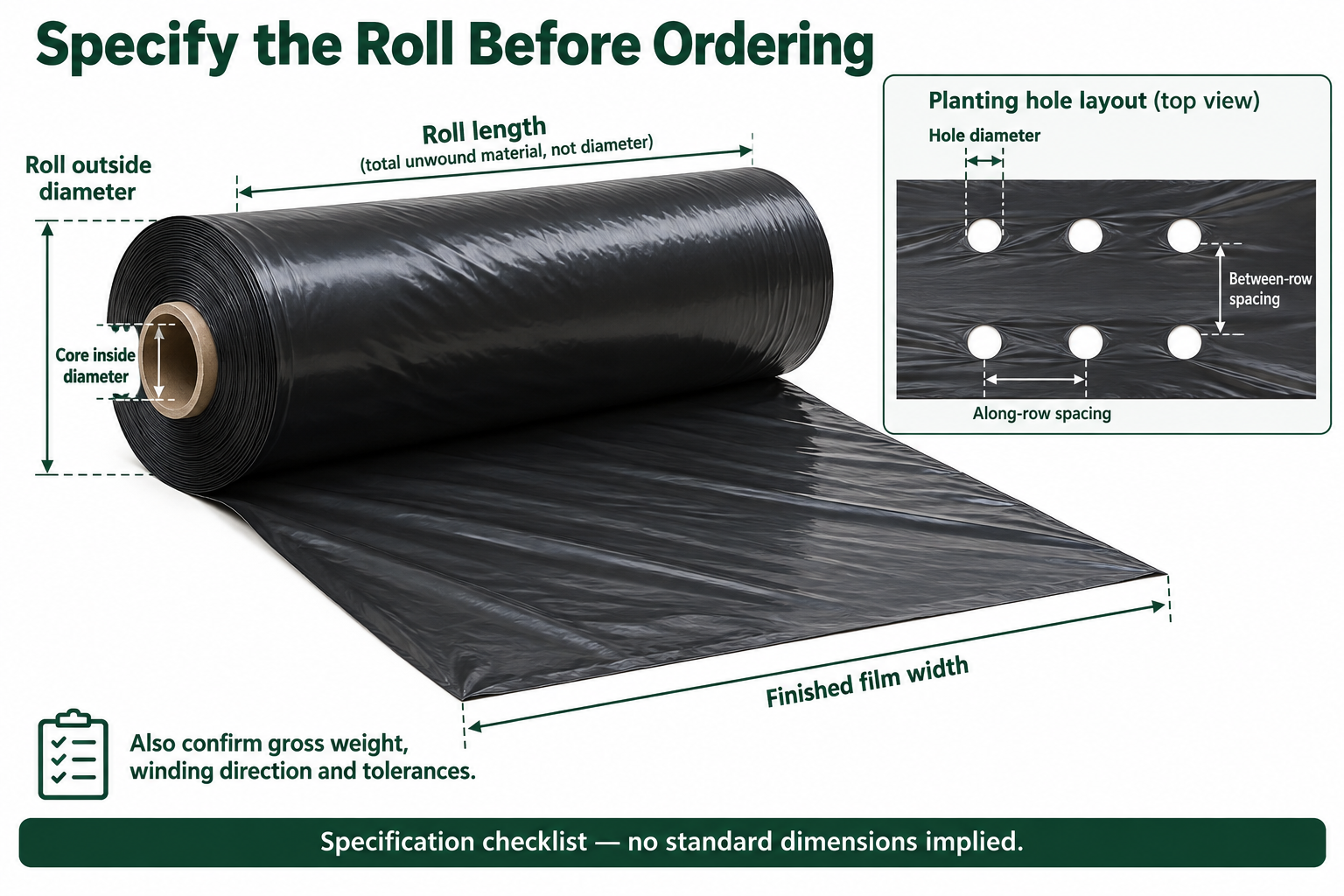
- Core and mounting: core internal diameter, core length and required mounting arrangement.
- Maximum outside diameter: clearance for the full roll.
- Roll mass: distinguish net film mass from gross roll mass and confirm safe handling arrangements.
- Unwinding orientation: identify which surface must face outward or upward after laying.
- Application requirements: confirm the offered film is suitable for the intended equipment and installation procedure.
A longer roll is not automatically a better purchase. Ask for the proposed finished diameter and gross weight rather than assuming either from length alone. Keep these approved values on the purchase specification.
Use a drawing for pre-punched planting holes
A request such as “two rows of holes” leaves several dimensions open. Send a simple dimensioned drawing with the film's machine direction marked.
- Finished film width and the intended exposed face.
- Hole diameter or the dimensions of another opening shape.
- Number of planting rows across the film.
- Center-to-center spacing along each row.
- Center-to-center spacing between rows and offsets from the film edges.
- Aligned or staggered arrangement, repeat pattern and first-hole position where relevant.
State that the drawing dimensions refer to the film as supplied, and discuss how the pattern will align with the laying and transplanting process. Approve the drawing and relevant tolerances before production rather than relying on a photograph alone.
Order checklist for plastic mulch rolls
Scroll sideways on a small screen to view both columns.
| Order item | What to record |
|---|---|
| Film identity | Material, construction, color and intended application. |
| Dimensions | Unfolded finished film width, thickness and units, roll length, and agreed tolerances. |
| Roll configuration | Core specification, maximum outside diameter, gross weight limit and winding orientation. |
| Planting pattern | Plain or pre-punched film; approved drawing and revision if applicable. |
| Quantity | Number of rolls by specification, supported by the row-length and cutting plan. |
| Delivery and acceptance | Destination, packing, labels, required inspection records and agreed acceptance method. |
Before finalizing the order, use our plastic mulch thickness guide to confirm the units, nominal thickness and acceptance criteria alongside the roll dimensions.
Suggested inquiry
We need mulch film for [crop] in [country/region]. Our bed profile is [drawing or measurements], with [number] covered beds of [lengths]. The planned laying method is [manual / machine model].
Please review the required film width and propose a roll length. Equipment limits are [core, maximum roll diameter and weight / not yet confirmed]. We need [plain film / planting-hole drawing attached].
The intended material, color and thickness are [details / undecided]. Please state the offered dimensions, tolerances, usable length, packing and any missing information needed for a final quotation.
Send your bed dimensions and roll requirements. If some details are unknown, identify them rather than guessing. You can also review the mulch film product options before choosing a construction.
Frequently asked questions
How wide should plastic mulch be for my bed?
Measure the surface path the film must cover and add the required edge allowances if they are not already included. Check that width against the finished bed and laying system; bed-top width alone is insufficient.
How many mulch rolls do I need per hectare?
Area alone is insufficient. You also need the covered bed count, strip lengths, row layout and usable length per roll. Check complete-strip cutting and offcuts before finalizing the quantity.
Can I order film by roll weight instead of length?
You can ask for that quotation basis, but state how the supplied length will be established and accepted. Weight alone does not tell you how many complete bed-length strips are available.
Is the packed roll width always the film width?
Do not assume so if the film is folded or supplied in another format. State the unfolded finished film width and ask the supplier to identify the packing and winding configuration separately.
Should every project use the same extra percentage for waste?
No. End allowances, setup use, offcuts and contingency are different items. Estimate them for the actual row layout and operation, and avoid adding the same allowance twice.
References and further reading
- Torres Quezada, E., and da Silva, A. — Plasticulture for Commercial Vegetables. NC State Extension, 2025. Background on bed preparation, production systems and example mulch specifications.
- Mulching for Crop Production. Tamil Nadu Agricultural University Agritech Portal, PDF. Background on width selection, anchoring and laying practices.
The worked calculations and purchasing checklists are planning examples developed for this guide, not university prescriptions or certified equipment limits. Final roll specifications should be confirmed against the field layout, equipment instructions and approved order.