
Plastic Mulch Thickness: Microns, Mils and How to Choose
Plastic mulch thickness should be selected with the film material, crop duration and installation conditions—not from a micron number alone. First put competing quotations into the same unit, then compare the offered construction, tolerance and intended use. One mil equals 25.4 microns; it does not mean one millimeter.
This guide helps commercial growers and buyers prepare a thickness specification for agricultural mulch film. For product structures and supply enquiries, see our plastic mulch film range.
Plastic mulch thickness: microns, mils and millimeters
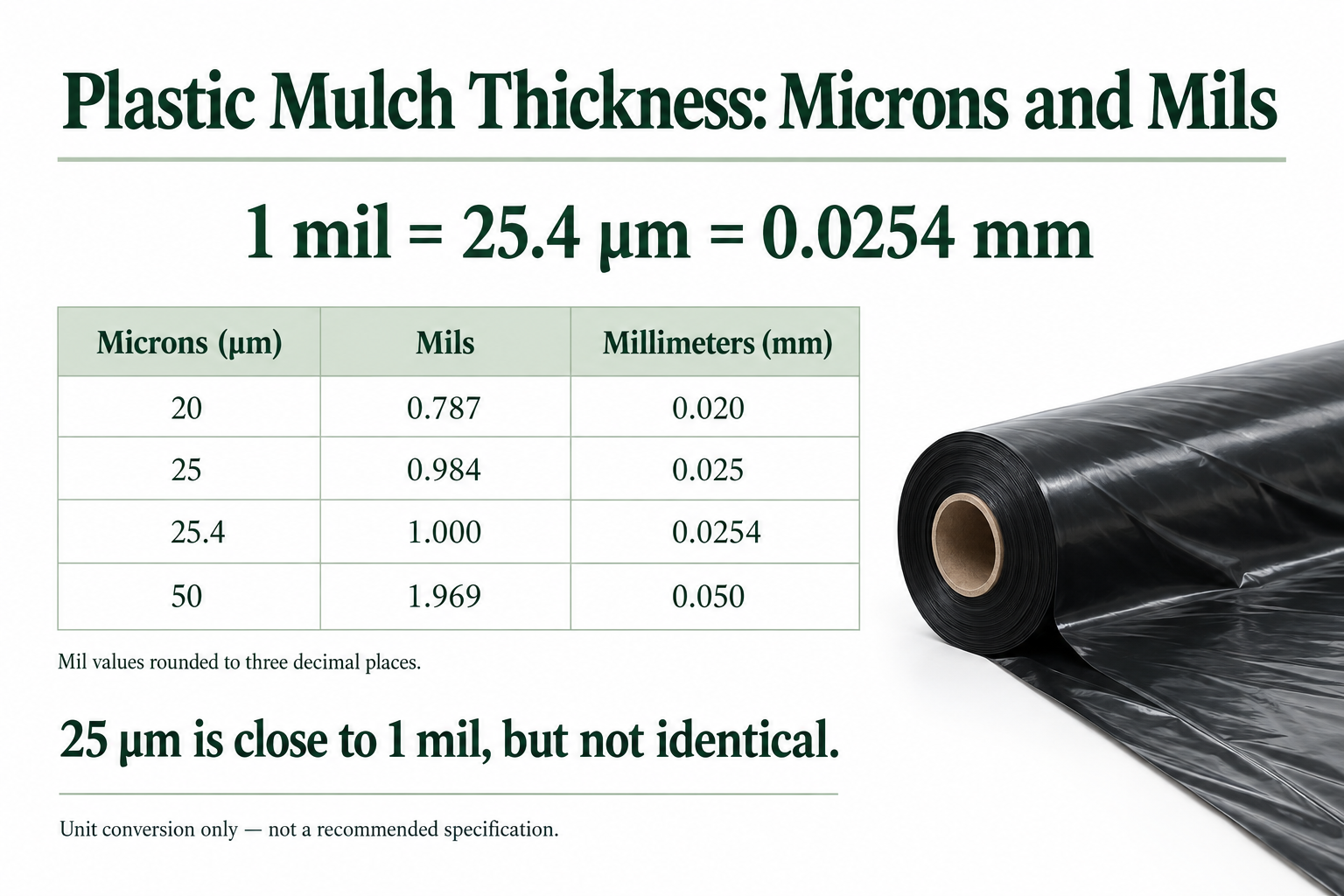
A micron is a micrometer, written as µm. A mil is one thousandth of an inch. NIST's conversion tables define 1 mil as exactly 25.4 µm, or 0.0254 mm.
- Mils to microns: multiply by 25.4.
- Microns to mils: divide by 25.4.
- Microns to millimeters: divide by 1,000.
Scroll the table sideways on a small screen if needed. These are unit conversions, not recommended grades or a stock list.
| Microns (µm) | Mils, rounded | Millimeters (mm) |
|---|---|---|
| 10 | 0.394 | 0.010 |
| 15 | 0.591 | 0.015 |
| 20 | 0.787 | 0.020 |
| 25 | 0.984 | 0.025 |
| 25.4 | 1.000 | 0.0254 |
| 30 | 1.181 | 0.030 |
| 40 | 1.575 | 0.040 |
| 50 | 1.969 | 0.050 |
25 microns and 1 mil are close, but not identical. If a purchase order requires 1 mil, specify 25.4 µm and an agreed tolerance rather than silently substituting 25 µm. If a supplier uses “gauge,” ask for the equivalent in microns on the same document.
What thickness should you consider for mulch film?
There is no single thickness that covers every material and growing system. NC State Extension's commercial vegetable guide lists LDPE mulch examples at 0.75–1.25 mil and HDPE examples at 0.50–1.0 mil. These are examples within that guide, not universal minimums or recommendations for every field.
The useful starting point is the specification of a film that already works in your operation. If there is no established reference, ask the supplier to propose a candidate grade for the stated conditions and explain the basis for the choice.
Do not approve “heavy duty” as a substitute for a measurable specification. Equally, do not reject a thinner candidate solely because its micron number is smaller: require comparable product information and evaluate it against the same application requirements.
Review five conditions before choosing a thickness
1. Required field duration
State the planned laying date, planting date and removal date. If the film must remain through a second crop, include that explicitly. A supplier cannot reliably interpret “one season” without knowing the calendar and location.
2. Bed preparation and puncture risks
NC State identifies sharp stones, sticks and poor bed preparation as problems for film installation. Do not treat a thicker roll as a substitute for preparing the bed properly. Describe any known failure points and provide photographs of the field rather than only an image of the torn film.
3. Manual or mechanical laying
Give the laying method and, for machine application, the equipment details available to you. Ask for the candidate film's installation guidance. If tearing occurs, record where it starts, whether it repeats across rolls and what settings were used before deciding that thickness is the cause.
4. Material and construction
Compare like with like: ask whether quotations refer to the same material family, layer structure and surface finish. Tamil Nadu Agricultural University's mulching guide discusses thickness alongside longevity and mechanical weakness in thin films. It is useful background, not proof of the performance of a particular modern formulation.
5. Exposure and end-of-use requirements
Describe the installation location and intended use period. Ask the supplier to identify the exposure assumptions behind the offered grade and to provide the relevant handling and end-of-use instructions. Conventional PE film and soil-biodegradable film should not be treated as interchangeable simply because their thicknesses match. For material-selection and end-of-use differences, see our biodegradable vs PE mulch film comparison.
Nominal thickness is not the same as an acceptance limit
A quotation that says “25 µm” leaves an important question unanswered: what variation is acceptable, and how will it be checked? Ask the supplier to distinguish the target thickness from any limits applying to individual readings or the average.
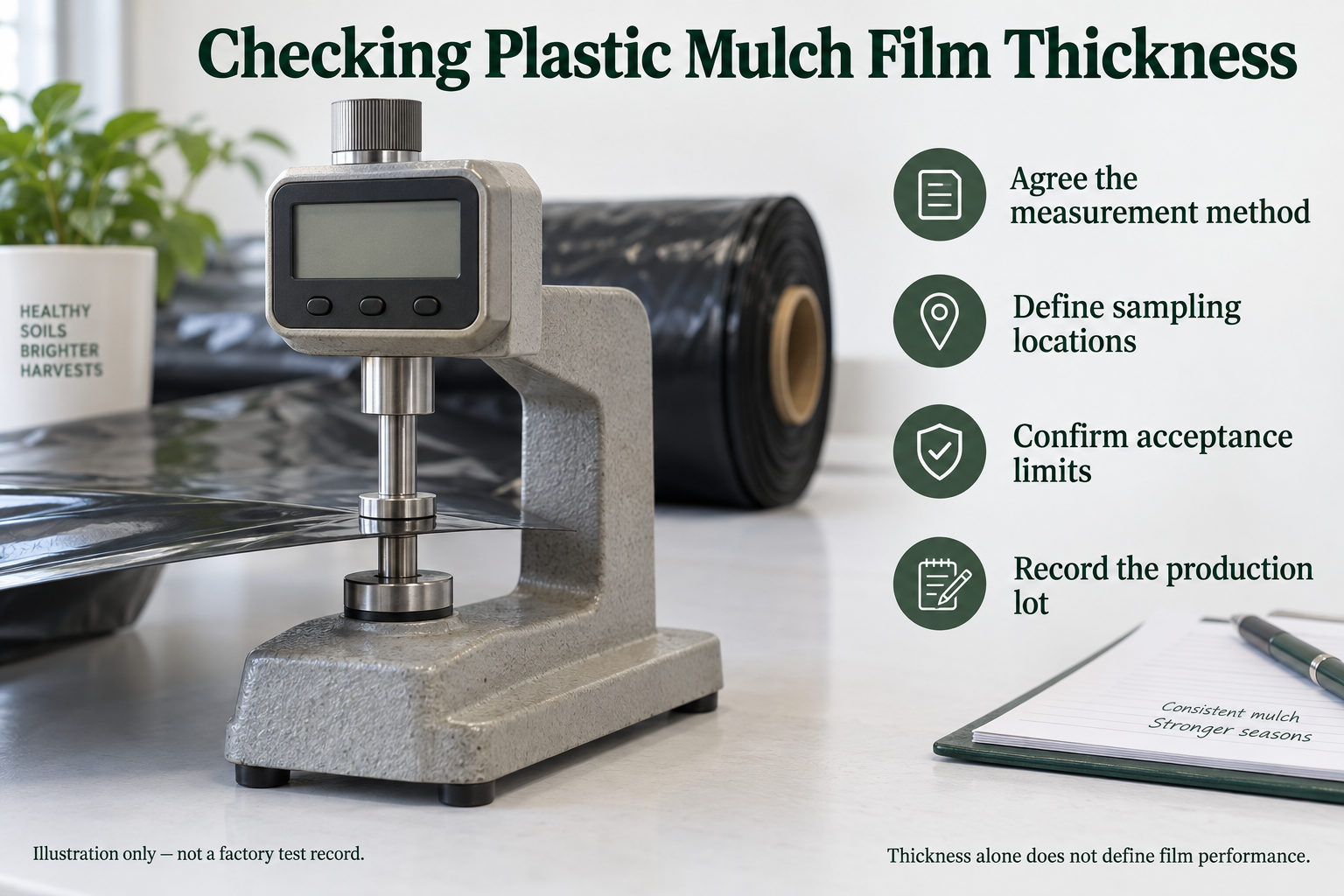
The following is a purchasing checklist, not a prescribed testing standard:
- Measurement method: agree the applicable procedure, equipment and sample preparation.
- Sampling: define which rolls and positions are checked.
- Reported result: specify whether the record includes individual measurements, an average, or both.
- Acceptance rule: state the agreed limits and how nonconforming results are handled.
- Traceability: connect the inspection record with the supplied lot and approved specification.
A simple tolerance example
If two parties explicitly agree a nominal thickness of 25 µm with a ±10% band, the arithmetic limits are 22.5–27.5 µm. This is an illustrative calculation only: ±10% is not presented here as a legal requirement, industry-wide tolerance or our factory's default. The contract must also say which measurement result the band applies to.
For multilayer film, clarify whether the quoted number refers to the total finished film. Do not assume that a total thickness figure describes the thickness of each layer.
Compare thickness and price on the same basis
Before ranking quotations by price, put their units, dimensions and commercial terms in one comparison sheet. A lower price per roll may refer to a shorter or narrower roll, a different construction, or different packing.
- Convert all thickness values to the same unit.
- Confirm finished film width and usable roll length.
- Check whether stated weight is net film weight or includes the core and wrapping.
- Compare the offered tolerances and supporting inspection information.
- Confirm that currency, delivery terms, quantity and packing are comparable.
For bed-width measurement and complete-strip cutting calculations, see our plastic mulch roll sizes guide before comparing the quantity supplied in each quotation.
Example: roll price versus material area
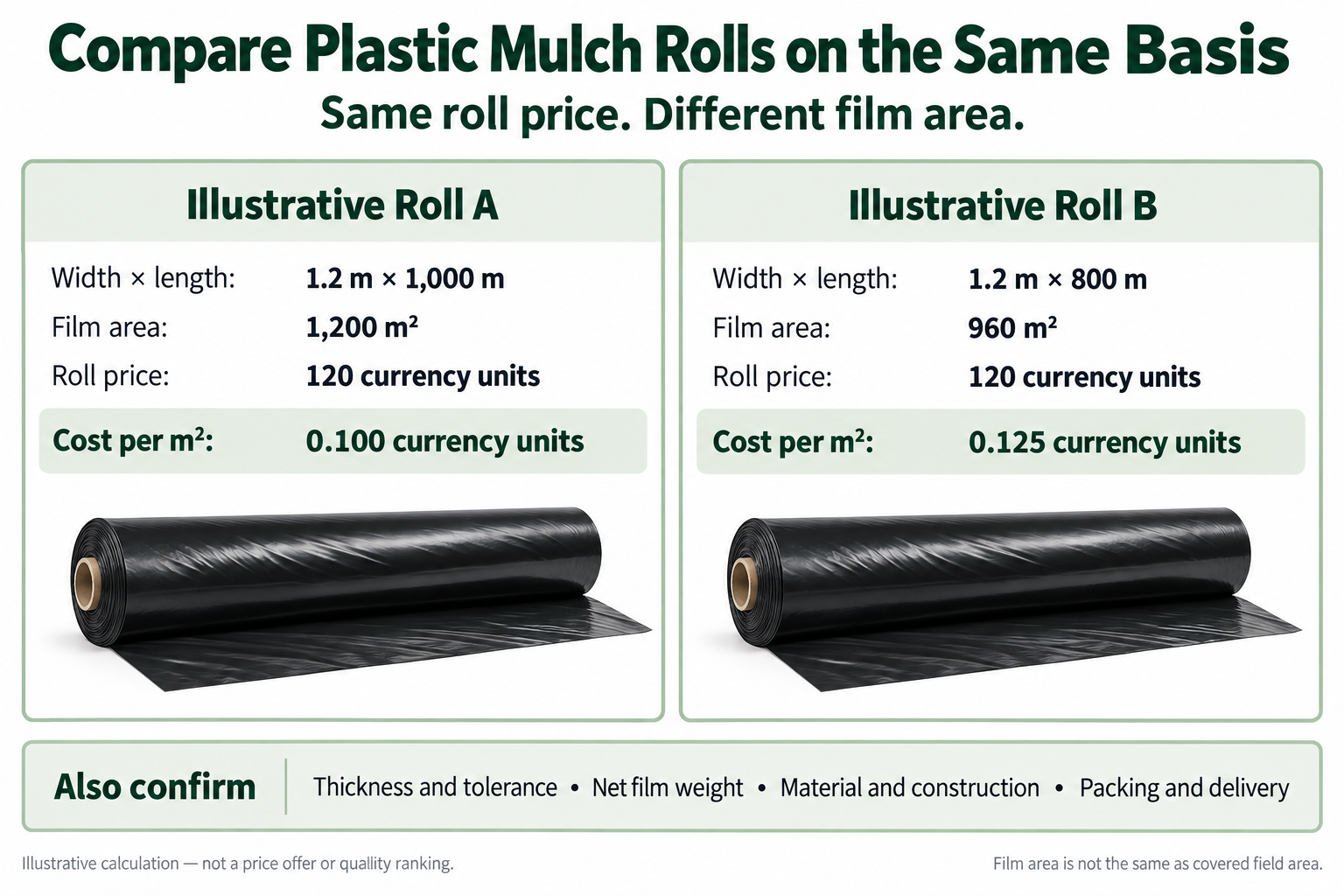
For an illustrative unperforated roll, 1.2 m width × 1,000 m length equals 1,200 m² of film. If the roll costs 120 currency units, its material price is 0.10 per m². At the same width and price, an 800 m roll contains 960 m² and costs 0.125 per m².
That comparison does not establish which film is better. It only prevents unequal roll lengths from hiding inside a price comparison. Material area is also not the same as planted land area; bed layout and buried edges require a separate calculation. To estimate field requirements from production area and bed-center spacing, use our plastic mulch per acre quantity and cost guide.
Keep color selection separate from thickness acceptance. Use our plastic mulch color comparison to review the field objective, then check the mulch film range for the intended construction and request comparable thickness and roll information.
Send a useful inquiry even if the thickness is undecided
Suggested inquiry:
We need mulch film for [crop] in [country/region]. It will be laid in [month] and needs to remain until [month]. Installation is [manual / machine, with details if known]. Our main concern is [describe the problem].
The proposed film structure is [known type / undecided]. Our current thickness is [value and unit / unknown]. Please propose a suitable grade and state the nominal thickness, tolerance, inspection method and relevant supporting information.
Required width, roll length and quantity are [details / not yet confirmed]. Please identify any missing information needed before a final quotation.
Send your mulch film requirements. You can begin with the crop, location and laying method; identify unknown specifications rather than guessing them.
Frequently asked questions
Is 1 mil the same as 1 mm?
No. One mil is 0.0254 mm, or 25.4 microns. One millimeter is 1,000 microns. Check the written unit whenever a quotation uses an abbreviated thickness description.
Is 25-micron mulch film suitable for every vegetable crop?
No. A thickness value alone does not specify a complete grade. Provide the field duration, material requirement, installation method and relevant field conditions before choosing it.
Will a thicker mulch film always last longer?
Do not infer a guaranteed service life from thickness alone. Request the offered grade's intended application and exposure conditions, and distinguish product information from a contractual warranty.
Can I verify thickness from the roll's total weight?
Total weight alone cannot isolate film thickness: it also includes the effects of dimensions, material and any core or wrapping. Use the agreed inspection method for acceptance rather than treating gross weight as a direct thickness measurement.
Should I buy the lowest price per kilogram?
Only compare that figure alongside the approved film specification and the quantity of usable material supplied. Ask for the same pricing basis across quotations before assessing the total order cost.
References and further reading
- NIST Handbook 133, Appendix E: General Tables of Units of Measurement, 2025. Source for the exact mil-to-micrometer conversion.
- Torres Quezada, E., and da Silva, A. — Plasticulture for Commercial Vegetables. NC State Extension, 2025. Background on film types, example specifications and bed preparation.
- Mulching for Crop Production. Tamil Nadu Agricultural University Agritech Portal, PDF. Background on thickness, longevity and other selection parameters.
Extension examples do not establish our available grades, local regulatory compliance or a warranty. The calculations in this article are clearly identified examples; final specifications and acceptance criteria must be agreed for the order.