
Plastic Mulch for Strawberries: Planting Season, Bed Layout and Film Selection
Plastic mulch for strawberries should match the production system, planting season and bed layout—not simply carry a “strawberry film” label. Start with the field problem, then turn the crop plan into an agreed film specification.
The short answer: plastic bed mulch helps separate fruit from soil, conserve soil moisture and modify soil temperature. Opaque films can also suppress many weeds. However, film does not solve poor drainage, eliminate every weed or replace winter plant protection. Color, planting holes and required field coverage period must suit the actual crop plan.
This guide is for growers, farm suppliers and distributors choosing strawberry mulch film for soil-grown beds. It explains the benefits and limitations first, then the dimensions, hole pattern and quotation details needed to avoid an unsuitable order.
Start with the strawberry production system
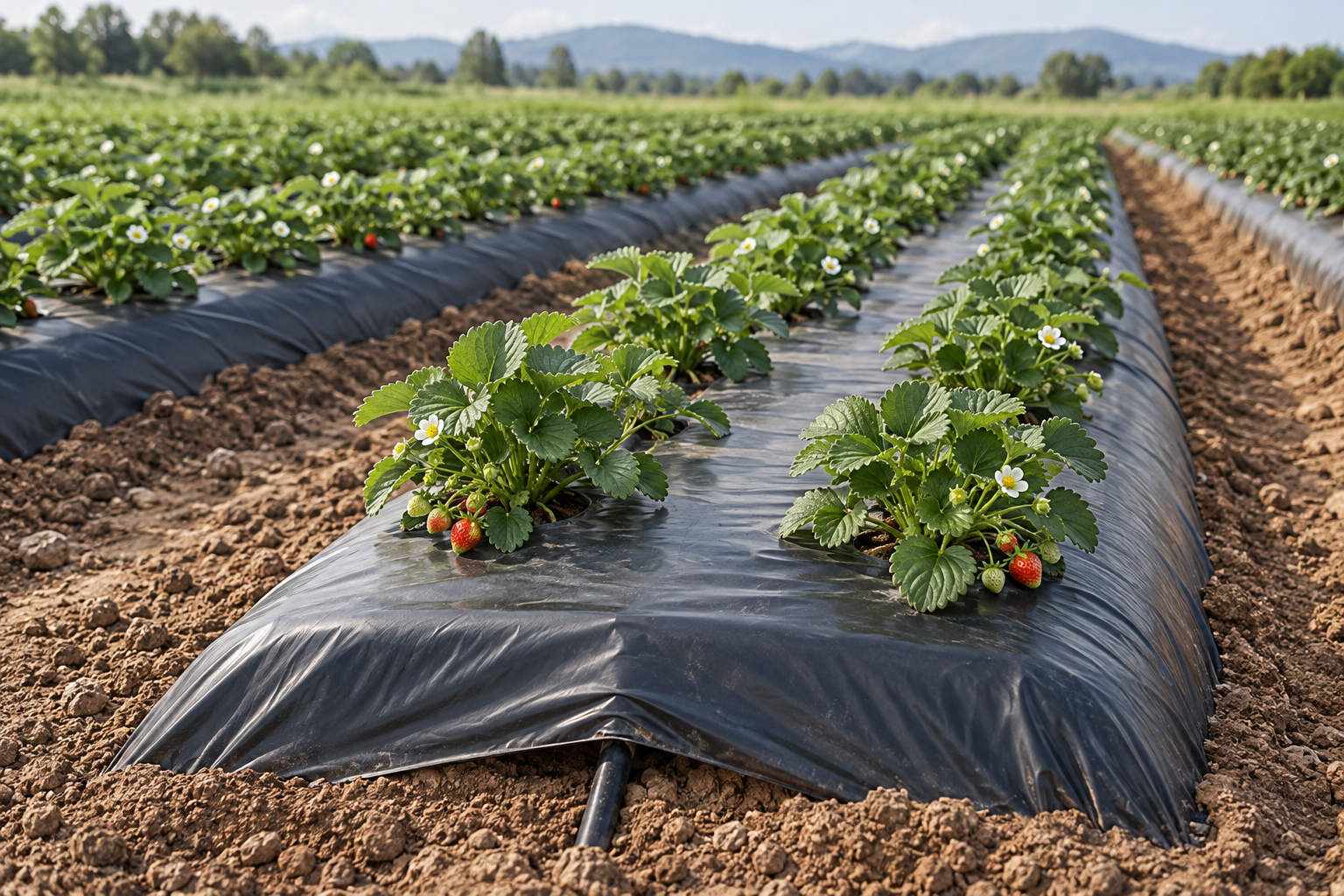
Annual raised-bed plasticulture places plants in a planned layout for the crop cycle. Perennial matted-row production allows runners and daughter plants to renew the planting. A continuous sheet with fixed openings fits these systems differently.
In Minnesota guidance, matted rows are generally managed without plastic so daughter plants can root, while day-neutral systems use plastic-covered beds. This is a regional comparison—not a rule that every June-bearing strawberry must be grown without film.
| Production example | Published regional layout | Purchasing implication |
|---|---|---|
| Southeastern US annual hill plasticulture | Autumn establishment, commonly two staggered rows with 12–16 in (about 30–41 cm) between plants within each row. | Confirm the local cultivar, planting window and selected layout before ordering holes. |
| Minnesota day-neutral production | A spring-planted two-row option with 8–12 in (about 20–30 cm) between rows and between plants within each row. | Review summer temperature needs alongside the chosen plant arrangement. |
| Minnesota perennial matted rows | Daughter plants root to renew the planting; continuous plastic bed mulch is generally not used. | Check whether fixed openings are compatible with runner management at all. |
These examples follow the Southern Regional production guide and University of Minnesota Extension guidance listed under References. Do not change planting density merely to fit an available roll.
Bed mulch is not winter plant protection
Bed film covers soil, with plants growing through openings. Winter straw covers dormant plants, while floating row covers serve separate crop-protection purposes. Plastic on the bed does not automatically replace a locally appropriate winter or frost-protection plan. Minnesota's straw guidance addresses when to apply and remove that protective cover.
What are the practical drawbacks?
Film adds material, installation and end-of-use work. The wrong color can conflict with temperature needs; unsuitable openings complicate transplanting; and conventional PE must be retrieved rather than tilled into the soil. Budget for the complete operation, not only the roll purchase. The color evidence and disposal considerations below explain these tradeoffs.
Choose mulch color for the planting window
Record the location, planting month, open-field or tunnel setting, and intended removal date. Evaluate establishment conditions and the later crop together: a film selected to limit heat during transplanting may not address the same need as a warming film during cooler weather.
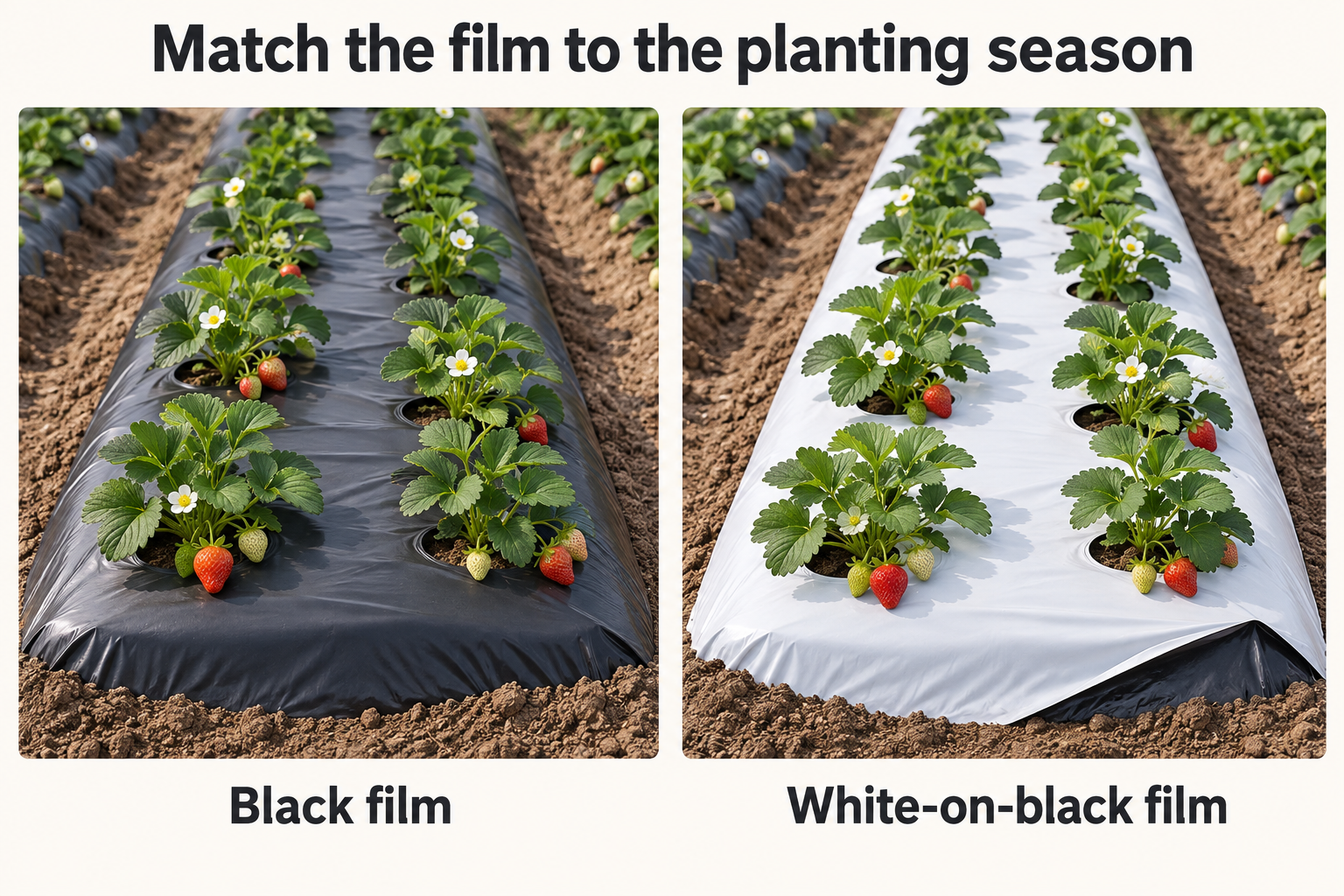
Black versus white-on-black
Black film is established in Southeastern annual hill production. White-on-black is an option discussed favorably in Minnesota day-neutral guidance. Neither regional recommendation establishes the best color for all strawberry systems. With white-on-black, the white surface faces upward and the black layer faces the soil.
A useful research example: Purdue compared black and white-on-black mulch across 15 cultivars at two Indiana locations, with September 2022 planting and two harvest seasons. Cumulative yield favored black at Lafayette (1.16 versus 0.84 lb per plant), but was similar at Vincennes (1.60 on black versus 1.63 lb per plant on white-on-black). At Vincennes, the annual direction also reversed between seasons. Frost affected the first harvest, and site and seasonal conditions mattered. These are trial results—not a yield, profit or film-lifetime guarantee for another farm or a TIAN FENG product.
Reflective films: identify the actual construction
UF/IFAS discusses reflective surfaces for reducing heat during hot Florida transplant establishment, including white-on-black, metalized-on-black and metalized-striped films. The complete growing season still matters.
Silver-pigmented coextruded PE is not aluminum-metallized film. TIAN FENG's silver-black film uses silver-pigmented coextruded PE. Results from a metallized-film trial cannot establish its cooling or pest-management performance merely because both surfaces appear reflective.
Clear film and weed-control limits
UC IPM describes clear film in some California systems, but clear and translucent film do not control weeds. Even opaque mulch is not a complete barrier: yellow nutsedge can penetrate it, and weeds can grow at planting holes. Coordinate film selection with local temperature conditions and the weed-management program.
Use our plastic mulch color guide for the broader comparison and our reflective mulch guide for construction differences. Before changing the whole farm, compare a small area while keeping cultivar, planting date and management as consistent as practical.
Translate the bed plan into finished film dimensions
Bed-top width is not film width. The film must follow the bed shoulders and provide enough material for the chosen edge-fixing method. Send a labeled bed profile showing the top, height, side slopes and fixing arrangement, then confirm the finished width for the actual laying method.
On a small screen, scroll sideways to view all columns.
| Field information | Film-order requirement | What to verify |
|---|---|---|
| Bed profile and edge fixing | Finished film width and tolerance. | Shoulder coverage and anchoring margins on the formed bed. |
| Plant rows and positions | Plain film or an approved hole drawing. | Across-bed spacing, longitudinal spacing, staggering and reference points. |
| Laying equipment | Roll dimensions, core, maximum outside diameter, weight and winding. | Compatibility with the machine or manual handling method. |
| Covered bed lengths | Roll lengths, cutting plan and quantity. | Allowances, usable offcuts and suitable stock already held. |
| Laying and removal dates | Required coverage period and exposure assumptions. | The proposed film's supporting information for that use. |
Keep bed-center spacing separate from plant-row spacing. One describes field layout; the other locates plants on a bed. Avoid the unqualified word “spacing” on a purchase order.
Estimate film from covered bed lengths, not total farm acreage alone. Our mulch roll size and ordering guide explains the dimension conventions and cutting-plan checks.
Pre-punched strawberry film or holes made in the field?
Pre-punched film is worth discussing when the planting layout is settled and can be aligned during laying. Plain film leaves opening positions to the planting operation. Compare both approaches against the transplant type, equipment and labor plan—not the crop name alone.
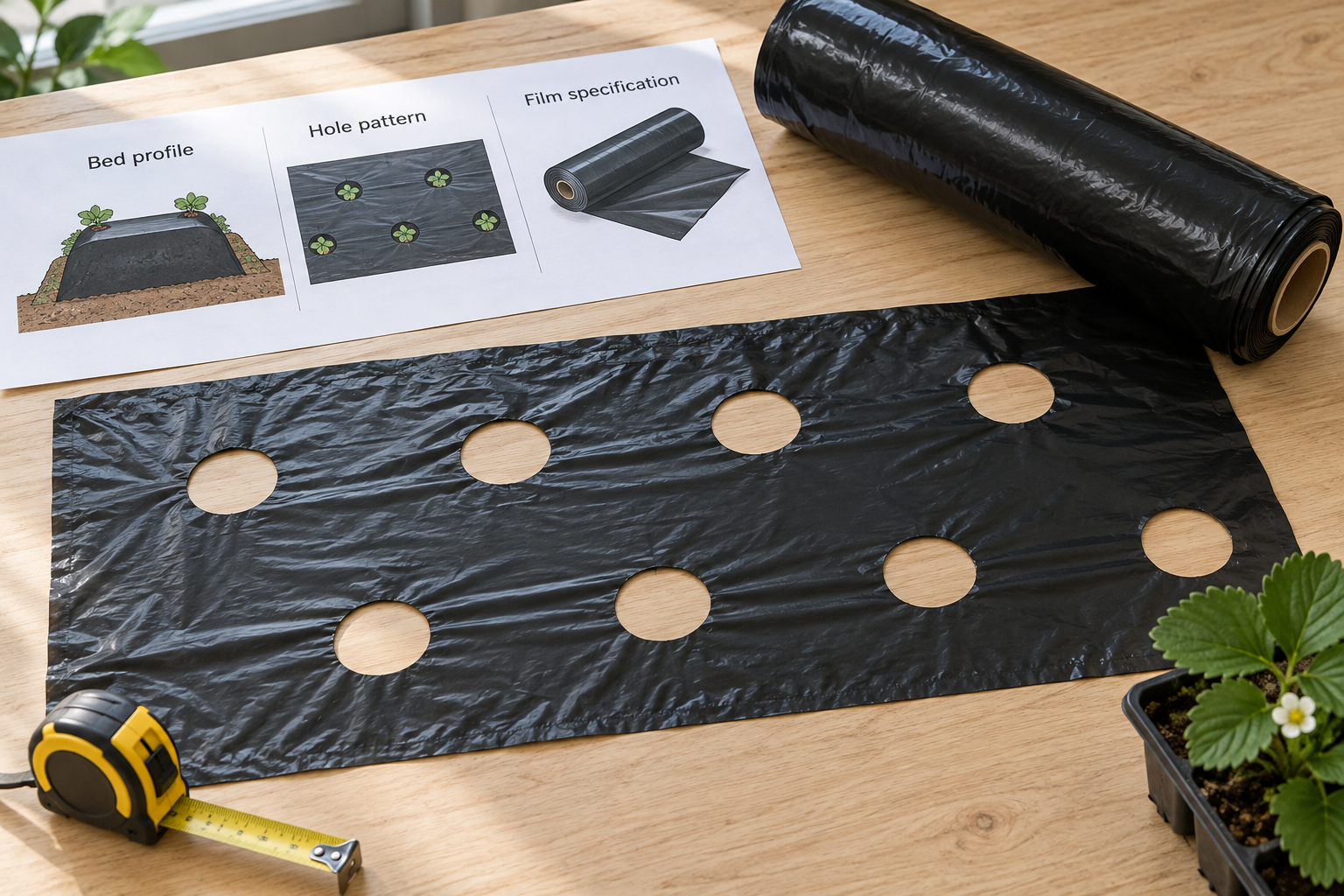
For a custom pre-punched roll, submit a drawing specifying:
- Number of planting rows and the reference film edge or centerline.
- Distance between row centerlines across the film.
- Longitudinal distance between holes within each row.
- Aligned or staggered rows, with the required offset stated separately.
- Hole shape, dimensions, first-hole position and unpunched end sections.
- Repeat pattern, tolerances, drawing revision and roll-laying direction.
Ask the supplier to confirm feasibility for the selected film and order quantity. An illustrated hole pattern does not prove that the pattern is stocked or that every custom dimension is available.
Approve the laid result as well as the flat drawing: the film follows a shaped bed and is tensioned during installation. Trial the planting team's access and alignment. Keep the irrigation route identified before cutting field openings so the operation does not damage the drip line.
Specify thickness and the required field coverage period
No single thickness is a universal strawberry specification. Ask the supplier to review the material, thickness and tolerance against the laying method, bed surface, handling, exposure period and planned removal.
An autumn-planted crop may retain film through autumn, winter and spring. Conversely, a thicker sheet alone does not establish a multi-year service life. State installation and removal dates, then request the product information supporting the proposed grade for those conditions.
- State thickness in an explicit unit and agree measurement and acceptance methods.
- Identify the film construction and the surface that faces upward.
- Request relevant durability information separately from the nominal thickness.
- Confirm roll identification, packing and storage instructions.
See our plastic mulch thickness guide for microns, mils and measurement conventions. A competitor's thickness or service-life label is not evidence that another film will perform identically.
Check a trial section before planting the full block
A trial section can expose a mismatch between the order, formed bed and planting operation before it is repeated across the field.
- Match the roll to the approved specification: identification, width, thickness information, surface orientation and hole drawing.
- Lay it on the intended bed: inspect shoulder coverage, edge fixing, damage and the result at the selected equipment settings.
- Test irrigation: check for leaks and confirm its relationship to the planting layout before covering the full block.
- Trial transplanting: confirm access and positioning without unnecessary tearing. Follow local crop guidance for planting depth.
- Resolve discrepancies: photograph them, identify the roll or batch, and agree any drawing, equipment or specification revision.
Film does not correct poor drainage. Establishment water requirements also depend on transplant type and local conditions; installing drip tape does not establish that every establishment or frost-protection requirement has been met.
Use our plastic mulch installation guide alongside equipment instructions and the regional crop plan. A successful fit check is not a yield trial or proof of long-term durability.
Plan removal or a verified biodegradable option
Conventional PE needs retrieval and an appropriate waste or recycling route. Confirm local acceptance: soil and crop residues complicate recycling. Do not incorporate standard PE into soil.
For soil-biodegradable film, request product identity, supporting evidence and end-of-use instructions. As UC ANR explains, breakdown depends on material and conditions. Confirm organic eligibility with the relevant certifier where applicable.
An “eco” label or industrial-composting claim does not establish soil-biodegradation suitability. Our biodegradable versus PE mulch guide explains the distinction.
Request a quotation you can compare and approve
If a value is unknown, write “to be confirmed.” Do not borrow spacing or thickness from another farm just to complete the inquiry.
Copy-ready strawberry mulch inquiry
We need film for soil-grown strawberries in [country/region], using [production system, cultivar and transplant type if known]. Film laying is planned for [date], planting for [date], and removal or approved end-of-use management for [date]. The crop will [overwinter / finish before winter].
Our main concern is [temperature, weeds or other]. Proposed material and color are [details / advice requested]. We can provide [bed profile, planting layout and equipment details]. We require [plain film / a hole pattern for feasibility review].
Known dimensions are [finished width, thickness with units, roll length]. Quantity is [rolls or other clearly defined unit], with delivery to [destination] by [arrival date]. Please separate confirmed specifications from assumptions and identify information needed before approval.
Confirm these commercial details
- Price basis: currency and price per roll, square meter or weight. For weight-based offers, identify net film weight separately from cores and packing.
- Like-for-like specification: material, color construction, dimensions, tolerances, perforation and required documentation.
- Minimum quantity: MOQ for each specification or hole pattern, not only the total mixed shipment.
- Timing: sample review, production lead time and transit time separately; confirm what starts the production clock.
- Delivery scope: destination and agreed delivery term, included charges, packing and quote validity.
- Approval and acceptance: agreed drawing revision, sample or trial requirements, inspection method and acceptance limits before production.
There is no useful universal “cost per strawberry mulch roll” without its dimensions and specification. Compare equivalent film quantities and delivery scope, then budget installation, planting and end-of-use work separately. A cheaper roll can simply contain less film.
Review your film requirements with TIAN FENG
Explore our plastic mulch film range or black mulch film product page. Send the bed drawing and crop-cycle information so available options and custom-hole feasibility can be reviewed.
Final specifications, minimum quantity and delivery timing need order-specific confirmation. The film quotation does not replace local decisions about cultivar, irrigation, planting density or frost protection.
Send your strawberry mulch requirementsPlastic mulch for strawberries FAQ
Why is plastic mulch used for strawberries?
It helps keep fruit away from soil, conserve soil moisture and modify soil temperature. Opaque film can suppress many weeds, but those benefits depend on film type and the production system. It is bed management, not a complete crop-protection program.
Is black plastic always the best mulch for strawberries?
No. Temperature needs change by location and season. Purdue's two-location comparison produced different cumulative yield results, illustrating why black versus white-on-black should be evaluated in the intended growing system.
What are the downsides of plastic mulch?
Costs extend beyond the film to laying, planting and end-of-use management. Incorrect color or hole layout can create operational problems. Conventional PE also needs retrieval; it is not a soil-biodegradable material.
Can plastic mulch replace winter straw or row covers?
Do not assume so. Bed film covers the soil, while winter straw and row covers have separate plant-protection roles. Retain the locally appropriate frost and winter-management plan.
What planting-hole spacing should I order?
Use the approved layout for the region, cultivar and production system. Specify row centerlines, within-row spacing, staggering, hole size and reference positions. The regional examples in this guide are not universal manufacturing dimensions.
Does strawberry mulch film always come pre-punched?
No. Confirm whether the offer is plain or perforated. A crop name or product photograph does not establish the supplied hole pattern. Custom perforation needs feasibility review and an approved drawing.
How much does strawberry mulch film cost?
Request a quote for the actual material, width, thickness, roll length, hole pattern and quantity. Compare the same price unit and delivery scope. Published short-roll retail prices are not a reliable substitute for a custom bulk quotation.
Can the same film be used under a strawberry tunnel?
Include the tunnel, production season and exposure in the specification review rather than assuming an open-field choice transfers unchanged. Bed mulch and the tunnel's cover are separate products with different functions.
References
Regional guidance and research findings support the distinctions above. They are not TIAN FENG product specifications, certifications or performance guarantees.
- University of California Statewide IPM Program. Field Preparation: Strawberry. UC IPM Pest Management Guidelines. Text updated July 2023.
- Klodd, A. Choosing a strawberry production system. University of Minnesota Extension. Reviewed 2021.
- Hoffmann, M., et al. Southern Regional Strawberry Plasticulture Production Guide. Second edition, 2024. NC State and partner Extension institutions.
- Wimmer, M., Klodd, A., Tepe, E., and Hoover, E. Day-neutral strawberries. University of Minnesota Extension. Reviewed 2024.
- Klodd, A., Hoover, E., and Tepe, E. Adding and removing straw mulch for strawberries. University of Minnesota Extension. Reviewed 2021.
- Guan, W., Meyers, S., and Arana, J. Performance of Strawberries on Black vs. White Plastic Mulches in Indiana. Purdue University, Facts for Fancy Fruit. May 16, 2025.
- Torres-Quezada, E. A., Zotarelli, L., Whitaker, V. M., and Agehara, S. Methods for Strawberry Transplant Establishment in Florida. UF/IFAS Extension, HS1376. Published November 2020; reviewed October 2023.
- Singh, M. Biodegradable Plastic Mulch: Is it Right for your Farm? University of California Agriculture and Natural Resources. September 28, 2025.