
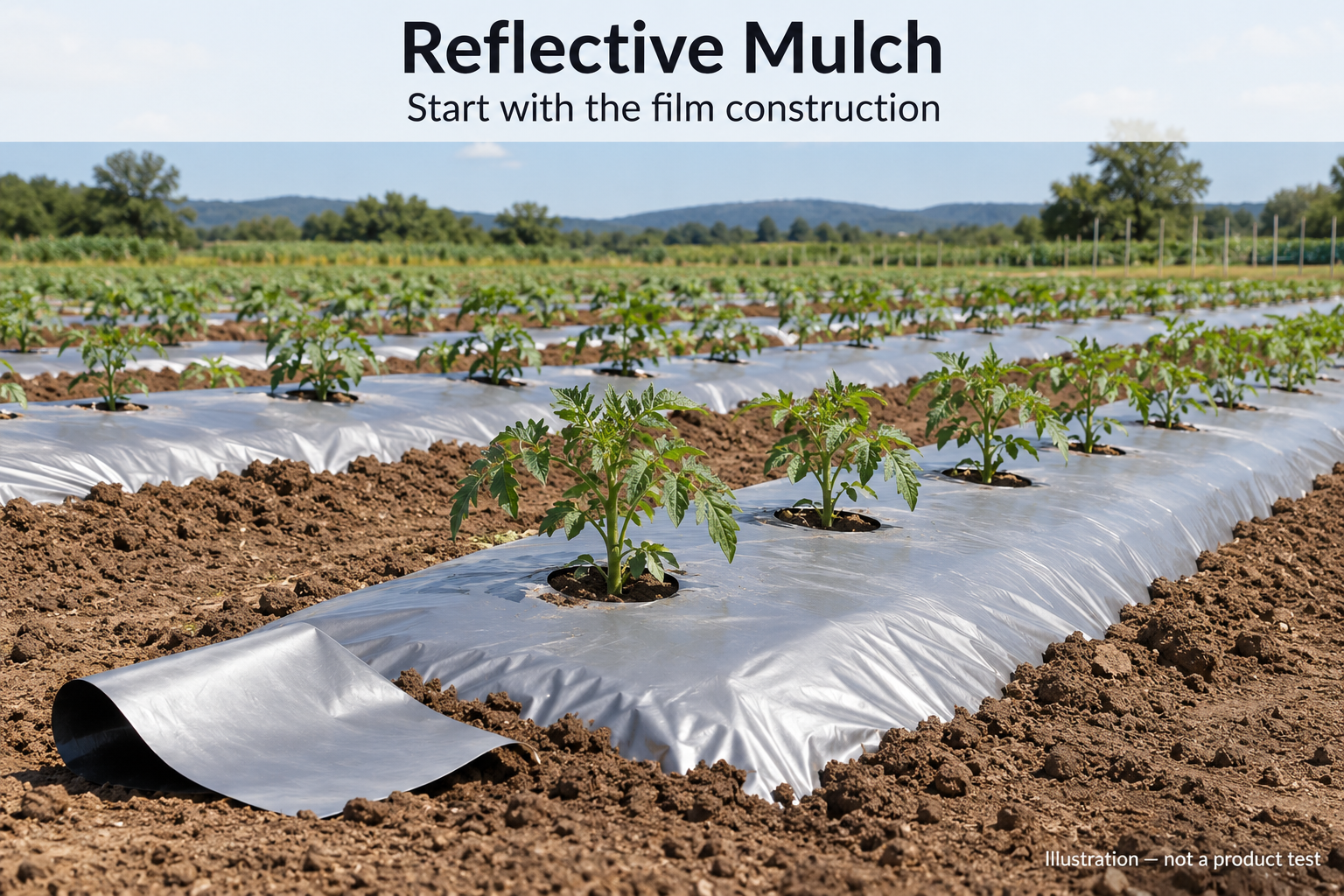
Reflective Mulch: Benefits, Limitations and Film Selection
Reflective mulch can be useful in a crop-management plan, but a silver surface does not tell you everything about the film. Before choosing a roll, establish how it is made, what evidence supports its intended use and whether the specification fits your field.
This guide is for commercial growers, distributors and buyers comparing silver-faced plastic mulch. It separates published research from supplier claims and explains what to check before a sample trial or bulk order.
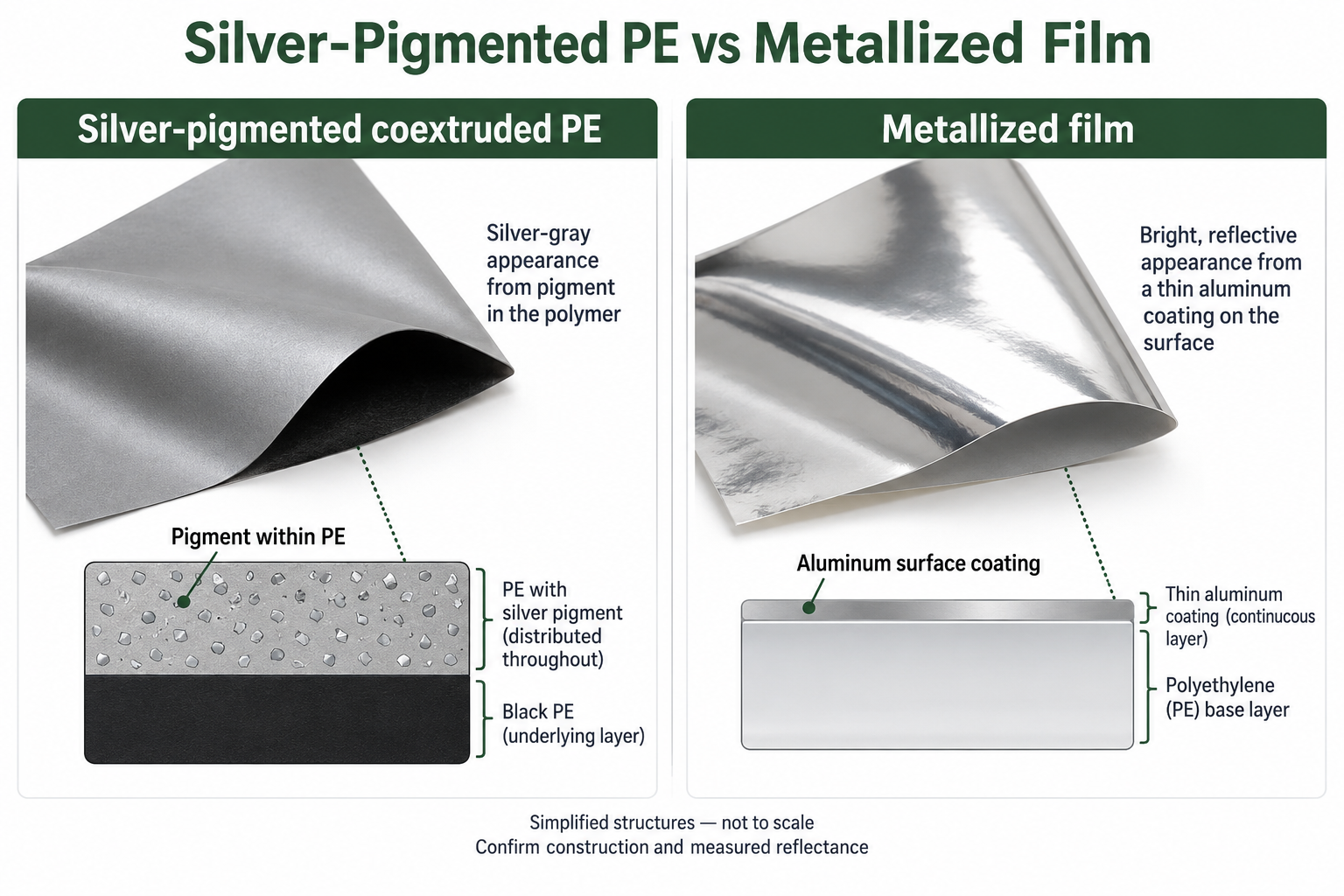
The short answer: reflective mulch redirects light from the bed surface. The University of California Statewide IPM Program describes how reflective mulches can help deter certain insect pests, particularly early in crop growth. Results depend on the material, pest and growing conditions. Silver-pigmented coextruded PE and aluminum-metallized film are different constructions; one product's trial results do not establish another product's performance.
First, identify what “silver reflective mulch” means
Do not order by color alone. A quotation for silver reflective mulch should identify the construction and the proposed grade. Ask whether the silver appearance comes from pigment within the polymer or a metallic surface coating.
On a small screen, scroll the table sideways to view all columns.
| Construction | What to establish | What not to assume |
|---|---|---|
| Silver-pigmented coextruded PE | A silver-pigmented polyethylene construction; confirm the layers, underside and intended installation face. | A silver appearance is not a measurement of UV reflectance or pest-control performance. |
| Metallized film | A polymer film with a deposited metallic surface, such as aluminum; confirm the coating and base film. | Results from this construction do not automatically apply to a pigmented PE film. |
University of Georgia project notes on reflective mulch distinguish historical pigmented or painted silver mulches from later metallized materials, with different results in tomato spotted wilt trials. These observations concern the tested materials, not every modern silver film. They demonstrate why construction and grade matter.
Our product distinction: TIAN FENG's black-silver mulch film is silver-pigmented coextruded PE, not an aluminum-metallized film. Request information for the proposed grade; do not treat the external studies in this guide as tests of our product.
Which side faces upward?
For a specified silver-on-black mulch, the silver face is normally exposed and the black face is placed toward the soil. Confirm winding and installation instructions before laying a roll. A black underside is intended to limit light transmission, but color alone does not establish the finished film's opacity. For a broader color comparison, see our plastic mulch color guide.
What does the evidence say about pests and yield?
Whiteflies and aphids: use the evidence in context
UC IPM’s whitefly management guidance describes reflective mulches as a way to help deter whiteflies and aphids, including protection of young plants. That is support for a management approach—not proof that every silver-colored roll will produce the same result. It is also not a treatment that cures plants already infected with an insect-transmitted virus.
For a project aimed at a particular pest, ask for evidence naming that pest, the crop, the film grade and the comparison treatment. A result against one species should not become a promise against another.
Thrips in tomatoes: distinguish higher averages from proven differences
A 2023 Florida tomato study by Khan and colleagues compared mulches within an insecticide experiment. Selected results from Tables 3–4 follow.
On a small screen, scroll the table sideways to view all columns.
| Measure | Silver-on-black | Black | Pairwise interpretation |
|---|---|---|---|
| 2018 adult thrips per 10 flowers | 2.07 | 5.03 | Significantly fewer with silver-on-black. |
| 2019 adult thrips per 10 flowers | 1.69 | 2.52 | No significant difference. |
| 2018 marketable fruit weight, kg per 4 plants | 6.22 | 4.25 | No significant difference. |
| 2019 marketable fruit weight, kg per 4 plants | 5.84 | 4.25 | No significant difference. |
Original Tukey groups determine significance at 5%. Means pool insecticide treatments; this was not a pesticide-free comparison or a test of TIAN FENG film.
Higher averages alone do not prove a yield advantage.
“Reflective” does not mean effective against every pest
A SARE project report from Virginia found no difference in squash-bug adult or egg-mass numbers among white, black and reflective plastic mulch treatments. All three had more adults and egg masses than bare-ground plots. The result concerns that pest and trial system, but it is an important counterexample to an “all insects” claim.
Check the planting window, exposed surface and temperature goal
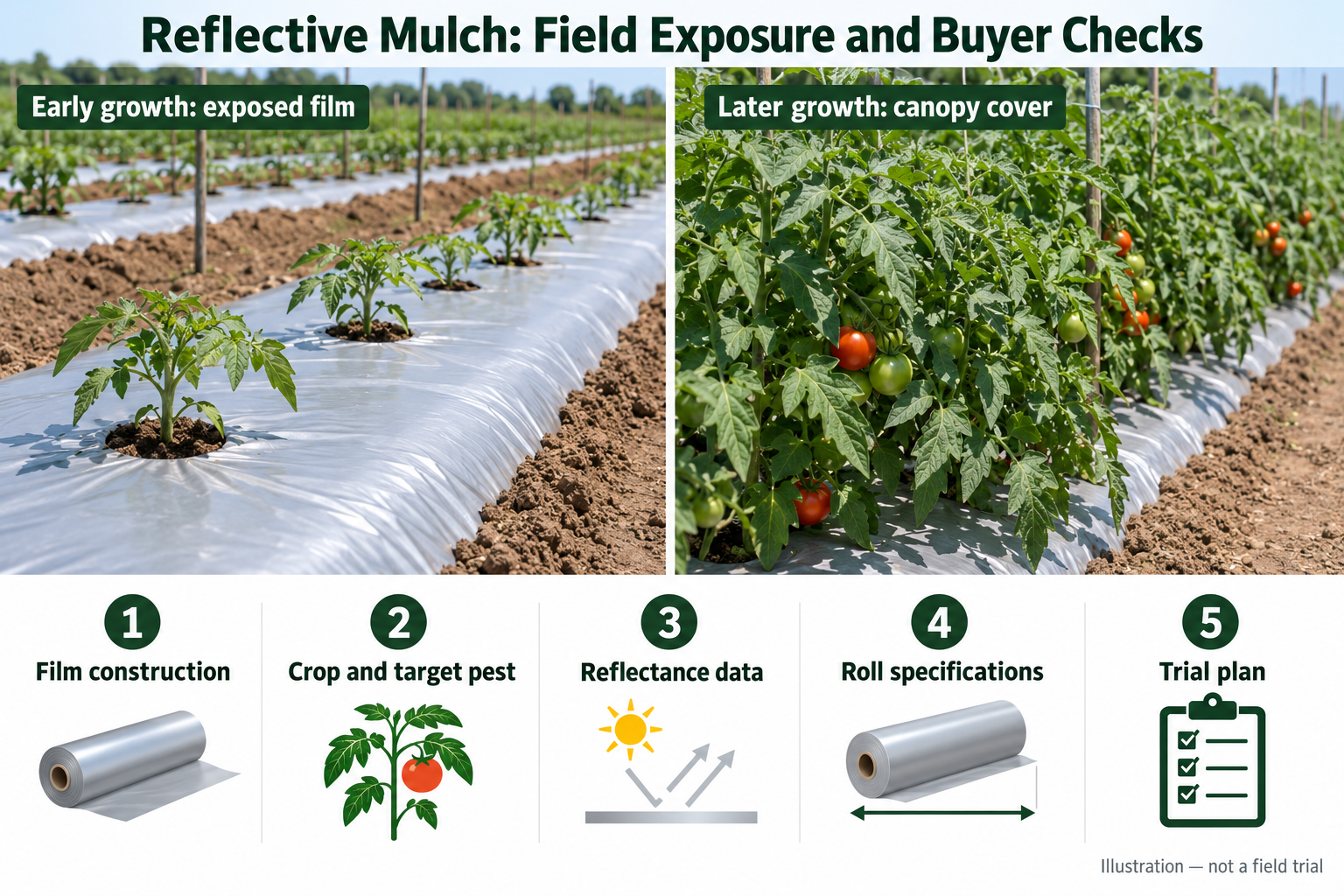
- Crop stage: as foliage covers the bed, less reflective surface remains exposed, as discussed in UC IPM’s reflective mulch guidance. Do not assume an early-season effect will persist unchanged through harvest.
- Surface condition: compare the condition of the trial film with actual field use. UGA’s project notes explain that some spray deposits can discolor metallized mulch and reduce reflectance. Do not assume a clean-film measurement represents every field condition.
- Temperature objective: a cooler bed is not always the target. UGA reports that cooling from metallized mulch sometimes delayed harvest or reduced yield in its tomato experience. Neither that cooling effect nor its magnitude should be assigned to an untested pigmented film.
- Management plan: continue crop scouting and use local agronomic advice. Film selection is one decision within the production system, not a replacement for it.
Before installation, check bed preparation, drip layout, film orientation and edge anchoring. Use our plastic mulch laying guide for the installation sequence. Discuss removal and an appropriate disposal or recycling route before the season starts; do not assume a local recycler accepts used agricultural film.
A buyer checklist for reflective mulch film
Use the following questions to compare offers on the same basis. This is a purchasing checklist, not a universal test standard or a statement that every supplier offers every test.
On a small screen, scroll the table sideways to view all columns.
| Check | Request or record | Decision it supports |
|---|---|---|
| Construction and grade | Pigmented or metallized; grade identifier; exposed face and underside. | Confirms that the quotation covers the intended material. |
| Reflectance information | If available: wavelength range, test method, measurement geometry, specimen condition and test date. | Distinguishes a measured optical property from a description such as “bright silver.” |
| Opacity or transmission | If important to the project, agree the relevant measurement and acceptance basis. | Checks the light-blocking requirement separately from reflectance. |
| Finished dimensions | Unfolded width, roll length, single-wall thickness, units and agreed tolerances. | Aligns the roll with the bed and laying equipment. |
| Mechanical and exposure requirements | Handling needs, intended outdoor period, available test records and any warranty conditions. | Avoids treating thickness alone as a service-life guarantee. |
| Crop-performance evidence | Crop, pest, location, season, tested grade, comparator and other treatments. | Shows whether the evidence is relevant to the proposed use. |
| Commercial basis | Quantity, sample arrangement, punching, packing, shipment basis, lead time and acceptance procedure. | Makes supplier quotations comparable and reduces unresolved assumptions. |
UV stabilization and UV reflectance are different questions. Ask separately about the film's outdoor-use specification and its measured optical response. Do not accept an outdoor durability statement as evidence of a particular insect-deterrence effect.
If optical data are unavailable, record that limitation. A sample can help assess handling and fit, but visual inspection does not establish UV reflectance, and a simple fit test does not establish pest-control efficacy.
Make a sample trial useful before scaling up
For an unfamiliar grade or application, a local trial can reveal practical mismatches before a larger commitment. Agree its purpose with the supplier and, for agronomic claims, a qualified local adviser.
- Define the question. Are you checking machine handling, opacity, crop establishment or a particular pest outcome? Use separate observations for separate questions.
- Keep a meaningful comparator. Record your current film and practice. If a crop-performance comparison is intended, keep other management conditions comparable and plan replication with the adviser.
- Identify the material. Record the grade, batch, thickness and installation face so any observations can be traced to the supplied sample.
- Record conditions over time. Note planting date, weather, film exposure, canopy development and relevant crop observations. A photograph of a good-looking bed is not a yield experiment.
- Agree the next decision. Review installation, specification compliance and any measured crop outcomes separately. Decide whether to proceed, change the specification or obtain more evidence.
For cost comparison, separate film price, transport, installation and end-of-season handling. Do not add a speculative yield bonus to make one quotation appear cheaper.
Send a clear inquiry without guessing technical values
Start with your crop, location, planting window and intended use. If you are unsure of the roll specification, say so. If your project specifically requires an aluminum-metallized film, state that before comparing offers with a silver-pigmented PE product.
Inquiry outline: We grow [crop] in [region] and plan to install mulch in [month]. Our main objective is [describe the need or target pest]. We are considering [film construction, if known] for [area or approximate quantity]. Our current or required roll dimensions are [details, if known]. Please confirm the proposed construction, available technical information, sample options and quotation basis.
TIAN FENG supplies silver-pigmented coextruded PE black-silver mulch film. For a suitable inquiry, review the product information and ask which specifications and supporting records are available for your order. Sample terms, minimum quantity and lead time require confirmation.
Frequently asked questions
Is silver mulch the same as metallized mulch?
No. “Silver” describes appearance, while “metallized” describes a surface-coating construction. Ask how the film is made and identify the grade. Our silver-black product is silver-pigmented coextruded PE, not aluminum-metallized film.
Will any silver reflective mulch control whiteflies?
Do not assume so. The material, optical properties, crop stage and local pest situation matter. Use relevant evidence and local advice; do not rely on the film's color or a study of a different construction.
Does silver mulch always produce more than black mulch?
No universal yield increase is established by the examples in this guide. The tomato comparison above illustrates why a higher average and a statistically supported advantage are different conclusions.
Can I verify UV reflectance by looking at a sample?
No. A sample is useful for appearance and handling checks, but a UV-reflectance claim needs an appropriate measurement. Request the wavelength range, method and specimen conditions rather than judging performance by shine.
How should I choose thickness and roll width?
Base the specification on the bed profile, anchoring allowance, laying method, handling and intended use. Confirm finished dimensions, units and tolerances with the supplier; no single thickness follows from the word “reflective.”
Can I request a quotation before every detail is fixed?
Yes. Share the information you have and identify what is still undecided. Ask the supplier to list assumptions, exclusions and items needing confirmation before the order is approved.
References and further reading
These independent sources support the specific discussions above. They are not tests, endorsements or certifications of TIAN FENG film.
- UC Statewide IPM Program. Reflective Mulches: Floriculture and Ornamental Nurseries. Guidance on pest-management use and crop-cover limitations.
- University of Georgia, USDA RAMP Project. Use of Reflective Plastic Mulch for Managing TSW. Stephen M. Olson's historical material comparisons and management notes.
- UC Statewide IPM Program. Pest Notes: Whiteflies. Reflective mulch within a broader management approach.
- Khan RA, Seal DR, Zhang S, Liburd OE, Colee J. Integrated Effect of Plastic Mulches and Biorational Insecticides in Managing Tomato Chlorotic Spot Virus (TCSV) and Its Vector Thrips in Tomatoes. Insects. 2023;14(9):740. DOI: 10.3390/insects14090740. See Tables 3–4.
- SARE Project LS20-337. Development and Evaluation of IPM Systems Components for Insect Pests and Pathogens of Cucurbit Crops in the Southeastern U.S. Project report, Objective 1.