
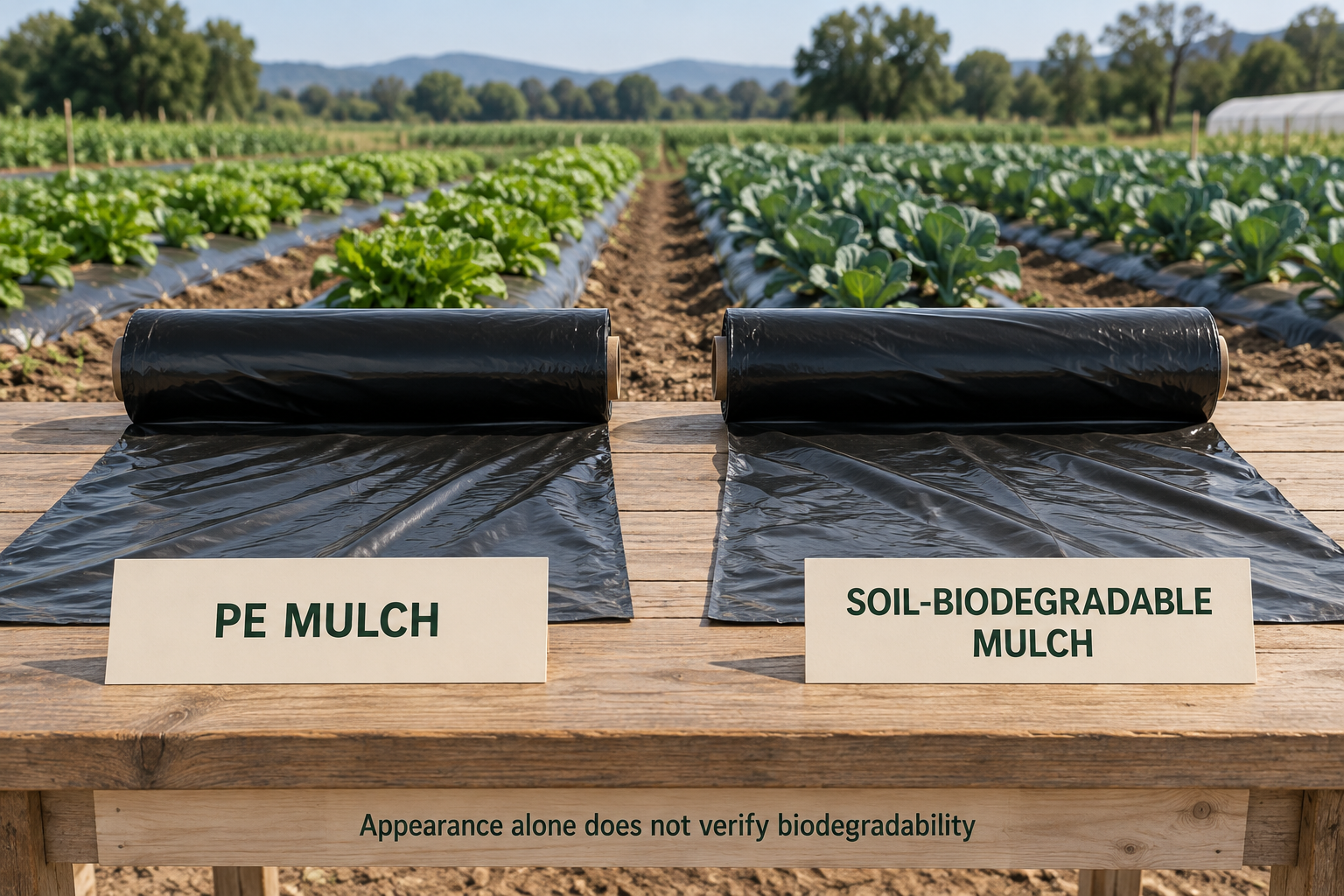
Biodegradable vs PE Mulch Film: How to Choose
Biodegradable vs PE mulch film is a decision about crop coverage, evidence and end-of-season work—not simply which roll has a greener label. Start with the field's required covering period, then compare the proposed grades and the work needed after harvest.
Quick answer: PE mulch needs a removal and waste-management plan. A verified soil-biodegradable mulch may suit a farm that wants to reduce film-removal work and can follow an appropriate incorporation plan. Neither choice is automatically cheaper or suitable for every crop. Do not till an unidentified film into soil merely because its label says “biodegradable” or “compostable.”
1. What does “biodegradable mulch” actually mean?
This guide compares conventional polyethylene film with soil-biodegradable plastic mulch. It does not compare PE with straw, wood chips or paper mulch.
“Biobased” describes the origin of some or all feedstock; it does not, by itself, establish how a finished film breaks down. Likewise, a compostability claim does not automatically demonstrate biodegradation in agricultural soil. The environment and the specific finished material matter. Washington State University's soil-biodegradable mulch overview explains these distinctions.
A formulation described as PLA, PBAT or starch-based is not a substitute for evidence covering the proposed film. Ask which grade is offered, which end-of-life environment it is intended for, and what documents support that claim.
Do not equate fragmentation with biodegradation. A film becoming brittle or breaking into smaller pieces does not demonstrate microbial conversion of its carbon. Oxo-degradable film should not be treated as an interchangeable soil-biodegradable option. See the university factsheet on standards, their purpose and limitations.
2. Biodegradable vs PE mulch film: a practical comparison
Use this table to structure a supplier discussion, not to assign identical performance to every roll within a material family.
On a small screen, scroll the table sideways to view all columns.
| Decision | PE mulch film | Soil-biodegradable mulch film |
|---|---|---|
| Coverage requirement | Specify the crop period and removal date. | Specify the same coverage need; check the proposed grade's field-use guidance. |
| End-of-season plan | Retrieve film and arrange an accepted recycling or disposal route. | Use soil incorporation only where supported by the grade's evidence and instructions. |
| Document review | Confirm identity, dimensions, intended use and acceptance criteria. | Add evidence for the soil-biodegradation claim and its scope. |
| Installation | Use settings appropriate to the film and equipment. | Do not assume existing PE tension settings transfer unchanged. |
| Cost comparison | Include retrieval, handling and the actual waste route. | Include the purchase price and remaining field-management work. |
| Main buying risk | An inexpensive roll without a workable removal plan. | A broad environmental label without grade-specific evidence or a suitable crop window. |
Material choice does not settle every specification. Compare mulch film colors, thickness and tolerances, and roll dimensions separately.
3. Crop coverage and soil degradation are different timelines
Write down two requirements: how long the film must perform above the soil, and how it will be managed after the crop. A supplier's soil-biodegradation evidence is not a promise of an exact number of weed-control days in your field.
A useful illustration comes from Griffin-LaHue and colleagues' 2022 field study. Five biodegradable mulches were applied and incorporated annually from 2015 through 2018 in Mount Vernon, Washington. Two years after the final incorporation, recovered visible fragments represented 4–16% of the total incorporated mulch mass. The study recovered fragments larger than 2.36 mm.
That measurement is not a direct measurement of complete mineralization. Material not recovered as visible fragments cannot simply be counted as proven conversion to carbon dioxide. The practical lesson is narrower: field conditions and laboratory test conditions differ, so do not promise a universal disappearance date.
For your project, request a recommendation tied to planting and harvest dates, soil conditions, irrigation, location and the planned post-harvest operation. Record premature loss of cover separately from post-incorporation observations.
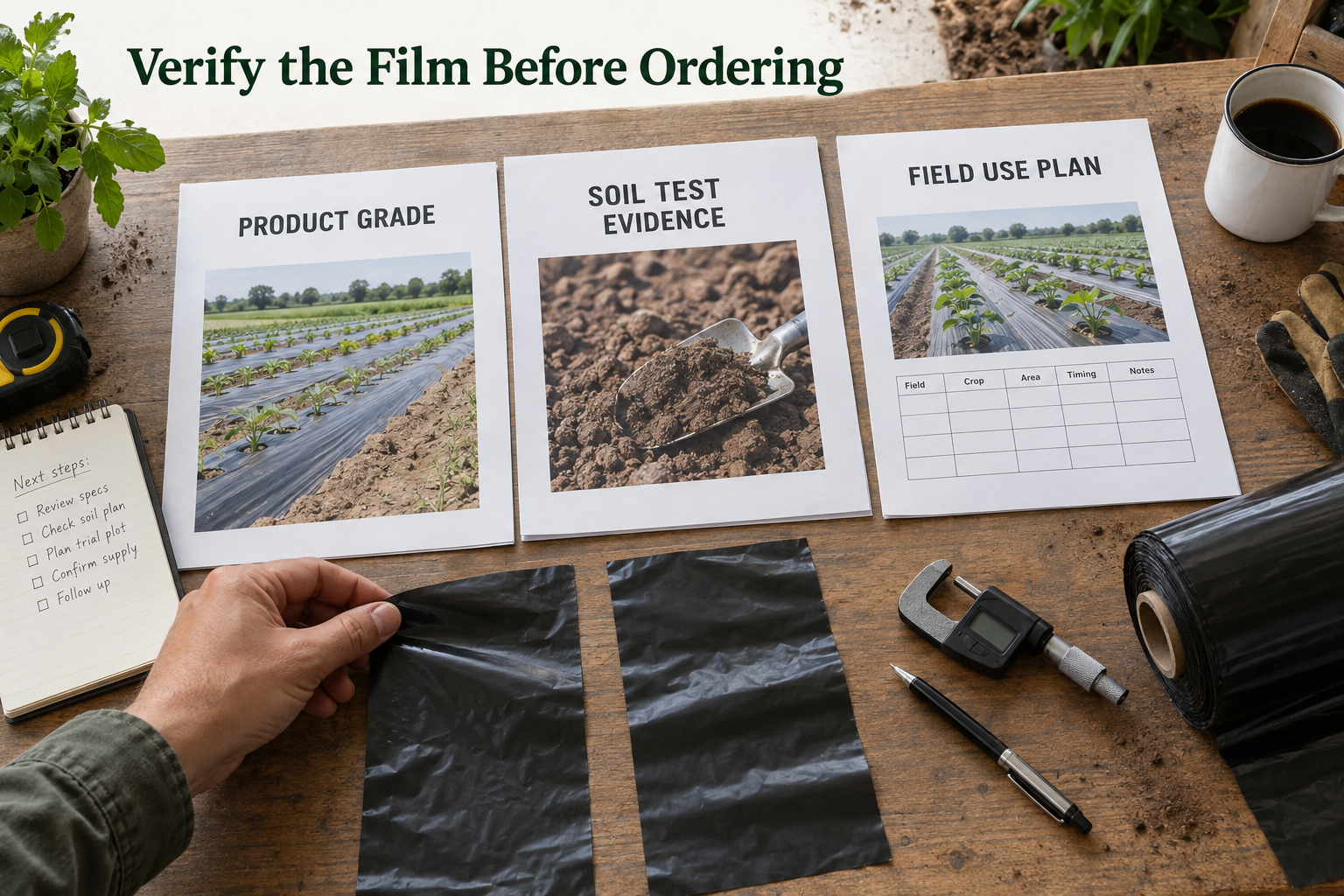
4. What evidence should a buyer request?
EN 17033 addresses biodegradable mulch films for agriculture and horticulture. A reference to a standard on a brochure is not the same as a reviewed report or a verified certificate for the film you are buying.
The university standards guidance distinguishes laboratory soil testing from industrial composting and warns against treating standardized tests as fixed on-farm timelines.
- Identify the item: manufacturer, grade, film construction, nominal thickness and proposed application.
- Match the evidence: ask whether the document covers raw resin, a formulation or the finished film, and whether it applies to the quoted version.
- Check the claim: soil, industrial composting and other environments are different scopes.
- Check the document: issuer, report or certificate number, date, test conditions, limitations and any validity information.
- Resolve gaps in writing: a missing report is “not supplied,” not an assumed pass.
This is a purchasing checklist, not a declaration that every supplier or product mentioned here holds a particular certification. Obtain the applicable documents before confirming a soil-incorporation plan.
5. Installation and seasonal cleanup still require a plan
Do not simply load a biodegradable roll and keep every PE setup unchanged. WSU's crop-production guide discusses avoiding excessive tension and equipment contact that can tear biodegradable mulch. Begin with the film and machine suppliers' instructions, then check a short run before laying the full field.
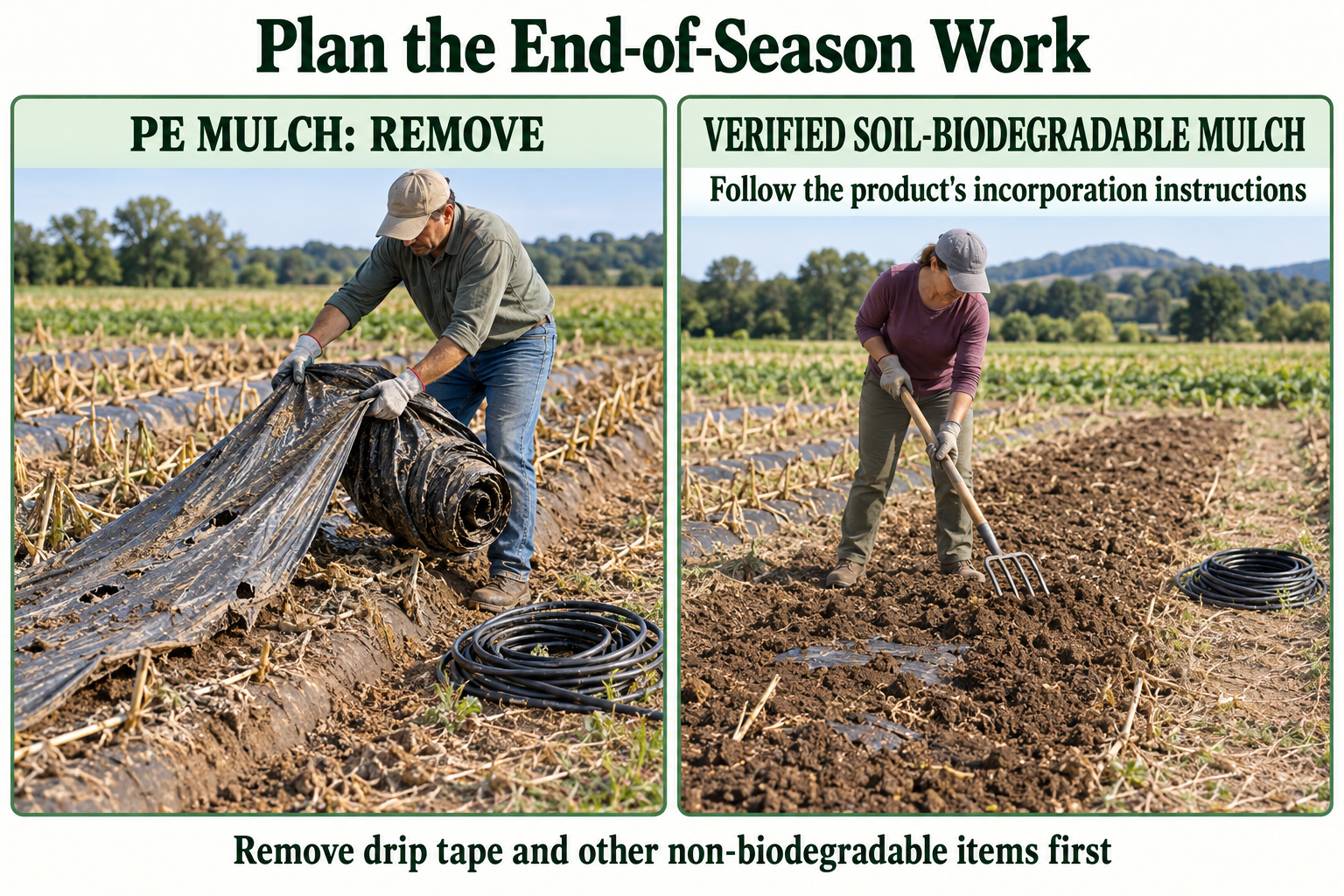
At season's end, separate the two workflows:
- PE: retrieve film and fragments for an accepted waste route. Soil and crop contamination can complicate recycling; confirm local acceptance and preparation requirements rather than assuming a recycler will take it. The university factsheet on mulch disposal challenges explains this constraint.
- Verified soil-biodegradable film: remove drip tape and other non-biodegradable items, then follow the product's incorporation instructions. WSU notes that incorporation and equipment cleanup still require labor. “No film retrieval” does not mean “no end-of-season work.”
6. Compare total field cost, not price per roll
The University of Tennessee's economic assessment considers whether end-of-season savings offset a higher material cost. Use its decision framework, not its historical prices as a current quotation.
Comparable cost per crop cycle = delivered film + installation + in-season repair or replacement + seasonal cleanup + transport and waste charges + any additional incorporation work.
Apply the calculation to the same field area and crop period. Count each operation once: if incorporation is part of an already-budgeted tillage pass, record only the relevant additional cost. Use realistic roll consumption, not equal roll counts for different lengths.
| Input | What to record for both options |
|---|---|
| Material | Grade, required rolls, delivered price, freight and unusable offcuts. |
| Field work | Worker-hours, operator-hours, machinery and any change in installation or cleanup passes. |
| Waste route | Actual acceptance, preparation, collection, transport and disposal or recycling charges. |
| Sensitivity | Recalculate with less labor saved or higher cleanup cost; identify when the preferred option changes. |
Keep potential yield changes outside the base comparison unless your own comparable trial supports them. A labor saving can be valuable without proving a yield increase. Neither material has a universal cost advantage.
7. Trial the proposed grade before a full conversion
UConn Extension's farm suitability discussion highlights handling differences and site-dependent experience. Turn that principle into a documented comparison, rather than relying on how one sample feels by hand.
- Keep a reference: compare the candidate with your current PE grade under similar crop, bed and irrigation conditions.
- Define success first: record the required covering period and acceptable tearing, weed breakthrough and handling performance.
- Record operations: log settings, weather-related damage, patching, labor and harvest observations.
- Follow the approved end-of-life plan: retain labels and document cleanup or incorporation dates.
- Review before scaling: use the results to revise the specification; photographs of fragments alone are not a biodegradation certificate.
For a long harvest window or an unfamiliar climate, request stronger local-use evidence before converting a large area. A practical trial checks suitability; it does not replace laboratory evidence for an environmental claim.
8. Send a quotation request suppliers can compare
State the use case before asking for the lowest price. A useful request includes:
- Crop, country or region, planting date and expected final harvest.
- Bed layout, irrigation, installation method and required covering period.
- Finished width, roll length, thickness with units and tolerances, color and punching pattern.
- Quantity by specification, core and roll-handling limits, packing and destination.
- The intended end-of-life route and documents needed to evaluate it.
- Trial quantity, acceptance checks and the decision point before a bulk order.
Compare the proposed grades before confirming the order
Review our biodegradable mulch film product page for customization inquiries, or use the plastic mulch selection page to compare film options. Ask which grade and supporting documents can be provided for your project. Confirm performance, evidence and supply terms in the quotation rather than inferring them from a general product label.
Frequently asked questions
Is biodegradable mulch the same as compostable mulch?
No. The claimed breakdown environment matters. Industrial compostability alone does not establish that a film is suitable for incorporation into agricultural soil.
Can I leave any biodegradable plastic mulch in the field?
No. Verify the exact grade, relevant soil-biodegradation evidence and end-of-life instructions first. An unspecified label is not enough.
How long does biodegradable mulch take to break down?
There is no universal field timetable. The product, soil and climate matter, and a laboratory result is not a guaranteed disappearance date on a farm. Also distinguish loss of visible fragments from measured biodegradation.
Is biodegradable mulch cheaper than PE?
Not necessarily. Compare current delivered prices and the complete field workflow. Lower film-removal work may offset a price premium, but use your own labor and waste-management costs.
Does the same thickness mean the same performance?
No. Treat thickness as one specification, not proof that different formulations have the same coverage life or handling behavior. Compare the actual proposed grades and trial them where appropriate.
Can a soil-biodegradation claim replace organic-use approval?
Do not treat it as approval. If the farm operates under an organic certification program, submit the exact product and documentation to its certifier before use.
References and further reading
- Washington State University — Soil-Biodegradable Plastic Mulch: Suitability for Sustainable and Organic Agriculture. Material terminology and the importance of the intended biodegradation environment.
- DIN Media — DIN EN 17033:2018-03. Official listing of the agricultural and horticultural biodegradable mulch-film standard; full standard text is separately available from the publisher.
- The Role of Standards for Use of Biodegradable Plastic Mulches: Truth and Myths. University guidance on test environments and limits of field-performance inferences.
- Griffin-LaHue et al. (2022) — In-field degradation of soil-biodegradable plastic mulch films in a Mediterranean climate. Study record and abstract; visible-fragment recovery must not be interpreted as direct mineralization measurement.
- WSU Extension — Important Considerations for the Use of Biodegradable Mulch in Crop Production. Installation and seasonal operations; historical price examples are not current quotes.
- University of Tennessee — The Economics of Adopting Biodegradable Plastic Mulch Films. Farm-specific comparison of material, labor and disposal costs.
- Moore and Wszelaki — Plastic Mulch in Fruit and Vegetable Production: Challenges for Disposal. Contamination and collection constraints; confirm current local waste services independently.
- UConn Extension — Soil-biodegradable plastic mulch: Is it right for you?. Application considerations and farm-level experience.
These independent sources provide technical context. They do not certify, endorse or establish test results for our products. Illustrations are explanatory, not photographs of a documented comparative trial.