
Plastic Mulch Colors: Black, White, Silver and Clear Compared
Plastic mulch colors affect how a film handles sunlight, but the right choice starts with your field objective. Black, white, silver and clear films are not interchangeable. Compare the need for soil warming, heat management and weed suppression before choosing a roll by appearance.
This guide is for commercial growers and agricultural buyers comparing colored plastic mulch. For available film structures and order specifications, see our plastic mulch film range.
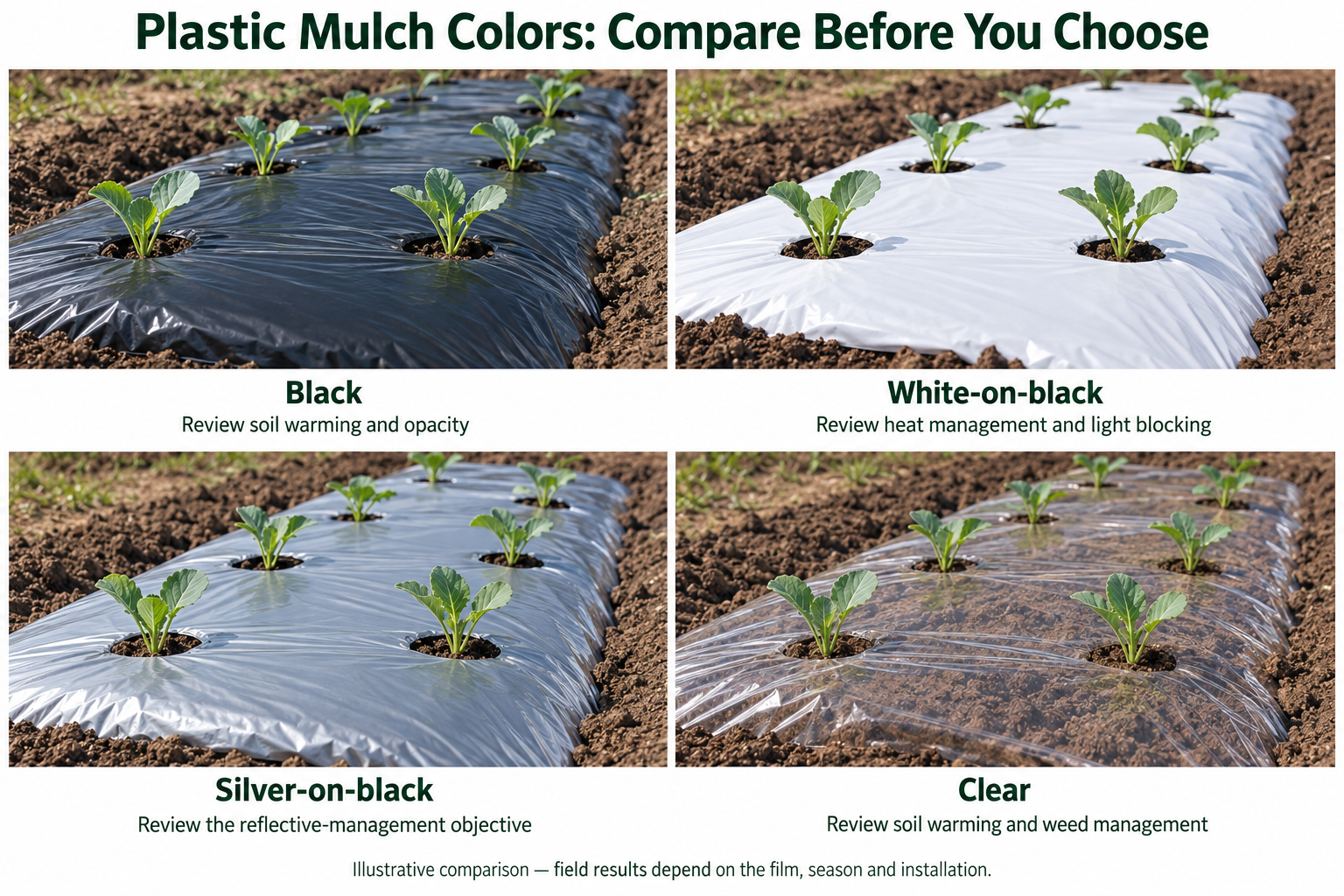
Plastic mulch colors at a glance
Separate the exposed surface from the complete film structure. A white or silver upper face may be combined with a black underside. Ask the supplier to identify both sides and the intended installation orientation.
On a small screen, scroll the table sideways to read every column.
| Color or structure | Reason to consider it | Main caution | Confirm with the supplier |
|---|---|---|---|
| Black | Light exclusion with soil warming in suitable conditions. | Not a universal choice for hot planting conditions. | Opacity, intended season and installation requirements. |
| White / white-on-black | A reflective surface where excessive soil heating is a concern. | White appearance alone does not establish weed control. | Layer construction, light blocking and which face goes upward. |
| Silver / silver-on-black | Reflective management where the crop and pest program justify it. | Not a substitute for a complete pest-management plan. | Reflective surface specification and supporting application evidence. |
| Clear | Solar transmission where soil warming is a priority. | Light also permits weeds to grow beneath the film. | Intended use and a separate weed-management strategy. |
The general distinctions above draw on UF/IFAS guidance on polyethylene mulch. Its recommendations concern a defined production region; use local crop guidance when applying them elsewhere.
Black versus clear: two different ways to warm soil
Black film absorbs sunlight and transfers heat to the soil through contact. Clear film allows sunlight to reach the soil beneath it. The University of Missouri explains these different heat-transfer mechanisms and why poor contact can limit warming under black mulch.
For a buyer, the practical distinction is not simply which film looks darker. Compare the warming objective with the weed-management requirement. Do not use a clear film as a direct replacement for an opaque film without reviewing both.
Keep these questions on the sample request:
- Is the film intended for an actively growing crop or a separate pre-plant treatment?
- What problem is the current film failing to solve?
- What observations would make the proposed replacement a better choice?
Review the black mulch film or transparent mulch film specification after identifying the intended application.
White mulch and white-on-black mulch are not identical specifications
A reflective upper surface and an opaque underside serve different purposes. Do not assume a plain white film and a white-on-black construction have the same light-blocking performance. UF/IFAS describes white and white-on-black mulch for crops established in hot conditions, and identifies light exclusion as an important property of black-backed structures.
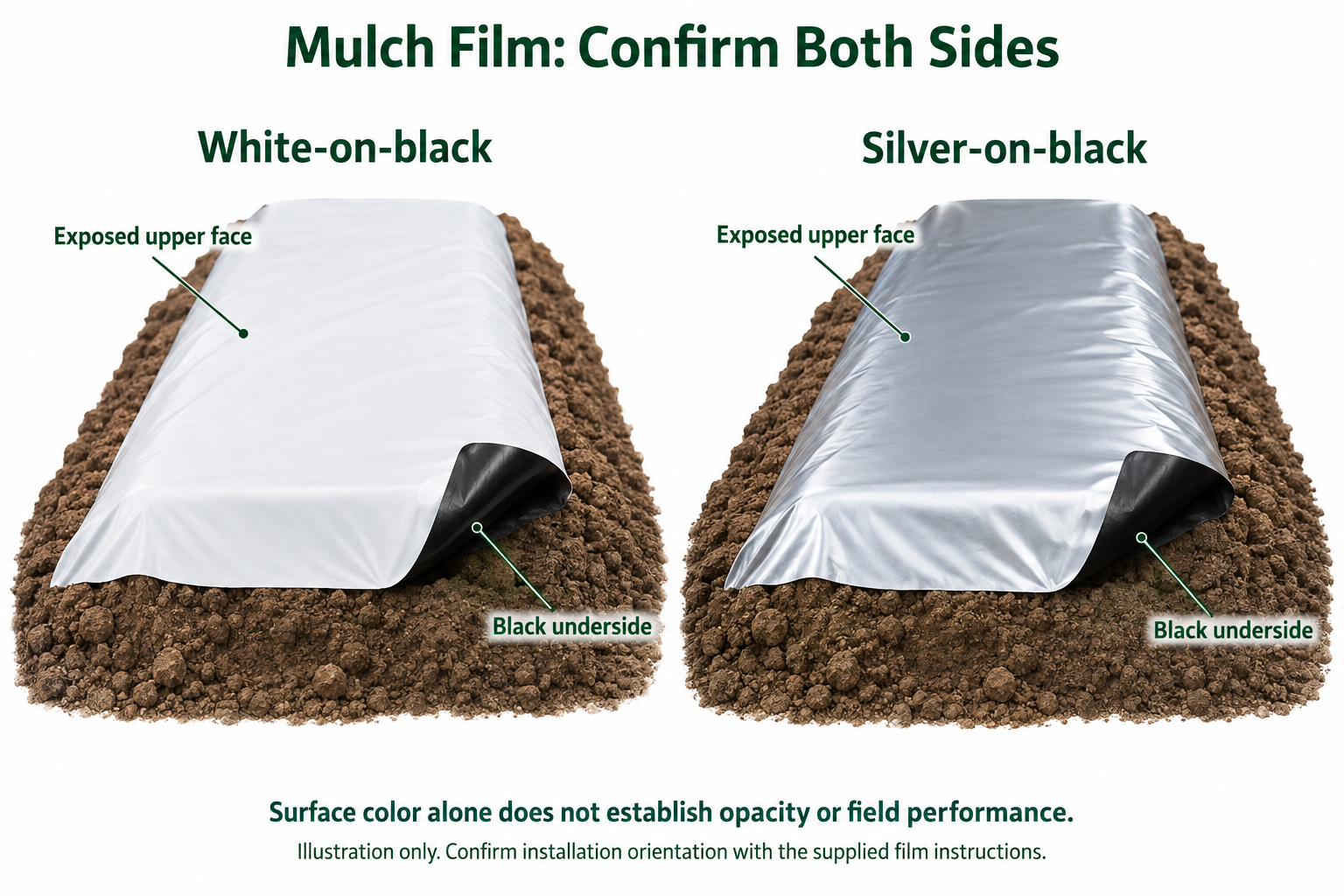
In the purchase request, write the required structure rather than only “white mulch.” Ask for a labeled sample showing the field-facing surface. If the supplier proposes a different construction, request the relevant optical information before approving the substitution.
Our white-on-black mulch film page provides a product-specific starting point. Confirm orientation against the supplied film instructions rather than relying on the product name alone.
What silver reflective mulch can—and cannot—do
Reflective mulch has documented uses within crop-specific pest programs. For example, UF/IFAS describes highly reflective mulch in tomato production in relation to thrips and tomato spotted wilt virus. That example is not evidence that every silver-colored film controls every insect.
NC State Extension also describes reflective mulch within a wider production system. Film selection does not remove the need for crop monitoring and other appropriate management measures.
Ask whether the offered product has a defined reflective face, an opaque backing and information relevant to your intended crop. A photograph alone is not enough to compare two suppliers’ claims.
See our silver-on-black mulch film for specification review. Discuss the actual use objective before choosing it simply as a more expensive alternative to black film.
Choose for the planting window, not only the crop name
The same crop can present different requirements in different planting windows. Missouri’s guidance discusses both daytime and nighttime energy transfer; a single daytime observation should not be treated as the whole temperature story.
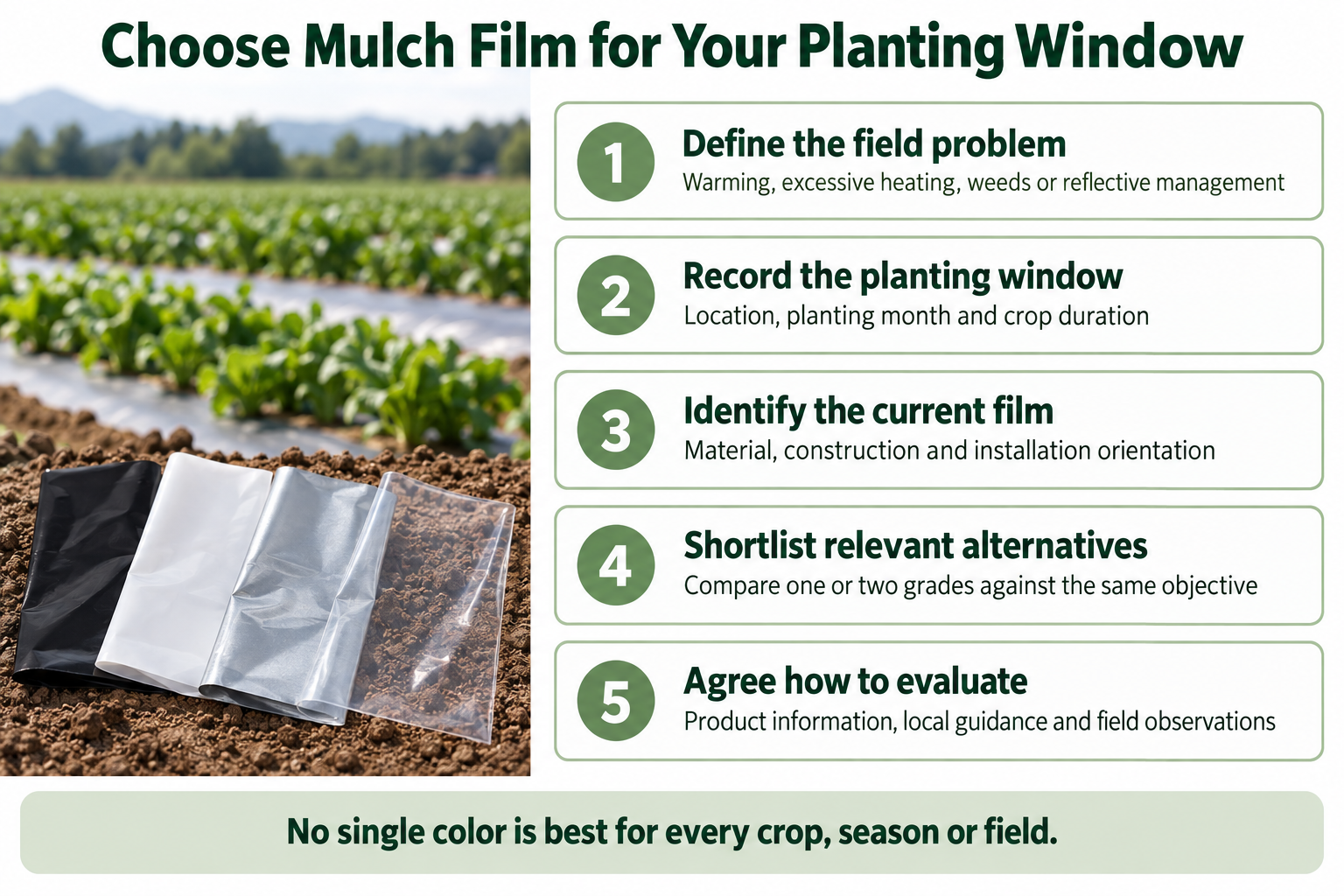
Use the following decision sequence to prepare a shortlist:
- Describe the current problem. State whether the concern is establishment in cool soil, excessive heating, weeds or a specific reflective-management objective.
- Record the calendar and location. Give the planting month, expected crop duration and growing area, not just “hot climate.”
- Identify the present film. Include its construction and a supplier reference where available. An unlabeled photo may not identify the grade.
- Compare only relevant alternatives. Request one or two candidates that address the stated problem, rather than samples of every color.
- Agree how to assess the choice. For a field comparison, record the film grade, installation date, management conditions and observation method. Seek local agronomic advice for trial design.
A practical buyer record can separate three columns: what is known, what needs supplier confirmation and what needs field validation. This avoids turning an early discussion into an unsupported performance promise.
Do not approve a yield claim without its context
If a quotation includes a percentage yield increase or a fixed temperature reduction, request the underlying report. Check the crop, location, comparator, measurement period and tested film. Keep that report attached to the offered grade; do not transfer the claim automatically to another color or construction.
What to send when the color is not yet decided
You do not need a finished technical specification to start an inquiry. A short description of the growing project is more useful than guessing a color and asking only for the lowest roll price.
Suggested inquiry:
We need mulch film for [crop] in [country/region], planted in [month] for approximately [crop duration]. Our main concern is [soil warming / excessive heating / weeds / a defined reflective-management objective]. We currently use [film type, if known].
Please suggest a suitable color and construction, and identify which claims are supported by product information or field evidence. Our estimated requirement is [quantity or planted area]. Bed dimensions and roll requirements are [details / not yet confirmed].
Before final approval, confirm the film structure, thickness and tolerance, width and roll format, hole layout and packing separately. This article helps narrow the color choice; it does not set those production parameters or guarantee availability for a particular order.
Send your crop and field requirements, or return to the mulch film product range to compare the available structures.
Frequently asked questions
Which plastic mulch color is best for my crop?
There is no single answer based on crop name alone. Start with the planting window and the problem you need to solve, then compare candidate film structures with local growing guidance.
Can I choose white and silver film interchangeably?
Do not approve them as equivalent from appearance alone. Ask which optical or application requirement matters for your project and compare supporting information for the offered grades.
Does a black underside guarantee a weed-free field?
No. UF/IFAS notes that nutsedge can penetrate mulch. A light-blocking film is not a guarantee against every weed or a replacement for a field-specific management plan.
Does mulch color tell me whether the film is biodegradable?
No. Ask for the material identification, intended end-of-use instructions and relevant supporting documentation as a separate purchasing requirement. Do not infer disposal instructions from color. For a separate comparison of material systems and end-of-use requirements, see our biodegradable vs PE mulch film guide.
Can I request a quote before choosing the color?
Yes. Send the project information above and identify the undecided items. Ask for the proposed specification to be listed with the quotation so alternatives can be compared on the same basis.
References and further reading
- Arancibia, R. A. — Plastic Mulch Color and Soil Temperature. University of Missouri, 2022. Explains heat transfer and the role of installation.
- Hochmuth, G. J., Hochmuth, R. C., and Olson, S. M. — Polyethylene Mulching for Early Vegetable Production in North Florida. UF/IFAS Extension. Regional guidance on mulch types and production considerations.
- Torres Quezada, E., and da Silva, A. — Plasticulture for Commercial Vegetables. NC State Extension, 2025. Places mulch selection within the wider production system.
These sources explain agronomic principles; they do not certify our products or guarantee results for a particular field. Confirm the selected film specification and use local advice where crop-management decisions are required.