
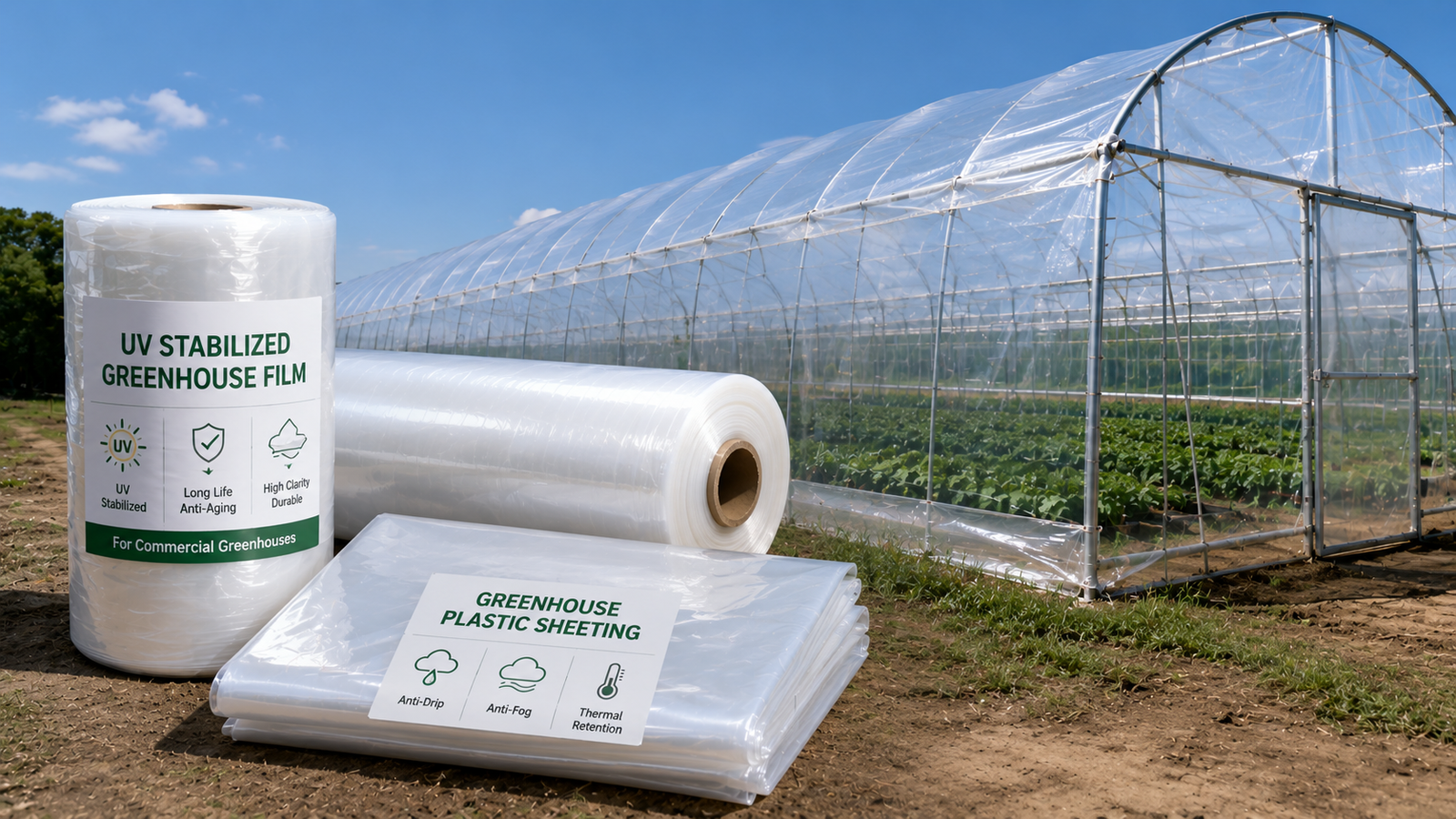
Greenhouse Plastic Sheeting vs Greenhouse Film: Which Cover Should You Choose?
Quick answer: The phrase greenhouse plastic sheeting vs greenhouse film often compares two market labels for the same flexible polyethylene covering, not two inherently different materials. A roll is a delivery format, not a quality grade. For most commercial hoop houses, high tunnels and multi-season greenhouses, the safer choice is greenhouse-grade, UV-stabilized film with confirmed thickness, dimensions, light properties and functional options. Ordinary clear construction sheeting is better treated as a temporary cover unless its technical data confirms that it is suitable for agricultural outdoor exposure.
The buying decision is therefore not simply "roll or sheet." It is whether the quoted material is a greenhouse covering with the right formulation and documented specification, or a general-purpose plastic sheet that only looks similar when new. If the greenhouse frame requires rigid panels rather than flexible film, the comparison changes again: polycarbonate, acrylic and fiberglass sheets belong to a different covering system.
Before placing an order, confirm the material grade, UV stabilization, nominal thickness and tolerance, finished width and length, light requirement, condensation-control options, installation method, roll weight, packing and required quality documents. These points affect more than price. They determine whether the cover fits the frame, can be handled on site and performs as expected after installation.
Greenhouse Plastic Sheeting vs Greenhouse Film: Quick Selection Answer
| Your Situation | Safer Starting Choice | Why | Confirm Before Buying |
|---|---|---|---|
| Commercial hoop house, high tunnel or multi-season greenhouse | Greenhouse-grade UV-stabilized polyethylene film | It is specified for greenhouse covering rather than general construction protection. | UV package, thickness and tolerance, finished dimensions, light properties, functions and packing. |
| Short-term emergency cover or temporary weather barrier | General-purpose clear plastic may be acceptable | The buyer may accept limited or unverified outdoor performance for a short use. | Exposure period, wind, fastening, light needs and the consequences of early failure. |
| Heated or humid greenhouse with recurring condensation | Greenhouse film with a confirmed condensation-control option | Surface treatment or additives may help condensation spread rather than form large droplets. | Treated side, product terminology, test basis, expected functional period and ventilation conditions. |
| Permanent rigid greenhouse designed for panels | Polycarbonate or another specified rigid glazing system | A rigid panel and flexible film use different framing, fastening and replacement systems. | Panel thickness, structure compatibility, thermal target, expansion allowance and installation details. |
For most commercial flexible-cover projects, start with greenhouse-grade film and then refine the dimensions, thickness and functions. Starting with the cheapest clear sheet and trying to add missing performance later is a false saving. UV stabilization, anti-drip treatment and a custom width cannot be added after the roll has been produced.
Roll, Sheeting, Film and Rigid Sheet Do Not Mean the Same Thing
Much of the confusion begins with inconsistent market language. Retail listings, distributors and buyers may use greenhouse plastic sheeting, greenhouse film and greenhouse plastic roll for the same flexible cover. Technical documents may use the terms more narrowly. A quotation must move beyond the label and identify the actual product.
| Term | What It Usually Describes | What It Does Not Prove | Procurement Action |
|---|---|---|---|
| Greenhouse plastic roll | Flexible covering wound around a core or packed as a roll. | Material grade, UV performance, thickness accuracy or service life. | Request the complete film specification, finished roll dimensions and packing format. |
| Greenhouse plastic sheeting | A broad commercial phrase that often means flexible PE greenhouse film. | Whether the product is greenhouse grade, construction grade or a rigid sheet. | Ask whether the seller means flexible film or a rigid panel, then confirm the grade. |
| Greenhouse film | A flexible agricultural covering commonly made from polyethylene-based formulations. | That every greenhouse film has the same UV, optical or condensation-control performance. | Match the quoted item to the application and written technical data. |
| Construction plastic sheeting | General-purpose plastic used for vapor barriers, dust control, painting and temporary protection. | Agricultural outdoor stability, greenhouse light properties or crop-use suitability. | Use only when the project accepts temporary or unverified greenhouse performance. |
| Rigid plastic sheet | Polycarbonate, acrylic, fiberglass or another rigid glazing panel. | Compatibility with a frame designed for flexible film. | Review the greenhouse structure and panel installation system before comparing cost. |
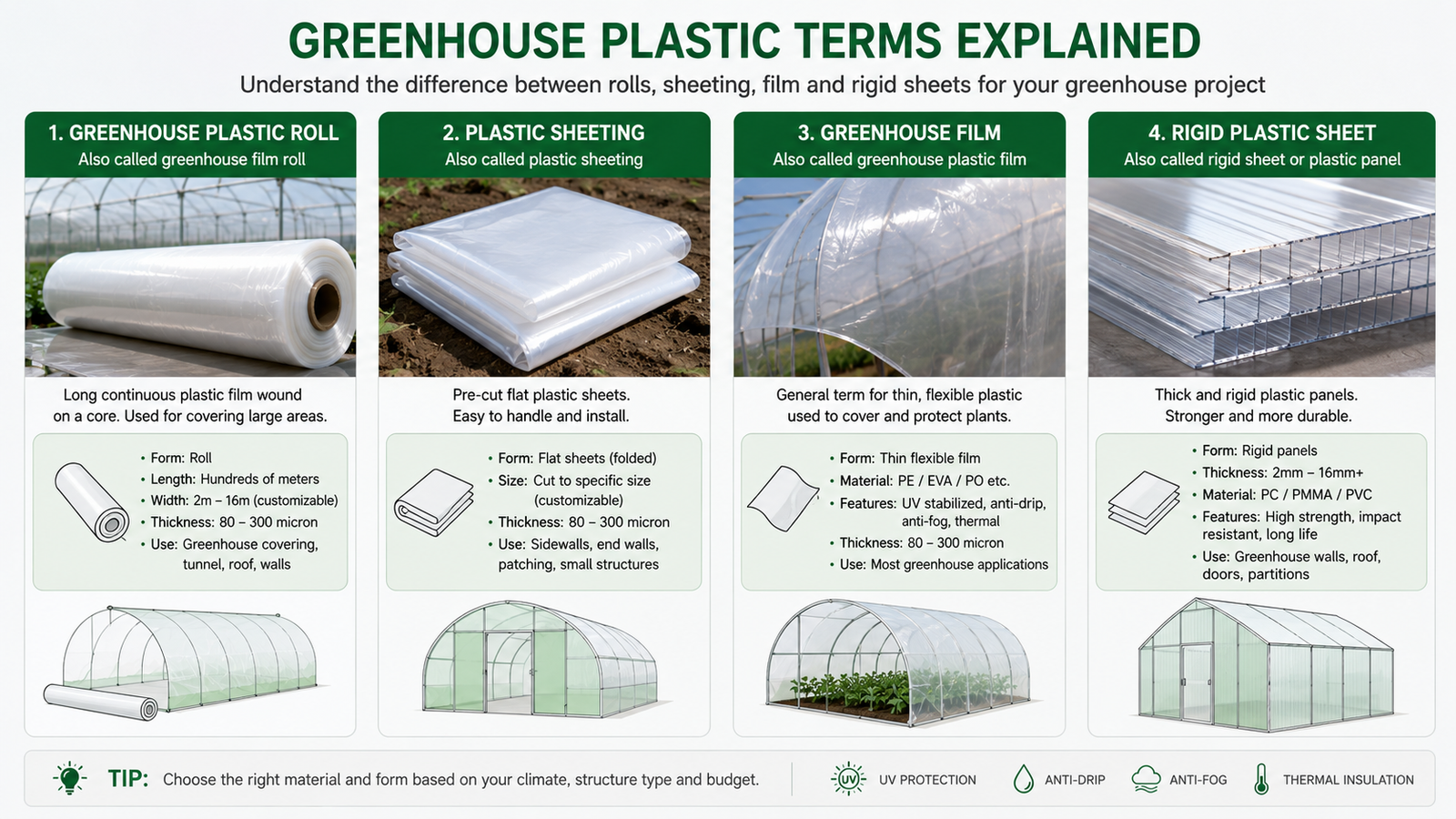
Industry judgment: When a buyer asks for "greenhouse sheets on a roll," do not correct the vocabulary and stop there. Confirm whether the project needs flexible greenhouse film, its outdoor grade, dimensions and functions. The useful answer is a specification, not a terminology lesson.
Washington State University Extension treats flexible polyethylene film and rigid polycarbonate panels as different greenhouse covering systems and compares covering choices by properties such as light transmission, heat retention, longevity, structural strength, cost and installation. Commercial listings may still use "sheeting" for flexible polyethylene. This difference is exactly why a buyer should confirm the physical form and material instead of relying on the noun alone. For the broader material explanation, read what greenhouse film is and how it works.
The Real Comparison: Greenhouse-Grade Film vs Ordinary Clear Plastic Sheeting
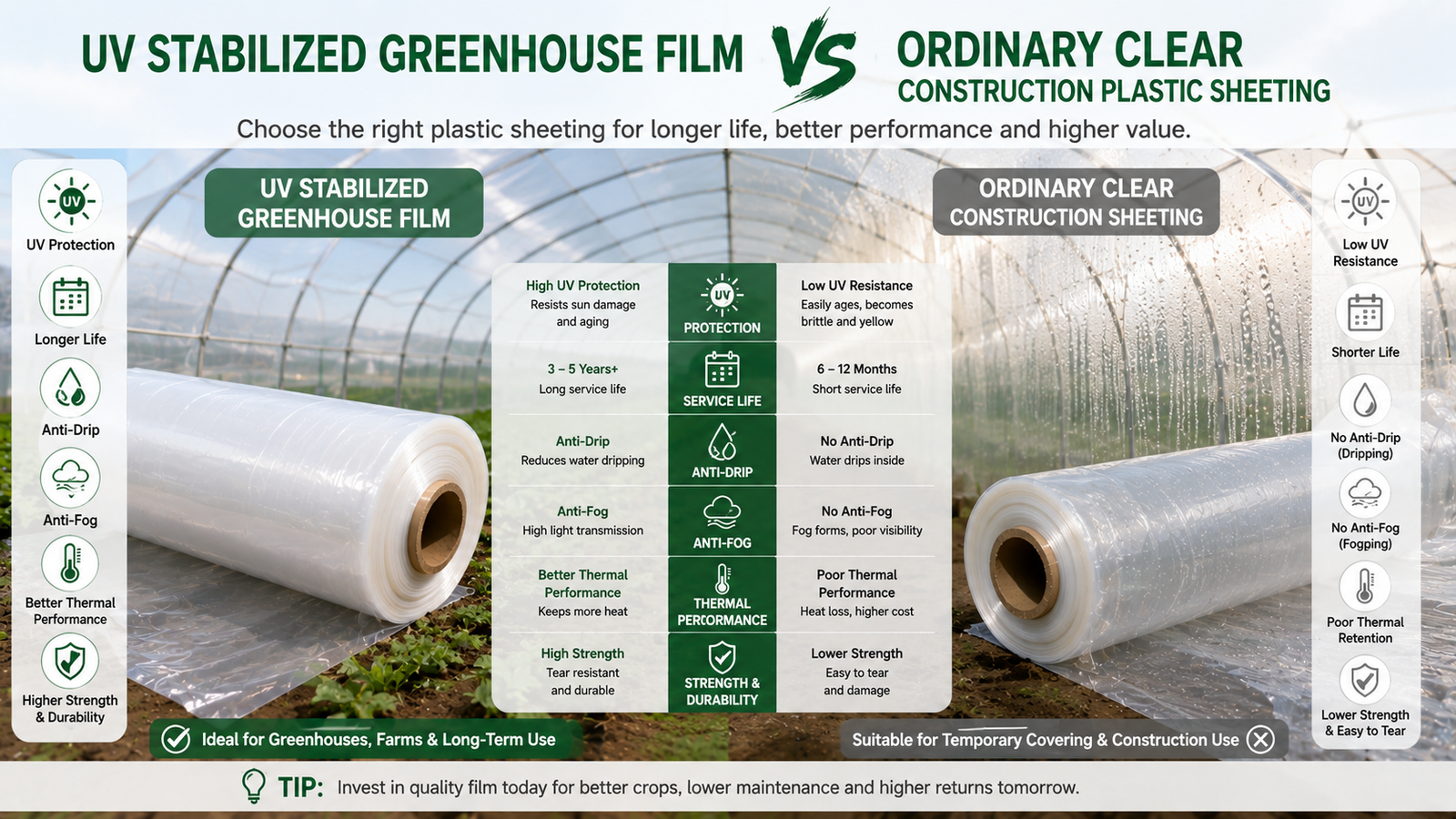
Two clear rolls can look similar in a warehouse and behave very differently outdoors. The visible appearance does not confirm UV stabilization, thickness consistency, optical performance or condensation behavior. This is why buying only by color and mil thickness creates avoidable risk.
Oklahoma State University Extension's greenhouse-covering guidance recommends UV-stabilized polyethylene products that are slower to yellow and crack and distinguishes film-cover decisions by structure and intended use. That guidance supports a practical procurement rule: for prolonged greenhouse exposure, require an identifiable greenhouse product rather than assuming that every clear sheet is equivalent.
| Evaluation Point | Greenhouse-Grade Flexible Film | Ordinary Clear Plastic Sheeting | Buyer Decision |
|---|---|---|---|
| Intended application | Designed and sold for greenhouse or protected-cropping use. | Often designed for construction, painting, moisture barriers or temporary protection. | Match the product's stated application to the greenhouse project. |
| Outdoor UV stability | UV stabilization should be part of the quoted greenhouse formulation. | May be absent, limited or not documented for prolonged agricultural exposure. | Ask for the written UV-related product specification, not just the words "UV resistant." |
| Light performance | Clear, diffused or other optical properties may be specified by product. | Transparency may be visible, but greenhouse-relevant optical data may not be supplied. | Do not use visual clarity as a substitute for technical data. |
| Condensation control | Anti-drip or related options may be available and must be confirmed for the quoted item. | Normally not supplied as an agricultural condensation-control product. | For humid houses, confirm the function, treated side and limitations before production. |
| Dimensions | Commercial widths, cut lengths and roll formats can often be specified. | Usually limited to stocked construction or retail sizes. | Measure the covering path before selecting a convenient stock width. |
| Documents and repeat orders | A product specification, TDS, sample or inspection record may be arranged by agreement. | Documentation may cover general physical properties rather than greenhouse performance. | Agree required evidence before production and preserve the approved SKU for repeat orders. |
When Can Ordinary Plastic Sheeting Be Used on a Greenhouse?
Ordinary plastic sheeting is not automatically useless. It can be a rational choice when the project is genuinely temporary and the buyer accepts its limitations. Examples include an emergency repair cover, short indoor protection during maintenance or a low-risk seasonal experiment where early replacement will not damage a valuable crop or disrupt a commercial schedule.
The decision becomes unsafe when "temporary" is never defined. A sheet expected to remain outdoors through intense sun, repeated wind movement, chemical exposure or a full commercial growing cycle is no longer a simple temporary barrier. The project has moved into greenhouse-covering territory even if the purchase description still says clear plastic.
Use ordinary sheeting only when all four conditions are understood
- The expected exposure period and season are stated.
- The buyer accepts that agricultural UV and optical performance may be unverified.
- Failure or early replacement will not create an unacceptable crop, labor or scheduling loss.
- The fastening method will not create obvious tearing or abrasion points.
A low purchase price is meaningful only when the consequences of replacement are also low. Labor, crop disruption, disposal and a second installation can cost more than the original material difference.
When Is Greenhouse-Grade Plastic Film the Safer Choice?
For most commercial greenhouses, greenhouse-grade film is the safer starting point. The case becomes stronger when the structure is expected to remain covered for more than a short temporary period, the crop has meaningful value, the house is heated or humid, the site has strong sun or wind, or custom widths are needed to reduce seams.
Commercial crop production
Cover failure affects more than material cost. It can interrupt temperature control, crop protection and the production schedule.
Custom-width greenhouse frames
A purpose-made width can reduce unnecessary joints, but it also changes roll weight, packing and installation handling.
Humid or heated houses
Condensation and thermal requirements should be addressed through a suitable product specification, not assumed from thickness.
Distributor repeat stock
Consistent SKUs, labels, packing and approved specifications matter more than repeatedly buying the lowest-priced anonymous clear roll.
Buyers can compare the available greenhouse film options before reviewing a specific custom greenhouse plastic roll. The category page helps identify the product direction; the product page is where dimensions, functions and quotation details should be confirmed.
Do You Mean Flexible Film or Rigid Greenhouse Sheets?
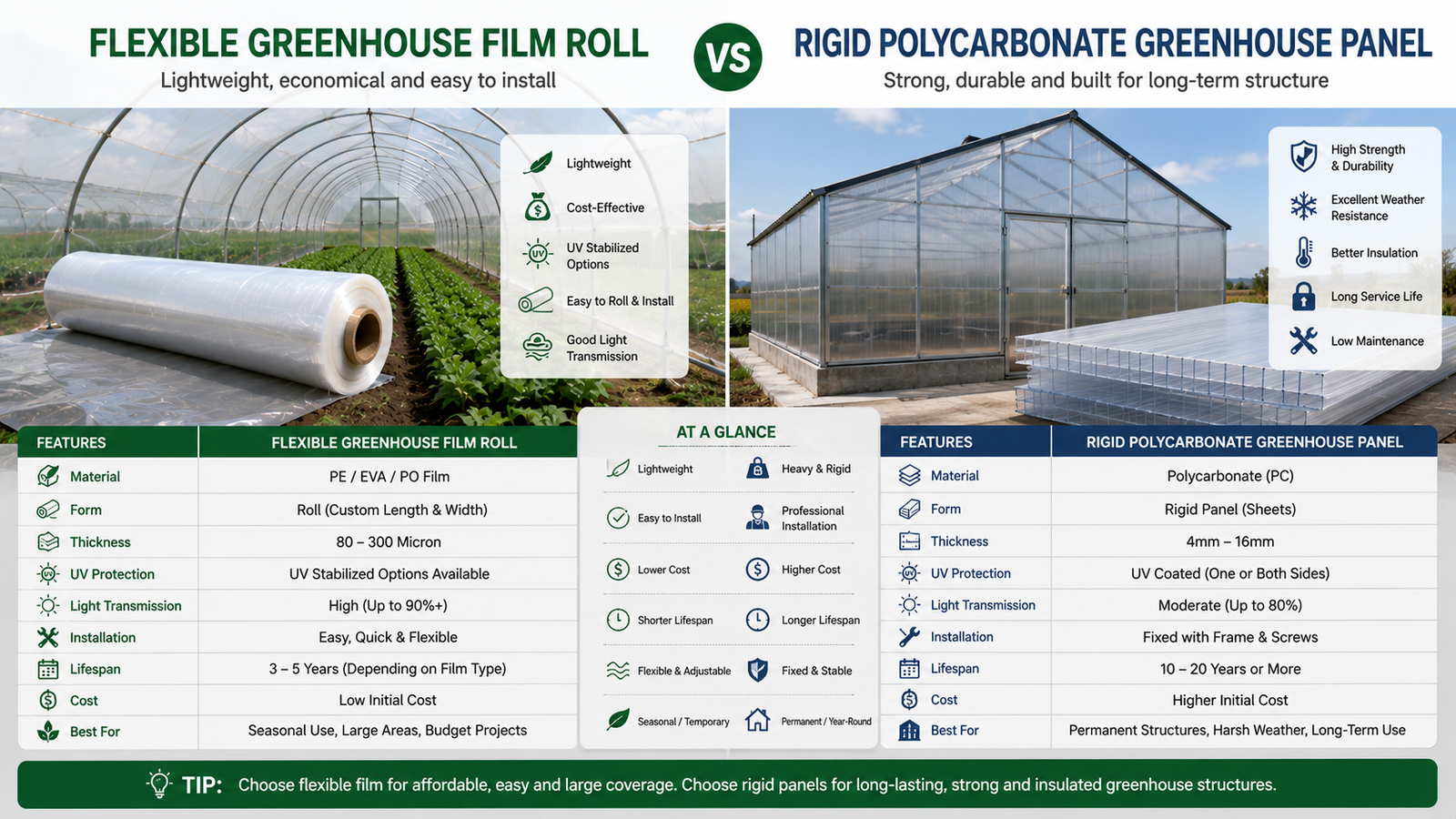
A request for "plastic sheets for a greenhouse" may actually mean polycarbonate panels. Flexible film and rigid panels are not interchangeable grades of one product. They use different frames, fastening systems, freight methods and replacement plans.
| Covering System | Main Advantage | Main Limitation | Typical Fit |
|---|---|---|---|
| Flexible greenhouse film | Available in large rolls, follows curved frames and has a lower initial covering cost. | Requires correct tensioning, protection from abrasion and planned replacement. | Hoop houses, high tunnels, multi-span film houses and seasonal structures. |
| Rigid polycarbonate or similar sheet | Rigid, impact resistant and available in insulating multiwall constructions. | Higher material and installation cost; requires a compatible rigid frame and panel system. | Permanent rigid greenhouses, hobby houses and projects designed around panels. |
The PE film and polycarbonate greenhouse-cover comparison examines this material decision in more detail. This page keeps the narrower question in view: whether flexible plastic sheeting is a verified greenhouse film or an ordinary general-purpose sheet.
Greenhouse Plastic Sheeting Selection Matrix
| Application | Recommended Direction | Why | Critical Order Checks |
|---|---|---|---|
| Commercial hoop house or high tunnel | UV-stabilized greenhouse-grade flexible PE film | Fits a curved frame and can be supplied in project widths and roll lengths. | Covering path, thickness tolerance, UV requirement, fastening and roll weight. |
| Year-round humid greenhouse | Greenhouse film with project-appropriate condensation and optical options | Humidity, light and crop conditions require more than an anonymous clear sheet. | Anti-drip terminology, treated side, haze or diffusion target, ventilation and crop. |
| Seasonal low tunnel | Rated seasonal agricultural film or another confirmed short-use product | The specification can prioritize installation, removal and seasonal economics. | Season length, width, crop, expected weather and disposal plan. |
| Emergency temporary cover | General-purpose sheeting may be acceptable after risk review | Immediate availability may matter more than long-term performance. | Duration, wind exposure, fastening, light needs and replacement consequences. |
| Distributor inventory | Repeatable greenhouse-film SKUs in standard local sizes | Stock consistency, labels and predictable reorder specifications support resale. | Common widths, lengths, packing quantity, SKU marks, samples and reorder tolerance. |
| Permanent rigid-frame greenhouse | Polycarbonate or another engineer-specified rigid glazing | The frame and glazing system are designed around rigid sheets. | Panel type, thickness, framing, fastening, expansion and freight protection. |
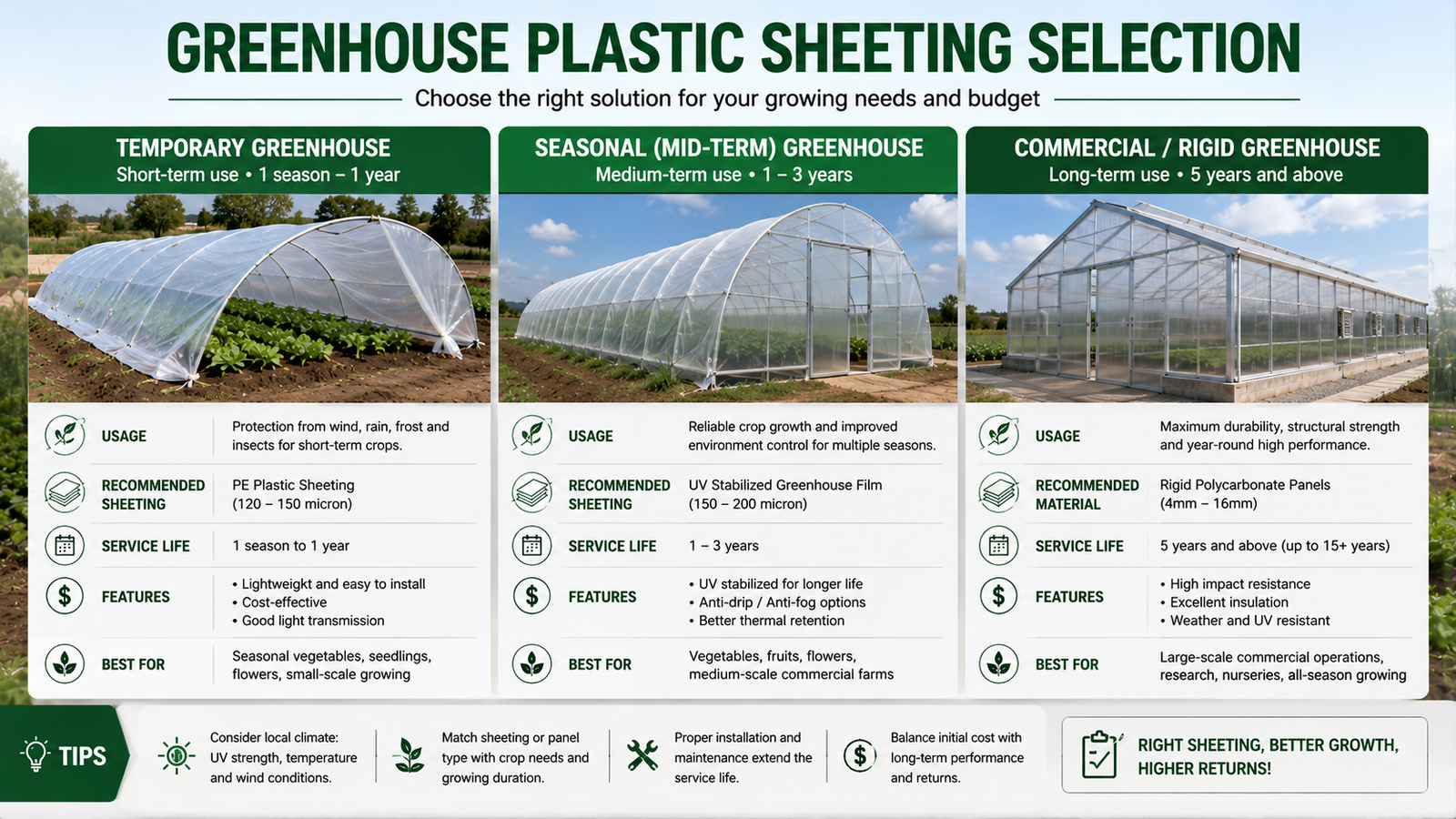
Specification Tradeoffs That Matter More Than the Product Name
Thickness vs light transmission
Thicker film uses more material, but thickness alone does not predict usable light transmission. Resin, additives, surface condition, aging, haze and dust also affect optical performance. Do not assume that a thinner clear sheet automatically gives the better crop environment or that a thicker roll is automatically lower in light. Confirm product-specific optical data when the project requires it.
Thickness vs roll weight and installation
Increasing thickness increases material per square meter and therefore roll weight. A wide, long and heavy roll may reduce seams but require more labor, lifting equipment or a different pulling plan. This looks like a logistics detail, but it can decide whether the cover reaches the frame undamaged.
UV stabilization vs actual service life
UV stabilization is essential for prolonged outdoor exposure, but it is not a universal life guarantee. Formulation, solar exposure, temperature, chemicals, abrasion, fastening stress and installation quality all influence service life. Ask what the supplier is prepared to confirm for the quoted product and avoid turning a generic market claim into a project warranty.
Buyers who need to compare UV, light, condensation and mechanical criteria can use the separate guide to greenhouse film quality factors. Product-level values should still be taken from the quoted item's own specification or agreed test record.
Anti-drip and anti-fog vs the growing environment
Condensation-control functions can change how moisture behaves on the film surface, but they do not replace greenhouse ventilation, humidity management or crop-disease control. The treated side and expected functional period should be confirmed. A buyer who simply writes "anti-fog" may receive a different interpretation from one supplier to another.
Custom width vs packing and unloading
A custom width can reduce joints and installation waste. It can also create a heavier roll that does not fit the buyer's rack, forklift, container plan or installation equipment. Before approving the widest possible roll, confirm estimated roll weight, core, package dimensions, pallet arrangement and site handling.
Lowest price vs usable cost
The lowest unit price is not automatically the lowest covering cost. Compare like-for-like material grade, dimensions, tolerance, UV package, functions, packing and evidence. A cheaper sheet that needs an early replacement or arrives in an unmanageable roll format can increase labor and crop risk.
Standard stock vs project customization
Custom dimensions are valuable for builders working from controlled drawings. Distributors often need the opposite: a small number of repeatable SKUs that match local demand. The right purchasing strategy follows the sales and installation model, not the longest customization list.
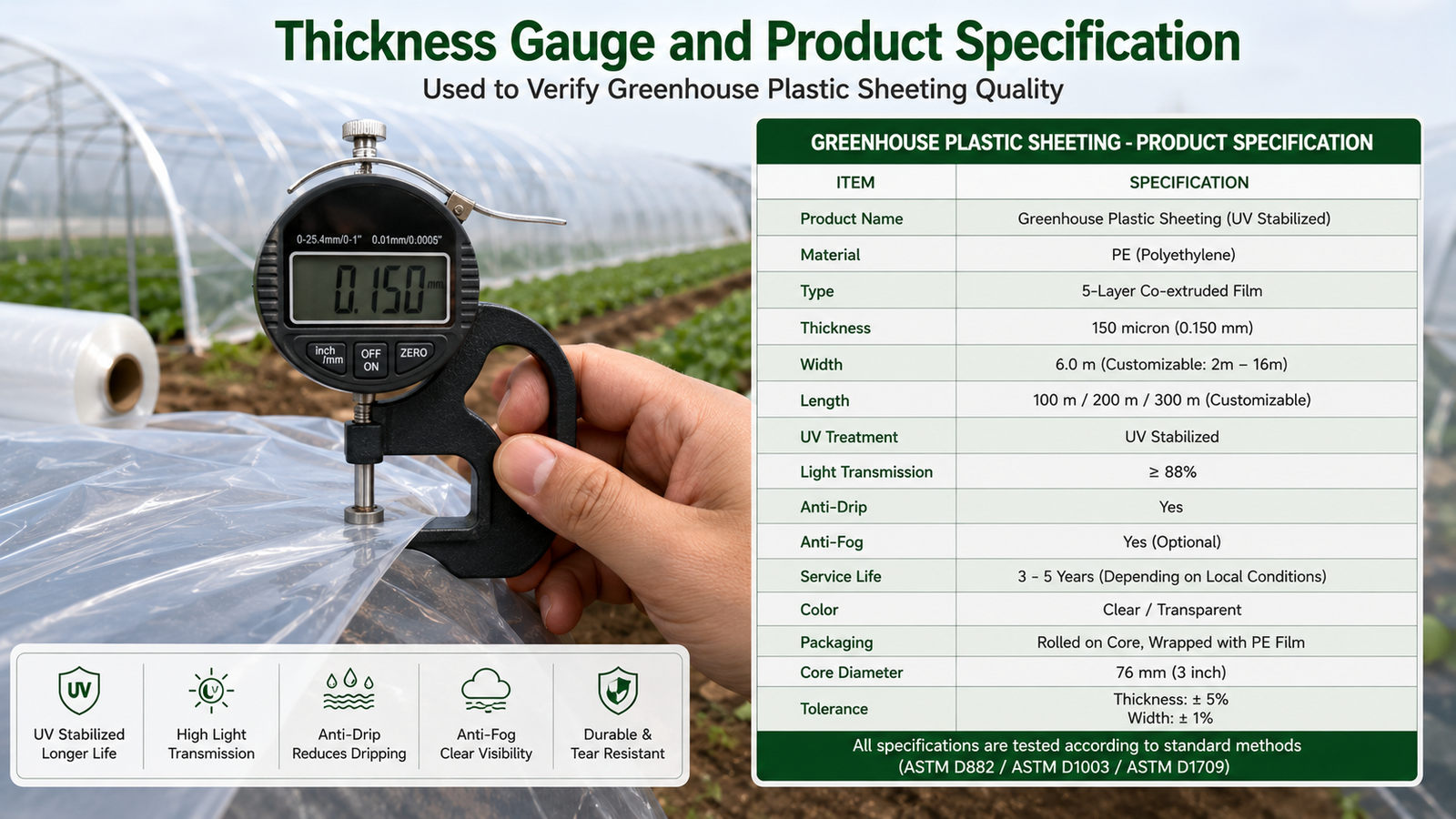
For the detailed mil-to-micron comparison and climate-related selection limits, use the greenhouse plastic thickness guide. For project width and roll-length planning, use the greenhouse plastic roll size guide. Those pages handle the calculations; this comparison page determines which product category should be calculated in the first place.
Four Real Buyer Scenarios That Expose the Difference
Scenario 1: The farm requests "clear 6 mil plastic"
The request sounds complete because it includes a color and thickness. It is not complete. The buyer has not identified greenhouse grade, UV stabilization, finished width, required length, condensation conditions or expected use period. A supplier can attach a price to those words, but the farm may receive a clear 6 mil sheet that is technically unrelated to the intended growing cycle.
Correct approach: Confirm greenhouse application, UV requirement, nominal thickness and tolerance, covering dimensions, single or double layer, functional needs and packing. Use 6 mil as one parameter, not the whole product definition.
Scenario 2: The greenhouse builder asks for "plastic sheets" from a drawing
The phrase may suggest rigid panels, but the drawing shows a curved hoop frame with lock channel and roll-up sides. The project actually needs flexible film. If the quotation team follows the wording rather than the drawing, it will compare the wrong product system.
Correct approach: Confirm the frame type, covering path, fastening method, openings, cut schedule and installation sequence. The builder should approve the final width and length before production.
Scenario 3: The distributor wants a low-priced stock roll
A distributor does not want to redesign the product for every resale order. The real requirement is a stable SKU with agreed width, length, thickness, label, packing quantity and repeat-order tolerance. Constant one-off customization creates slow stock and inconsistent quotations.
Correct approach: Select the few greenhouse plastic sheeting sizes that match local demand, approve the product data and packaging, then preserve those identifiers for reordering.
Scenario 4: The farm supplies only the greenhouse ground width
Ground width is not the film covering path. A curved roof, sidewalls, fastening allowances and installation grip all consume width. Ordering from the ground dimension can leave a roll that reaches the site but not the lock channel.
Correct approach: Measure the actual path over the structure or use a controlled drawing. Confirm allowances with the greenhouse builder or installer rather than expecting the film factory to infer the frame geometry.
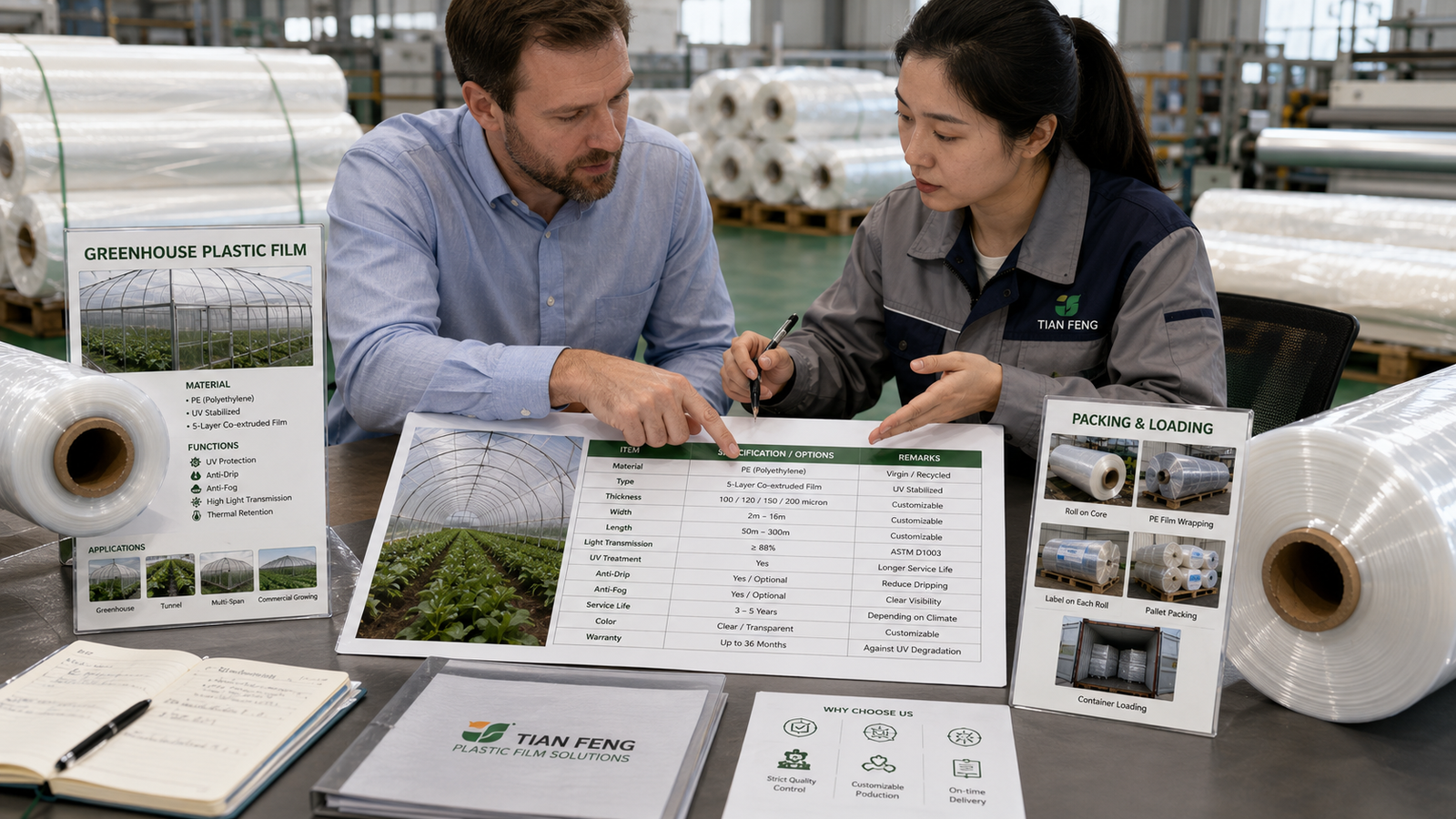
Factory and Procurement Review Before Production
In actual quotation work, a factory should not approve a custom roll from a product name alone. It reviews whether the requested material, width, thickness, roll length, functions and packing can be produced together. The buyer or project team remains responsible for the structure dimensions, local engineering requirements and installation plan.
| Stage | Buyer or Project Input | Supplier Confirmation | Why It Matters |
|---|---|---|---|
| Before quotation | Application, frame type, dimensions, quantity, destination and target use. | Feasible product direction, missing information and preliminary packing approach. | Prevents an attractive price from being attached to the wrong covering. |
| Before production | Approved specification, drawings or cut schedule, required documents and label details. | Material, thickness and tolerance, width, length, functions, roll format, packing and production feasibility. | Creates one controlled version for manufacturing and inspection. |
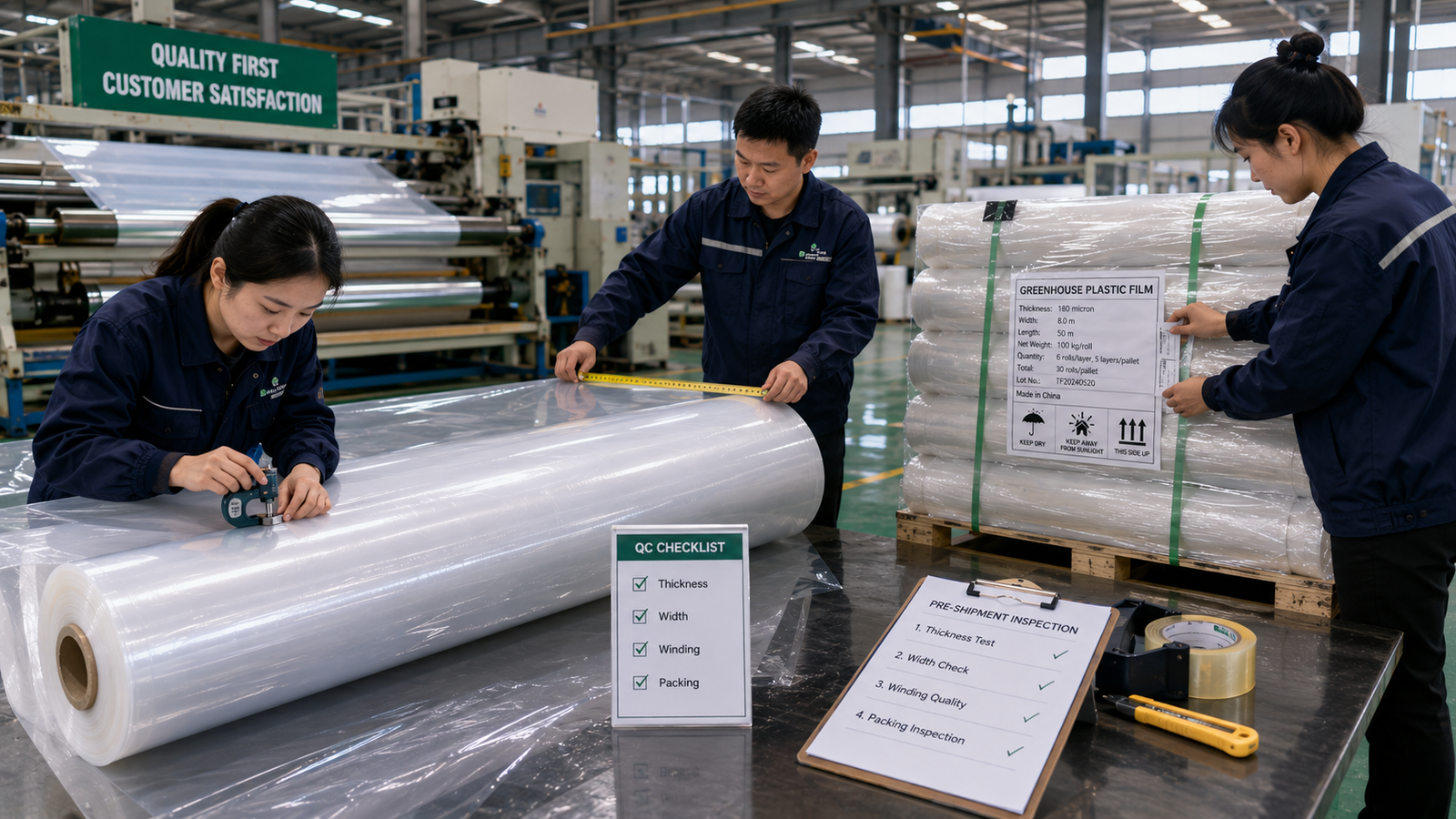
| During production | Any agreed witness, sample or inspection requirement. | Checks arranged for the order, which may include dimensions, thickness, appearance, roll weight or other agreed items. | Inspection must follow the purchase specification rather than a generic marketing claim. |
| Before shipment | Delivery marks, consignee information, document list and unloading constraints. | Quantity, packing, labels, shipment readiness and agreed records. | A correct roll can still create loss if it is mislabeled, damaged or impossible to handle. |
Which documents should be confirmed?
The appropriate evidence depends on the purchase. It may include a product specification sheet, TDS, approved sample, internal inspection record or third-party report. A document should identify the product or batch it applies to and should not be presented as proof of a property it did not test.
When a contract specifies testing, the method and acceptance criteria should be agreed before production. For example, ASTM D882 addresses tensile properties of thin plastic sheeting, while optical requirements may reference an applicable method such as ASTM D1003. Mentioning a standard is not evidence that a particular roll was tested. The order documents must connect the test, specimen and result to the supplied product.
Review the site's factory and plastic film quality-control process and the explanation of available TDS and quality documents before deciding what the purchase order requires.
Common Greenhouse Plastic Sheeting Buying Mistakes
1. Treating "clear" as a specification
Why it happens: Clear rolls look similar in photos. Consequence: UV, light and intended-use differences remain unknown. Correct action: Identify the product grade and written performance requirements.
2. Treating "roll" as a quality level
Why it happens: Roll is used as a product name. Consequence: A delivery format is mistaken for greenhouse suitability. Correct action: Confirm formulation, dimensions, functions and documents.
3. Ordering by 6 mil alone
Why it happens: Thickness is easy to compare. Consequence: The buyer may receive the right gauge with the wrong UV package or width. Correct action: Treat thickness as one line in a complete specification.
4. Measuring only the ground width
Why it happens: The floor is easier to measure than the covering path. Consequence: The sheet may not reach the fastening points. Correct action: Measure over the structure and include approved allowances.
5. Confusing flexible sheeting with rigid panels
Why it happens: Both appear under "plastic sheets" in search results. Consequence: Price, framing and installation comparisons become meaningless. Correct action: Confirm the covering system before comparing materials.
6. Assuming anti-drip removes humidity
Why it happens: Functional names sound absolute. Consequence: Ventilation and climate-control problems remain unsolved. Correct action: Treat the function as one part of condensation management.
7. Approving the widest roll without a handling plan
Why it happens: Fewer seams appear automatically better. Consequence: The roll may be too heavy or long for unloading and installation. Correct action: Confirm roll weight, core, packing and site equipment.
8. Requesting evidence after production
Why it happens: Documents are treated as paperwork rather than purchase requirements. Consequence: The requested test or sampling may no longer be available. Correct action: Agree documents, methods and acceptance criteria before production.
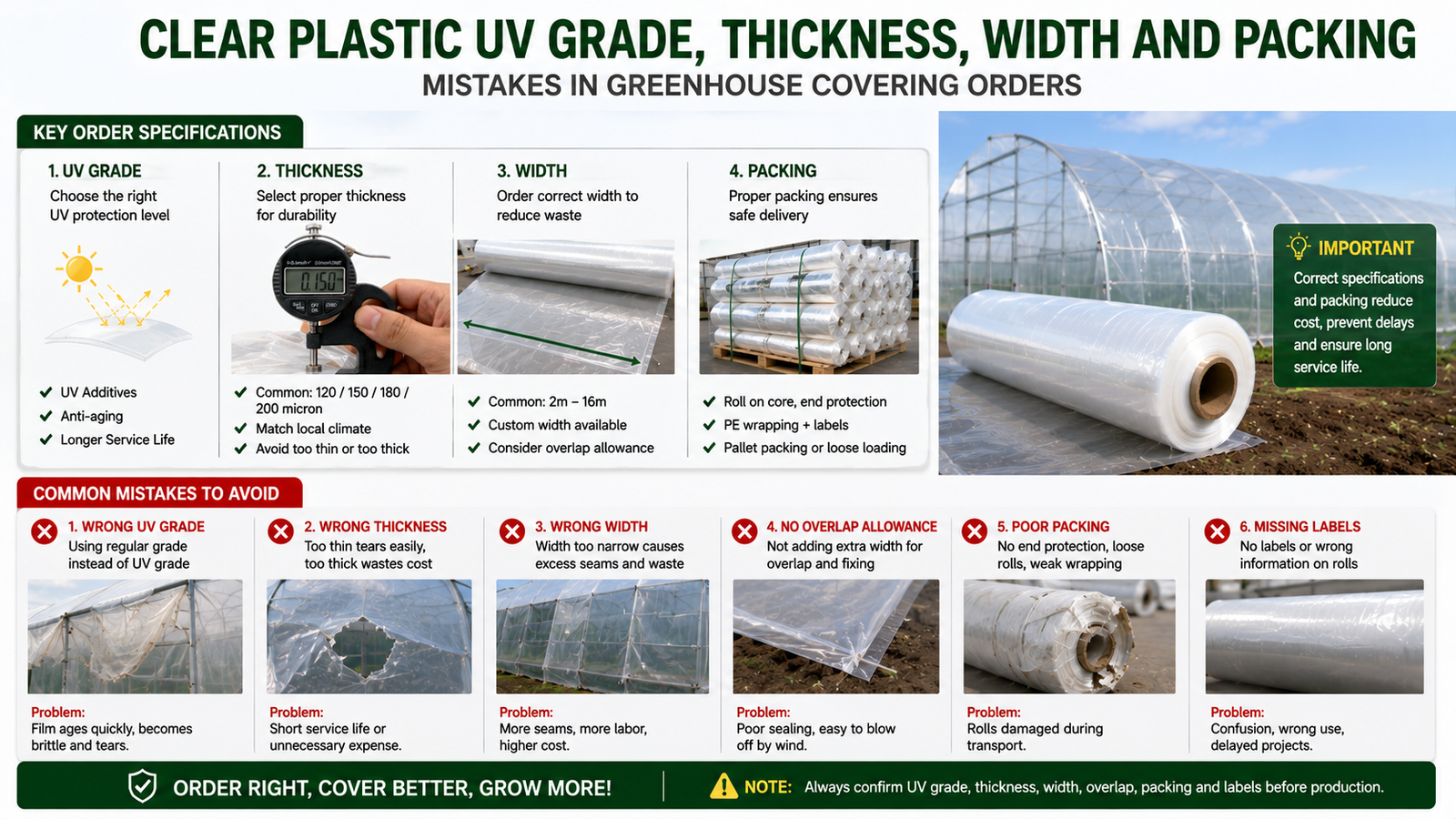
Information to Send for an Accurate Greenhouse Plastic Quotation
- Application: commercial greenhouse, high tunnel, nursery house, low tunnel, sidewall or temporary cover.
- Structure: frame type, single or double layer, fastening method and roll-up openings.
- Material direction: greenhouse-grade PE, PO greenhouse film or another confirmed product.
- Dimensions: finished width, cut or roll length, quantity of rolls and measurement basis.
- Thickness: nominal mil or micron value, tolerance and any required minimum.
- Functions: UV stabilization, anti-drip, anti-fog, diffusion, thermal or other project-specific options.
- Optical requirement: clear or diffused film and any stated transmittance or haze criterion.
- Commercial details: total quantity, destination, requested schedule and delivery terms.
- Packing: core, roll marks, protective wrap, woven bag, carton, pallet and unloading limits.
- Evidence: specification sheet, TDS, sample, inspection record or third-party testing required by the purchase.
For a complete commercial purchasing workflow, use the commercial greenhouse plastic roll order checklist. For field attachment and tensioning, refer to the guide on installing greenhouse plastic on metal and wood frames.
Example RFQ wording:
"Please quote greenhouse-grade flexible PE film for a commercial hoop house. Finished width: [value]. Roll or cut length: [value]. Nominal thickness and tolerance: [value]. Quantity: [value]. Required functions: [UV / anti-drip / diffusion / other]. Fastening method: [value]. Destination: [value]. Please confirm estimated roll weight, packing method, production feasibility and available TDS or inspection documents before order approval."
Frequently Asked Questions
Is greenhouse plastic sheeting the same as greenhouse film?
Often, yes. In commercial search and purchasing language, both terms can describe flexible polyethylene greenhouse covering. "Sheeting" is broader and may also refer to ordinary construction plastic or rigid panels, so the product grade and form must be confirmed.
Can I use clear plastic sheeting for greenhouses?
It can be used for a short-term or low-risk temporary cover when the buyer accepts unverified agricultural UV, optical and condensation performance. For commercial or multi-season crop protection, greenhouse-grade UV-stabilized film is the safer starting point.
What is the best plastic sheeting for greenhouse use?
For most commercial flexible-cover structures, the safer starting point is greenhouse-grade UV-stabilized polyethylene film whose thickness, dimensions, optical direction and required functions are confirmed for the project. A permanent rigid structure may instead require polycarbonate or another panel system.
What thickness should plastic sheeting be for a greenhouse?
Six mil, approximately 152.4 microns, is a common reference for greenhouse covering, but it is not a universal answer. Structure, exposure, handling, installation and required use period matter. NIST identifies one mil as 0.001 inch, equal to 25.4 micrometers. Confirm the nominal thickness and tolerance with the supplier.
Is 6 mil greenhouse plastic sheeting automatically UV resistant?
No. Thickness and UV stabilization are separate specification items. A 6 mil clear construction sheet and a 6 mil greenhouse-grade film may have different intended uses and formulations.
How should UV resistant greenhouse plastic sheeting be specified?
State the greenhouse application, expected outdoor exposure, material grade, thickness and tolerance, width, length and any required technical evidence. Do not treat "UV resistant" as a complete specification or an automatic service-life guarantee.
Is the clearest greenhouse plastic always the best?
No. Clear film may suit projects prioritizing direct light, while diffused or functional films may suit other crops and climates. Optical performance should be selected from the growing objective rather than appearance alone.
Does anti-drip greenhouse film prevent all condensation?
No. Anti-drip treatment changes how condensation behaves on the film surface. It does not remove moisture from the greenhouse or replace ventilation and climate management.
How do I know which side of greenhouse plastic faces inward?
Follow the supplier's roll markings and installation instructions. This is especially important when a surface treatment or functional layer must face the greenhouse interior. Do not infer orientation from visual appearance.
Should I choose greenhouse film or polycarbonate sheets?
Choose based on the frame and project economics. Flexible film suits hoop houses and large curved structures; rigid polycarbonate suits frames designed for panels and can provide different insulation and replacement characteristics.
How long does greenhouse plastic sheeting last?
There is no responsible universal answer based only on thickness. Product formulation, UV stabilization, climate, chemicals, frame abrasion, tension and maintenance all affect service life. Use the supplier's product-specific statement and agreed warranty terms where available.
What should a factory confirm before producing a custom roll?
The factory should confirm production feasibility for the material, thickness, width, length, functions, roll format and packing. The buyer or project team should approve the structure dimensions, installation method, intended use and required documents.
Purchase the Specification, Not Just the Product Label
The greenhouse plastic sheeting vs greenhouse film decision should end with a written specification, not a product-label debate. Greenhouse plastic sheeting is a broad purchase description. For a commercial greenhouse, the safer decision is normally a greenhouse-grade flexible film whose UV package, thickness, dimensions, optical direction, functional options and packing have been confirmed in writing.
If the finished width, length and thickness are already known, review the available custom greenhouse plastic roll specifications. If the measurements are uncertain, complete the roll size and measurement guide before requesting production. For a custom project, send the application, dimensions, quantity, functions, packing requirement, destination and required documents through the plastic film specification and quotation form.
References and Technical Sources
- Oklahoma State University Extension: Greenhouse Structures and Coverings. Background on polyethylene film, UV stabilization, anti-drip options and flexible-cover selection.
- Washington State University Extension: Greenhouse Construction and Management. Greenhouse covering selection criteria and comparison of flexible polyethylene film with rigid polycarbonate systems.
- NIST Guide to the SI, Appendix B.8. Exact conversion of one mil, or 0.001 inch, to 0.0254 millimeter or 25.4 micrometers.
- ASTM D882: Tensile Properties of Thin Plastic Sheeting. Example of a standardized mechanical test that may be specified when relevant to a purchase.
- ASTM D1003: Haze and Luminous Transmittance of Transparent Plastics. Example of an optical test method when a contract requires defined haze or transmittance data.