

Commercial Greenhouse Plastic Roll Buying Guide: 12 Checks Before Ordering
This commercial greenhouse plastic roll buying guide is built around 12 checks that should be completed before a final quotation is approved. Confirm the greenhouse application, finished film width and length, nominal thickness and tolerance, material, UV requirement, condensation-control functions, installation method, roll format, packing, order quantity and required quality documents. A supplier can quote from incomplete information, but that does not mean the resulting roll will fit the structure or suit the growing environment.
Practical starting point: For many single-layer commercial greenhouse and high-tunnel projects, UV-stabilized greenhouse-grade polyethylene around 6 mil, or approximately 150 microns, is a common starting specification. It is not a universal answer. Final width, thickness, additives and roll format should be confirmed from the frame measurements, fastening method, climate, crop, expected exposure and handling plan.
In actual quotation work, the expensive mistakes rarely begin with an obviously defective roll. They begin with a missing measurement, an assumed film function or a packing detail that nobody confirmed. The safest purchase order is therefore not the one with the longest specification. It is the one that separates project information supplied by the buyer from film performance confirmed by the manufacturer.
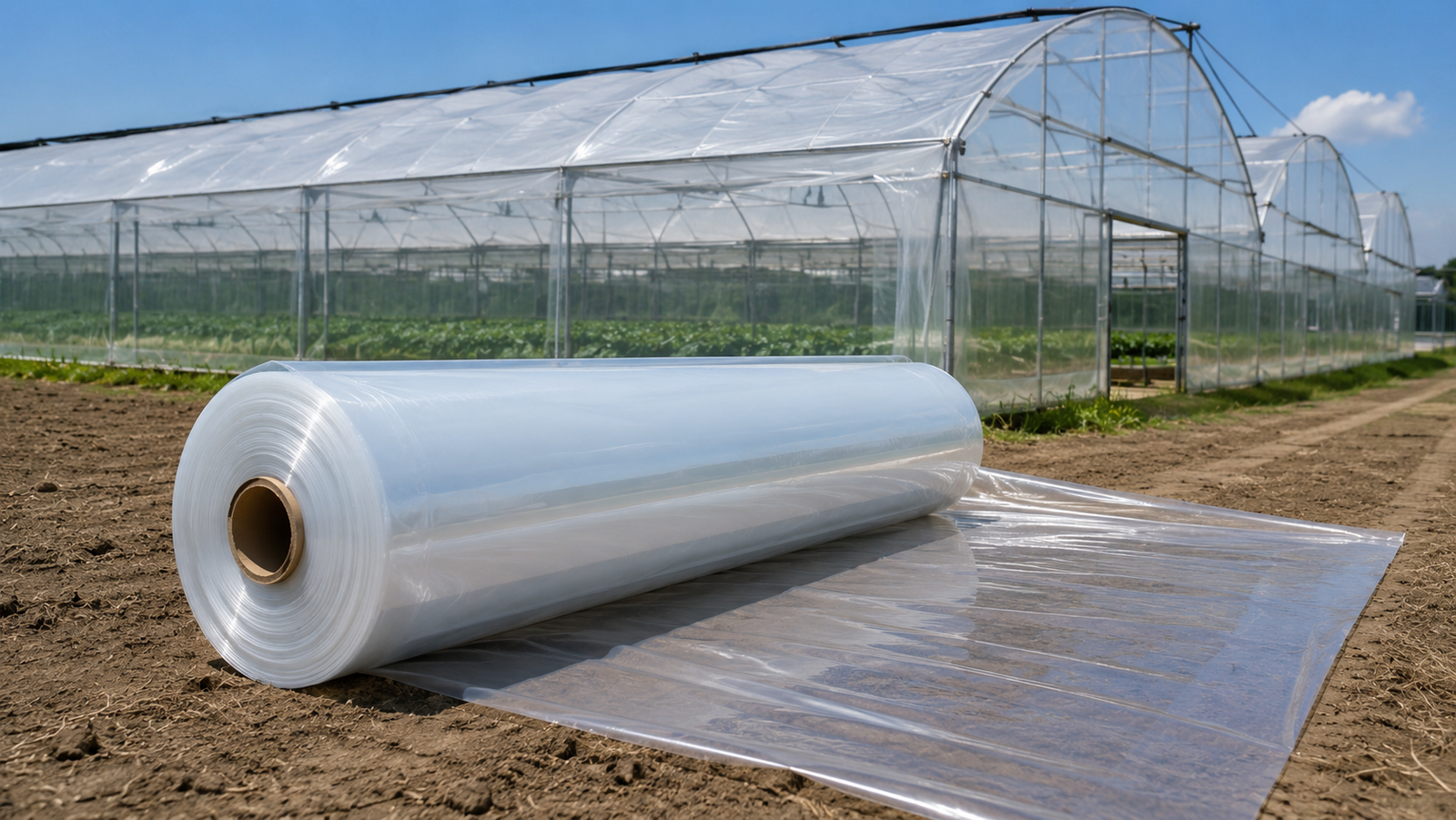
Quick Answer: 12 Checks Before Ordering a Commercial Greenhouse Plastic Roll
A usable quotation needs more than the words “clear greenhouse plastic.” The supplier should be able to identify the product being priced, while the buyer should be able to identify the structure and operating conditions the film will face.
| Check | Information to Confirm | Why It Changes the Order |
|---|---|---|
| 1. Application | Commercial greenhouse, high tunnel, nursery house, roll-up sidewall or another use | Determines whether the request is truly a greenhouse-covering application and which functions matter. |
| 2. Structure | Single span, multi-span, gutter-connected, single layer or inflated double layer | Changes measurements, film arrangement and installation compatibility. |
| 3. Material | Greenhouse-grade PE formulation and any required material or layer structure | Construction sheeting and greenhouse film are not automatically equivalent. |
| 4. Thickness | Nominal thickness, permitted tolerance and any minimum-thickness requirement | A nominal number alone does not show thickness consistency. |
| 5. Width | Finished width based on the covering path and fastening allowances | Ground width alone normally understates the required cover width. |
| 6. Length | Cut length, master-roll length, number of houses and waste allowance | Changes roll weight, handling, installation planning and total quantity. |
| 7. Optical needs | Clear or diffused light, transmittance or haze requirement if specified | The highest transparency is not automatically the best result for every crop and climate. |
| 8. Functions | UV stabilization, anti-drip, anti-fog, thermal or other project-specific options | Functional claims must match the environment and be confirmed in writing. |
| 9. Installation | Lock channel, wiggle wire, batten, clips, roll-up sides and film orientation | Fastening and moving parts affect allowances and damage risk. |
| 10. Packing | Core, protective wrap, woven bag, carton, pallet, labels and roll marks | Packing must protect the roll and match the buyer's warehouse and installation process. |
| 11. Commercial terms | Quantity, MOQ, destination, delivery terms and requested schedule | These factors affect production planning, packing and freight. |
| 12. Documents | Specification sheet, TDS, sample approval, inspection record or third-party testing | The required evidence must be agreed before production, not requested after shipment. |
Separate Buyer Inputs from Supplier Confirmations
This distinction prevents a common B2B failure: both sides assume the other party has checked the missing detail. A film manufacturer can verify whether a width, thickness and formulation can be produced. The buyer, greenhouse builder or project engineer must confirm the structure dimensions, covering path, fastening points, local exposure and site handling conditions.
| Usually Supplied by the Buyer or Project Team | Usually Confirmed by the Film Supplier |
|---|---|
| Frame drawings or measured covering path | Available finished width and production tolerance |
| Number of houses, bays and required cut lengths | Roll configuration, estimated roll weight and packing method |
| Single-layer or double-layer covering design | Suitable film formulation and available functional options |
| Fastening, roll-up side and opening details | Film orientation, marking and handling instructions when applicable |
| Climate, crop, chemical exposure and target use period | What the selected formulation can support and what remains unverified |
| Destination, unloading equipment and installation schedule | Pallet, core, protection, labeling and production feasibility |
Scope boundary: A plastic-film supplier should not silently assume responsibility for structural wind, snow or frame-load calculations. When a specification depends on structural engineering, use the greenhouse drawings and the responsible engineer's requirements as the basis for the film order.
1. Start with the Application and Greenhouse System
“Commercial greenhouse” covers several different operating conditions. A film for a seasonal high tunnel is not automatically the same order as a year-round multi-span greenhouse with inflated double glazing. The crop, ventilation strategy, sidewall movement, chemical use and local weather all shape the specification.
The first quotation question should therefore be: What will the roll cover, and how will that covering be used? This sounds basic, but it determines which later details deserve priority.
| Project Situation | Safer Starting Direction | Why | Confirm Before Ordering |
|---|---|---|---|
| Single-layer commercial greenhouse or high tunnel | UV-stabilized greenhouse-grade PE; around 150 microns is a common starting point | Balances common covering practice with manageable roll handling, but does not replace project review | Covering path, fastening allowance, exposure, crop and required service period |
| Inflated double-layer roof | Film combination compatible with the designed inflation system | The two layers affect light, condensation, air space and installation | Outside and inside layer requirements, blower arrangement, film orientation and locking system |
| Humid greenhouse with recurring condensation | Greenhouse film with a confirmed condensation-control option | Dripping can reduce usable light and wet the crop canopy | Anti-drip or anti-fog terminology, treated side, test basis and expected functional period |
| Greenhouse builder ordering for a project | Project-specific widths and cut lengths from drawings | Installation crews need rolls that match bays, openings and fastening details | Revision-controlled drawing, cut schedule, labels and delivery sequence |
| Distributor building local stock | Repeatable standard SKUs rather than constant one-off customization | Stock turnover, labels and reorder consistency matter more than a single project's perfect cut length | Standard widths, lengths, packaging, SKU marks, sample and reorder tolerance |
For a broader comparison of flexible film and rigid coverings, use the greenhouse covering material comparison. Buyers comparing clear, PO and functional agricultural films can also review the greenhouse film product category. This ordering guide assumes that flexible greenhouse film has already been selected.
2. Confirm Greenhouse-Grade Material and Film Construction
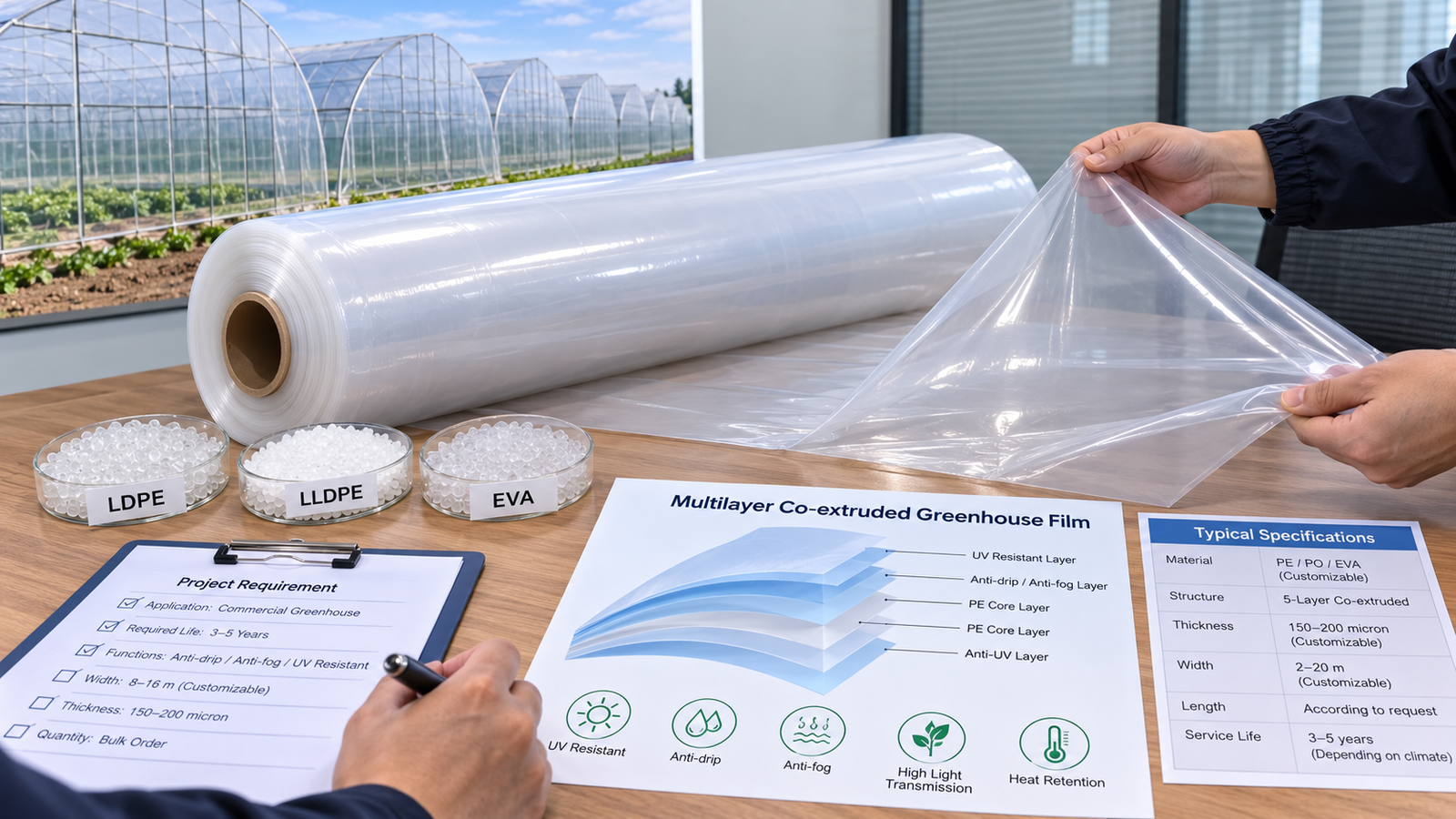
Greenhouse film is commonly based on polyethylene formulations, but the material description on a quotation should be more useful than the single word “PE.” Depending on the product and performance target, a formulation may use LDPE, LLDPE, EVA, PO-related structures or functional masterbatch options. The exact recipe is normally proprietary; the buyer still needs a clear product identity and a written performance specification.
A common mistake is to treat ordinary construction plastic as a lower-priced substitute. Both products may look clear when unrolled, yet greenhouse film is selected for outdoor covering, light management and weathering functions. If the purchase is for temporary emergency protection, ordinary sheeting may be acceptable. If the film must stay on a crop structure through prolonged sun and weather exposure, greenhouse-grade UV stabilization should be explicitly confirmed.
Do not assume that more layers automatically mean better film
Layer count describes how a film is manufactured, not whether every property is suitable for the project. A multilayer structure can place different functions in different layers, but only when the actual product is designed and verified that way. Ask the supplier to confirm the layer structure for the quoted item. Do not transfer a five-layer claim from a PO greenhouse film to an ordinary PE roll unless the specification states it.
For the material basics, read what greenhouse film is and how it differs from ordinary plastic sheeting. Buyers ready to review a customizable roll can then move to the commercial greenhouse plastic roll product page.
3. Confirm Thickness, Tolerance and Actual Minimum
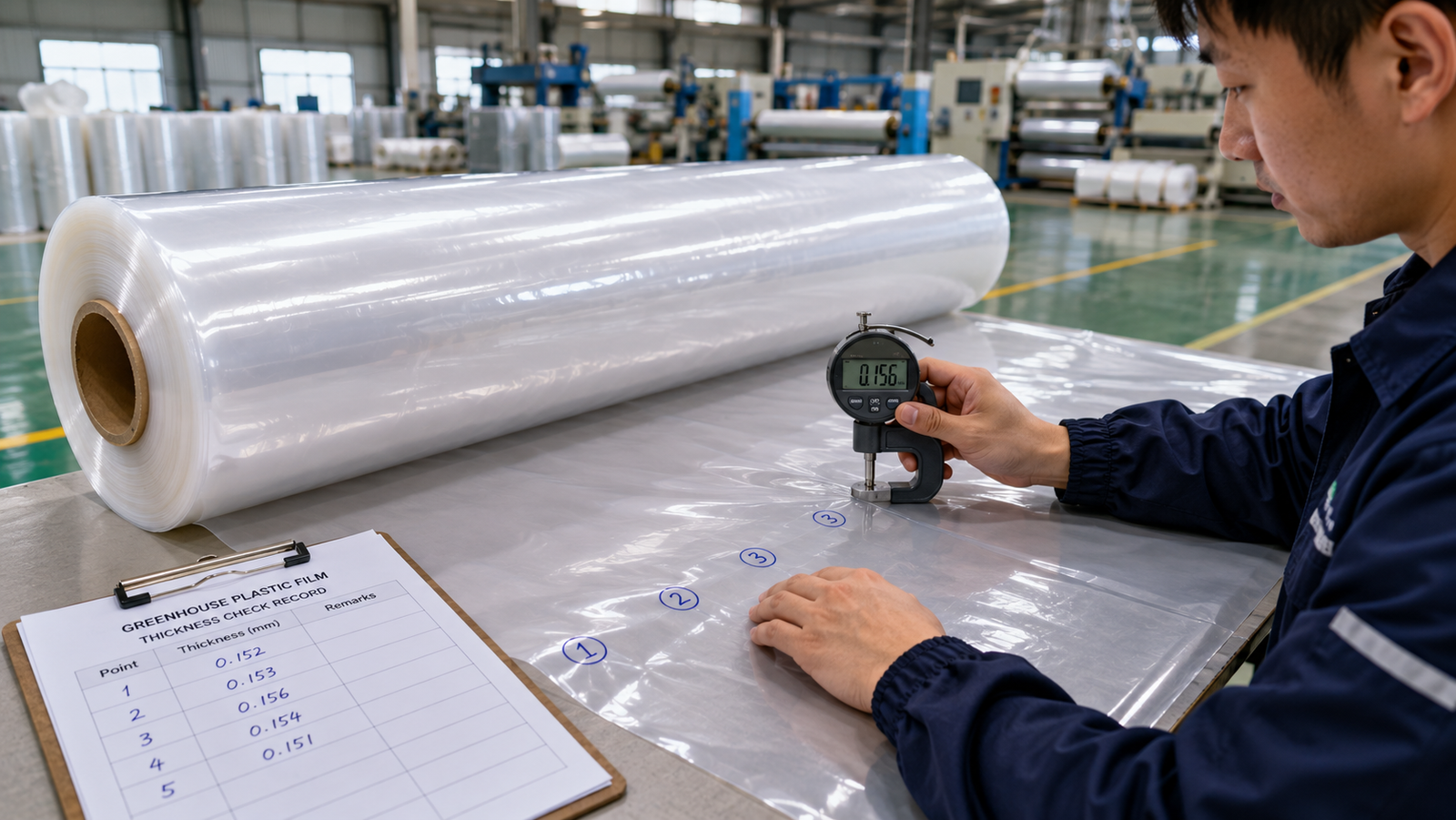
Thickness is often the first number a buyer asks for because it is easy to compare. It is also one of the easiest numbers to misuse. A request for “6 mil film” is incomplete unless both parties agree on the unit, nominal thickness, accepted tolerance and, where necessary, minimum measured thickness.
NIST lists one mil as 0.001 inch, equal to 25.4 micrometers. Therefore, 6 mil equals 152.4 microns and is commonly rounded to 150 microns in commercial discussion. The rounding is practical, but the purchase specification should use one agreed unit so that 150 microns, 0.15 mm and 6 mil are not treated as three unrelated products.
| Nominal Direction | Approximate Mil Equivalent | Procurement Interpretation | Tradeoff to Review |
|---|---|---|---|
| 100 microns | 3.9 mil | Lighter film sometimes used where the project accepts a thinner specification | Lower roll weight, but less material reserve against puncture, handling and local stress |
| 150 microns | 5.9 mil | Common starting point for many greenhouse and high-tunnel covers | Still requires UV, tolerance, installation and climate confirmation |
| 180–200 microns | 7.1–7.9 mil | Used when the project calls for a heavier film specification | Higher roll weight and more difficult pulling or positioning |
| 250 microns | 9.8 mil | Project-specific heavy film rather than an automatic upgrade | Production width, winding, freight, fastening and installation handling need review |
Thicker film can provide more material at a puncture or wear point, but thickness does not create UV stability, anti-drip performance or good thickness uniformity. It can also make a wide roll substantially heavier. A heavier roll may need more crew, lifting equipment or a different installation sequence. This is why the cheapest “upgrade” on a quotation can become a more expensive installation on site.
For detailed mil-to-micron comparisons, use the greenhouse plastic thickness guide. In the purchase order, state the nominal thickness, tolerance and test or inspection method agreed with the supplier.
4. Measure Finished Width, Length and Roll Format
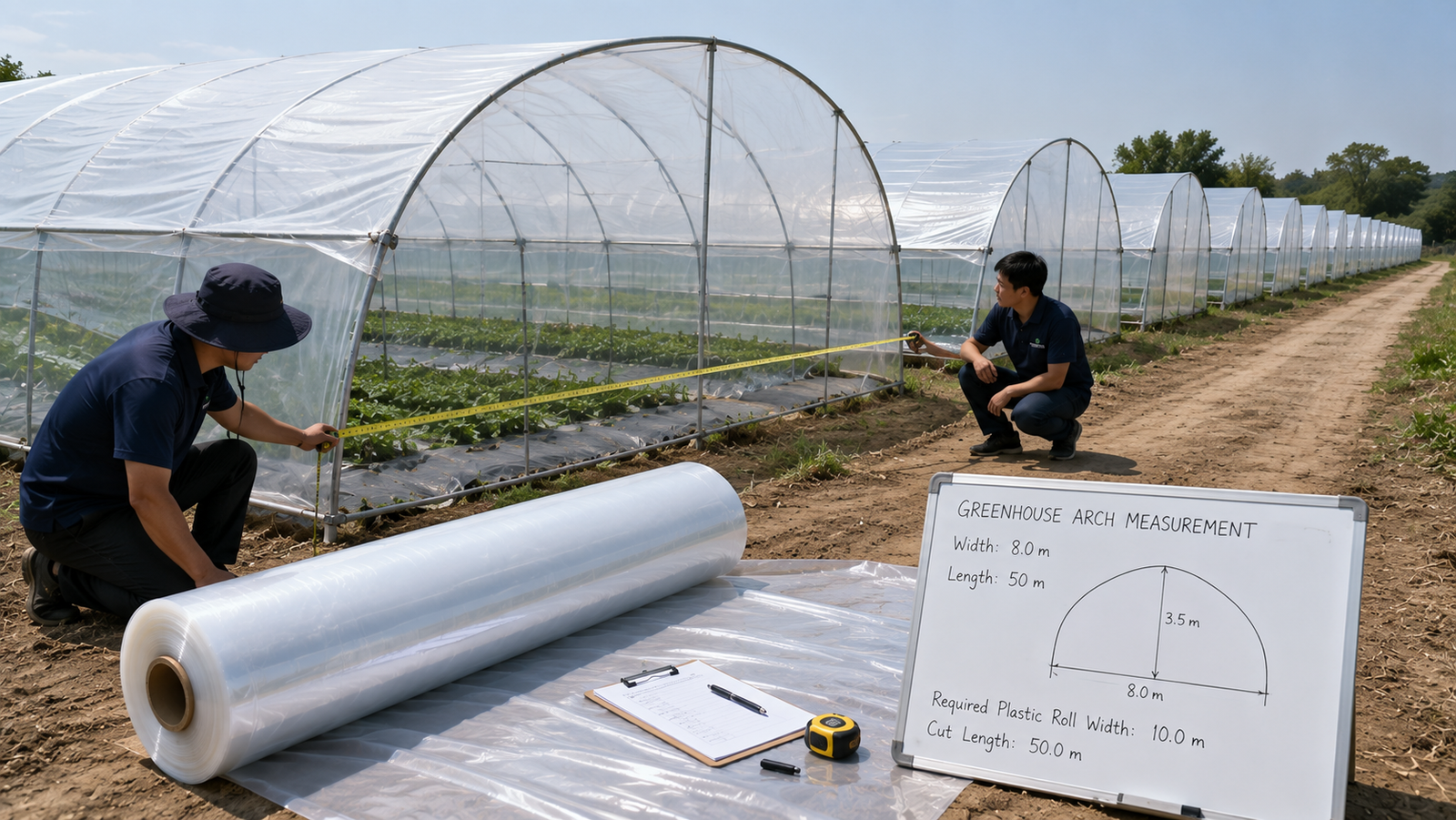
The most common width error is simple: the buyer supplies the ground width of the greenhouse, while the supplier needs the full covering path over the frame plus fastening allowances. A 10-meter-wide structure does not require a 10-meter-wide roof film. The film follows the arch, continues to the fixing points and may need extra material for gripping, tensioning or roll-up components.
Real quotation scenario: A farm sends “greenhouse width: 8 m” and requests an 8 m roll. After the frame drawing is reviewed, the actual path over the arches is longer, and both sides terminate below the shoulder. The original quote can be produced, but the film cannot reach the intended locks. The correct action is to measure the covering path, not to increase the order after the roll has been made.
Cut-to-length rolls and master rolls serve different buyers
A greenhouse builder may prefer labeled cut lengths that match each bay or house. A distributor may prefer repeatable master rolls that can be stocked and cut locally. Neither format is universally better. Cut rolls reduce site measuring and waste, while master rolls can simplify inventory and serve several projects. The decision affects roll weight, core, pallet layout, labels and installation handling.
Useful quotation format: “Finished width 12 m × cut length 45 m, 150 microns nominal, 18 rolls, individually labeled by greenhouse number.” This is much safer than “plastic for 18 greenhouses.”
Use the illustrated greenhouse plastic roll size and measurement guide when calculating the covering path, roll length and project quantity. The final measurements should still be checked against the actual frame and fastening design.
5. Specify the Optical Result, Not Just “High Transparency”
Buyers frequently request the highest possible light transmission because the number appears easy to compare. In practice, light quality is a combination of transmission, haze or diffusion, film thickness, additives, condensation, dust and aging. Clear film may be appropriate where maximum direct light is wanted. Diffused light can be useful where more even distribution through a crop canopy is the priority.
There is a real tradeoff. Additional layers, pigments or functions may change optical performance. A double-layer covering also transmits less light than a comparable single layer because light passes through two films and the surfaces between them. The project team should decide whether heat retention, diffusion, condensation control or maximum direct transmission is the leading requirement.
If optical values are part of the contract, identify the test method, specimen thickness and whether the value represents total luminous transmission or another measurement. ASTM D1003 is one recognized method for haze and luminous transmittance of transparent plastics, but the supplier and buyer must agree on the applicable method and acceptance limits.
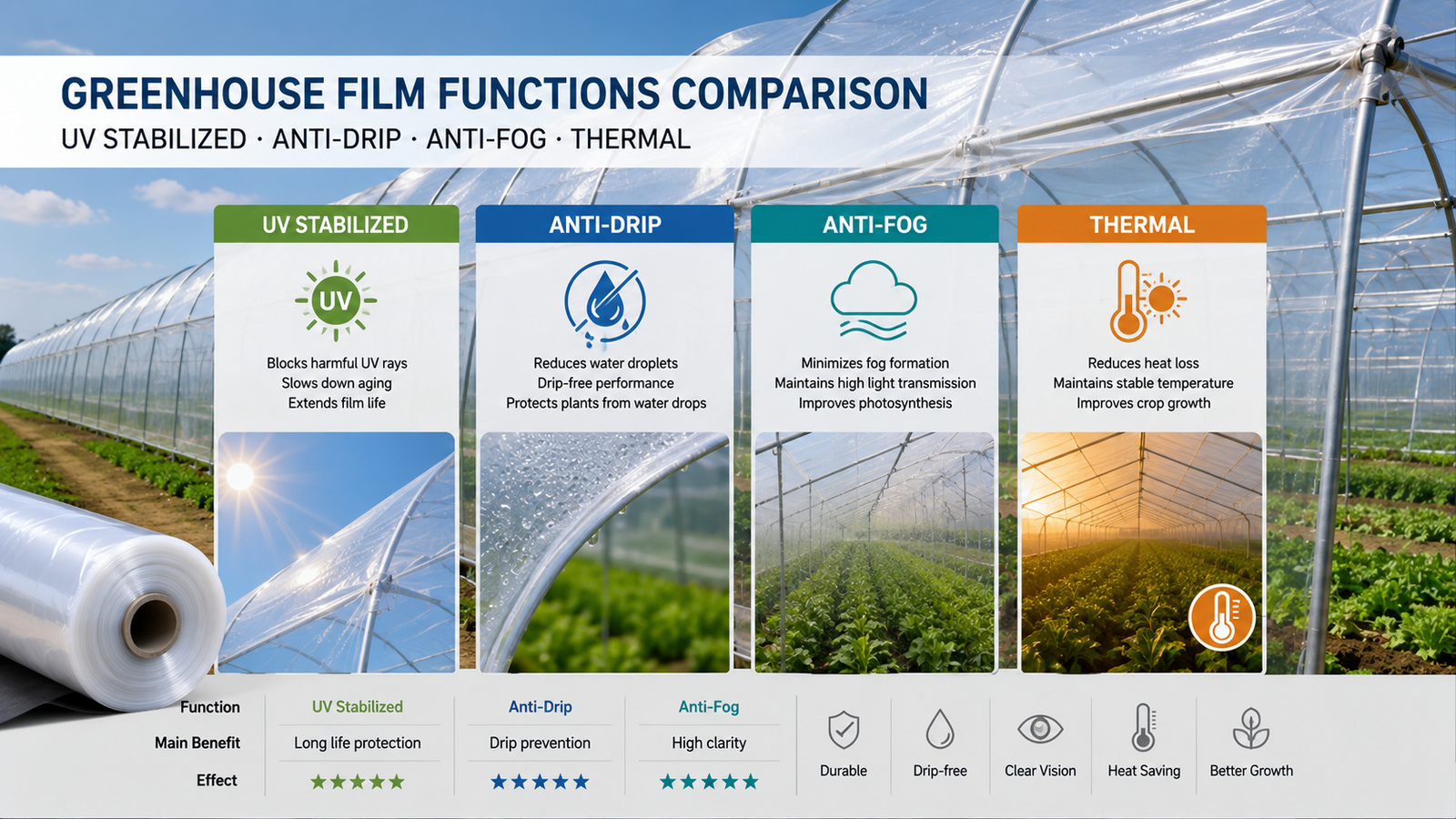
6. Confirm UV, Anti-Drip, Anti-Fog and Thermal Options
Functional additives should solve a defined operating problem. Listing every available additive can raise cost without producing a better greenhouse.
| Operating Need | Film Direction to Discuss | Why It Helps | What Must Be Confirmed |
|---|---|---|---|
| Long outdoor exposure | UV-stabilized greenhouse-grade formulation | Slows sunlight-related yellowing, brittleness and loss of film properties | Intended exposure, formulation statement, warranty basis if offered and chemical restrictions |
| Condensation dripping onto crops | Anti-drip or anti-condensation function | Encourages condensate to form a film and run toward the edges instead of falling as large droplets | Treated side, installation orientation, test basis and expected functional period |
| Persistent internal fog or visibility problem | Anti-fog option where available | Targets suspended fine droplets or visibility conditions that are not identical to surface dripping | How the supplier defines anti-fog and how performance is evaluated |
| Heat-loss management | IR or thermal-retention option | Can alter long-wave infrared transmission and nighttime heat behavior | Climate, greenhouse system, expected benefit and possible optical tradeoff |
| Dust-prone environment | Anti-dust or surface option where available | May help reduce surface contamination that lowers useful light | Exposure conditions, cleaning practice and whether the function is documented |
Do not assume that anti-drip life equals film service life. A film may remain physically intact after a surface or additive function has weakened. The written specification should separate structural service expectations from functional duration. Agricultural chemicals, cleaning products and greenhouse treatments may also interact with stabilizers, so disclose unusual chemical exposure before the formulation is confirmed.
If the required UV performance has not yet been defined, use the UV-stabilized greenhouse plastic specification guide before approving the final purchase order.
7. Review Mechanical Performance in Both Film Directions
A roll can have the correct thickness and still behave poorly if its tensile, elongation, tear or puncture performance is unsuitable or inconsistent. Mechanical values are especially useful when comparing approved samples, investigating a production issue or setting a repeat-order specification.
Review machine direction (MD) and transverse direction (TD), because blown film is not necessarily identical in both directions. Also check the test method, specimen thickness, conditioning and test speed. ASTM D882 notes that tensile results can change with specimen thickness, preparation, speed and grip method. Two suppliers' numbers should not be treated as directly comparable when the methods differ.
- Tensile strength: indicates the stress carried before failure under the defined test.
- Elongation at break: helps describe how much the specimen stretches before breaking.
- Tear resistance: matters once a cut, nick or edge defect has started.
- Puncture or impact resistance: is relevant around rough frames, handling tools and wind-driven contact.
These figures support purchasing decisions; they do not replace good frame preparation. A strong film can still fail early when it rubs against a sharp bolt, is trapped under an uneven batten or is tensioned over a rough surface.
For a practical review of optical, weathering, condensation and strength criteria, see the guide to greenhouse film quality factors.
8. Match the Film to the Fastening and Installation Method
Film dimensions cannot be finalized in isolation from installation. Lock channel and wiggle wire, timber battens, clips, roll-up side tubes, end-wall transitions and inflated double layers each create different allowances and stress points.
Real project scenario: A greenhouse builder orders film from a drawing, but the quotation does not identify which bays have roll-up sides. The roof width is correct, while the sidewall pieces lack the additional material required for attachment to the roll tube. The film quality is not the problem; the cut schedule is.
Before production, remove sharp edges, isolate hot or abrasive frame surfaces where required and confirm which film side faces inward or outward. Do not solve an unclear fastening design by ordering a much thicker roll. Extra thickness cannot correct missing allowances or continuous abrasion.
For the field sequence and fastening methods, refer to the guide on installing greenhouse plastic on metal and wood frames. The installation team should approve the measurements before custom cut lengths are released.
9. Treat Packing, Freight and Unloading as Part of the Specification
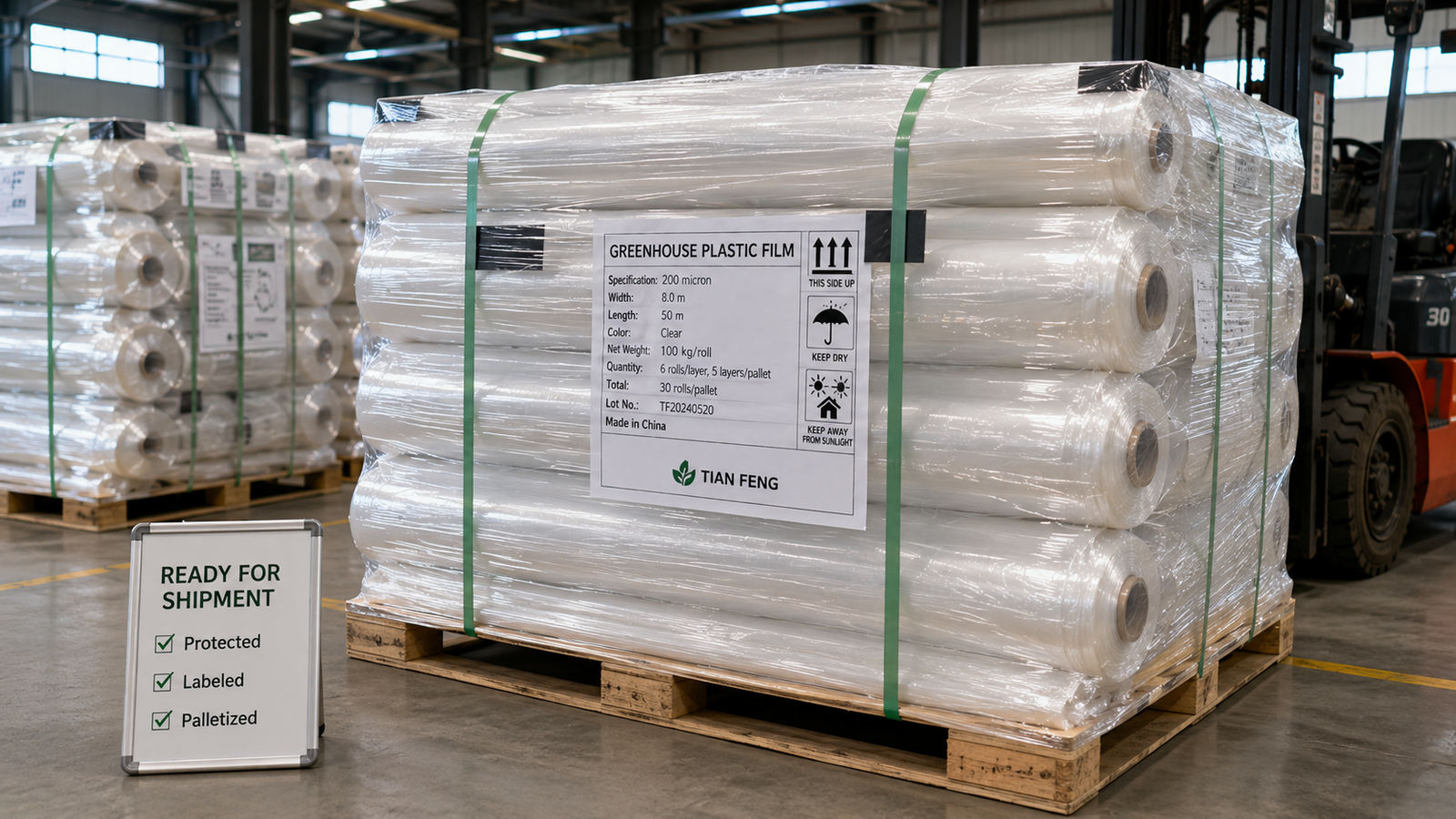
Wide commercial rolls can become heavy even when the film itself is flexible. Increasing thickness, width or length changes the roll weight and can affect the core, winding tension, pallet, container loading and site handling. The buyer should know how the roll will be unloaded and moved before choosing the largest possible roll.
- Confirm net and gross roll weight or the method used to calculate it.
- Confirm core material, core inside diameter and whether the installation equipment fits it.
- Specify individual roll protection, woven bag, carton or pallet requirements.
- Use labels that identify product, width, length, thickness, batch or project position as agreed.
- Confirm whether a forklift, lifting bar or manual crew will handle the roll at destination.
- For container shipments, review pallet dimensions, loading arrangement and moisture protection.
Distributor scenario: A distributor may accept longer master rolls to reduce the number of SKUs, but only if the local warehouse can rewind, cut and identify them. If those capabilities are absent, project-sized rolls with clear labels can reduce customer complaints even when the unit price is slightly higher.
10. Confirm MOQ, Lead Time and Repeat-Order Logic
MOQ and lead time are not fixed by the product name alone. They may change with material, color, additive package, thickness, width, cut length, printing, packing and whether the formulation is already scheduled. A supplier should review the complete specification before confirming production timing.
For repeat purchases, the first order should create a usable reference rather than a vague description. Record the approved specification, sample or color reference, packing, labels and any agreed inspection points. When a buyer says “same as last order,” both parties should be able to identify the last approved version.
Standard specifications can be a better choice than excessive customization when a distributor needs stable stock, short replenishment cycles and interchangeable inventory. Project customization is more valuable when it reduces cutting waste, installation labor or mismatched functions. Customization without an operational reason only creates another SKU to control.
For greenhouse plastic wholesale orders, repeatable product codes, approved packing and reorder tolerances are usually more valuable than changing the formulation with every shipment. When comparing greenhouse plastic film manufacturers, ask how each supplier controls the approved specification across batches, not only whether a custom roll can be made once.
11. What the Factory Should Review Before Quoting
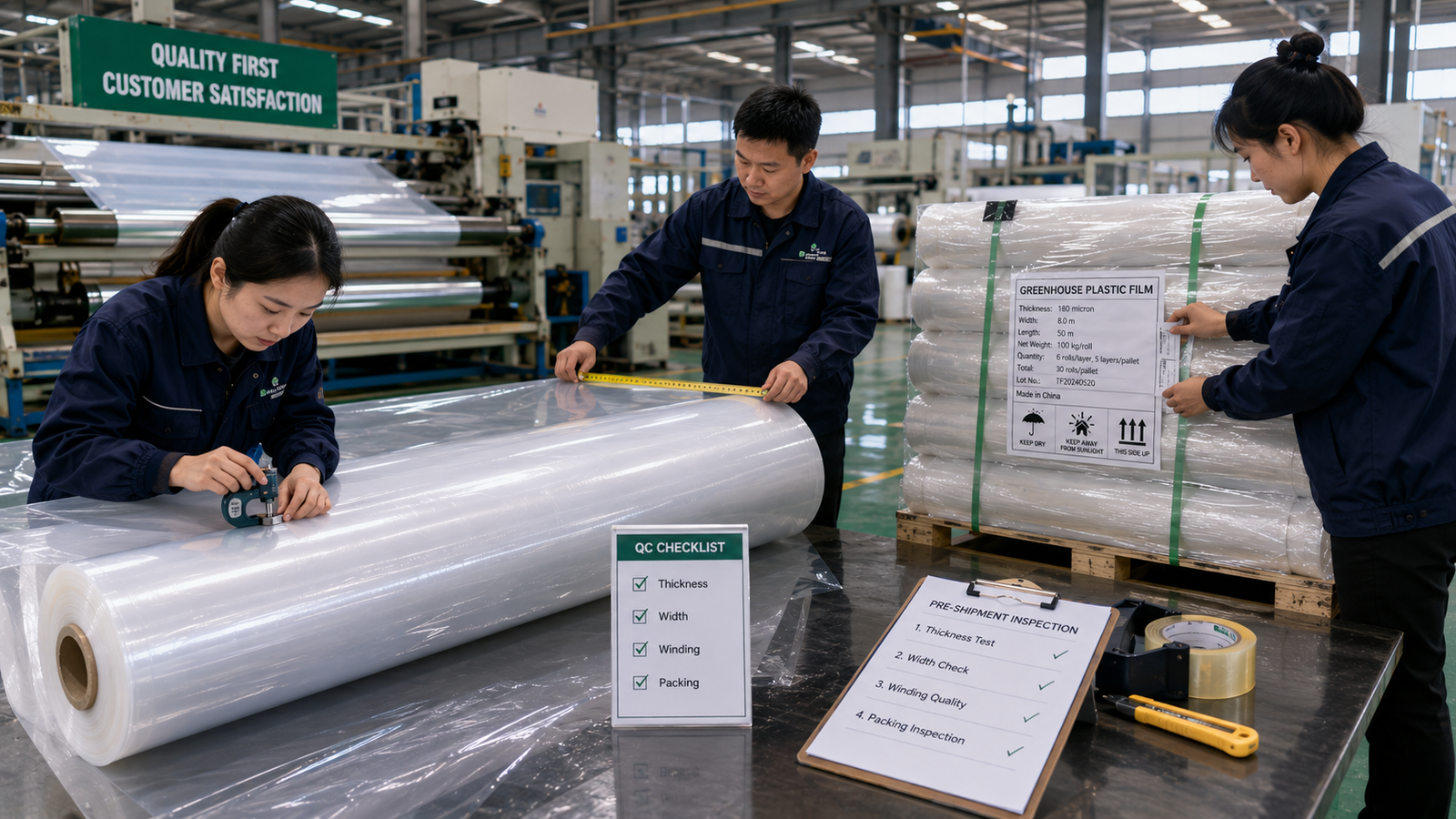
A professional quotation review is a feasibility check, not just a price calculation. Before issuing a firm production specification, the supplier normally reviews the material, width, thickness, winding, functions, packing and quantity together.
1. Specification Review
Confirm product use, material direction, dimensions, tolerance, function, packing and applicable documents.
2. Production Feasibility
Check whether the requested width, thickness, roll weight, color and formulation can be produced and wound consistently.
3. Commercial Review
Evaluate quantity, material preparation, production scheduling, packing labor, pallet use and destination requirements.
4. Sample or Document Approval
Agree on any sample, TDS, product specification sheet, color reference or third-party test before bulk production.
5. In-Process Checks
Define relevant checks such as thickness, width, appearance, roll weight, winding, packing and functional testing where specified.
6. Final Shipment Review
Verify quantity, labels, packing condition, shipment marks and the documents required with the order.
Not every order needs an independent laboratory report. The document package should match the purchasing risk and contract. Common options include a signed product specification, TDS, approved sample, internal inspection record and third-party report for specifically agreed tests. Requesting a report after production is risky because the sampling plan, test method and acceptance criteria were never part of the order.
Review the site's custom plastic film manufacturing process, plastic film factory and quality-control process, and guide to TDS, inspection records and plastic film quality documents before deciding which evidence the purchase requires.
12. Commercial Greenhouse Plastic RFQ Checklist
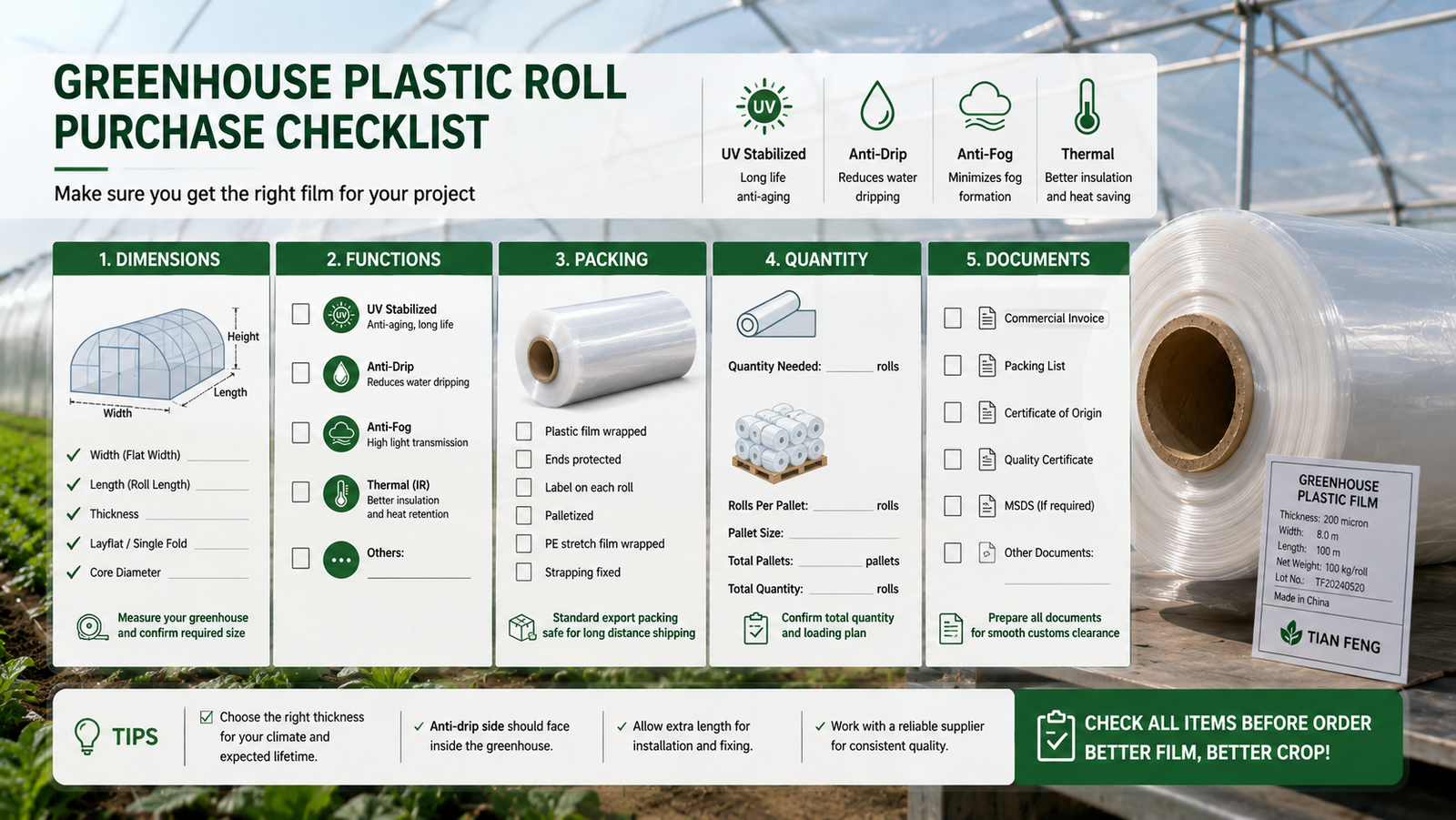
The following format gives a supplier enough information to identify gaps before preparing a final quotation.
- Application: commercial greenhouse, high tunnel, nursery house, roll-up side or other use
- Structure: frame type, single or double layer, number of houses and covering drawing if available
- Material: greenhouse-grade PE or requested formulation
- Thickness: nominal micron or mil value, tolerance and minimum requirement if applicable
- Finished width: based on measured covering path and fastening allowance
- Length: cut length or master-roll length and number of rolls
- Functions: UV, anti-drip, anti-fog, thermal, diffusion, color or other documented requirement
- Installation: lock channel, wiggle wire, battens, clips, roll-up sides and required orientation
- Packing: core, individual protection, woven bag, carton, pallet, labels and project marks
- Quantity: rolls, total area or estimated net weight
- Destination: country, port or delivery location, unloading limitations and requested delivery terms
- Documents: specification sheet, TDS, sample, inspection record or agreed third-party testing
If some parameters are unknown, do not invent them. Send the known dimensions, application, photos or drawings and mark the missing items for review. A qualified supplier can help translate project information into a manufacturable specification, but the buyer must approve the final version.
Common Mistakes When Ordering Greenhouse Plastic Rolls
Using Ground Width as Film Width
Why it happens: Ground width is the easiest number to find. Consequence: The film may not reach the fastening points. Correct method: Measure the full covering path and add approved fixing allowances.
Buying by Thickness Alone
Why it happens: Microns and mils look objective. Consequence: A thick roll may still lack UV stability, condensation control or consistent tolerance. Correct method: Review thickness with formulation, functions and test basis.
Assuming Anti-Drip Lasts as Long as the Film
Why it happens: Both claims appear on one product. Consequence: Condensation performance may weaken while the cover remains usable. Correct method: Confirm functional duration separately from physical service expectations.
Ignoring Film Orientation
Why it happens: Both sides look similar. Consequence: A surface or layer-specific function may face the wrong direction. Correct method: Request roll markings and written orientation instructions where applicable.
Ordering the Largest Possible Roll
Why it happens: Fewer rolls appear to mean less work. Consequence: Roll weight can exceed site lifting or crew capability. Correct method: Balance joints and waste against safe transport and installation handling.
Comparing Only Price per Kilogram
Why it happens: It creates one simple number. Consequence: Width, length, tolerance, additives, packing and usable service are ignored. Correct method: Normalize the complete delivered specification before comparing cost.
How to Compare Supplier Quotations Fairly
Two greenhouse plastic quotations are comparable only when they describe the same deliverable. Before choosing the lower number, place the following items on one comparison sheet:
| Comparison Line | What Must Match | Hidden Difference to Watch |
|---|---|---|
| Product identity | Greenhouse-grade film, material and structure | Ordinary sheeting priced as if it were stabilized greenhouse film |
| Dimensions | Finished width, length, thickness and tolerance | Nominal dimensions without an agreed tolerance |
| Quantity | Number of rolls, net area or net film weight | Gross pallet weight compared with net film weight |
| Functions | UV, condensation, diffusion, thermal or color options | Unspecified marketing claims without test or duration basis |
| Packing | Core, wrap, bag, carton, pallet, labels and marks | Low quote excludes export packing or pallets |
| Quality evidence | Specification, TDS, sample and agreed inspection documents | Test results use another thickness, method or product |
| Delivery | Incoterm, port, schedule and shipment quantity | Prices use different freight responsibilities |
The best commercial choice is not necessarily the highest specification. It is the lowest-risk specification that fits the structure, crop, climate, installation process and purchasing plan. Standardize what should repeat; customize only what improves the project.
Next Step: Turn the Buying Guide into a Confirmed Roll Specification
The purpose of this commercial greenhouse plastic roll buying guide is to produce one quotation basis that the buyer, supplier and installation team can all review. Once the missing project inputs have been resolved, transfer the agreed dimensions, film functions, packing and document requirements into the purchase specification.
If the finished width, cut length, thickness and required functions are already known, review the available custom greenhouse plastic roll options. If the frame has not been measured, complete the roll size worksheet first.
For a custom commercial project, send the application, frame or covering dimensions, quantity, packing requirement, destination and any required quality documents through the plastic film specification and quotation form. Unknown items can be marked for technical review before the production specification is approved.
Frequently Asked Questions
What thickness is commonly used for commercial greenhouse plastic?
Approximately 6 mil, or 150 microns, is a common starting point for many single-layer greenhouse and high-tunnel applications. The final thickness should still be matched to the structure, exposure, fastening method, handling plan and required formulation. Thicker film is not a substitute for UV stabilization or correct installation.
Are greenhouse plastic rolls and greenhouse plastic sheeting the same product?
The terms often overlap. “Roll” describes the supply form, while “sheeting” describes the flexible sheet material. In a purchase order, use the exact material, width, length, thickness, functions and packing rather than relying on either name alone.
Can ordinary construction plastic cover a greenhouse?
It may provide temporary physical coverage, but it should not be assumed to perform like greenhouse-grade film during prolonged outdoor exposure. Confirm UV stabilization, optical requirements and any condensation-control functions for the intended crop and service period.
How is the correct greenhouse plastic roll width calculated?
Measure the complete path over the frame from one fixing point to the other, then add the allowances required by the fastening or roll-up system. Do not use only the ground width. Complex structures should be checked against a drawing or measured by the installer.
Does anti-drip performance last as long as the greenhouse film?
Not necessarily. Functional duration and physical film life should be confirmed separately. Ask how the supplier defines the function, which side faces inward, what test basis is used and what operating conditions can affect performance.
Can commercial greenhouse film be made in custom widths and lengths?
Custom widths and roll lengths may be available within the manufacturer's production and winding limits. Very wide, thick or long rolls require a handling review because roll weight, core, packing, freight and installation equipment may become the limiting factors.
Which documents should a B2B buyer request?
Start with a confirmed product specification. Depending on the order risk, also request a TDS, approved sample, internal inspection record or agreed third-party test. The required test methods, sampling and acceptance criteria should be written into the order before production.
What information has the greatest effect on the quotation?
Material, thickness, width, length, functional additives, quantity, packing and destination usually have the most direct effect. Custom color, printing, special test requirements, short cut lengths and project-specific labels can also change production planning and cost.
Technical References
The following neutral technical sources support the greenhouse-covering and test-method principles used in this guide. They do not replace the final product specification agreed between buyer and supplier.
- Washington State University Extension: Greenhouse Construction and Covering Materials
- University of Arizona CEAC: Greenhouse Covering Systems
- University of Florida IFAS Extension: Physical Greenhouse Design Considerations
- NIST Guide to the SI: Conversion Factors for Mil, Inch and Micrometer
- ASTM D882: Tensile Properties of Thin Plastic Sheeting
- ASTM D1003: Haze and Luminous Transmittance of Transparent Plastics