
Single vs Double Layer Greenhouse Plastic: How to Choose
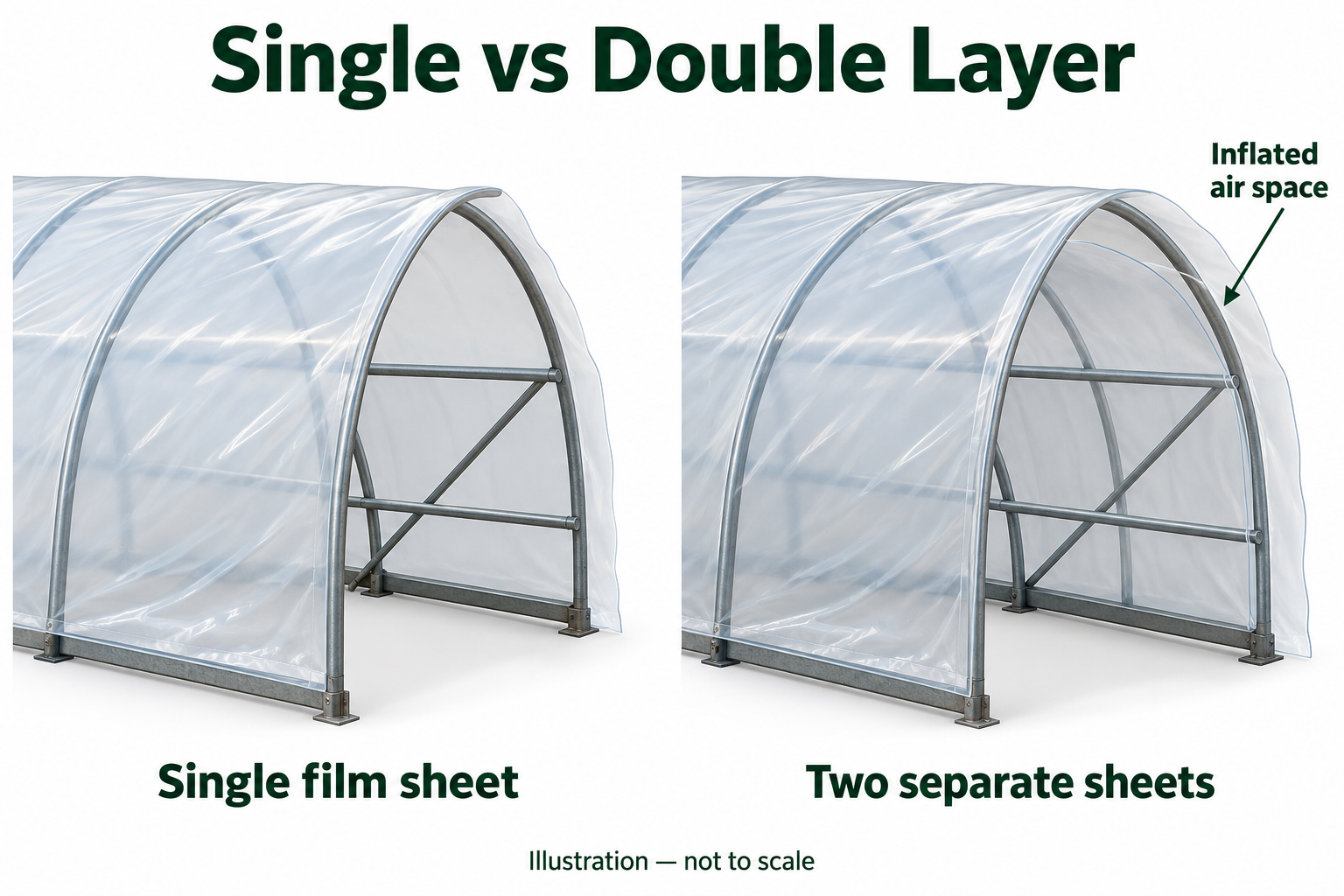
Double layer greenhouse plastic uses two separately installed film sheets, usually with a blower maintaining an air space between them. It can be worth evaluating for a heated greenhouse, but an extra sheet is not automatically the best choice for every crop, tunnel or climate.
The buying decision is about the complete covering system: heat retention, available light, compatible fixing, reliable inflation and operating cost. This guide helps commercial growers, greenhouse builders and distributors compare single and inflated double covers before specifying the film.
The short answer: consider inflated double film when reducing heat loss is important and the structure, power supply and maintenance arrangements support it. A single cover remains a valid option for seasonal production, light-sensitive winter schedules or projects where a reliable inflated assembly is not practical. Do not add a second sheet to an existing tunnel until its manufacturer or system supplier confirms compatibility.
What is double layer greenhouse plastic?
In this guide, single layer means one installed cover sheet. Inflated double layer means two installed sheets with an air space maintained by an inflation system. Each sheet may itself be manufactured by multilayer coextrusion.
These descriptions answer different questions. A five-layer coextruded film is still one cover sheet; it is not automatically a two-sheet greenhouse covering. Likewise, placing two loose sheets together does not establish the separated, maintained air space assumed in an inflated-cover specification.
When a quotation says “double layer greenhouse film,” ask whether it means two rolls for an inflated covering, one multilayer film roll, or another construction. Record the answer before comparing prices.
If you are still choosing between film families and rigid coverings, start with our greenhouse covering selection guide. The comparison here begins after flexible film has become a practical candidate.
Single or double layer: which fits the project?
Use the following table to decide what needs checking, not as a substitute for a greenhouse-specific recommendation.
On a small screen, scroll the table sideways to view all columns.
| Project condition | When a single cover may fit | When to evaluate inflated double film |
|---|---|---|
| Heating schedule | Little or no active heating, with acceptable crop temperatures under the existing cover. | Substantial heating demand makes reduced covering heat loss worth investigating. |
| Winter light | Available light is already limiting and an additional cover could affect the crop schedule. | Heat retention is valuable and the proposed film pair can meet the crop's light requirements. |
| Existing structure | The structure is specified for a single cover or its double-cover compatibility is unknown. | The supplier confirms the attachment method, inflation zones and treatment of vents or roll-up sides. |
| Power and maintenance | Reliable inflation and fault response cannot be maintained. | Suitable power, routine inspection and a response to loss of inflation are available. |
| Replacement plan | A simple seasonal replacement meets the production need. | A planned re-covering allows a complete, comparable upgrade proposal to be evaluated. |
What if the greenhouse is not heated?
A second cover may help retain heat, but it does not create heat. University of Maryland Extension lists inflated double plastic among passive warming measures and treats heaters separately. The result still depends on weather, stored heat, crop requirements and management. Read Maryland's high-tunnel management guidance.
For an unheated project, evaluate the temperature and light tradeoff directly. There is no heating-fuel bill to reduce if no heater operates, while inflation can still consume electricity. Do not justify the upgrade with a fuel-saving percentage borrowed from a heated greenhouse, or assume it guarantees frost protection.
How much heat loss can double greenhouse plastic reduce?
UMass Extension reports that an inflated double layer can reduce nighttime heat loss by about 40%. That is useful guidance about the covering arrangement, not a promise that a particular greenhouse's annual fuel bill will fall by the same percentage. See John W. Bartok's Plastic Greenhouse Film Update.
A design-table example helps explain the distinction. Alabama Cooperative Extension lists the following heat-transmission coefficients for polyethylene covers:
| Covering | Reference U-value | What it describes |
|---|---|---|
| Single polyethylene film | 1.2 | Heat transmission through the reference single-cover arrangement. |
| Inflated double polyethylene film | 0.7 | Heat transmission through the reference separated double-cover arrangement. |
The source calculates transmission loss using Q = U × A × ΔT × C: U is the heat-transmission coefficient, A is the covering surface area, ΔT is the temperature difference, and C is a construction factor. See the Alabama Extension explanation and tables.
With the other factors unchanged, moving from 1.2 to 0.7 gives about 41.7% less modeled transmission loss. This calculation does not include every loss from the greenhouse or establish a bill reduction. Air leakage, perimeter losses, heating efficiency, weather, operating hours and inflation electricity still matter.
Why installation can change the outcome
In a study of plastic greenhouses, Lee and colleagues found that roof-vent leakage affected the heat-retention performance of the air-inflated house. The tested houses also had thermal screens and differing covering and ventilation arrangements. Their results cannot be treated as universal bare-film properties. Read the covering-method study by Lee and colleagues.
Buying implication: request the proposed film specification and the assumptions behind the covering-system estimate. A lower material or assembly U-value is not enough to establish an actual project's annual savings.
Balance heat retention with light and condensation
Check the light available to the crop
An additional cover can reduce light transmission. Michigan State and Rutgers Extension discuss the need to weigh energy conservation against the growing environment and crop development. The importance of that tradeoff changes with season, crop and location. See Greenhouse Energy Conservation Strategies.
Ask whether a quoted optical value describes one new film sheet, the proposed two-sheet assembly, or measurements inside a greenhouse. Those are not interchangeable. Confirm the measured spectral range, test conditions and film condition; a single-sheet data sheet does not by itself establish the light reaching the crop through the finished structure.
For an existing winter operation, include current crop-level light records and production timing in the decision. Do not treat an unknown crop response as zero cost simply because the heating calculation is easier to complete.
Separate three different moisture questions
- Between the films: outdoor intake air can reduce the risk of moisture from humid greenhouse air condensing in the cavity. The intake arrangement must match the system instructions.
- On the crop-facing film: anti-drip treatment manages how condensate forms and drains; it does not remove water vapor from the greenhouse.
- Around the crop: ventilation and humidity management remain necessary even when the covering performs as intended.
Outside air intake is not the same as requiring the blower body to sit outdoors. Follow the equipment arrangement approved for the structure. UMass discusses both interlayer condensation and anti-drip film functions in its greenhouse-film guidance.
IR or thermal performance is a separate film property, not another name for double covering. For that material-level decision, use our thermal greenhouse film guide.
Before adding a second layer, confirm system compatibility
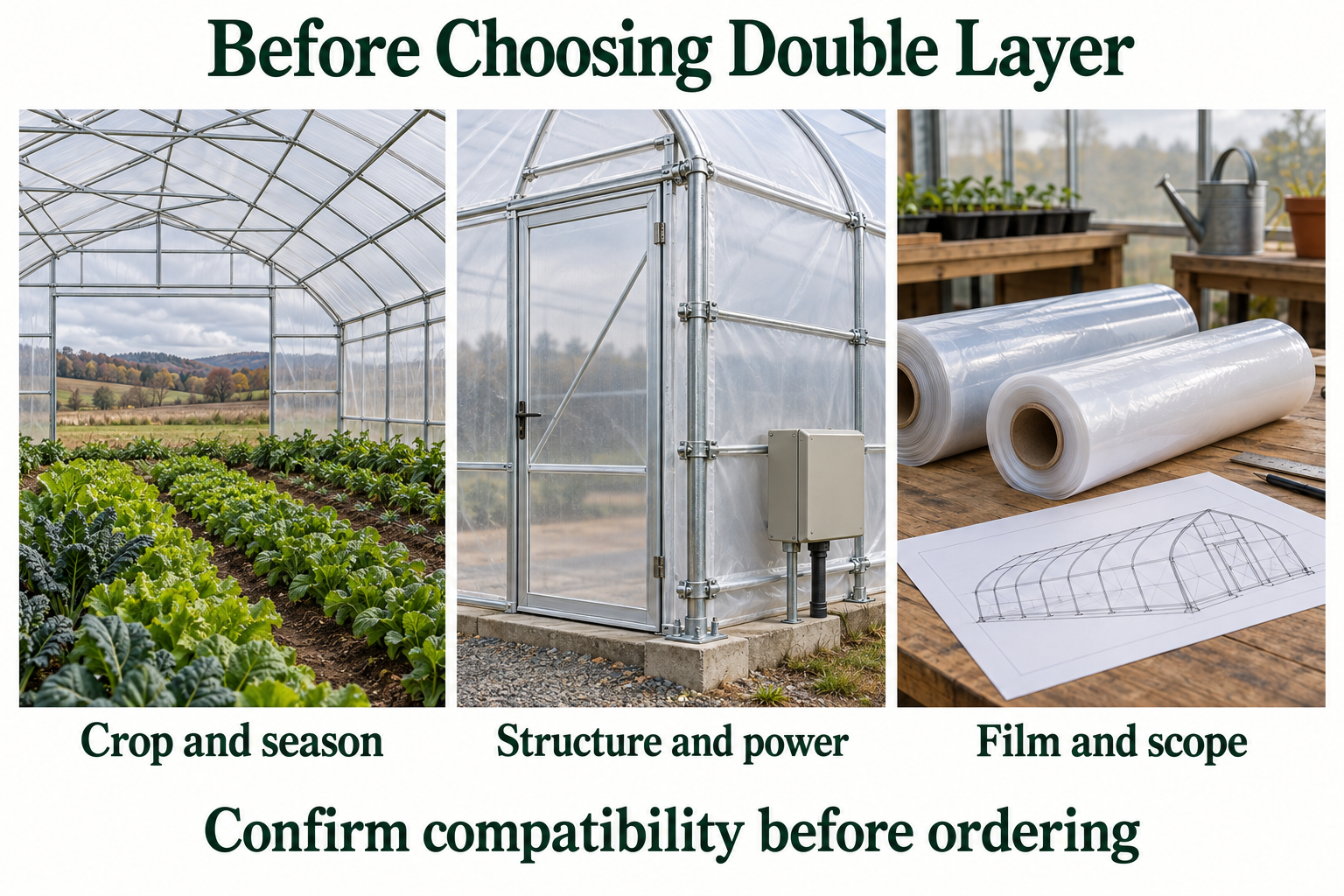
A tunnel that accepts one sheet does not automatically accept an inflated pair. Before buying extra film, ask the structure or inflation-system supplier to confirm:
- Cover boundaries: which roof, sidewall and end-wall areas will be inflated, and how those areas meet.
- Fixing: whether the channels, locking components, edges and attachment paths are suitable for the proposed sheets.
- Moving parts: how roof vents, doors and roll-up sides remain functional without compromising the intended assembly.
- Inflation: the equipment, air source, measurement method and operating conditions required for that system.
- Operations: power availability, maintenance access, inspection responsibility and the response to a blower or power failure.
Do not copy a pressure, air-gap width or blower size from another greenhouse without confirming that it applies. Blower airflow at a stated static pressure is a performance point on the equipment curve; it is not automatically the required pressure inside your film cavity.
MSU and Rutgers emphasize checking inflation and reducing air leaks. If the layers collapse together, the expected insulation advantage may be substantially reduced. Review the energy-conservation guidance.
In practice, follow the system supplier's inflation operating schedule; do not assume that the blower can be stopped whenever the heater is off.
Inflation also does not establish a wind or snow rating. UConn's wind-load guidance addresses the structure, exposure, openings and anchorage as a system. Obtain the appropriate structural assessment for the site. See Wind Loads on Greenhouses.
For installation preparation and handling, refer to our greenhouse plastic installation guide and the instructions for the actual greenhouse and inflation equipment. Electrical installation should be handled by a qualified person under local requirements.
Specify the inner and outer film as separate order items
The two sheets do not have to use different grades, but their intended positions and specifications must be unambiguous. “Two rolls of greenhouse plastic” is not a sufficiently complete order description.
Scroll sideways on a small screen to compare the specification fields.
| Field | Record for each film | Why it matters |
|---|---|---|
| Position and identity | Inner or outer sheet; material/grade and specification revision. | Prevents a grade, roll or drawing from being assigned to the wrong location. |
| Finished dimensions | Finished width, roll/cut length, thickness, units, tolerances and quantity. | Makes both quoted lines comparable and traceable. |
| Required functions | UV exposure basis, IR/thermal requirement, anti-drip and diffusion requirements where applicable. | A generic “greenhouse film” label does not define the requested functional package. |
| Optical and test information | Available test method, measured property, conditions and whether the data cover one sheet or an assembly. | Avoids comparing unlike measurements or treating a single-sheet result as a system result. |
| Orientation and identification | Film position, treated-side instructions, roll labels and packing identification. | The inner/outer position and the direction a treated surface faces are different instructions. |
In a double cover, an IR or anti-drip grade may be specified for a particular position and surface orientation. Confirm the proposed pairing against the selected film's technical information and installation markings. Do not assume that a familiar product name supplies every missing instruction.
Use the approved structure drawing and attachment paths to establish required dimensions. Retain film-specific allowances and folding conventions in the order record rather than calculating the second roll solely from the greenhouse's nominal floor width.

Compare single and double covers on the same cost basis
First define the actual alternative. If a single cover already needs replacement, the choice is often a single re-covering versus a double re-covering, not a complete double-cover installation versus spending nothing.
Use the same project boundary, delivery basis and tax treatment for both. List what each proposal includes: film, inflation equipment, fixing components, electrical work, installation and any disposal or replacement work. Do not compare a film-only quotation with a kit price that already includes another roll and hardware.
Include the inflation system's operating cost
Use verified electrical input power, not motor horsepower or current alone. If input power is reasonably constant:
Electricity cost = kWh × the applicable electricity rate.
For multiple units or variable operation, calculate each operating condition or use measured consumption. The blower's running calendar may be longer than the heating season; use the system's actual requirements.
Only calculate payback when the assumptions are usable
Estimate avoided heating cost using the site, heating schedule and proposed assembly. Then allow for added electricity, maintenance, replacement costs and material crop-related effects. Keep unresolved effects visible instead of entering zero to make a calculation look complete.
A simple payback calculation is meaningful only when the estimated annual net benefit is positive and its assumptions are credible. If heating records, operating hours or crop effects are missing, obtain them before presenting a payback period. A universal “one-season return” is not an appropriate purchase guarantee.
For the wider commercial checks, including quotation scope, packing and delivery, see our commercial greenhouse plastic roll buying guide.
What to send with a double layer greenhouse film inquiry
A useful inquiry should let the film supplier understand the proposed covering without asking you to invent engineering settings. Send the information available and identify what still needs confirmation.
- Project: country/location, crop, production months and whether the greenhouse is heated, unheated or heated only for frost protection.
- Structure: manufacturer/model or drawings, house count, dimensions, proposed covered areas, and new-build or replacement status.
- Film: inner/outer requirements, known dimensions, thickness and quantities, requested functions, data or sample requirements.
- System interface: existing/proposed inflation-system supplier, known equipment, power availability and unresolved compatibility questions.
- Order: destination, required arrival date, packing or roll-handling limits, and which items or services are included in the request.
Copy-ready inquiry outline
We are evaluating a [single / inflated double] covering for [crop and production season] in [location]. The structure is [manufacturer/model or drawing available], with [number of houses and dimensions]. Heating is [none / frost protection / regular heating].
For the double-cover option, please identify the inner and outer film specifications separately, including finished dimensions, thickness and tolerances, requested functions, quantities and roll identification. Our greenhouse/inflation-system supplier is [name / to be confirmed].
Please state the scope included in your quotation and list any missing information needed before the film specification can be approved. Delivery destination and target arrival are [details].
Discuss the film requirements with TIAN FENG
Review our greenhouse plastic roll product page, then send the project details and proposed inner/outer film requirements. Ask for the available grades and a clearly defined film quotation.
Confirm separately who is responsible for inflation equipment, structure compatibility and installation. Do not assume those items are included in a film quotation unless they are expressly listed.
Send your film requirementsSingle and double layer greenhouse plastic FAQ
Is five-layer greenhouse film already a double cover?
No. Five-layer usually describes coextruded layers within one film sheet. A double cover uses two separately installed sheets. Confirm the supplier's terminology and whether the quotation covers one sheet or two.
Can I use two layers without an inflation blower?
Do not assume two uninflated sheets perform like an air-inflated assembly. Other supported, separated double-cover arrangements may exist, but they need their own design and evidence. Ask the structure supplier which arrangement it supports.
Does double layer greenhouse plastic remove the need for heating?
No. It can reduce heat loss but does not generate heat. Crop requirements and local conditions determine whether additional heating or frost protection is needed.
Should both films have the same thickness and functions?
Not necessarily. Specify each position separately, using the approved system and film requirements. Neither identical sheets nor different grades should be assumed correct before the pairing is confirmed.
What air gap or inflation pressure should I request?
Request the system supplier's approved operating requirements and measurement method. There is no single setting that this guide can prescribe for every structure, film pair, leakage condition and blower.
What happens if the inflation blower stops?
The layers may lose separation and the intended insulation performance can change. Follow the system's fault-response instructions, monitor crop conditions and arrange safe corrective work. Do not assume a deflated cover retains its quoted performance.
How can I compare a film quotation with an inflation kit?
List the included items first. Confirm whether each price covers one or two film sheets, a blower, mounting and fixing components, electrical work, delivery and installation. Then compare equivalent scopes.
References
The sources below support the technical explanations in this guide. Their design values, research conditions and installation requirements are not specifications or performance guarantees for TIAN FENG products.
- Bartok, J. W., Jr. UMass Extension. Plastic Greenhouse Film Update. Updated June 30, 2026. Film characteristics and single/double-cover guidance.
- Pickens, J., and Wells, D. Alabama Cooperative Extension System. Controlling the Greenhouse Environment for Vegetable Crops. September 30, 2022. Heat-transmission coefficients and greenhouse heat-loss calculations.
- Lee, H.-W., Kim, Y.-S., Sim, S.-Y., Lee, J.-W., and Diop, S. Estimation of Heat Insulation and Light Transmission Performance According to Covering Methods of Plastic Greenhouses. Protected Horticulture and Plant Factory, 22(3), 270–278, 2013. Study-specific covering and ventilation effects.
- Runkle, E., and Both, A. J. Michigan State University and Rutgers Extension. Greenhouse Energy Conservation Strategies. Bulletin E3160, 2012. Air leakage, inflation maintenance and growing-environment tradeoffs.
- Little, N. University of Maryland Extension. High Tunnel Best Management Practices. Updated October 29, 2021. Passive warming, active heating and temperature management.
- Bartok, J. W., Jr.; reviewed by Krasnow, C. UConn Extension. Wind Loads on Greenhouses. Updated October 2024. Structural loading, exposure and openings.