
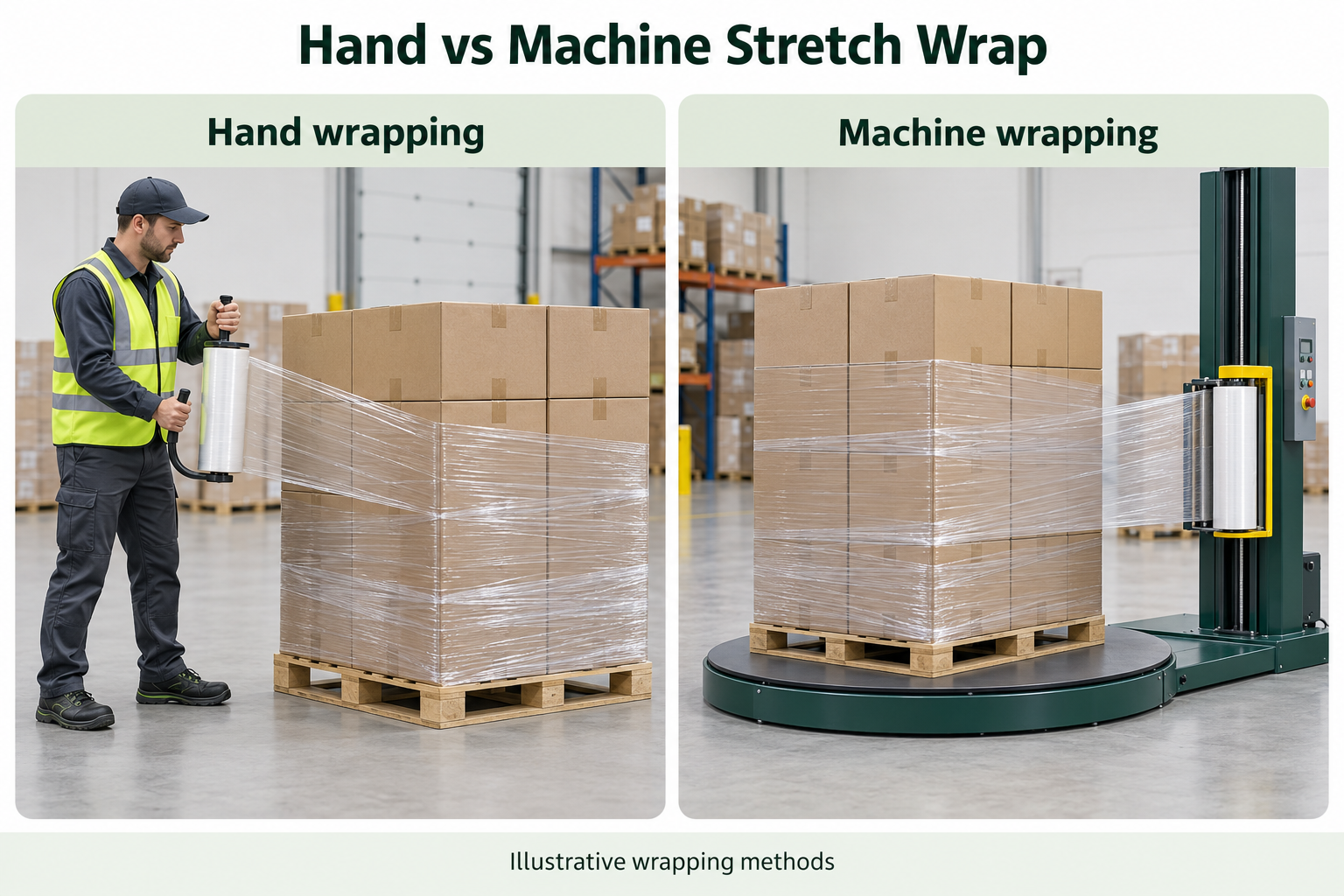
Hand vs Machine Stretch Wrap
Quick answer: Hand stretch wrap is intended for manual application; machine stretch wrap is intended for compatible wrapping equipment. Choose the film for the actual process, then check roll fit, the proposed grade and the result on representative loads. A daily pallet count, familiar thickness or low roll price cannot make that decision by itself.
This hand vs machine stretch wrap guide is for warehouse buyers, distributors and manufacturers. Use it to compare how you apply the film and what to order. The aim is a repeatable process and a clearly specified roll that works with it.
Hand stretch film vs machine stretch film: key differences
With hand wrapping, an operator moves the film around the load using a suitable manual method or dispenser. With machine wrapping, equipment performs the wrapping movement and controls the film-delivery process. Semi-automatic equipment can still require an operator to position loads, attach or cut film, or complete other tasks.
| Decision | Hand stretch wrap | Machine stretch wrap |
|---|---|---|
| Application | Manual wrapping around the load. | Application through a compatible wrapper and film carriage. |
| Roll handling | Check the roll and dispenser against the intended manual task. | Check the reel against the machine's mounting and operating limits. |
| Consistency | Depends on the film, operator and agreed method. | Depends on the film, equipment condition, settings and maintained process. |
| Purchase decision | Confirm handling, specifications and actual consumption. | Confirm grade suitability, carriage requirements and actual consumption. |
Keep three descriptions separate.
- Hand or machine: how you apply the film.
- Blown or cast: how the supplier makes the film.
- Pre-stretch: film can arrive already pre-stretched, or a wrapper can stretch it through its carriage. Confirm which meaning applies.
For example, IPG's stretch-film range includes blown and cast film in hand- and machine-applied formats. Its separate pre-stretched hand-film product also shows why manual wrapping does not always mean conventional, unstretched film.
If your question concerns top coverage as well as containment, see pallet covers vs stretch wrap. Choose how to cover the load's top separately from the hand-or-machine decision.
Which wrapping process fits your operation?
Start with the work that needs doing. Hand wrapping may suit dispersed workstations, occasional jobs or an operation retaining a manual process. Evaluate a machine when repeated wrapping becomes a bottleneck or when the operation needs a more controlled application process. Neither situation establishes the final film grade.
Record the busiest hour as well as the daily total. One site may wrap loads steadily all day. Another may face a late dispatch rush. The daily total can be the same while the peak demand differs. Lantech's explanation of stretch wrapping identifies this issue.
- Workflow: where wrapping occurs, how loads arrive and leave, and which steps cause delays.
- Loads: dimensions, mass, stack arrangement, fragile surfaces and projecting corners.
- Resources: available operators, working space, equipment, maintenance and training requirements.
- Current problems: film breaks, loose tails, crushed cartons, inconsistent wrapping or rework.
There is no universal “switch at 50 pallets a day” rule. Use measured workload, the proposed equipment and the required package result to evaluate a change. A machinery investment and a film order are related decisions, but they need different evidence.
Match the roll and film grade to the dispenser or wrapper
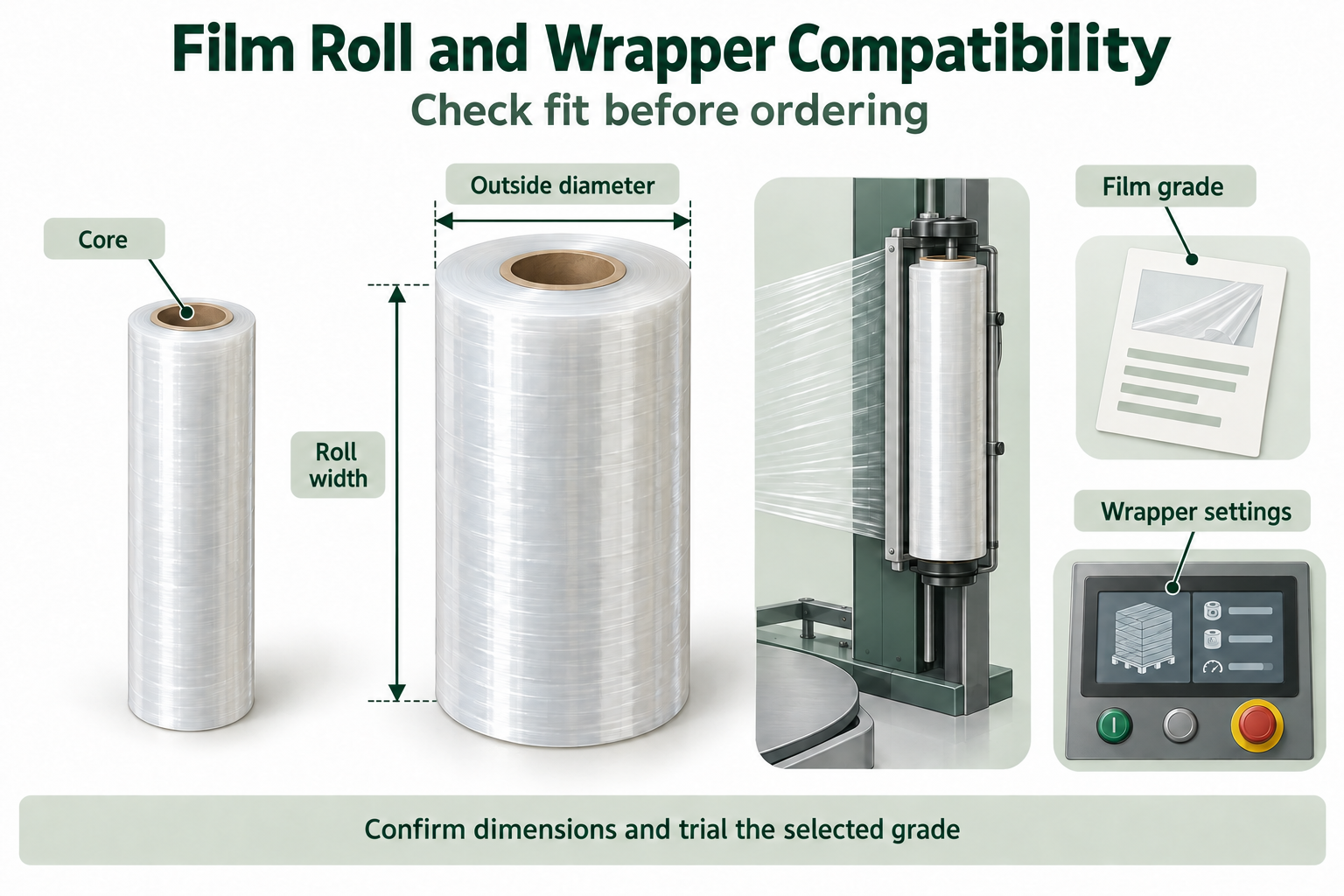
Two rolls can look similar while differing in net film quantity, core dimensions, winding or suitability for the application. For manual use, confirm the roll with the dispenser and handling method. Do not improvise a manual arrangement for a machine reel simply because the film can be unwound.
For machine use, send the wrapper make, model and film-carriage details. Review its manual for permitted film width, reel outside diameter, reel weight and core requirements. Equipment limits are model-specific: Robopac's Rotoplat range, for example, lists different carriage systems rather than one universal pre-stretch configuration.
| Check | What to confirm before ordering |
|---|---|
| Roll specification | Width, nominal thickness and tolerance, length or net film mass, core dimensions, outside diameter and packing. |
| Film delivery | Dispenser or carriage type, the selected grade and its suitability for the actual operating settings. |
| Pre-stretch | Whether the wrapper has a pre-stretch system and what the proposed operating condition requires from the film. |
| Load response | Film behavior at corners, package deformation, breaks, tails and the agreed containment assessment. |
Pre-stretch is not the same as force applied to the load. Pre-stretch occurs before the film leaves the relevant delivery system. The force applied during wrapping and the number and placement of layers also affect containment. A higher stretch percentage is not proof that a load is more secure.
Ask for grade-specific information and trial the combination. A machine brochure's maximum setting does not establish that a particular film will run successfully at that setting.
Compare film cost per acceptable wrapped pallet
A cheaper roll may contain less usable film or require more material in the approved process. Begin with the same purchasing basis: net film mass excludes the core and outer packing. Keep freight, taxes and other charges consistently included or separately stated.
Define the trial boundary and acceptance criteria first. Include film used in starts, breaks, rejected attempts and rewrapping within that boundary. Count each final accepted pallet once. If your consumption figure includes that waste, do not add it again.
| Input or result | Option A | Option B |
|---|---|---|
| Total consumed film, including trial waste and rewrap | 2.4 kg | 1.8 kg |
| Assumed film price | US$2.00/kg | US$2.40/kg |
| Accepted pallets | 12 | 12 |
| Film cost calculation | 2.4 × 2.00 ÷ 12 | 1.8 × 2.40 ÷ 12 |
| Film cost per accepted pallet | US$0.40 | US$0.36 |
These numbers are assumptions for the calculation. They are not quotations or factory measurements, and do not prove savings from machine wrapping. A and B do not identify a hand or machine product. The example shows why price per kilogram alone cannot settle the comparison.
Total operating cost needs more information: labor time, loading and unloading, interruptions, equipment costs and the agreed treatment of rework. Film cost alone does not calculate a wrapper's payback. A visually acceptable trial also does not establish transport performance.
Run a comparison that another buyer can reproduce
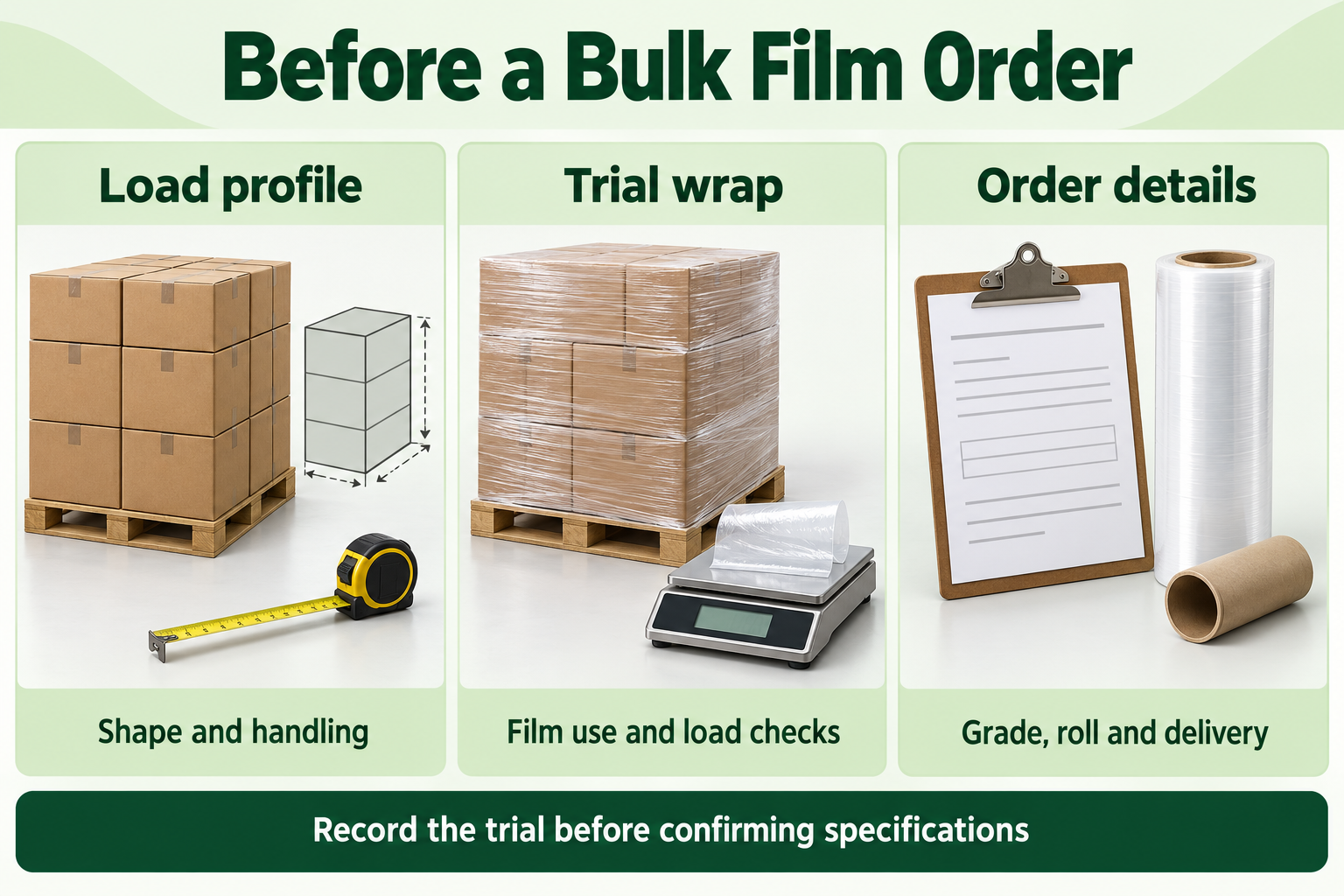
Use representative loads and define what an acceptable result means with the responsible packaging team. Keep the load configuration and comparison method documented. If film, equipment and settings all change, record the trial as a comparison of complete processes rather than attributing every difference to the film.
Use this checklist to plan and document the comparison. Keep actual measurements and observations in your trial record.
| Check | Current process: establish the baseline | Proposed process: compare on the same basis |
|---|---|---|
| Date, operator and load configuration | Record the trial date, operator, load dimensions, load weight and stacking arrangement. | Use comparable loads. Record the trial date, operator and any differences that could affect the result. |
| Film grade, batch and roll specification | Record the film grade, batch, thickness, width and net film quantity from the roll label or specification. | Identify the candidate grade and roll specification. Keep the trial batch traceable and note any unconfirmed details. |
| Dispenser or wrapper model, carriage and settings | Record the dispenser or wrapper model, carriage type where applicable, and settings used. | Confirm that the candidate roll and film grade suit the equipment. Record the actual trial settings. |
| Method, film placement and any changes | Document the wrapping sequence, film placement and how the film is secured. | Record changes to the method or film placement. If equipment and film both change, compare the complete processes. |
| Total film consumed and waste accounting | Measure film used within a defined trial, including film lost to breaks, discarded wraps and rewrapping. | Use the same measurement boundary and waste rules. Account for roll changes and avoid counting the same film twice. |
| Total working time, breaks and rewraps | Time the defined work steps. Record stoppages, film breaks and rewrapping. | Time the same work steps, including loading or handling when these are part of the comparison. |
| Acceptance criteria, measurements and accepted pallets | Agree the acceptance criteria with the packaging team. Record the required measurements and number of accepted pallets. | Apply the same criteria and measurement method. Use accepted pallets when calculating film cost per accepted pallet. |
| Observed damage, tails and follow-up required | Record visible product or packaging damage, loose film tails and unresolved issues. | Repeat the same checks. Flag any handling or distribution assessment needed before approval. |
Where practical, determine consumption from the change in roll mass over a clearly bounded trial, accounting for any roll changes and using an appropriate scale. Record how discarded or rewrapped film is included. Do not compare a carefully measured net-film figure with another option's gross shipping weight.
Review application consistency, film damage and load behavior. Required containment measurements and handling or distribution assessments should follow the packaging team's validation plan. A short wrapping trial is useful procurement evidence, but it is not transport certification or a universal safe wrap-count recommendation.
Send the information needed for a useful film quotation
A request for “strong machine film” leaves too much unresolved. Send what is already known and identify the decisions still open:
- Application: hand wrapping or machine wrapping; dispenser or wrapper model and carriage where applicable.
- Load and work: packed dimensions, product and stack description, peak workload and handling route.
- Current film: roll label, grade or sample, dimensions, net quantity and the problem you want to solve.
- Requested specification: thickness with units and tolerance, width, roll length or net mass, core, outside diameter, color and packing.
- Commercial details: approximate quantity or monthly use, destination and required delivery timing.
- Approval: sample requirements, agreed trial conditions and any supporting grade documentation needed.
Discuss a blown stretch-film specification with TIANFENG
TIANFENG supplies blown stretch film with hand- and machine-wrapping options and custom roll specifications. Send your application, current roll details, equipment information if relevant, quantity and destination. The proposed grade and roll format should be confirmed for your process before bulk approval.
Hand and machine stretch wrap FAQ
Can I use machine stretch film by hand?
Do not assume a machine reel is suitable for manual handling or your dispenser. Confirm the roll format and intended application with the supplier. Choose a hand-applied option when the process remains manual.
Can a hand stretch-wrap roll be used on a machine?
Physical fit alone is insufficient. Check the wrapper's requirements, carriage and operating settings, then confirm the film grade. Do not substitute solely because the widths look similar.
Is machine stretch film always thicker?
No universal thickness rule distinguishes the applications. Film formulation, grade and operating requirements matter. Compare the selected specifications and actual trial results rather than using “machine” as a thickness rating.
Is blown stretch film the same as hand wrap?
No. Blown describes how the film is manufactured; hand describes how it is applied. TIANFENG's confirmed manufacturing route is blown film, with the proposed hand or machine option reviewed for the intended process.
How many pallets justify a stretch wrapper?
There is no single number for every operation. Evaluate peak workload, labor and handling time, space, equipment costs, film consumption and the required packaging result. Use your own operating records for the calculation.
What should I send when requesting a trial roll?
Provide the current film label or specification, application method, wrapper and carriage details where relevant, load description, observed issue and the conditions under which the sample will be evaluated. Identify missing information rather than guessing it.