
Cast vs Blown Stretch Wrap: How to Choose a Film Grade
Cast vs blown stretch wrap: the short answer. Cast film forms a flat sheet that cools on a chilled roll. Blown film forms an inflated tube that cools before conversion into rolls. Many standard cast grades offer clearer views and quieter unwind. Many blown grades suit trials where puncture is a concern.
Neither process alone tells you which film will hold your load better. Compare the grades, cling faces and fit with your wrapper. Then test them on loads that represent your work.
For regular cartons where scanning and quiet operation matter, a suitable cast grade is a reasonable first sample. Where protruding loads repeatedly puncture the film, include a suitable blown grade in the comparison. Then check the complete wrapping result, not just that one advantage.
This guide helps packaging buyers and warehouse teams compare films for pallet wrapping. It explains how the films differ, separates common claims and shows what to check before switching. Stretch film works under tension; heat-shrink film is outside this comparison.
How cast and blown stretch film are made
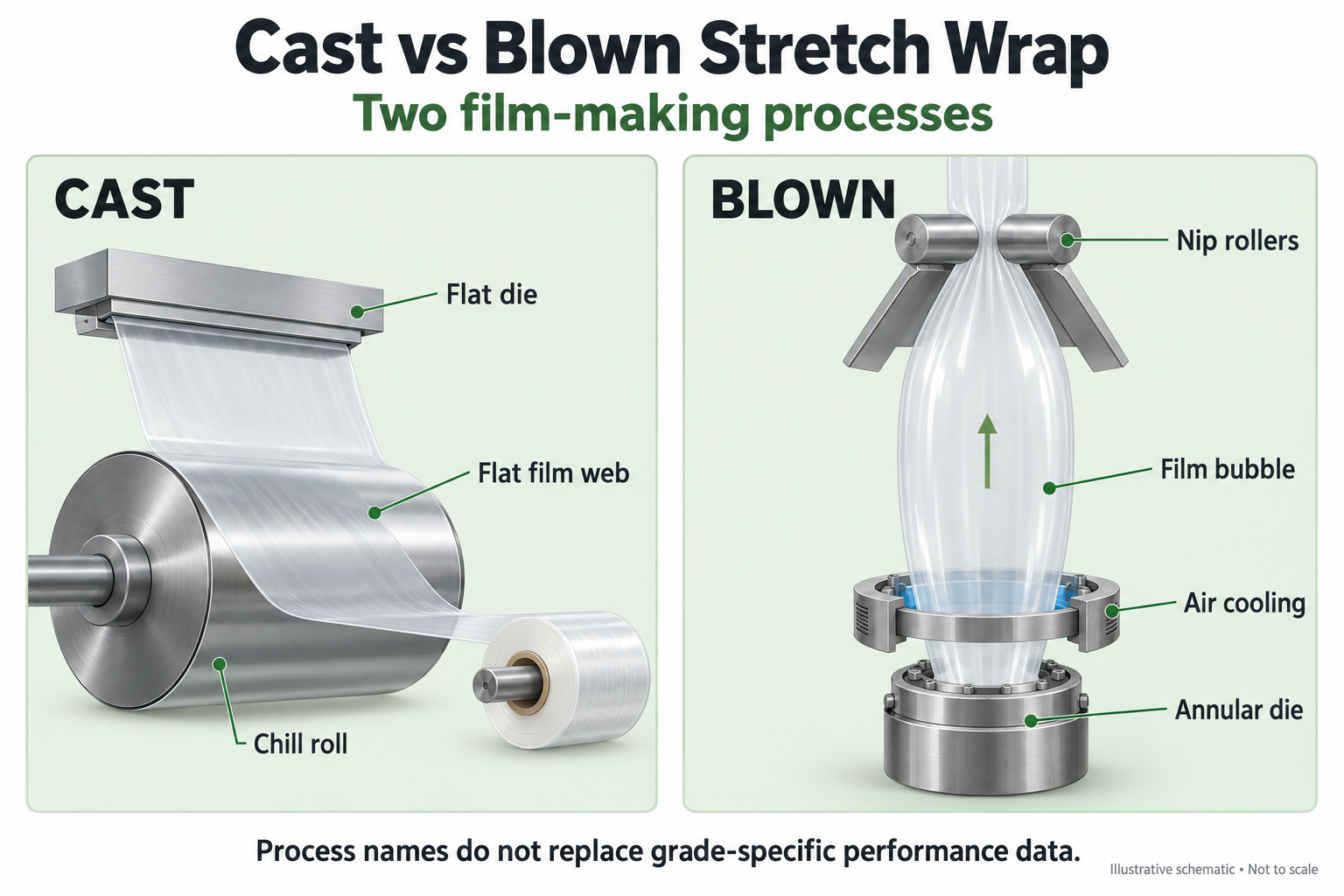
The cast extrusion process feeds molten polymer through a flat die with a narrow slot. The sheet contacts a chilled roll, which removes heat and sets the film. The web then passes through the line for winding and conversion into rolls.
Blown stretch film passes through an annular, or ring-shaped, die. Air inflates the tube into a bubble. The line cools and flattens the tube, then converts the film into the required rolls. Drawing and cooling differ from the cast process.
Alliance Plastics’ Stretch Film 101 illustrates both processes. Dover Flexo Electronics’ process overview also explains the cooling and winding steps. These sources describe how the film is made; they do not rank every finished grade.
Resin selection, layer design, additives, thickness and manufacturing conditions also affect the finished grade. “Cast” and “blown” are useful starting descriptions; neither is a complete purchase specification.
Cast vs blown stretch film: practical differences
Use this comparison to decide which samples to request. The tendencies describe common products, while the final column identifies the check needed for your operation.
| Buying concern | Cast stretch wrap | Blown stretch wrap | Check on the proposed grade |
|---|---|---|---|
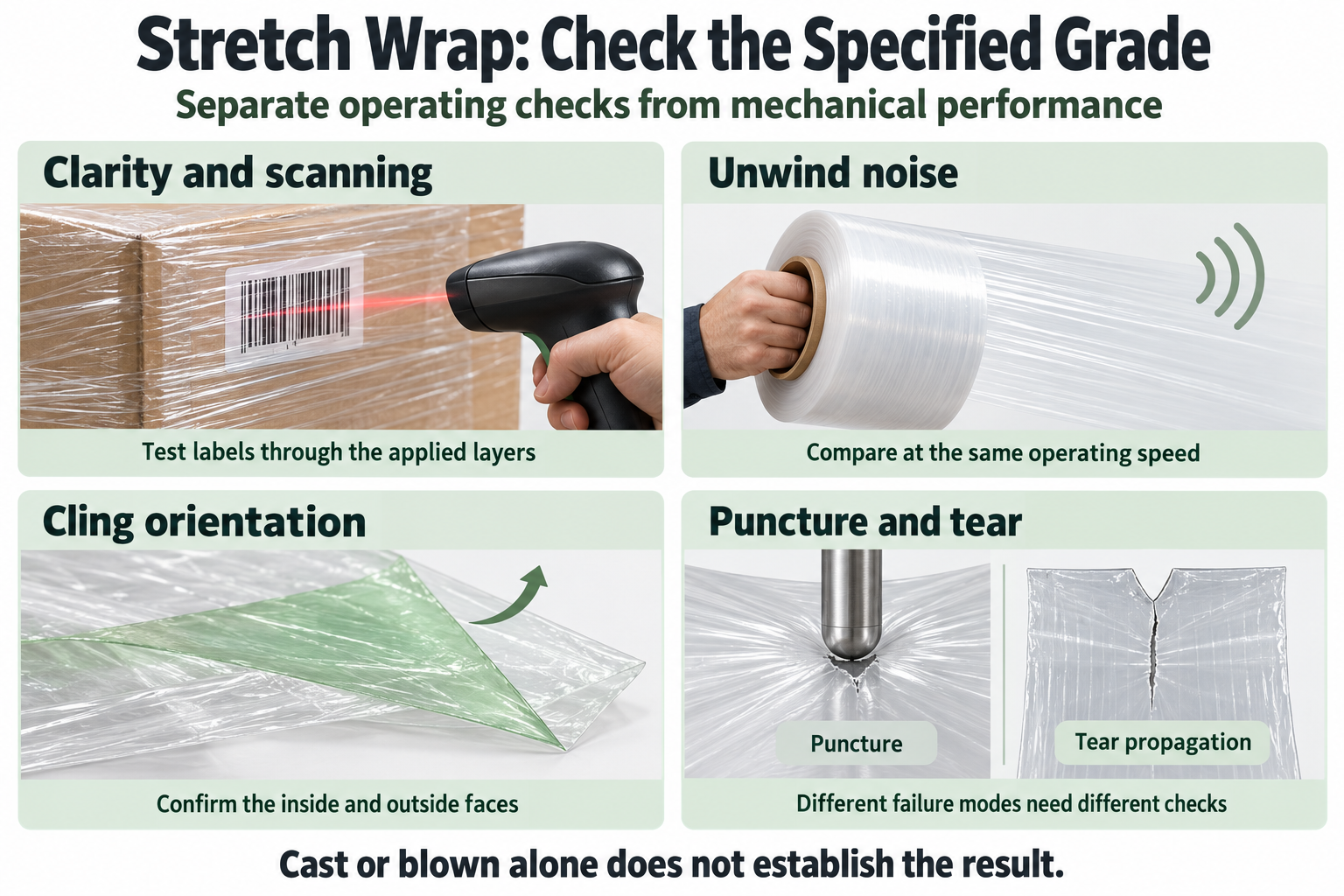
| Visibility | Often offers high clarity. | Conventional grades may appear hazier. | Read and scan actual labels through the finished layers, under working lighting. |
| Unwind noise | Often unwinds more quietly. | Conventional grades can be noisier. | Compare the rolls at the intended application speed and setup. |
| Puncture and tearing | Performance varies; high-performance grades are available. | Often considered where protrusions create puncture challenges. | Separate puncture resistance from the spread of an existing tear. |
| Cling | Can have one-sided or two-sided cling; inside and outside behavior may differ. | Cling design also needs a grade-specific description. | Confirm the intended inward face, overlap adhesion and outside-surface behavior. |
| Load containment | Depends on the grade and how it is applied. | Depends on the grade and how it is applied. | Assess the wrapped load after the agreed holding and handling conditions. |
Consider Signode’s Eliminator cast film. It has differential cling: the inside face has higher cling. Cast film therefore does not always have two equally sticky faces. This is an example of one grade’s design, not a promise about all cast film.
Similarly, IPG’s stretch-film range includes both cast and blown films in hand-applied and machine-applied formats. Manufacturing process and application method are separate choices. For roll and equipment selection, use our hand vs machine stretch wrap guide.
Why “blown is stronger” is an incomplete answer
A film can resist one form of damage yet perform differently in another. Before accepting a strength claim, identify the failure you need to prevent.
Puncture is different from tear propagation
Puncture resistance concerns a protrusion pushing through the film. Tear propagation concerns how an existing tear grows. A corner that makes a hole and a nick that runs across the web are different problems. Film direction also matters: machine direction follows the length of the web, while transverse direction runs across it.
Ask which property was tested, by which method and at what thickness. Check the test conditions too. A dart-impact test is not the same as a protrusion-puncture test. Intertek’s testing overview lists separate methods for puncture, tear, tensile behavior, cling and stress retention. One “strength” number cannot replace them all.
Stretch percentage is not load-holding performance
Elongation describes how far film extends in a test. Elastic recovery describes how it recovers after stretching. Stress retention concerns how much stress remains over time while the film stays at a set extension. The test conditions matter. Load containment is the restraint that the applied wrap provides.
A lab value measured at break is not a wrapper setting. For example, IPG’s SFIII technical data sheet reports elongation and pre-stretch-at-break separately. Ask for a suitable grade and operating range, then verify it in a trial.
More tension is not automatically better, particularly when cartons can deform. The goal is sufficient restraint without unacceptable product or package damage. Lantech’s load-containment guidance emphasizes measurement, evaluation and adjustment rather than a universal force setting for every pallet.
Dealing with recurring film breaks? Use the stretch-wrap breakage checks to record where the first damage appears and review the roll, film path and load before proposing a different grade.
How to choose and qualify a cast or blown grade
Start with the job the film must do. Use the common process tendencies to shortlist samples, then investigate the actual problem. A film’s manufacturing label cannot identify why a particular load failed.
| What you observe | What to examine first | What the comparison should establish |
|---|---|---|
| Film holes at protruding corners | Load geometry, exposed edges, film placement and puncture behavior. | Whether the grade and wrapping arrangement tolerate the actual contact points. |
| A small nick becomes a long split | Damaged roll edges, the film path and tear propagation in the relevant direction. | Whether the defect starts in the roll or equipment, and how the film behaves after initiation. |
| The load loosens after wrapping | Applied containment, load settling, wrap placement, stress retention and the handling sequence. | Whether the finished load retains acceptable restraint after the agreed evaluation period. |
| Adjacent wrapped loads stick together | Cling orientation, outside-surface slip and storage contact. | Whether the specified surfaces perform as required when loads meet and separate. |
These checks help isolate causes; they do not diagnose a failure from appearance alone. Switching from cast to blown will not necessarily solve a damaged roller, an exposed pallet nail or a mismatched roll.
Run the change as a controlled comparison
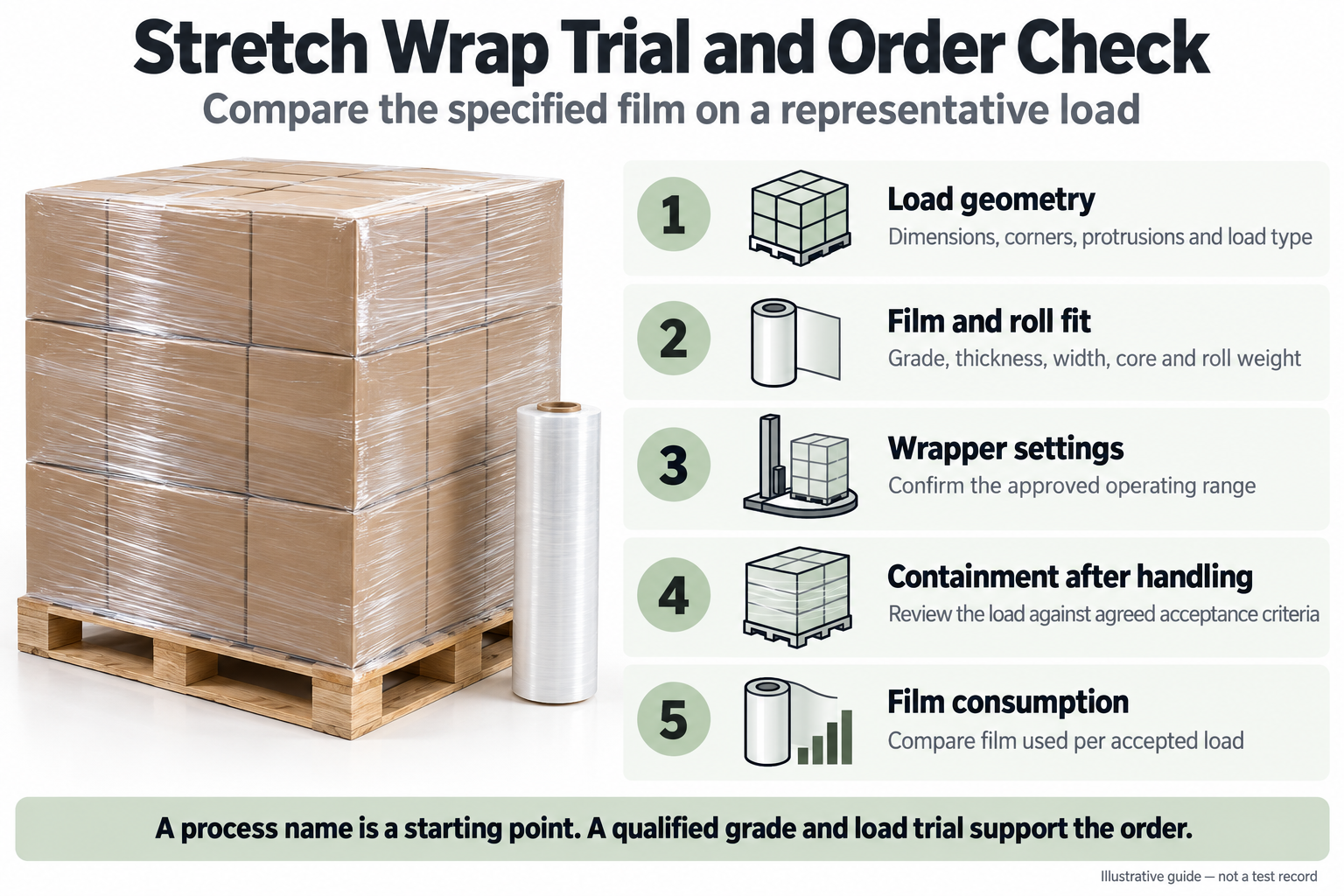
- Set common acceptance criteria. Use representative loads and agree on required visibility, package-damage limits and the holding or handling sequence. Record the current film, roll, equipment and wrapping setup as the baseline.
- Set up each suitable grade within its operating range. Follow supplier and equipment guidance and record changes. Use the same acceptance criteria, but allow each grade its suitable settings. This compares two wrapping systems. It does not prove that the extrusion process alone caused the difference.
- Recheck under comparable conditions, then assess cost. Measure containment at consistent locations and times, and assess scanning, loose film ends, damage and handling. Compare total trial consumption per accepted pallet, including film used in breaks, scrap and rewraps. Keep labor and other operating costs separate.
The hand and machine selection guide explains the film-cost-per-accepted-pallet calculation. A short wrapping trial helps select a candidate; any required transport assessment remains a separate step.
For example, if a cast sample scans well but develops corner holes, keep its visibility result and investigate the damage separately. If a blown sample resists those contact points but fails the required label scan through the finished wrap, it has not met the full specification either. The decision should reflect all required outcomes, not the best single property.
What to put in a stretch-film inquiry
Give the supplier enough detail to propose a grade, rather than asking only for “cast” or “blown.” The most useful starting information is:
- Load and problem: loaded dimensions, weight, carton or product arrangement, protrusions, crush-sensitive areas and photos of recurring failures where available.
- Application: hand dispenser or wrapper model, carriage type, current settings and the existing film specification.
- Roll specification: film width, nominal thickness and tolerance, length or net film mass, core dimensions and equipment roll-size limits.
- Required behavior: intended cling face, label-scanning needs, unwind-noise concerns, handling environment and acceptance checks.
- Order basis: trial quantity, expected purchase quantity, destination, packing requirements and required delivery timing.
Keep film mass separate from the core and shipping packaging when comparing quotations. If suppliers use different thickness units, our stretch-wrap gauge, mil and micron guide explains the conversion and measurement checks.
Discuss a blown stretch-film option with TIANFENG
TIANFENG supplies blown stretch film. Share your load, current roll specification and application method to discuss a suitable proposal and sample evaluation. Review the stretch-film product page or send the application details. Available roll specifications, cling construction and operating suitability should be confirmed for the proposed grade.
Cast and blown stretch wrap FAQ
Can I identify cast or blown film just by its appearance?
Clarity and unwind behavior can suggest a process, but they do not verify it. Ask for the manufacturer’s grade identification and process description. Use appearance to assess your visibility needs, not as proof of the film’s construction or performance.
Does the same thickness make cast and blown film equivalent?
No. Thickness is only one variable. Resin and layer design, cling, puncture and tear behavior, operating stretch and retained containment can differ. Compare the actual grades against the same load requirements; equal thickness does not establish equal results.
Technical reading
The linked manufacturer and testing-provider resources explain the processes and evaluation terms used here. Their product-specific measurements are not TIANFENG specifications.
- Alliance Plastics — Stretch Film 101: process diagrams and separate film properties.
- IPG — Stretch film range: hand and machine formats across both processes.
- Signode — Eliminator cast stretch film: an example of a specified differential-cling design.
- Intertek — Stretch-wrap film testing: distinct methods for different properties.
- IPG — SFIII technical data sheet: an example of separately reported laboratory properties.
- Lantech — How tight should you wrap your pallet loads?: evaluating applied containment.