
Stretch Wrap Thickness and Gauge: Mil, Microns and Buying Checks
Quick answer: In the common plastic-film convention, 100 gauge = 1 mil = 25.4 microns. Multiply gauge by 0.254 to get microns: 80 gauge is 20.32 microns. Start with the thickness label. Before you approve a change, check the grade, tolerance and trial result on your actual load.
This stretch wrap gauge guide helps warehouse buyers, packaging distributors and manufacturers compare thickness labels and bulk quotations. It covers conventional stretch film. It also explains what to ask about thinner or pre-stretched film.
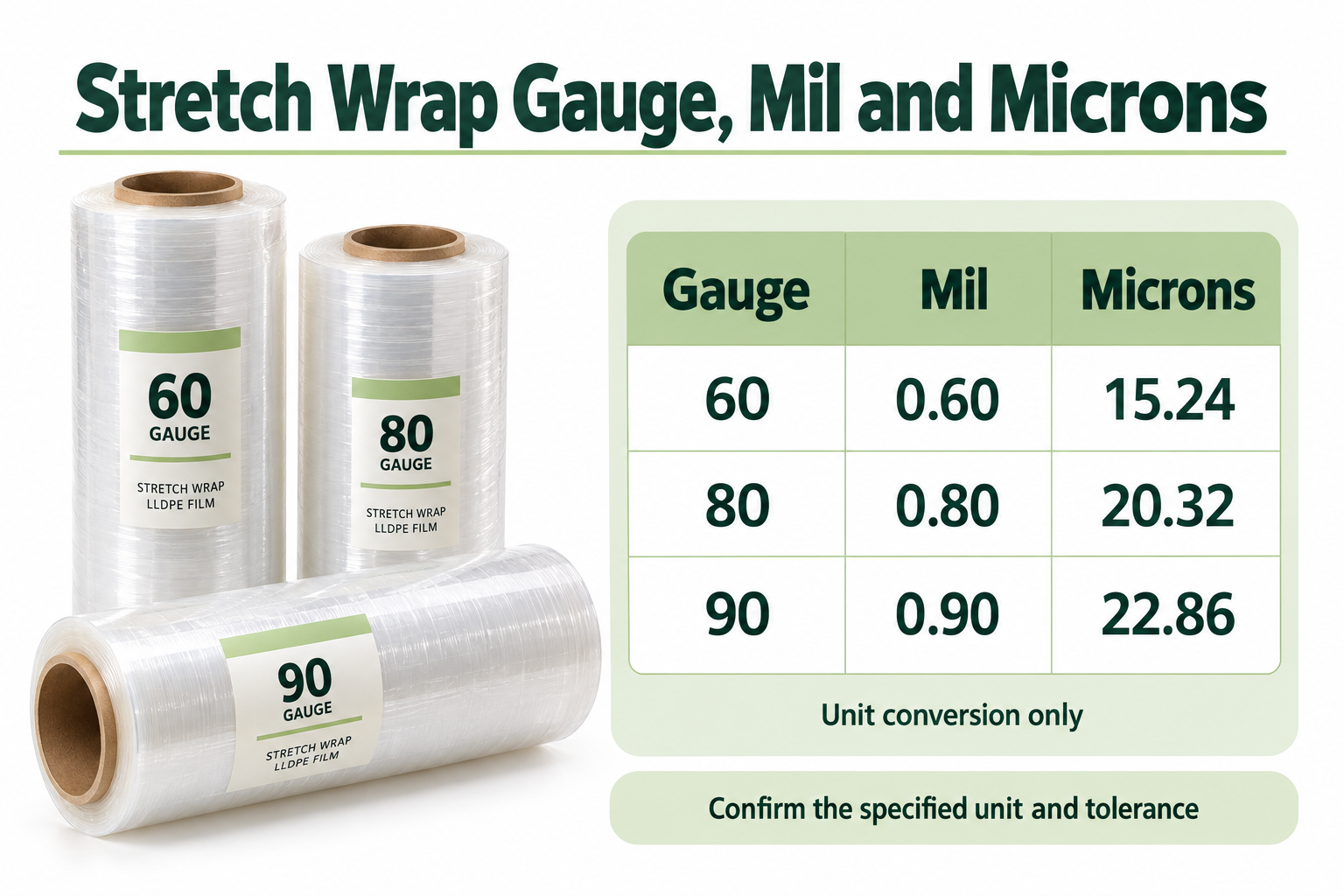
Stretch wrap gauge chart: mil and micron conversions
Gauge, mil and micron describe thickness. In this plastic-film convention, one gauge is 0.01 mil. A mil is one-thousandth of an inch.
A micron is one micrometre (µm), or one-thousandth of a millimetre. Mil does not mean millimetre. Metal and wire gauge systems use different rules.
The NIST conversion reference provides the mil-to-metric relationship. An IPG hand-film technical data sheet lists gauge, mil and rounded micron values side by side. It shows how this plastic-film convention works.
Mil = gauge ÷ 100
Microns = gauge × 0.254
Gauge = microns ÷ 0.254
Swipe the table sideways to view every column.
| Gauge | Mil | Microns (µm) | Millimetres (mm) |
|---|---|---|---|
| 50 | 0.50 | 12.70 | 0.01270 |
| 60 | 0.60 | 15.24 | 0.01524 |
| 63 | 0.63 | 16.00* | 0.016002 |
| 70 | 0.70 | 17.78 | 0.01778 |
| 80 | 0.80 | 20.32 | 0.02032 |
| 90 | 0.90 | 22.86 | 0.02286 |
| 100 | 1.00 | 25.40 | 0.02540 |
| 120 | 1.20 | 30.48 | 0.03048 |
| 150 | 1.50 | 38.10 | 0.03810 |
| 200 | 2.00 | 50.80 | 0.05080 |
Microns are displayed to two decimal places. *63 gauge is exactly 16.002 microns under this convention. The table converts units. It does not list stock or recommend load limits.
60 vs 80 gauge stretch wrap, and 20 vs 23 microns
80 gauge is physically thicker than 60 gauge: 20.32 versus 15.24 microns. That is a 33.3% thickness increase relative to 60 gauge. It does not mean 33.3% more strength. It also does not set a safe pallet weight. Those results depend on the grade and wrapping conditions.
For 20 vs 23 micron stretch film, 23 microns is 15% thicker than 20 microns. This compares thickness only. When you change grades, test the new settings and check the wrapped load. Do not assume either thickness will perform better.
Is 80 gauge the same as 20 microns?
The exact conversion is 80 gauge = 20.32 microns; 20 microns is approximately 78.74 gauge. Similarly, 90 gauge is 22.86 microns, while 23 microns is approximately 90.55 gauge. Catalogues may round these labels for convenience.
Make one unit control the order. A quote may say “80 gauge / 20 microns.” Ask which value sets the nominal thickness. Ask how the supplier rounded the other value. Then agree the allowed variation. A rounded catalogue label does not set the acceptance tolerance.
Actual thickness, nominal thickness and equivalent gauge
Nominal thickness is the stated target. Measured thickness is the result from a stated sample and test method. An equivalent-gauge claim compares performance with a reference film. It does not convert thickness units.
These example labels show how to read a quote. They are not TIANFENG product specifications or test results.
Swipe the table sideways to compare the labels.
| Example wording | What it establishes | What to ask next |
|---|---|---|
| “20 µm nominal” | A stated thickness target in microns. | What tolerance, sampling method and acceptance rule apply? |
| “80 gauge / 20 µm” | Two labels with a possible rounding convention. | Which unit controls the specification? Is 20 µm a rounded description? |
| “80-gauge equivalent; 17 µm nominal” | A 17 µm target plus a separate performance claim. The physical conversion is about 66.93 gauge. | Which reference grade, load and wrapping conditions support the equivalence claim? |
Pre-stretched film adds another question: was the film stretched before supply, or will your wrapper stretch it during application? IPG's pre-stretched hand-film data sheet illustrates a separately specified product construction. Check the film as supplied, its intended use and its thickness.
Keep the blown or cast production method separate, too. “Blown” describes how the supplier makes the film. “Hand” or “machine” describes how you apply it. These terms alone do not set a load limit or tell you which stretch setting will work.
Agree thickness tolerance and measurement before delivery
For repeat bulk orders, ask for a written specification and test records linked to the batch. Keep the method and sample details with each result. You will need them if you and the supplier disagree.
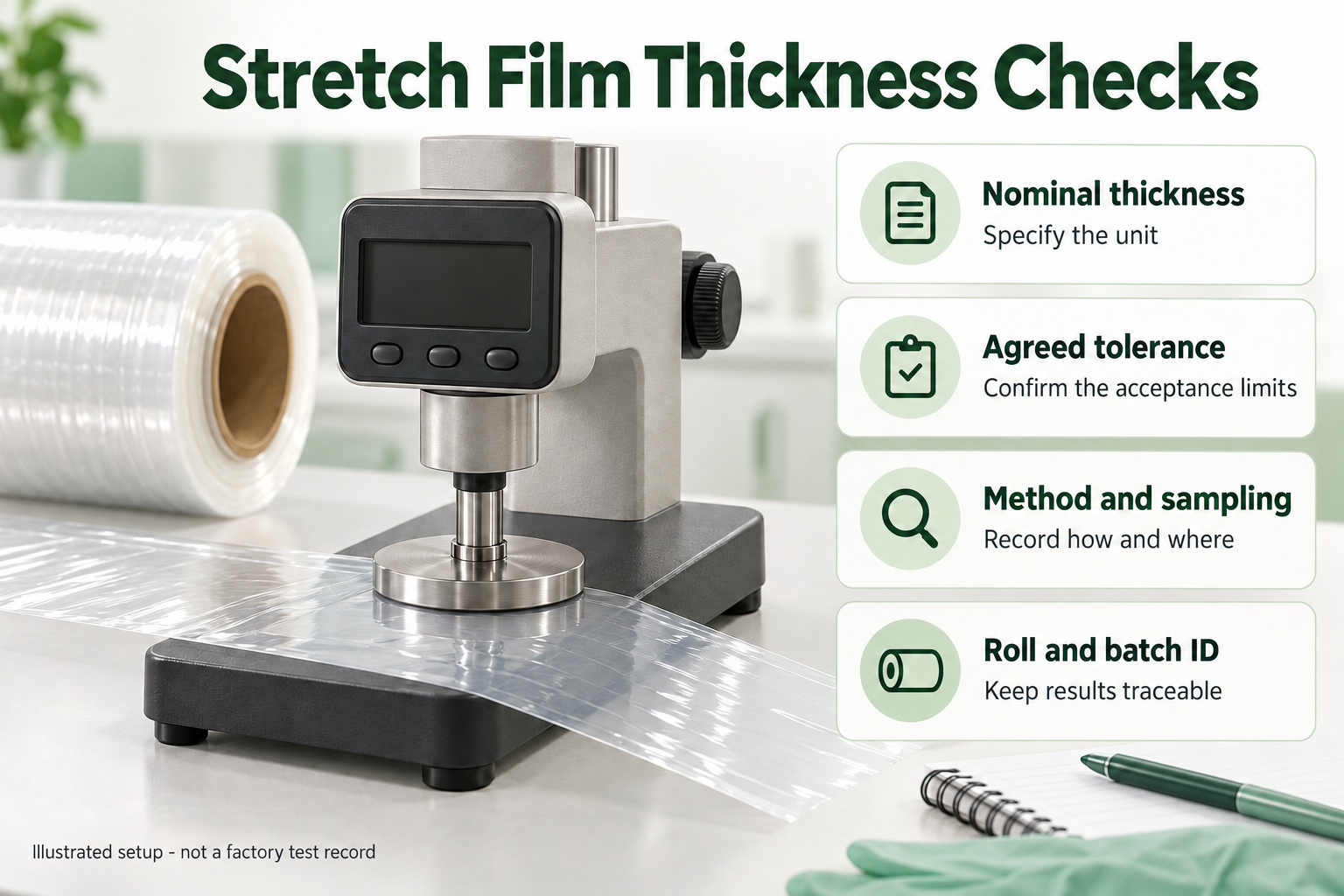
ISO 4593 describes mechanical film-thickness measurement. ISO 4591 addresses gravimetric average thickness, using mass, area and density. One instrument reading checks a local point. A calculated average describes a sample or roll. They give different evidence.
Use an unstretched sample and a suitable, agreed method. Film from a wrapped pallet may have stretched. Do not use a stretched strip to verify thickness as supplied. For mechanical tests, check the instrument and how it contacts the sample. Check its calibration status, too. Follow the chosen method; do not copy a test from a photograph.
Swipe the table sideways to read the complete checklist.
| Check | Information needed |
|---|---|
| Controlling specification | Nominal thickness, controlling unit and the agreed treatment of converted or rounded labels. |
| Tolerance and acceptance | Allowed variation. State whether limits apply to single readings, a stated average, or both. Agree what happens if a result fails those limits. |
| Sampling | Choose the rolls and test positions. State how many readings to take and how to report them. Agree these before shipment. |
| Method and instrument | The test method, key instrument details and calibration status. A gravimetric calculation also needs a density value backed by evidence. |
| Traceability | Film grade, roll or batch ID, date and actual test results. Keep the label and any retained sample linked to that record. |
If readings differ, first check the unit, sample identity, measurement method and sampling positions. Use the agreed process to decide whether the film passes and how to resolve a dispute. Do not judge it from one reading taken on a different basis. A test method name does not set the factory's thickness tolerance.
How to choose stretch film thickness for a trial
A pallet wrap thickness chart cannot approve a film from load weight alone. Record the load size and weight. Note sharp corners, the way packs are stacked, their surfaces and the handling route. Then choose a grade to trial with your hand-wrapping method or machine.
Thickness is one input. The film recipe, tear and puncture behavior, recovery and wrap settings also affect the result. A laboratory elongation-at-break value is not automatically a suitable wrapper setting. Lantech's explanation of stretching and down-gauging describes how reducing thickness can lead to breaks or compensating layers.
- Keep a baseline: record the current grade, load, wrapping pattern and settings.
- Define acceptance: agree the required packaging checks with the team in charge. Include any handling or transport tests needed.
- Record the change: note the candidate grade, thickness, settings, breaks, added layers and rewrapping.
- Measure the complete result: compare film used and loads that pass. Count trial waste the same way for both films.
If the new grade needs new settings, assess that whole process. Thinner film may need more layers. A lower starting thickness alone does not prove a saving. A short visual trial does not prove how the load will perform in transport.
For help choosing a process, checking roll fit and comparing costs, use our hand vs machine stretch-wrap guide.
Compare bulk stretch-film quotations on the same basis
First match the written specification. Then compare how much film the price buys. Two rolls with the same outside size can differ in core weight, film quantity and grade. Separate net film mass from the core and outer packing. List freight and other charges on the same basis.
Swipe the table sideways to read the order checks.
| Quotation item | Confirm in writing |
|---|---|
| Film identity | Grade or product code, manufacturing route, and whether the product is conventional or supplied pre-stretched. |
| Thickness | Nominal value, controlling unit, tolerance, and whether an “equivalent” label is separate from the physical thickness. |
| Usable quantity | Film width as supplied. Roll length or net film mass. State quantity tolerances and whether the core and packing are included. |
| Application and roll fit | Hand method or wrapper details. Roll and core sizes. Any machine limits that affect roll fit. |
| Approval and supply | Sample or trial requirements, agreed acceptance evidence, order quantity, destination, packing and delivery terms. |
Why a lower price per roll can mislead
Use the quoted film width and roll length to find the price per 1,000 m². This compares the film before wrapping. The rolls can have different widths:
Material price per 1,000 m² = film price per roll ÷ [film width in metres × film length in metres] × 1,000
Use the film size as supplied. Do not assume extra yield from stretch. This is an example comparison of two conventional-film offers. The sizes, labels and prices are examples, not TIANFENG specifications, quotes or test results.
Swipe the table sideways to compare the two illustrative offers.
| Stated item or calculation | Example offer A | Example offer B |
|---|---|---|
| Nominal thickness label | 20 µm | 80 gauge: 20.32 µm by conversion |
| Supplied film width | 0.5 m | 0.5 m |
| Film length per roll | 1,500 m | 1,200 m |
| Assumed material price | US$15 per roll | US$13 per roll |
| Film area | 0.5 × 1,500 = 750 m² | 0.5 × 1,200 = 600 m² |
| Material price per 1,000 m² | 15 ÷ 750 × 1,000 = US$20.00 | 13 ÷ 600 × 1,000 = US$21.67 (rounded) |
Offer B costs less per roll but more per stated area. Its converted nominal thickness is also 0.32 microns greater, if gauge controls that specification. These facts alone do not show which offer is better. Check the grade, controlling unit, tolerance and trial result. The price calculation does not approve the product.
The price per area does not replace the trial cost per wrapped load that passes. For a price per net kilogram, ask for the net film mass. Get the matching length or area basis, too.
Have an incomplete specification? Send the current roll label or a sample, your wrapping method, load description and the problem you want to solve. Ask the supplier to propose a grade. Have them flag any sizes, tolerances or approval terms still to be agreed.
A specification request you can adapt
Please propose a blown stretch-film grade for our use. We can share our current roll label, load details and wrapping method.
State the nominal thickness of the supplied film in microns. Show any gauge label as a reference. Confirm the tolerance, test method and acceptance rules.
Quote the supplied width and roll length or net film mass. List the core and packing separately. Confirm sample or trial plans and supply terms for our quantity and destination. Flag anything still to be agreed.

Discuss a blown stretch-film specification with TIANFENG
TIANFENG supplies blown stretch film with custom roll specifications. Send your current film label and any known thickness need. Add your hand method or machine details, load details, quantity and destination. Before bulk approval, agree the grade, sizes, tolerance and trial plan.
Stretch wrap thickness and gauge FAQ
What does gauge mean in stretch wrap?
In the common plastic-film convention, gauge describes thickness: 100 gauge equals 1 mil, or 25.4 microns. Check the supplier's written units. Take extra care if the label also claims equivalent performance.
How thick is 80 gauge stretch wrap?
80 gauge converts to 0.80 mil, 20.32 microns or 0.02032 mm. A catalogue may round this to 20 or 20.3 microns. State which unit controls the order. Agree the tolerance separately.
Is 60 gauge or 80 gauge stretch wrap better?
80 gauge is thicker: 20.32 microns versus 15.24 microns. The better choice depends on the grade, load, wrap method and trial result. Neither number alone sets a safe load weight.
Is 23 micron film the same as 90 gauge?
They are close commercial labels, but not exact conversions. 90 gauge is 22.86 microns, while 23 microns is approximately 90.55 gauge. Agree which value controls the order. Suppliers may round labels in different ways.
Does a higher gauge always mean stronger stretch film?
A higher physical gauge means thicker film under the same unit convention. It does not prove better tear resistance, puncture behavior or recovery. It also does not show how well a given grade and wrap process will hold a load.
Is equivalent gauge the film's actual thickness?
An equivalent-gauge label compares performance. Ask which reference film and test conditions the supplier used. Request the actual nominal thickness, tolerance, grade and evidence for the claim.
What thickness tolerance should I put on the order?
Agree a tolerance with the supplier that suits the film and your purchase needs. State the controlling unit and the sampling and test methods. Say whether the limits apply to single readings or an average. Agree what happens if a result fails those limits.
Can I check supplied thickness on film removed from a wrapped pallet?
Wrapping may have stretched the film. Check the supplied thickness on an unstretched sample linked to the roll or batch. Use the agreed test method. Assess the finished wrapped load separately.