
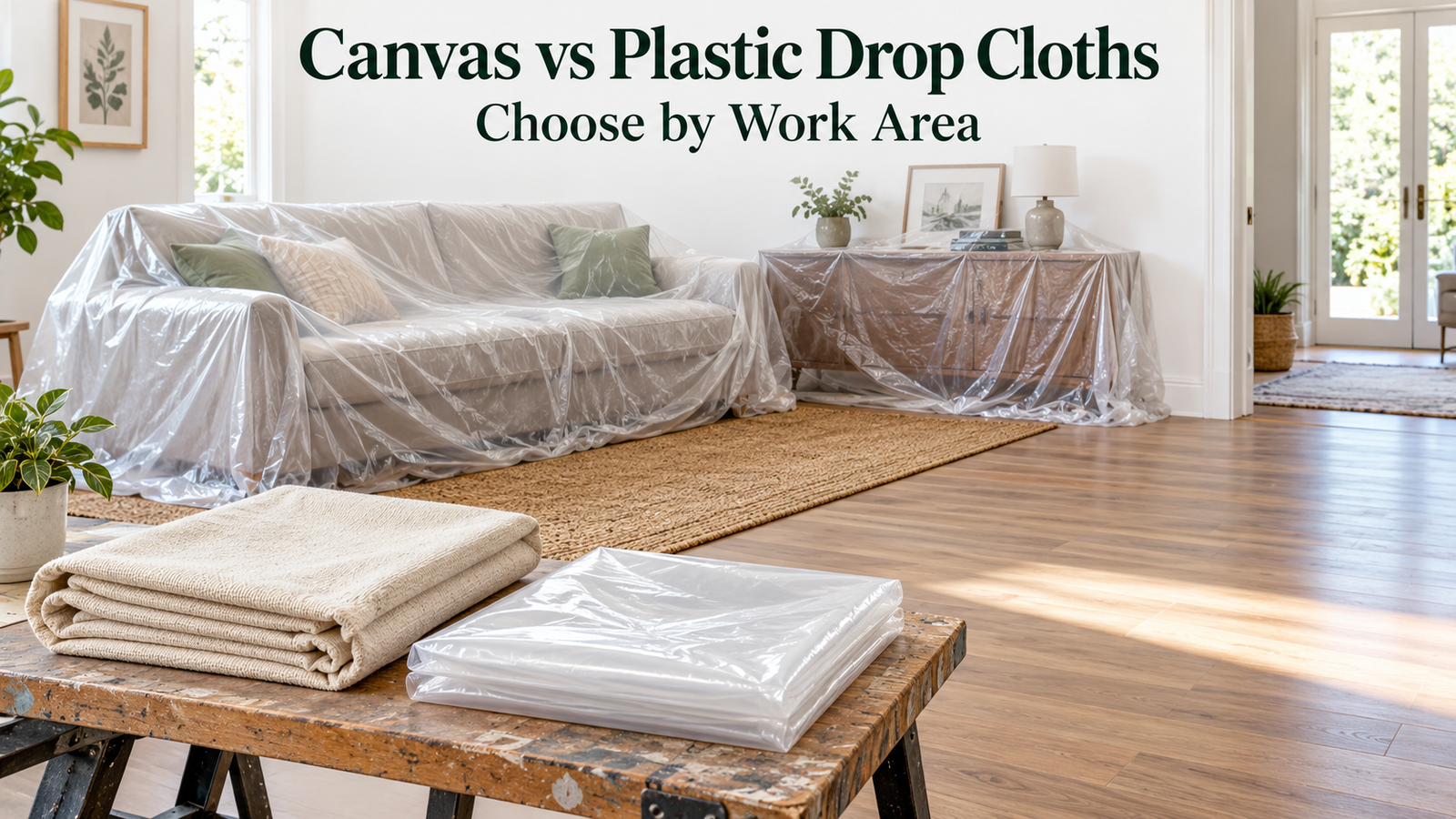
Canvas vs Plastic Drop Cloths: Choose by Work Area
The canvas vs plastic drop cloth decision starts with what you are covering and what will happen there. A sheet draped over a cabinet has a different job from protection under a painter's feet. Separate those areas before choosing a material or comparing pack prices.
The short answer: ordinary PE plastic is a useful candidate for draped furniture protection and temporary coverage away from foot traffic. Conventional canvas can absorb small paint drips and may suit repeated painting work, but plain canvas is not universally leakproof or slip-resistant. For stairs, busy walkways or a floor requiring documented slip or liquid protection, select an appropriate purpose-designed system rather than assuming either material name is enough.
Four product descriptions that should not be treated as interchangeable
“Drop cloth” describes a use, not one construction. Read the actual material specification, especially when a listing adds words such as backed, treated, cling or slip-resistant.
| Construction | Useful distinction | Do not assume |
|---|---|---|
| Conventional canvas | Woven fabric that can absorb small drips; some products are washable and reusable. | All spills are stopped, every floor grip is adequate, or cleaning restores the original condition. |
| Ordinary PE plastic | Nonabsorbent film supplied as sheets or rolls for temporary covering. | Anti-slip performance, static cling, paint adhesion or compatibility with every coating. |
| Backed or multilayer protection | Fabric combined with a barrier or other purpose-designed layers. | The same behavior as plain canvas, or identical performance across different products. |
| Specialized masking film | A specified masking product that may have surface treatments and a defined dispensing system. | Any generic PE sheet will provide the same properties or fit the same tool. |
Trimaco's canvas and plastic comparison discusses both conventional materials and specialty products. Its named-product claims should not be transferred to unbranded canvas or PE. Similarly, 3M Hand-Masker Advanced Masking Film is a specific product with stated cling and tool-related features, not a definition of all plastic drop cloths.
Choose, avoid or refer: a work-area decision matrix
One room may need more than one protection material. Keep furniture covering, painting positions and access routes separate in the plan.
| Work area | Consider | Avoid or refer when |
|---|---|---|
| Furniture and fixtures, without people standing on the cover | A suitably sized PE sheet for draping; account for exposed sides and snagging corners. | The item has a delicate finish, ventilation requirement or coating compatibility concern that has not been resolved. |
| Vertical masking beside trim or walls | A masking product and attachment method suited to the surface and task. | The job depends on cling, paint retention or dispenser compatibility that ordinary PE has not demonstrated. |
| Painting position on a floor | For small drips and planned reuse, canvas is a candidate after reviewing the floor and movement. If liquid transfer must be blocked, choose a declared backing or barrier system suitable for that floor. | The covering shifts, bunches, transfers liquid or creates an unsafe working arrangement. Plain canvas does not automatically meet a liquid-barrier requirement. |
| Stairs, frequently used routes or wheeled access | A purpose-designed protection and access plan appropriate to that location. | Loose ordinary film or an unassessed canvas sheet is being treated as a default walking surface. |
| Work requiring a documented barrier or fire rating | The specified system and its applicable instructions and evidence. | A general-purpose drop cloth is being substituted solely because it is plastic, thick or described as heavy duty. |
Hazardous-material work needs its own qualified assessment and appropriate containment system. This comparison does not establish a drop cloth's suitability for that work. Where the product or work-area requirements are unresolved, change the protection plan before proceeding.
Absorbing a drip and preventing transfer are different jobs
Conventional canvas can take up small paint drips, but absorption does not guarantee that liquid cannot reach the surface underneath. Construction, condition and exposure matter. Trimaco's canvas FAQ explicitly answers no when asked whether its canvas drop cloths are waterproof. An absorbent top combined with a separately specified backing is a different product from plain woven canvas.
Ordinary PE does not absorb a spill. Liquid can remain on the upper surface, move toward an edge or escape through a tear or uncovered joint. Even intact film does not make an entire loosely covered area leakproof. Deal with spills according to the coating's instructions instead of using the covering as a storage tray.
Removal also belongs in the decision. Plan how the dirty face will be contained while the cover is lifted or folded, without spreading debris or wet paint onto clean surfaces.
Reuse is a condition decision, not a material slogan. Follow the product's cleaning and reuse instructions, then inspect for contamination, holes, damaged backing and distorted edges. Repeated use may be practical for a particular canvas product; it is not a promised service life. Likewise, a PE sheet is not automatically suitable for another job because it has no obvious large tear.
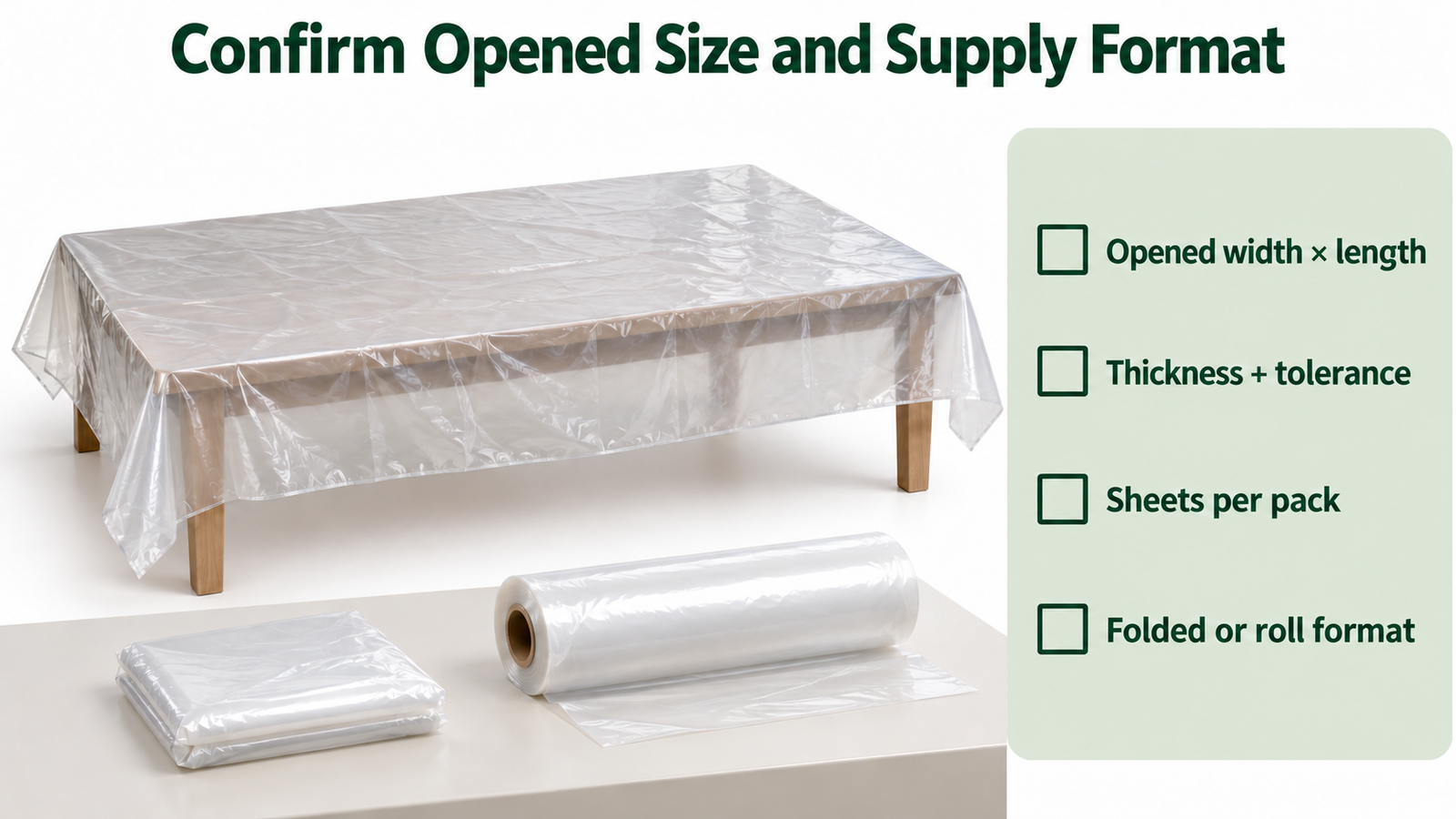
Specify film thickness and fully opened coverage
A mil is one thousandth of an inch, not a millimeter. For PE film, 1 mil = 25.4 micrometers: 0.5 mil is 12.7 micrometers, 2 mil is 50.8 micrometers and 4 mil is 101.6 micrometers. These are unit conversions, not a verified TIANFENG stock range or a table of safe walking grades.
Request the nominal film thickness, units, agreed tolerance and measurement basis. Folded layers are not a single film layer. For a canvas ounce label, ask what is being weighed: fabric per unit area, such as ounces per square yard (oz/yd²), or the completed item. Neither basis can be directly compared with a film's mil number as a protection rating.
For sheets, write fully unfolded width × length with units. For rolls, separate unfolded film width, wound roll width and usable length. A compact folded pack or narrow folded roll can open into a much wider sheet; package dimensions alone do not establish coverage.
Measure the intended protected area, including furniture sides or other drops, and plan joints, overlap, edge treatment and access separately. There is no universal extra allowance that suits every room or object. Any dimensions used for cutting or folding should appear on the agreed drawing or packing specification.
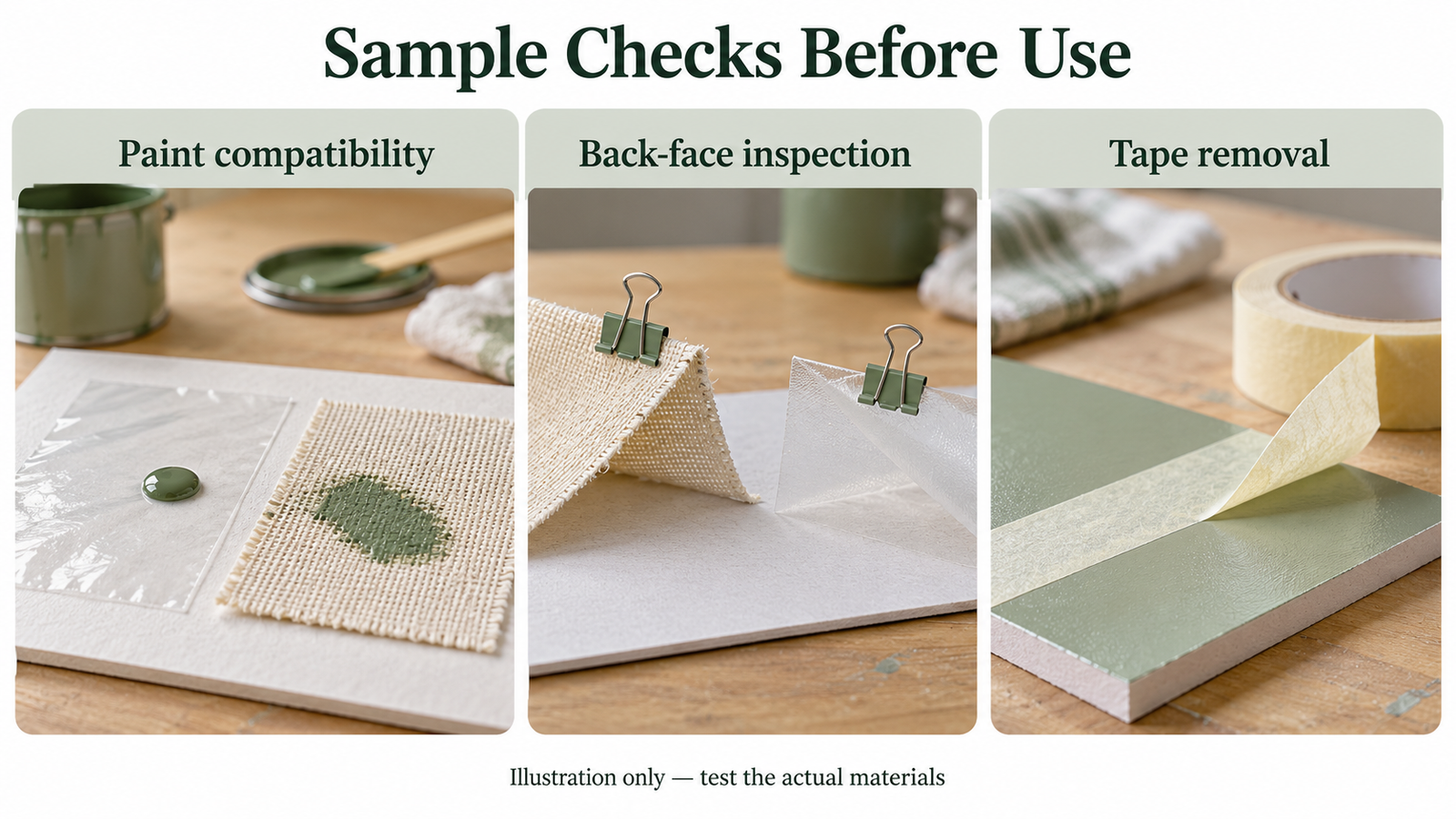
Sample checks that lead to a decision
Use this as a project-selection record, not a laboratory certificate or a do-it-yourself slip test. Begin with the product and coating instructions. Assess compatibility on an appropriate offcut or inconspicuous area where permitted; do not deliberately expose a valuable finish to an unverified material or create an unsafe walking test.
Identify the trial: record the project area, sample and batch identity, substrate and finish, coating or tape, planned exposure time, reviewer and date. The checks below describe evidence to collect; they are not completed trial results.
| Decision question | Evidence to record | Decision gate |
|---|---|---|
| Does the sample cover the planned area? | Measure the opened dimensions and document joints, uncovered edges, drape and fit. | Resolve gaps or revise the layout before approving the size. |
| Does the intended exposure transfer to the back or substrate? | Identify the coating and exposure duration, and record the underside condition and any marks. | Observed transfer means this tested arrangement is unsuitable for that exposure; reconsider the construction. |
| Is the attachment compatible? | Identify the tape, contact time and removal method; record residue or finish lifting. | Follow the tape and surface instructions; a short successful check does not validate every duration or finish. |
| Is the installed arrangement appropriate for movement? | Inspect unsecured edges, bunching and obstructions; identify any unresolved grip requirements. | Stop and revise unsafe arrangements. Do not infer certified slip resistance from an informal trial. |
| Can the cover be removed as planned? | Record debris or wet-paint transfer, tearing, and the condition for disposal or reuse. | Revise the removal sequence or material where contamination spreads. |
Edge attachment and grip underfoot are different. Securing an edge may limit movement at that edge, but does not establish traction on the upper face. Taping ordinary PE down does not make the film slip-resistant.
Outcome: suitable for the recorded scope / revise and repeat / use a different system. Record restrictions, the responsible reviewer and the approved sample or specification revision. A changed coating, floor finish or work duration may require another review.
Compare the cost of usable coverage, not just a pack
Compare the same work area and the same protection requirements, with both candidates suitable for that use. A furniture drape is not a like-for-like alternative to traffic-floor protection. For an eligible comparison, use:
Material cost per protected square meter = defined material cost ÷ area actually protected in the approved layout.
State whether cost includes only the material or also named delivery and other charges. Use the same currency and scope for each candidate. Base coverage on the approved layout and accepted material, not the folded pack size or a roll length without its width.
Overlap does not create twice the protected floor area. Cut-offs, unusable pieces and openings can reduce coverage, while a reusable piece may have value on another job. Record these separately rather than assuming every purchased square meter is useful on this project.
Hypothetical example: one accepted 4 m × 5 m sheet contains 20 m² of purchased material and costs C currency units. Assume the approved layout actually protects 16 m² after overlap and cut-offs. Its material cost is C/16 per protected m², not C/20. This illustrates the denominator; it is not a stock size, price or trial result.
Do not divide reusable canvas cost by an invented number of future jobs. A lifecycle comparison also needs actual cleaning, handling, storage and replacement records. If those records are absent, compare the current project's confirmed requirements and leave future savings unquantified.
A reusable quotation brief for PE sheets or rolls
Contractors and distributors can copy the fields below into an inquiry. Unknown items can remain open for discussion; naming the task is more useful than guessing a performance claim.
- Work area and object: specify in the inquiry; draped covering, masking or other intended use.
- Exposure and duration: coating/dust conditions and expected use period.
- Film specification: PE grade or existing sample, color, nominal thickness, units and tolerance.
- Opened dimensions: sheet width × length, or unfolded roll width × usable length.
- Delivery format: individually folded sheets or rolls; fold pattern, pack size and count.
- Commercial details: approximate quantity, counting unit, carton/label requirements and destination.
- Approval needs: sample identity, surface/coating checks and any required documented properties.
Request a quotation that repeats those dimensions and units. Separate film net quantity from gross packed weight where weight is quoted. Keep the accepted sample and written specification together so that a reorder is not based only on “heavy-duty plastic.”
Discuss custom PE drop cloths
TIANFENG supplies PE plastic drop cloths with size, thickness and packing details agreed for the order. Check the current product specifications, 1-ton minimum order and sample terms. Send the work area, opened dimensions, approximate quantity and destination to begin a specification discussion.
This inquiry route is for PE film, not an offer of canvas, certified anti-slip flooring or a specialist containment system. Where the job requires a documented property, identify it before selecting ordinary film.
Canvas and plastic drop cloth FAQ
Is canvas or plastic better for furniture?
For lightweight draped coverage away from foot traffic, ordinary PE may be suitable. Fit, sharp corners, the furniture finish and the intended coating exposure still matter. Choose a product and attachment method compatible with the actual item.
Can I use an ordinary plastic drop cloth on stairs?
Do not assume loose ordinary PE is a suitable walking surface. Stairs require an appropriate protection and access arrangement. Select a product intended for that location and follow its instructions rather than relying on thickness alone.
Does canvas stop paint from leaking through?
Plain canvas can absorb small drips but is not universally leakproof. Where liquid transfer must be prevented, assess the specified construction, including any backing, for the intended exposure.
Is thicker painters plastic automatically better?
No. Thickness is one specification, not proof of grip, cling, paint retention or compatibility. Choose the construction for the work area, then agree gauge, tolerance, opened dimensions and a suitable sample review.
Are masking film and plastic drop cloths the same?
Not necessarily. A specialized masking film may have treatments and a defined tool or tape system. Those features should not be assumed for an ordinary PE sheet, even when both products are sold for painting work.
Further reading
The following manufacturer sources explain material and product distinctions. The worksheet and quotation brief above are purchasing aids, not published test standards or TIANFENG performance results.
- Trimaco. Canvas vs. Plastic Drop Cloths for Painting Projects — Which Is Better? Work-area selection and differences between conventional and specialty protection materials.
- Trimaco. Frequently Asked Questions: Canvas Drop Cloths. The manufacturer distinguishes its conventional canvas from products with separately specified waterproof or flame-retardant properties.
- 3M. Hand-Masker Advanced Masking Film. An example of product-specific masking, cling and dispensing features; not specifications for ordinary PE.