
Plastic Pallet Covers vs Stretch Wrap: When to Use Each or Both
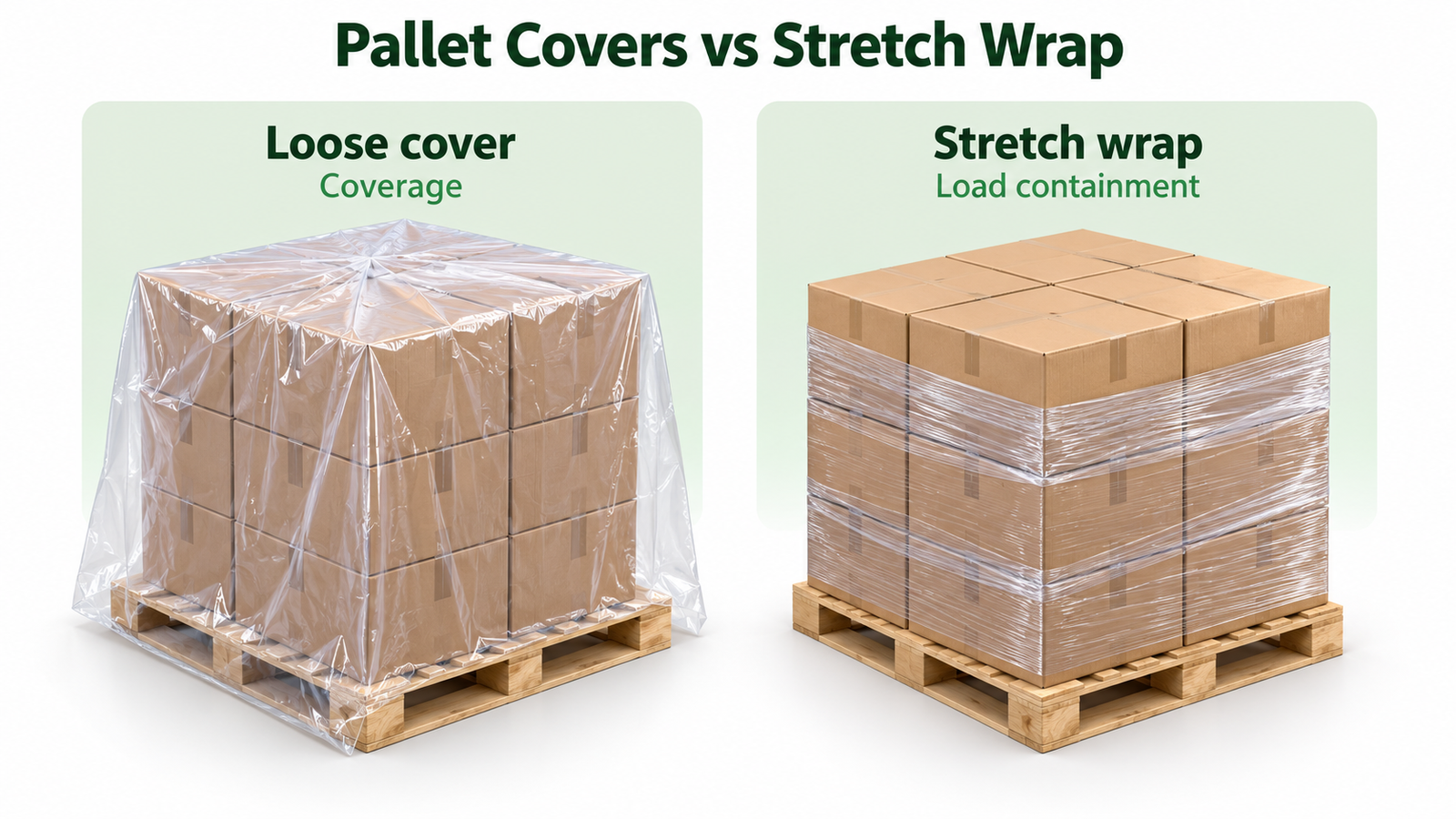
Pallet covers vs stretch wrap is not simply a choice between two thicknesses of plastic. A loose cover and an applied wrapping film usually address different packaging requirements. Warehouse teams and exporters need to identify both the surfaces that require covering and the load movement that the packaging must control.
The short answer: an ordinary plastic pallet cover provides top or top-and-side coverage, depending on its form. Stretch wrap is applied around a load as part of a load-containment system. A cover does not automatically replace restraint, and side wrapping does not automatically close the top. A top sheet or cover can be used with stretch wrap, but the combined arrangement must be checked on the actual packed load and handling route.
First identify the packaging form
Words such as “pallet bag,” “hood” and “wrap” are sometimes used loosely. Ask for a drawing or application description rather than assuming that every bag-shaped cover stretches or shrinks onto a load.
| Form | Main role | Important boundary |
|---|---|---|
| Loose pallet cover or bag-style cover | Cover the specified top and side surfaces with an appropriately sized film enclosure. | Its opening, lower edge and other gaps remain part of the package design. Loose coverage is not verified load restraint. |
| Pallet top sheet | Cover the top surface as one component of the packaging arrangement. | It does not by itself cover the full sides, close the bottom or stabilize the stack. |
| Stretch wrap | Apply film around the load under a controlled wrapping process to support containment. | Film choice, load design, application and consistency matter. A wrapped appearance is not proof of transport performance. |
| Engineered stretch or shrink hood | Use a purpose-designed hood and application system, stretching or heat-shrinking it as specified. | These are different systems, not interchangeable names for an ordinary loose PE cover. |
This guide compares ordinary PE covers or top sheets with stretch wrapping. It does not present TIANFENG's loose covers as stretch-hood or shrink-hood products. If an existing machine requires such a system, identify its film and equipment requirements separately.
Balcan's cover, cap and top-sheet range illustrates why the supply format also matters: a cover may be supplied as a finished bag, folded film or another configuration for a particular process. Another manufacturer's options are not automatically the offered TIANFENG specification.
Ask two separate questions: what needs covering, and what needs restraining?
Coverage concerns exposed surfaces and the required barrier. Containment concerns how the unit load holds together during the intended handling. A package can look well covered while its cartons move, or be well wrapped around the sides while its top remains exposed.
| Situation | What to evaluate |
|---|---|
| Stationary indoor storage with a covering requirement | A top sheet or loose cover may address the specified exposure. Assess stack stability and any later handling separately. |
| A pallet moving through a distribution route | Evaluate the complete containment arrangement, including load configuration and wrap application. Add surface coverage if required. |
| Side-wrapped cartons with an exposed top | Assess a compatible top sheet or cover rather than assuming more side wraps close the upper surface. |
| Sharp or irregular projections | Review contact protection, geometry and film compatibility. Simply choosing a thicker cover may not resolve snagging or puncture. |
| Outdoor or temperature-sensitive storage | Define exposure, duration and required performance. Ordinary PE coverage is not automatically a validated weather or temperature-control system. |
Lantech's explanation of load containment treats the result as a system outcome, not just a film-gauge decision. Case arrangement, gaps, load geometry, film behavior and application consistency all affect the assessment. Do not approve a transport package solely because it feels tight or uses a familiar number of wraps.
The useful purchasing question is therefore not “Which film is strongest?” It is “Which components and application method meet the defined needs of this load?”
When can pallet covers and stretch wrap be used together?
A combination can be appropriate when a load needs both surface coverage and containment. FROMM describes top sheets as an addition to pallet wrapping. That establishes a complementary role, not a universal application sequence or a guarantee that the complete package is waterproof.
For the selected equipment and materials, review the combination in this order:
- Mark the required coverage. Identify the top, sides and lower edge on a sketch, including any access openings that must remain available.
- Confirm component interfaces. Check where the sheet or cover meets the applied wrap and how the arrangement is retained without unintended tears or openings.
- Follow the specified application process. The correct order, overlap and settings depend on the chosen system; do not replace its instructions with a generic online recipe.
- Inspect the completed unit. Look at coverage and damage, then evaluate containment as a separate requirement under the responsible packing team's validation plan.
A neatly folded overlap is not automatically a liquid-tight seal. An open-bottom cover also leaves a different exposure boundary from a sealed enclosure. Describe the protection required before accepting words such as “full cover” or “waterproof” as a complete specification.
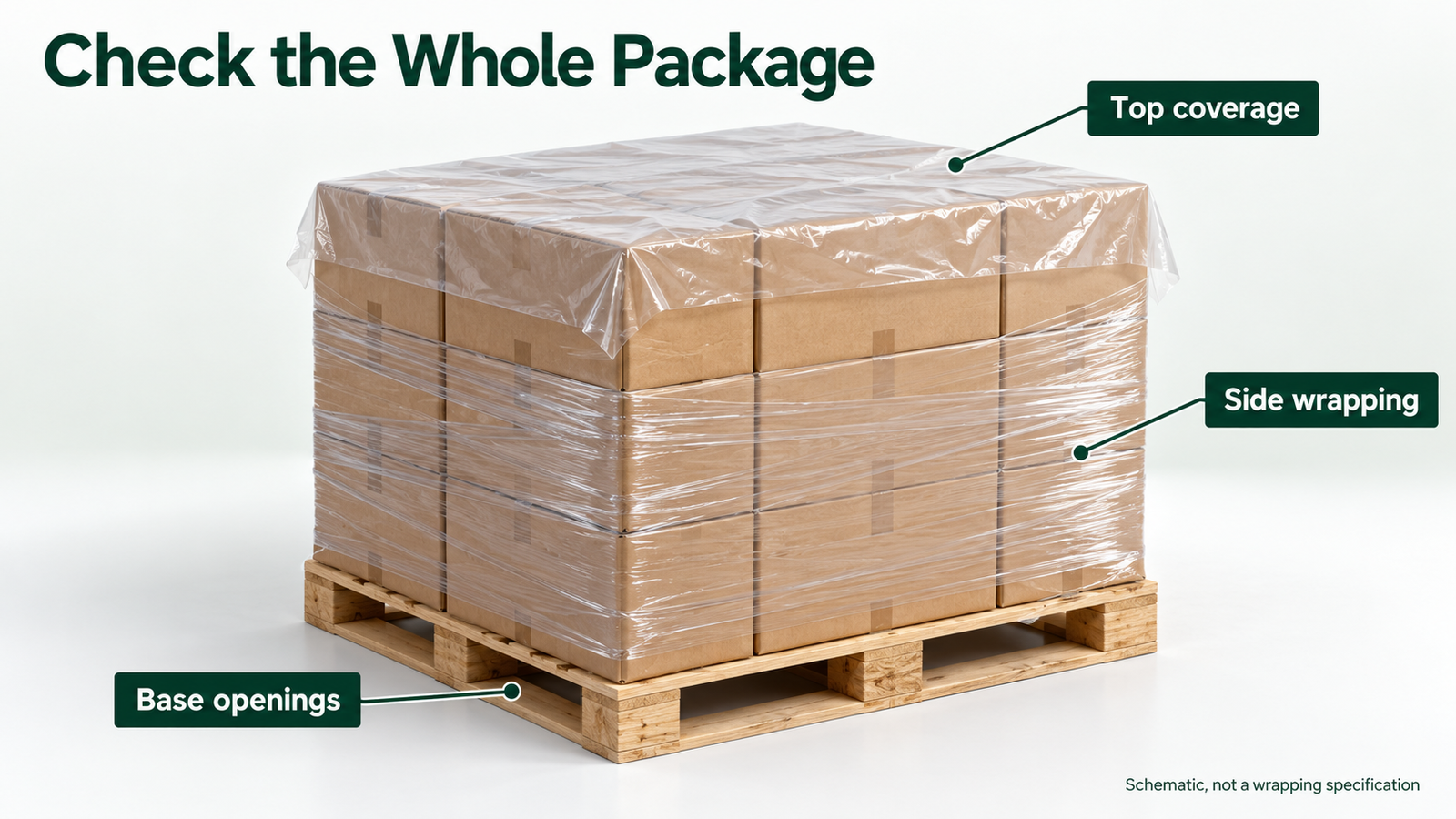
Two components do not automatically make a validated system. Adding a cover can change the wrapping process and contact between layers. Check the actual combination, not only a cover sample and a film roll separately.
Measure the packed load, then agree the cover drawing
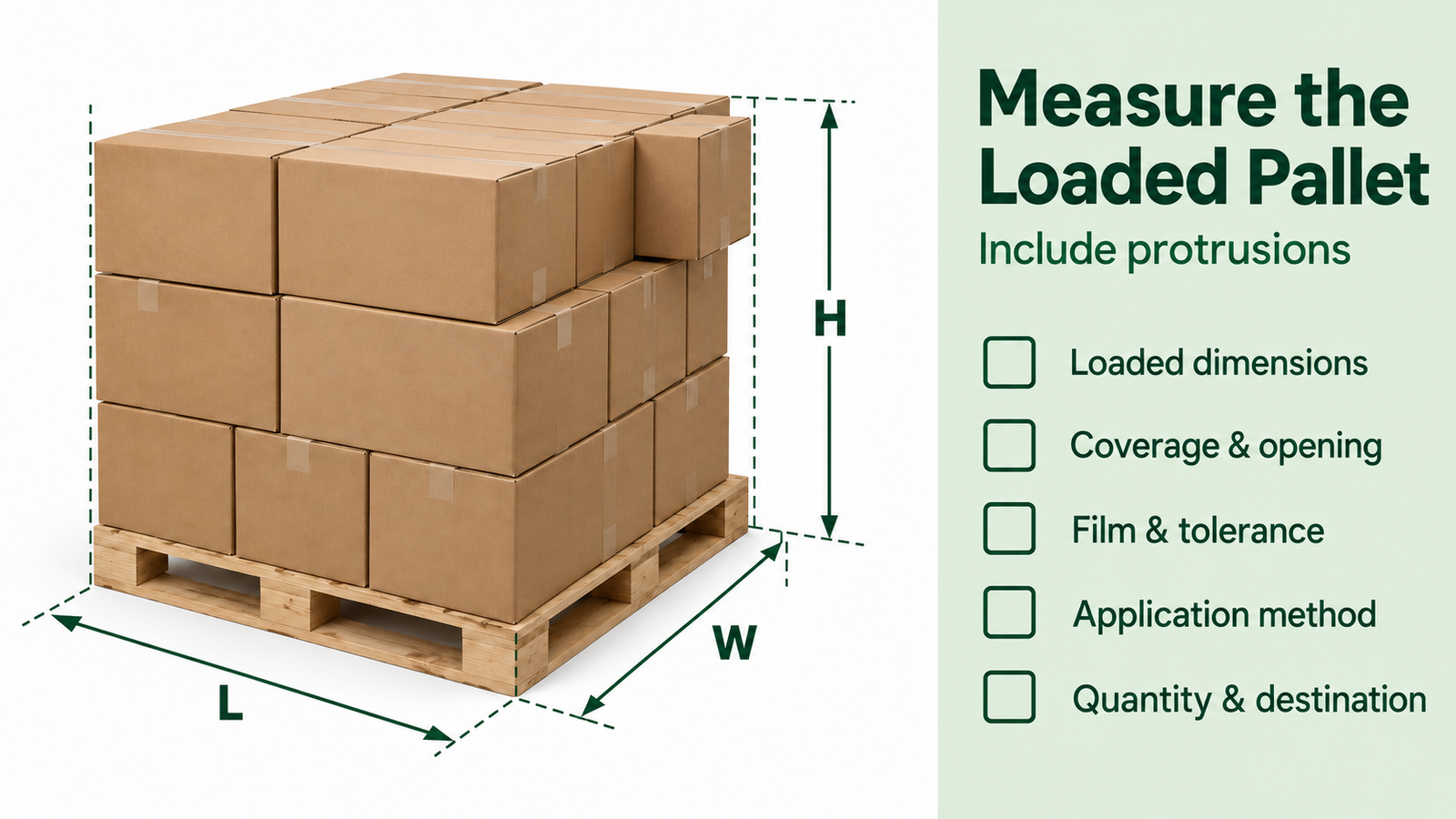
The empty pallet footprint is only a starting point. Measure the maximum loaded length, width and height, including carton overhang, irregular corners, protection materials and other projections. Record which dimensions include the pallet itself and where the cover is intended to finish.
A useful cover drawing identifies:
- The load envelope and the surfaces that must be covered.
- Finished open dimensions, gussets or folds, opening position and seal arrangement.
- Required coverage depth and the intended position of the lower edge.
- The allowance needed for the actual application method, agreed through the drawing and sample rather than a universal addition formula.
- Any area that must remain accessible for the equipment, pallet handling or identification process.
Clarify how the supplier expresses gusset dimensions, and show the units on every drawing. Folded roll width, lay-flat bag width and the open cover dimensions are not necessarily the same measurement. A nominal “standard pallet” label does not establish fit around every loaded pallet.
Specify film properties separately from dimensions
Agree material construction, nominal thickness, units, tolerance, color and relevant seal or opening requirements. For a bag-style cover, specify single-wall film thickness, not the combined reading across two walls or a folded section. Increased gauge alone does not certify load containment, eliminate sharp-contact damage or establish outdoor life.
For stretch film, identify hand or machine application, the actual equipment where applicable, roll and core requirements, and the grade proposed for that process. Do not compare roll gross weight as though it were the net amount of usable film.
Require product-specific evidence for special conditions. Black color is not a documented UV service-life rating. Covering cartons of food does not establish direct-food-contact compliance. If heat, moisture or a regulated application matters, state that requirement and request the relevant grade-specific documentation rather than inferring it from “PE.”
Review coverage and containment as two sample checks
Use a representative fully packed load and the intended work station. Record the cover drawing revision, film grade, sample or batch identity, load arrangement and application method so later changes are traceable.
| Review track | What to record |
|---|---|
| Coverage and application fit | Whether the cover opens and fits as intended; top and side coverage; lower-edge position; snagging, punctures, seal damage and access conflicts. |
| Containment and handling | The actual wrapped configuration, application consistency and observations from the agreed handling or distribution assessment; measurements and criteria defined by the responsible packing team. |
Set the required outcomes before trialling the samples. A cover that fits may still leave an unacceptable exposure; a clean-looking wrapped pallet may still need a different load arrangement or further containment assessment.
If damage appears, record its position and the stage where it was first observed. A corner puncture, split cover seal and shifted carton are different observations—not proof of one common material defect. Review possible contact, fit or application causes before changing several variables at once.
Relevant force measurements, repeatability checks or distribution testing may be needed for the chosen load and route. There is no universal safe wrap count or force value supplied by this article. The packing-system owner should define the validation method and acceptance criteria with the appropriate expertise.
A short fit trial is a procurement aid, not transport certification. Do not create unsafe handling conditions to test a pallet, or treat one successful movement as proof of every future shipment.
Make the quotation compare the same packaging job
Start an inquiry with the load and the required result. A request for “heavy-duty pallet plastic” leaves the supplier guessing whether you need coverage, containment or both.
- Load: product type, packed arrangement, maximum loaded dimensions, projections and relevant mass information.
- Environment: indoor or outdoor use, expected duration, handling route and the exposure that needs controlling.
- Requested form: loose cover, top sheet, stretch film or separate components for a combination; include a sketch or current sample.
- Application: manual or machine, equipment details, how material is dispensed and the required open or folded dimensions.
- Specification: material, nominal thickness and tolerance, seals, color, marking and any documented special requirements.
- Commercial basis: quantity, bags or sheets per pack or roll, film net quantity where relevant, packing and delivery destination.
Compare a cover quote per defined finished cover, a top-sheet quote per defined sheet, and a stretch-film quote using the same stated roll and net-film basis. A price per roll is not comparable if counts, dimensions or core weights differ.
If you compare cost per packaged pallet, first measure the material consumption and labor for the same approved process. Separate material purchase, freight and application costs. Do not claim a lower package cost from a cheaper film roll before checking how it performs and is used.
Review your pallet-cover and stretch-film requirements
TIANFENG supplies custom PE pallet covers and stretch-film options. Send the load dimensions, application method, required coverage, approximate quantity and destination. Known requirements can be reviewed first; undecided specifications should remain explicit rather than being guessed.
The quotation concerns the offered film products. A loose cover is not a certified load-restraint system, and film supply does not replace validation of the complete package.
Pallet cover and stretch wrap FAQ
Can a loose pallet cover replace stretch wrap?
Not merely because it fits over the load. A loose cover addresses the specified coverage, while the need for containment must be assessed separately. If a supplier proposes a restraining hood system, verify that different product and its application requirements.
Is a pallet top sheet the same as a full pallet cover?
No. A top sheet covers the upper surface as part of an arrangement. A bag-style cover can extend down the sides, but its opening and lower edge still need to be defined. Neither description alone proves a completely sealed package.
Are stretch wrap and shrink wrap the same?
No. Stretch wrap is stretched around the load during application; shrink film is designed to contract when heat is applied. Do not substitute ordinary stretch wrapping film or a loose PE cover for a heat-shrink system solely because all are plastic packaging.
How much extra size should I add to a pallet cover?
There is no universal allowance for every load and bag construction. Measure the maximum packed load, specify the open dimensions and intended coverage, then confirm fit against the agreed drawing and application sample.
Does a black pallet cover provide guaranteed outdoor protection?
No. Color alone does not establish UV durability, weather resistance or a defined service period. Request the actual grade's documented conditions and evaluate the complete package, including openings and the intended exposure.
Further reading
These first-party manufacturer resources explain product roles and packaging questions. Their specific grades, dimensions, test results and commercial claims are not TIANFENG specifications.
- Lantech. Load Containment: What It Is, How It's Measured, and Why It Matters. System-level considerations, measurement and application consistency.
- Balcan. Pallet Covers, Caps & Top Sheets. Product forms and packaging-process specifications.
- FROMM Packaging. Pallet Top Sheets. Top sheets as an additional component in wrapped pallet packaging.