
-
By Sean
-
April 28, 2026
- 0 Comment
What Is Plastic Film and What Is It Used For?
Introduction: Most People Think Plastic Film Is Simple — Until It Fails
If you ask someone what plastic film is, they’ll probably say:
“It’s just a thin layer of plastic used for packaging.”
That’s technically correct — but dangerously incomplete.
Because in real production environments, plastic film is often the reason behind:
sealing failures on packaging lines
unexpected product spoilage
inconsistent machine performance
I’ve seen companies change machines, redesign packaging, even blame operators —
only to find out later:
the problem was the film all along.
So instead of giving you a textbook definition, let’s approach this the way a buyer or engineer actually needs to understand it.
What Is Plastic Film — From a Real-World Perspective
At its simplest, plastic film is a thin, flexible plastic material produced by melting and stretching polymer resins.
But that definition doesn’t help you make decisions.
A more useful way to understand it is this:
Plastic film is a functional layer designed to control protection, sealing, and performance.
Three things it always does (whether you realize it or not):
Protects (against moisture, oxygen, dust, damage)
Controls interaction (what gets in or out)
Enables processing (how it runs on machines)
If a film fails in any one of these areas, everything downstream is affected.
Why Plastic Film Is Not a “Commodity”
This is where many buyers go wrong.
On paper, two plastic films may look identical:
same thickness
similar material name
close pricing
But in practice, they behave very differently.
Why?
Because plastic film performance depends on:
raw material quality
formulation (additives, blends)
production stability
process control
That’s why experienced buyers don’t ask:
“How much per kg?”
They ask:
“How stable is this across batches?”
Types of Plastic Film (And When Each Actually Makes Sense)
Instead of listing materials like a catalog, let’s talk about when you would actually choose them.
PE Film — When Flexibility and Cost Matter Most
Polyethylene is the most widely used plastic film, and for good reason.
You use PE when you need:
flexibility
impact resistance
low cost
Typical real-world uses:
shipping bags
pallet stretch film
inner liners
But here’s the part many suppliers won’t tell you:
Not all PE films behave the same — especially in high-speed lines.
The difference often comes down to formulation and processing, not just “PE vs PE”.
PP Film — When Appearance and Structure Matter
Polypropylene film is often chosen when:
clarity matters (retail packaging)
stiffness is needed
higher temperature resistance is required
You’ll see it in:
snack packaging
labels
laminated structures
But PP has a narrower processing window than PE —
which means if your line conditions fluctuate, it can cause issues.
PET Film — When Performance Is Critical
PET is not the cheapest option, but it solves problems other materials can’t.
You choose PET when you need:
dimensional stability
high strength
heat resistance
Common in:
electronics
high-end food packaging
industrial applications
In simple terms:
You don’t use PET unless performance matters more than cost.
Other Films (PVC, Nylon, Multi-layer Structures)
In many real applications, especially food and medical packaging,
you’re not using a single material at all.
You’re using multi-layer films designed to combine properties:
barrier + strength
flexibility + sealing
clarity + durability
This is where things stop being “standard” and become engineering decisions.
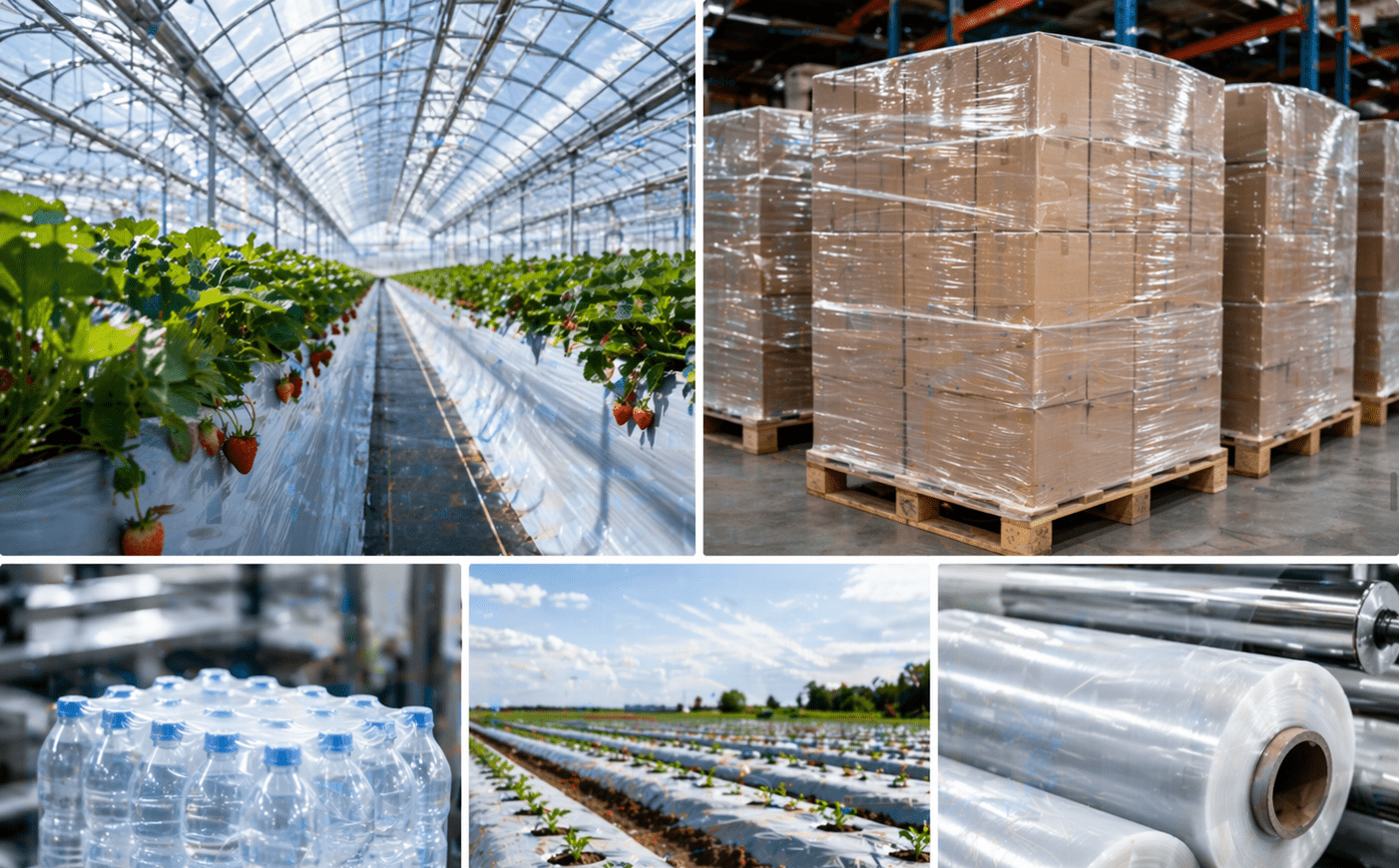
Plastic Film Uses — What It Actually Does in Different Industries
Instead of listing industries, let’s focus on what role the film plays.
1. In Food Packaging: It Controls Shelf Life
Plastic film isn’t just wrapping food — it’s managing:
oxygen levels
moisture transfer
contamination risk
A small change in film structure can mean:
3 days shelf life
or 30 days
That’s not a packaging issue. That’s a business issue.
2. In Logistics: It Prevents Loss, Not Just Damage
Stretch film, shrink film — these aren’t just protective layers.
They:
stabilize loads
reduce shifting
lower breakage rates
A slightly weaker film might look fine…
until a pallet collapses during transport.
3. In Agriculture: It Creates Micro-Environments
Agricultural films do something very specific:
They change the environment around the crop.
control temperature
retain moisture
block weeds
This is why film selection directly affects yield.
4. In Industry: It Enables Processes
In many manufacturing settings, film is not the product —
it’s part of the process.
Used for:
surface protection
insulation
separation layers
If it fails, the entire process can stop.
How to Choose the Right Plastic Film (Without Guessing)
Here’s a simple framework I’ve seen work consistently.
Step 1: Start With Failure, Not Specs
Instead of asking:
“What film do I need?”
Ask:
“What problem am I trying to prevent?”
sealing issues?
breakage?
short shelf life?
This changes how you evaluate everything.
Step 2: Match Material to Function
Need flexibility → PE
Need clarity → PP
Need strength & heat resistance → PET
But always remember:
Material is only the starting point — not the full answer.
Step 3: Test in Real Conditions
Lab data is useful.
But production reality is different.
Always test:
on your actual machine
at real speeds
with real products
Step 4: Evaluate the Supplier, Not Just the Film
A good supplier should:
understand your application
help troubleshoot issues
maintain consistency
Because in the long run:
You’re not buying film. You’re buying reliability.
Final Thought: Plastic Film Is Simple — Until It Isn’t
Plastic film looks like one of the simplest materials in manufacturing.
And that’s exactly why it’s underestimated.
But once you’ve dealt with:
inconsistent batches
machine downtime
product failures
You start to see it differently.
It’s not just a material. It’s a control point in your entire operation.